Quality control (QC) for medical devices is the set of inspection, testing, and verification activities used to confirm that a medical device, component, or material meets predefined requirements before the device, component, or material is released to the next manufacturing stage or placed on the market.
Quality control (QC) for medical devices is important because it protects patient safety, supports clinical performance, prevents the release of nonconforming devices, and provides documented evidence that devices meet defined safety, performance, and intended-use requirements.
The QC process involves 11 main steps. The process starts with defining acceptance criteria and inspecting incoming materials and components. QC then controls process parameters, environmental conditions, and contamination risks. QC teams perform in-process checks and monitor and measure finished products. QC teams ensure the calibration of monitoring and measuring equipment to support reliable results. QC reports and segregates nonconforming materials when defects are found. QC teams support the implementation of corrective and preventive actions (CAPAs) when required and manage QC documentation. Added controls are applied for high-risk devices, such as Class D in vitro diagnostics.
Key regulations and standards that apply to medical device QC include ISO 13485:2016, FDA 21 CFR Part 820, European Union Medical Device Regulation (EU MDR), European Union In Vitro Diagnostic Regulation (EU IVDR), ISO 11737, and device-specific ISO standards, such as ISO 11040 for prefilled syringes.
Quality Assurance (QA) is proactive and process-oriented, preventing defects through procedures, audits, supplier controls, training, risk management, and CAPA. QC is detective and product-oriented, identifying defects through inspection, testing, measurement, and release checks. A Quality Management System (QMS) is the framework of policies, processes, procedures, responsibilities, records, and controls that ensures medical devices consistently meet safety, quality, and regulatory requirements. A medical device QMS provides the structure for QA to prevent defects through controlled processes and for QC to detect defects through product testing.
Medical device companies need QMS software because QC depends on controlled documents and processes, trained personnel, qualified equipment, and traceable records. Manual systems make these QC elements harder to maintain reliably. SimplerQMS is a QMS software for life science companies, including medical device organizations. SimplerQMS supports QC by centralizing and streamlining core quality processes such as document control, training management, change management, design control, nonconformance management, CAPA management, and equipment management. Centralized processes help QC teams maintain inspection readiness, reduce manual record handling, and keep conformity evidence accessible across the device lifecycle.
What Is Quality Control for Medical Devices?
Quality control for medical devices comprises the inspection, testing, measurement, and verification activities that confirm a medical device, part, or component meets defined requirements. Quality control for medical devices detects nonconformities before the product moves to the next production stage or reaches the market. QC verifies that each finished device meets defined safety, performance, and intended-use requirements.
Quality control in the medical device industry involves hands-on checks at defined control points. These control points include incoming material inspection, in-process checks during manufacturing, final acceptance testing, and stability or sterility testing when required. Quality control relies on calibrated equipment, validated test methods, documented acceptance criteria, and trained personnel.
The 4 main areas of quality control for medical devices are listed below.
- Acceptance Criteria: Acceptance criteria define the measurable requirements used to accept or reject materials, components, in-process items, and finished devices. These criteria are established during product design and development, but QC uses them as the basis for inspection and testing.
- Testing and Inspection: Testing and inspection form the core QC activity. Quality control checks raw materials, production outputs, and finished devices against approved specifications. Reliable results depend on validated testing methods and calibrated, controlled monitoring and measuring equipment.
- Management of Nonconforming Materials: Nonconforming material management ensures that defects are reported promptly, investigations are supported, and nonconforming materials are properly segregated. Quality control prevents unintended use or release of defective materials or products.
- Documentation and Traceability: Documentation and traceability ensure that inspection results, test records, equipment status, acceptance decisions, and nonconformance records remain complete and retrievable. QC records provide evidence that product requirements were verified before release.
Quality control for medical devices supports the full device lifecycle by verifying that manufacturing outputs match the safety and performance specifications established during design. Medical device companies approach QC through defined procedures, sampling plans, inspection methods, defined acceptance criteria, trained personnel, and controlled records. Structured QC activities help manufacturers detect defects, protect patients, and maintain product conformity.
What Is the Difference Between Quality Control and Quality Assurance for Medical Devices?
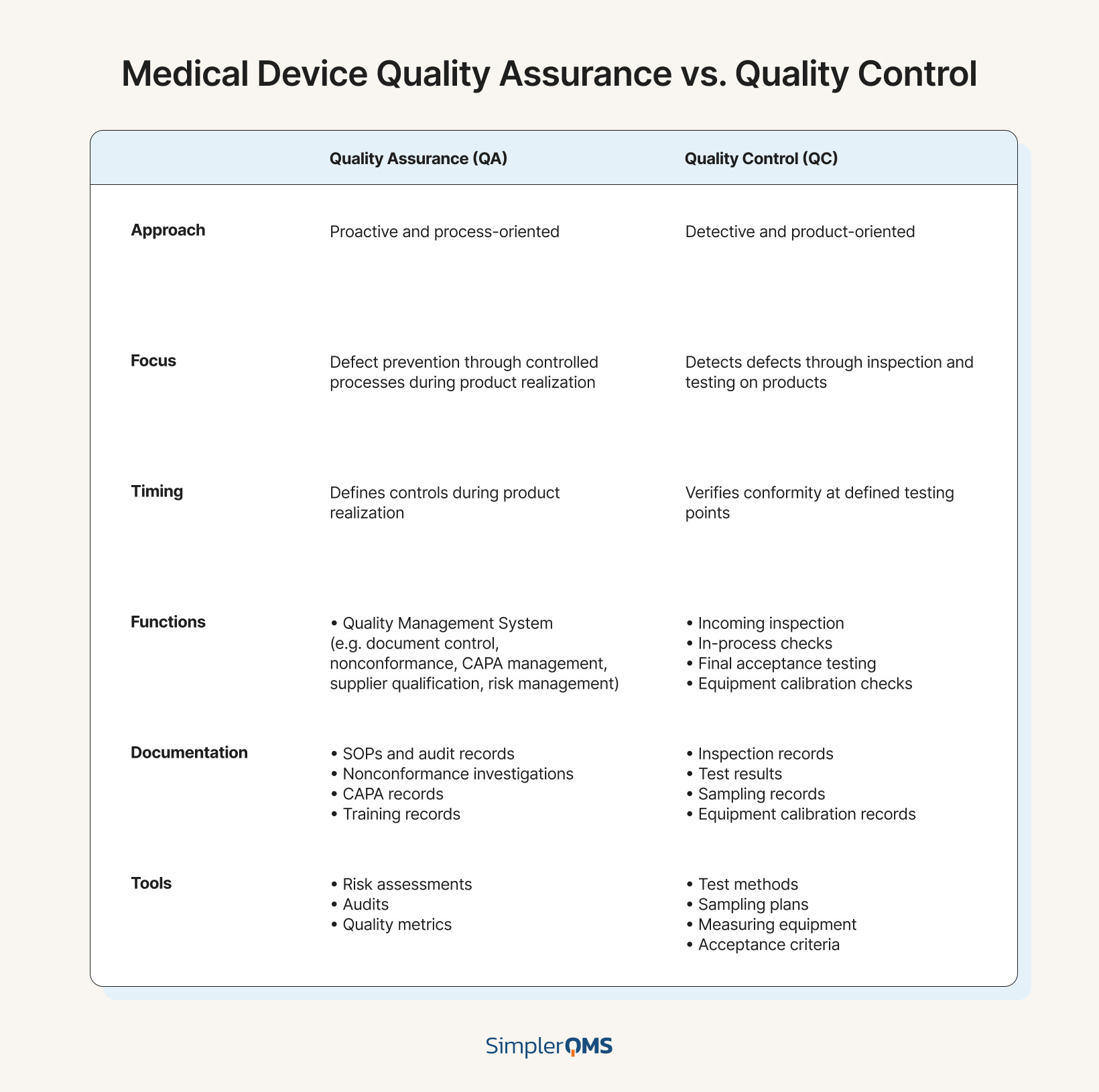
Quality assurance for medical devices is a proactive, process-oriented approach that prevents defects through controlled processes. Quality control for medical devices is a detective, product-oriented set of activities that identifies defects through inspection, testing, and measurement.
The primary factors that differentiate QA and QC are focus, timing, and function. QA focuses on processes and defect prevention during product realization. QC focuses on products and defect detection at testing points. QA includes quality management system functions such as document control, nonconformance and CAPA management, supplier qualification, and quality risk management. QC functions include incoming inspection, in-process checks, final acceptance testing, equipment calibration checks, and reporting of nonconforming material.
The secondary factors that differentiate QA and QC are documentation and tools. QA documentation includes standard operating procedures (SOPs), audit records, nonconformance investigations, CAPA records, and training records. QC documentation includes inspection records, test results, sampling records, and equipment calibration records. QA tools include risk assessments, audits, and quality metrics. QC tools include test methods, measuring equipment, sampling plans, and acceptance criteria.
Quality assurance and quality control support each other across the medical device lifecycle. QA defines the path to a quality device through procedures, specifications, controls, and planning. QC verifies that the device conforms to defined procedures, specifications, and acceptance criteria through testing and inspection. QC findings provide QA with evidence of process performance, which QA then uses to improve procedures, controls, training, or suppliers.
Medical device companies use QA and QC as part of their quality management systems (QMS). Medical device companies use QA to set the processes and controls for compliant and consistent production. QC verifies that those processes produced a conforming part through inspection, testing, and release of specific products or parts.
Medical device Quality Assurance (QA) and Quality Control (QC) are essential components of quality management, but they differ in their approaches, focus, timing, functions, documentation, and tools shown in the image below.
Why Is Quality Control Important in the Medical Device Industry?
Quality control for medical devices is important because it detects nonconformities and product defects before devices reach patients, clinicians, hospitals, or the next production stage.
The 6 main reasons quality control is important in the medical device industry are listed below.
- Protects Patient Safety: Quality control protects patients from unsafe or ineffective devices, clinicians from unreliable tools, and hospitals from care disruptions caused by defective products.
- Supports Device Reliability and Clinical Performance: Quality control supports device reliability and clinical performance by verifying that each device meets defined specifications for function, safety, usability, sterility, performance, and intended use.
- Ensures Regulatory Compliance: Quality control provides inspection records, test results, and acceptance evidence to support release decisions in accordance with medical device quality system regulations and standards, such as EU MDR/IVDR and ISO 13485.
- Maintains Production Consistency: Quality control maintains production consistency by testing components, in-process outputs, and finished devices against approved specifications.
- Prevents Release of Nonconforming Devices: Quality control prevents release of nonconforming devices by detecting issues such as contamination, software malfunction, hardware defects, dimensional failures, and packaging defects before distribution.
- Reduces Risk of Costly Failures: Quality control reduces the risk of costly failures, such as recalls, complaints, regulatory findings, and market disruption, linked to nonconforming medical devices.
What Are the Key Steps in the Medical Device Quality Control Process?
The 11 key steps in the medical device quality control process are listed below.
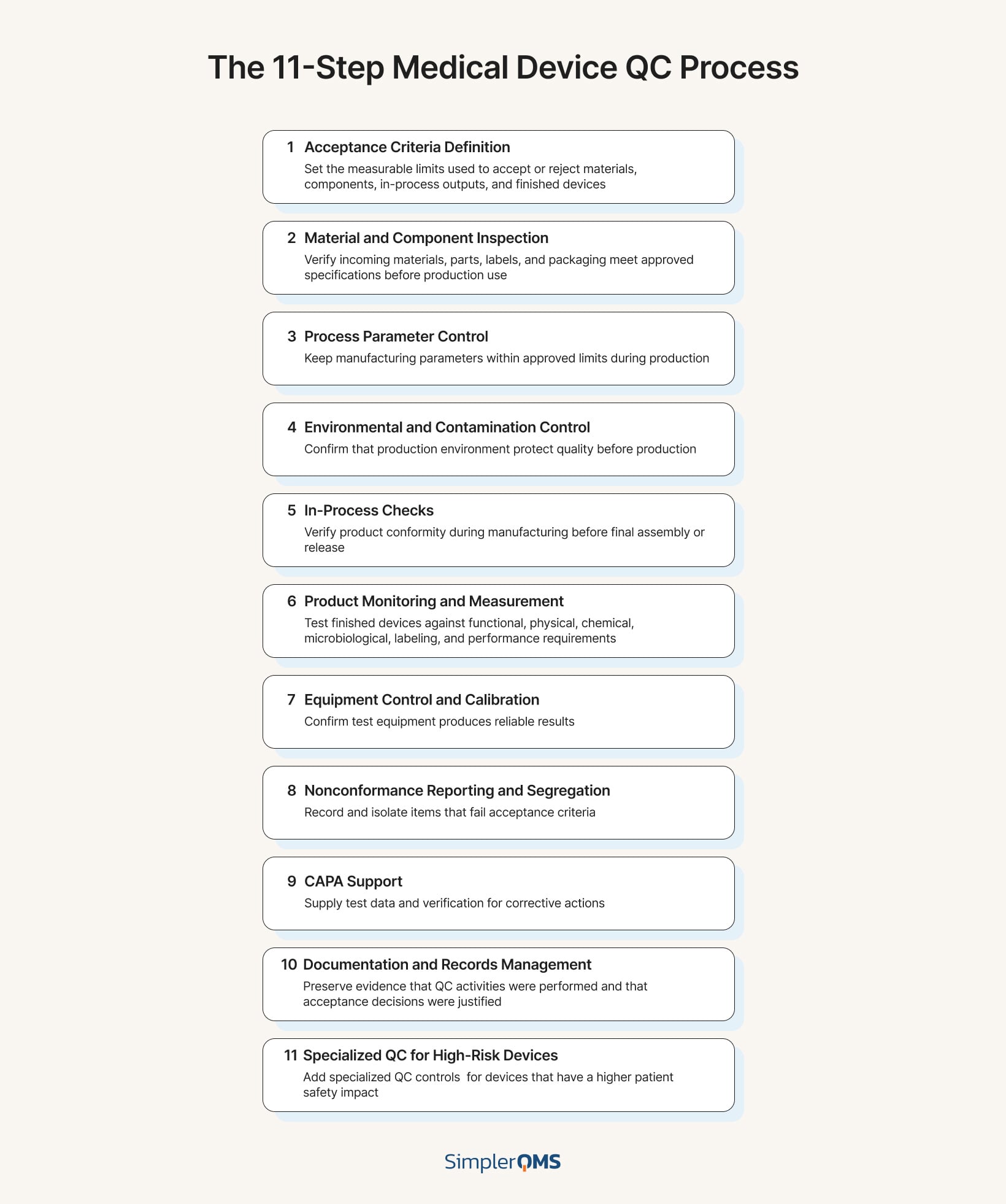
- Acceptance Criteria Definition: Acceptance criteria definition establishes the measurable limits used to accept or reject materials, components, in-process outputs, and finished devices. Acceptance criteria are established during the design and development phase and are included in the device’s technical documentation or medical device file. QC teams use specifications, drawings, test methods, sampling plans, and release criteria to evaluate items. For example, for contact lenses, acceptance criteria must include defined limits for base curve, diameter, optical power, water content, and sterility.
- Material and Component Inspection: Material and component inspection verifies that incoming materials, parts, labels, and packaging materials meet approved specifications before production use. This step is performed in receiving inspection areas or QC laboratories. QC teams evaluate items such as catheter tubing, implant screws, surgical blades, electronic boards, and sensors. For instance, QC teams inspect catheter tubing for correct diameter, flexibility, and absence of surface defects before releasing the tubing to production.
- Process Parameter Control: Process parameter control verifies that manufacturing parameters remain within approved limits during production. Process parameter control is performed on production lines. QC or production teams review parameters such as seal temperature, injection molding pressure, torque settings, and coating thickness.
- Environmental and Contamination Control: Environmental and contamination control verifies that production environments protect product quality, including cleanliness and sterility when required. Environmental control applies in cleanrooms, microbiology laboratories, and controlled manufacturing areas. QC or production teams confirm that temperature, pressure, and humidity are within acceptance limits before the initiation of any production activity. QC evaluates water purity, gas purity, and microbial contamination when these controls are required.
- In-Process Checks: In-process checks verify product conformity during manufacturing before final assembly or release. This step is performed at production workstations, automated test stations, or inspection points. QC teams inspect items such as molded components, assembled surgical tools, implant surface finish, tubing connections, and packaging seals.
- Product Monitoring and Measurement: Product monitoring and measurement verifies that finished devices meet functional, physical, chemical, microbiological, labeling, and performance requirements. The product monitoring and measurement step is performed in QC laboratories, functional test areas, and microbiology laboratories. QC teams test items such as infusion pump flow rate, orthopedic implant dimensions, diagnostic assay, surgical equipment function, and wearable device connectivity.
- Monitoring and Measurement Equipment Control and Calibration: Monitoring and measurement equipment control and calibration confirm that inspection and testing equipment produce reliable results. Equipment calibration is performed in metrology rooms, QC laboratories, and external calibration provider sites. QC teams calibrate equipment such as calipers, micrometers, pressure gauges, balances, thermometers, and spectrophotometers.
- Nonconformance Reporting and Segregation: Nonconformance reporting and segregation identifies, records, and isolates materials, components, in-process items, or finished devices that do not conform to acceptance criteria. Nonconformances are found by QC personnel at inspection stations, production areas, or QC laboratories. QC teams report defects such as contaminated packaging, failed sterility tests, incorrect labels, failed electrical checks, cracked housings, out-of-tolerance implants, and damaged surgical instruments. QC teams then segregate affected items to prevent unintended use or release.
- CAPA Support: CAPA support involves QC providing important inputs to investigations and the CAPA process and executing corrective and preventive actions. QC teams support corrective and preventive actions, contributing to issue resolution and continuous improvement, with additional testing, process adjustments, enhanced monitoring, and verification activities. QC teams provide QC data that are reviewed by QA to identify recurring nonconformities, process variation, and quality trends.
- Documentation and Records Management: Documentation and records management preserve evidence that QC activities were performed and that acceptance decisions were justified. QC teams maintain inspection records, test reports, calibration records, environmental monitoring records, sampling records, labeling checks, sterilization records, and final release evidence.
- Specialized QC for High-Risk Devices: Specialized QC for high-risk devices applies added inspection, testing, and verification controls for devices marketed in the EU that have a higher patient safety impact. Specialized QC applies to Class D in vitro diagnostics under the IVDR, and can include batch verification or independent laboratory testing.
The medical device Quality Control (QC) process consists of 11 key steps as shown in the image below.
Which Other Processes Are Related to Medical Device Quality Control?
Medical device quality control is related to processes that define requirements, control production, qualify resources, manage changes, and drive continual improvement. These processes support QC because inspection and testing depend on approved designs, validated processes, trained personnel, controlled documents, qualified suppliers, and effective management of nonconformities.
The 9 main processes related to medical device quality control are given below.
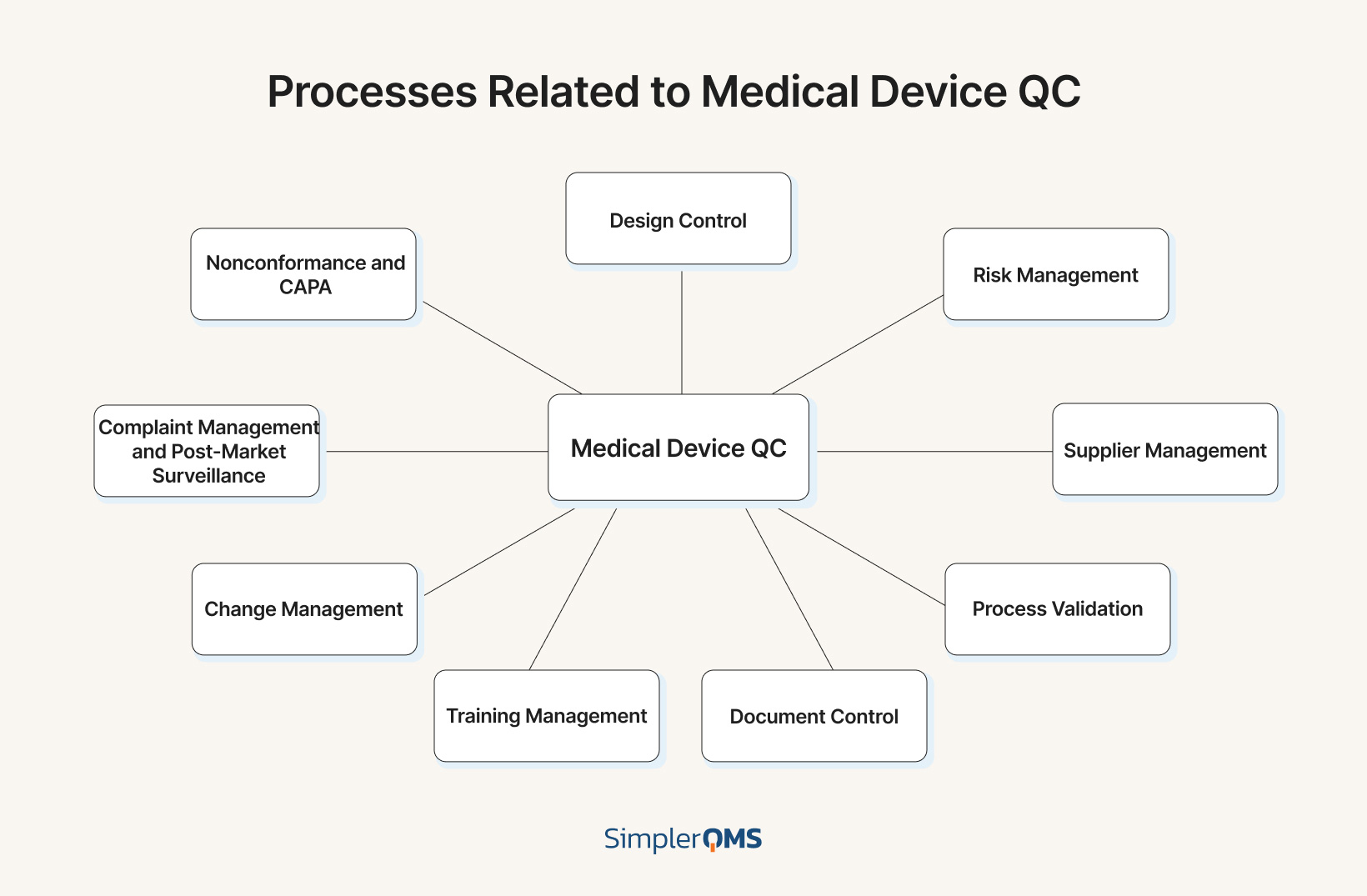
- Design Control: Design control covers design and development planning, design inputs, design outputs, design review, design verification, design validation, design transfer, and design changes. Design control defines the requirements that QC uses for inspection and testing. QC verifies production outputs against design control outputs such as drawings, acceptance criteria, specifications, and performance requirements.
- Risk Management: Risk management identifies device hazards, assesses risks, defines risk controls, monitors effectiveness of risk controls, and evaluates residual risks. QC supports risk management by testing critical features such as sterility or electrical safety and providing data on residual risk and previously unrecognized hazards.
- Supplier Management: Supplier management is a structured process for selecting, evaluating, controlling, and monitoring external suppliers and subcontractors. QC supports supplier management by verifying that supplied materials meet predefined requirements. QC also provides inspection feedback for supplier qualification and ongoing supplier monitoring.
- Process Validation: Process validation proves that a manufacturing process produces consistent outputs that fit their intended purpose. QC contributes to process validation through increased inspection and testing of validation batches. Routine QC checks verify that the validated process remains in a controlled state.
- Document Control: Document control is the process of creating, reviewing, approving, distributing, and maintaining documents to ensure accuracy, consistency, and traceability. Document control applies to procedures, specifications, work instructions, test methods, forms, and acceptance criteria used in QC activities. QC depends on document control to ensure personnel use the current version during inspection, testing, and release decisions.
- Training Management: Training management confirms that personnel are qualified to perform assigned tasks. QC activities depend on trained personnel who understand inspection methods, equipment use, sampling plans, data recording, and nonconformance reporting.
- Change Management: Change management controls changes to products, materials, suppliers, processes, equipment, software, documents, and test methods. QC supports change management by providing test results and inspection evidence to evaluate the proposed change. Changes directly affect QC when they require updates to inspection methods, acceptance criteria, sampling plans, and test procedures.
- Complaint Management and Post-Market Surveillance: Complaint management and post-market surveillance collect data on device performance after devices are released to the market. QC contributes to complaint handling and investigations by providing test data and inspection records, and by testing returned products.
- Nonconformance and CAPA Management: Nonconformance and CAPA management handles failed materials, defective products, process nonconformances, investigations, corrections, corrective actions, and preventive actions. QC identifies and records nonconformities, segregates affected items, and provides test evidence. QC implements assigned CAPA activities and provides data that QA uses to verify corrective action effectiveness.
Medical device Quality Control (QC) is supported by 9 interconnected quality management processes as shown in the image below.
What Equipment Is Used in Medical Device Quality Control?
Medical device quality control uses inspection tools, measuring instruments, reference materials, testing equipment, and software systems to verify that materials, components, in-process materials, and finished devices meet approved specifications. Medical device QC equipment varies by device type, acceptance criteria, and test method.
The 7 main equipment and systems used in medical device quality control are listed below.
- Dimensional and Metrology Equipment: Dimensional and metrology equipment measures physical dimensions, tolerances, and geometry. Medical device QC teams use calipers, micrometers, coordinate measuring machines, optical comparators, gauges, rulers, profilometers, and microscopes. These dimensional tools inspect items such as implant screws, catheter tubing, surgical instrument jaws, molded housings, and wearable device components.
- Mechanical and Functional Testers: Mechanical testers verify mechanical properties such as strength, durability, movement, pressure, and sealing. Functional testers also verify device functions such as flow, usability, and operating performance. Medical device QC teams use tensile testers, compression testers, torque testers, leak testers, burst testers, flow testers, force gauges, and cycle testers. These mechanical and functional testers evaluate items such as syringes, infusion sets, orthopedic implants, surgical tools, wound dressings, and wearable sensors.
- Electrical Safety Testers: Electrical safety testers confirm that powered devices meet defined electrical safety and performance requirements. Medical device QC teams use hipot testers, ground bond testers, insulation resistance testers, and leakage current testers to test items such as patient monitors, infusion pumps, diagnostic instruments, and wearable medical electronics.
- Analytical Instruments: Analytical instruments test chemical and biological attributes that affect device safety and effectiveness. Medical device QC teams use spectrophotometers, chromatographs, pH meters, conductivity meters, balances, incubators, and microscopes. These analytical instruments and equipment evaluate items such as diagnostic reagents, cleaning residues, sterile devices, and in vitro diagnostic components.
- Environmental Control Equipment: Environmental control equipment monitors and controls environmental conditions in production, storage, and QC areas. Medical device QC teams use particle counters, temperature sensors, humidity sensors, differential pressure gauges, microbial plates, and data loggers to control or monitor environmental conditions and minimize contamination risks.
- Reference Material and Standards: Reference materials and standards provide verified comparison points for calibration. Medical device QC teams use certified reference materials such as calibrated reference weights or reference thermometers, and reference standards to confirm that QC instruments and test methods produce reliable results.
- QC Software: QC software, such as laboratory information management systems (LIMS), manages sample tracking, test workflows, results recording, data review, and reporting. Medical device QC teams use LIMS to organize laboratory testing activities, ensure traceability of samples and results, enforce standardized procedures, and maintain data integrity.
Medical device manufacturers use artificial intelligence (AI) for QC in areas such as defect detection, image analysis, and advanced trend analytics. AI-based QC tools require validation, approved procedures, and human oversight.
Who Is Involved in QC in a Medical Device Organization?
Medical device quality control involves internal and external stakeholders. Internal stakeholders are directly responsible for planning, executing, and monitoring QC activities, while external stakeholders influence requirements, assess conformity, provide services, or are affected by QC outcomes. Internal stakeholders include QC, QA, design and development, production, and management teams. External stakeholders include regulators, notified bodies, certification bodies, suppliers and subcontractors, calibration service providers, healthcare professionals, and patients.
The main stakeholders involved in medical device quality control and each stakeholder’s role in QC are described below.
- QC Personnel: QC personnel perform inspections, tests, measurements, sampling activities, and equipment checks. QC personnel record results, report nonconformities, segregate affected materials, and provide evidence for product acceptance decisions.
- Design and Development Team: Design and development teams define the acceptance criteria and control points. QC teams use these outputs to inspect and test in-process materials, components, and finished devices.
- QA Team: QA teams maintain the quality management system, review QC procedures and records, manage audits, and oversee CAPA and training. QA teams use QC findings to improve procedures, training, supplier qualification, and process controls.
- Production Team: Production teams manufacture devices under approved procedures and perform line checks, process controls, and operator inspections when assigned. QC results affect production because failed tests trigger segregation, rework, investigation, or process adjustment.
- Top Management: Top management provides resources, personnel, equipment, facilities, and quality objectives for QC activities. Top management reviews QC trends, nonconformities, complaints, and CAPA performance during quality management reviews.
- Regulatory Authorities: Regulatory authorities define legal requirements for medical device quality systems and product conformity. In the United States, the FDA inspects manufacturers and reviews QC records as evidence of compliance, while in other regions, regulatory authorities may also conduct inspections or oversight activities.
- Notified Bodies: Notified bodies assess conformity for medical devices marketed under European Union requirements. Notified bodies review QC procedures, technical documentation, production controls, and product verification evidence during audits and conformity assessments.
- Certification Bodies: Certification bodies audit quality management systems against standards such as ISO 13485:2016. Certification bodies review QC procedures, inspection records, calibration records, nonconformance handling, and CAPA evidence.
- Suppliers and Subcontractors: Suppliers and subcontractors provide materials, reagents, testing services, or manufacturing support. QC teams test supplied materials or verify supplier results through incoming inspection, supplier records, and certificates.
- Calibration Service Providers: Calibration service providers calibrate measurement equipment used in QC. QC teams rely on calibration certificates and traceability records of reference materials to support the equipment’s calibrated status.
- Healthcare Professionals and Patients: Healthcare professionals and patients use the finished medical device. QC affects them by reducing the risk of defective devices and unreliable performance that can lead to clinical failures.
What Regulations and Standards Apply to Medical Device QC?
Medical device QC is governed by regulations, quality management system requirements, and technical standards that require manufacturers to verify product conformity before release. Regulations and quality management standards define the framework for QC, while technical standards specify the methods and acceptance criteria for testing particular device types or manufacturing processes.
The main regulations and standards that apply to medical device quality control are listed below.
- ISO 13485:2016: ISO 13485:2016 is the international quality management system standard for medical device organizations, establishing the framework for QC through product realization. ISO 13485:2016 addresses QC directly in Clause 8.2.6 which requires planned monitoring and measurement of the product at suitable stages to verify that specified requirements are met. Clause 7.6 controls monitoring and measuring equipment, supporting reliable QC measurements. Clause 7.4.3 requires verification of purchased products, and Clause 7.5.1 establishes controlled production and service provision. These clauses require approved acceptance criteria, inspection records, test evidence, calibrated equipment, supplier material verification, controlled production conditions, and release controls. Additional requirements, including process monitoring described in Clause 8.2.5, control of nonconforming products mentioned in Clause 8.3, and corrective action described in Clause 8.5, support effective quality control.
- FDA 21 CFR Part 820 (QMSR): FDA 21 CFR Part 820 is the United States Quality Management System Regulation (QMSR) for finished medical devices. FDA 21 CFR Part 820 incorporates ISO 13485:2016 by reference as the core quality management system framework. Part 820 addresses QC through ISO 13485 requirements and FDA-specific supplemental controls. Section 820.45 adds device labeling and packaging controls, including procedures for labeling and packaging integrity, examination of labeling and packaging before release or storage, documented labeling release, and prevention of labeling or packaging mix-ups.
- EU MDR (Regulation (EU) 2017/745): EU MDR is the European Union regulation for medical devices other than in vitro diagnostic devices. EU MDR Article 10 outlines manufacturer obligations. Article 10(9) requires procedures that keep the series production in conformity with the regulation. Article 10(9) also requires processes for monitoring and measuring of output, data analysis, and product improvement. Article 15(3)(a) requires the Person Responsible for Regulatory Compliance (PRRC) to ensure that device conformity is checked under the quality management system before release. Annex IX, Section 2.2(e), requires appropriate tests and trials before, during, and after manufacture. Annex VII, Section 4.5.3, requires notified bodies to examine incoming, in-process, and final checks and their results.
- EU IVDR (Regulation (EU) 2017/746): EU IVDR is the European Union regulation for in vitro diagnostics. EU IVDR Article 10 outlines manufacturer obligations. Article 10(8) requires procedures that keep the series production in conformity with the regulation. Article 10(8)(m) refers to monitoring and measurement of output, data analysis, and product improvement. Article 15(3)(a) requires the PRRC to ensure that device conformity is checked under the quality management system before release. EU IVDR Annex IX outlines conformity assessment requirements and Annex VII the requirements that notified bodies must meet. Sections 3.2 of Annex IX and 4.5.2, 4.5.3 of Annex VII connect conformity assessment to quality system documentation, product verification evidence, and notified body review of checks and results. EU IVDR Annex IX, Section 4.12, requires manufacturers of Class D devices to carry out tests on every manufactured batch and forward reports to the notified body.
- ISO 11737 Series: ISO 11737 is a standard series for microbiological methods used in medical devices and health care products. ISO 11737-1 covers the determination and characterization of the population of microorganisms on products, components, raw materials, or packaging. ISO 11737-2 covers sterility tests performed during the definition, validation, and maintenance of a sterilization process.
- Specialized ISO Standards for Medical Devices: Specialized ISO standards are product-specific standards that define testing, inspection, performance, and safety requirements for particular device families. Examples include ISO 14801 for dynamic loading tests for dental implants, ISO 7864 for sterile hypodermic needles, ISO 11040 for prefilled syringes, and the ISO 18369 series for contact lenses.
Compliance with medical device QC regulations and standards provides objective evidence of product safety and effectiveness. Medical device QC compliance gives patients and healthcare providers confidence in consistent device performance, supports market access, strengthens audit readiness, and reduces manufacturing defects, field failures, complaints, and product recalls. Compliance failure exposes patients and users to unsafe or ineffective devices. Compliance failure exposes manufacturers to recalls, certification suspension, import restrictions, warning letters, legal penalties, and loss of trust.
How Does Quality Control Fit Into Medical Device QMS?
Quality control fits into a medical device QMS as the product-testing and verification layer, providing the evidence to support product release and regulatory conformity. QMS is the overarching framework of policies, processes, and procedures designed to ensure that medical devices consistently meet safety, quality, and regulatory requirements throughout their lifecycle. A medical device QMS defines the requirements, responsibilities, procedures, acceptance criteria, training needs, equipment controls, and recordkeeping rules. QC applies those requirements and controls to the testing and inspection of components, in-process outputs, and finished devices. QC results feed back into the QMS through nonconformance records, QC trend data, and management review inputs.
QC data is used in day-to-day quality management. Software systems support the medical device lifecycle management by linking QC data with production, QMS, and inventory records. Software systems enable traceability, compliance, and oversight from design and development through post-market surveillance and eventual device discontinuation. The main software systems that support medical device QC, manufacturing, and QMS are given below.
- QMS Software: QMS software manages core quality system processes such as document control, training, nonconformances, CAPA, change controls, supplier qualification, and audits. QMS software supports QC by streamlining document management and nonconformance reporting, while keeping records traceable and equipment status visible.
- Manufacturing Execution System (MES): Manufacturing Execution System (MES) software controls and records production activities on the shop floor. MES supports QC by guiding operators through approved steps, capturing process data, enforcing in-process checks, and linking production events to device manufacturing records.
- Laboratory Information Management System (LIMS): Laboratory Information Management System (LIMS) software manages QC samples, test workflows, laboratory results, data review, and reporting. LIMS supports QC by controlling sample traceability, standardizing test execution, and maintaining reliable laboratory records.
- Electronic Manufacturing Record Software: Electronic Manufacturing Record software manages electronic batch records, in-process inspection results, signatures, and release documentation. Electronic Manufacturing Record software supports QC by creating a complete production and inspection history for each batch or device.
- ERP Software: Enterprise Resource Planning (ERP) software manages purchasing, inventory, materials, suppliers, production orders, and distribution data. ERP software supports QC by linking material status, supplier information, quarantine decisions, and release status to manufacturing and supply chain activities.
How Does QMS Software Support QC for Medical Device Organizations?
Medical device QMS software supports QC by centralizing procedures, specifications, training records, equipment records, nonconformance records, CAPA records, and release evidence that verify product conformity. Medical device QMS software supports QC throughout the lifecycle by linking design outputs, production controls, test records, supplier records, and post-market surveillance quality data in a controlled system.
Medical device organizations should choose QMS software that supports compliance with ISO 13485:2016, FDA 21 CFR Part 820 (QMSR), EU MDR, and EU IVDR, while meeting Part 11 and EU Annex 11 expectations. Medical device organizations should assess whether the software supports medical device quality workflows, electronic signatures, audit trails, and access controls. SimplerQMS is an all-in-one QMS software built for life science companies, including medical device and MedTech organizations. SimplerQMS supports medical device QC by providing fully validated software with controlled, traceable workflows for core quality processes, such as document control, change management, training management, equipment management, nonconformance, and CAPA management, designed to support compliance with medical device requirements.
The 7 main SimplerQMS capabilities that support QC for medical devices are listed below.
- Document Control: SimplerQMS document control module manages QC procedures, specifications, test methods, work instructions, release templates, and forms in a controlled, centralized platform. QC teams use the current version of each document during inspection, testing, and release checks.
- Training Management: SimplerQMS training management assigns and tracks QC personnel training for procedures, test methods, and equipment use. Training records provide documented evidence that QC personnel are trained before they perform inspection or testing tasks.
- Change Management: SimplerQMS change management module controls changes to products, materials, suppliers, processes, equipment, documents, and test methods. QC teams use change records to evaluate whether inspection plans, acceptance criteria, calibration needs, or release checks need updates. QC teams use change records to check the status before implementing approved changes.
- Design Control: SimplerQMS design control documents design inputs, design outputs, design reviews, verification records, and validation records. QC teams use approved design outputs, specifications, and acceptance criteria as the basis for production inspection and finished device testing.
- Nonconformance Management: SimplerQMS nonconformance management records failed inspections, rejected materials, process nonconformances, and finished device failures. QC teams document the issue, support the investigation, and maintain traceable records.
- CAPA Management: SimplerQMS CAPA management module manages corrective and preventive actions linked to QC findings, audit findings, complaints, and process trends. QC teams provide test data, defect evidence, and reinspection results for CAPA closure. A QC team member receives automated notifications that support on-time closure when a CAPA is assigned to that team member.
- Equipment Management: SimplerQMS equipment management tracks QC equipment records, calibration status, maintenance history, and equipment-related documentation. QC teams use equipment status records to confirm that inspection and testing results come from controlled and calibrated instruments.
SimplerQMS supports QC processes for medical device organizations by connecting controlled documents, personnel training, changes, design outputs, nonconformance, CAPAs, and equipment records in one system. SimplerQMS helps QC teams maintain inspection readiness, reduce manual record handling, and keep product conformity evidence accessible across the medical device lifecycle.
