SimplerQMS Validation: Fully Validated eQMS for Life Sciences
Reduce validation effort with SimplerQMS, a fully validated eQMS built for regulated life science organizations.
Trusted by 5,000+ life science professionals worldwide – and growing.
15,000+ life science professional community
4.6 rating on Capterra
4.9 rating on G2


Case study


Case study


Case study


Case study


Case study


Reduce the Burden of eQMS Validation
SimplerQMS performs and maintains system-level validation of the standard application. This reduces duplicated validation work, allowing customers to focus on intended use, configuration, procedures, access controls, and users.
Reduce Internal Validation Effort
Rely on vendor validation of the standard SimplerQMS application instead of repeating the same application-level validation internally.
Maintain the Validated State Through Software Updates
SimplerQMS software changes undergo controlled impact assessment, risk-based testing, approval, and validation updates appropriate to their assurance level.
Stay Ready for Audits and Inspections
Access structured documentation that supports supplier qualification and helps your team explain how the SimplerQMS validated state is maintained.
How SimplerQMS Software Validation Works?
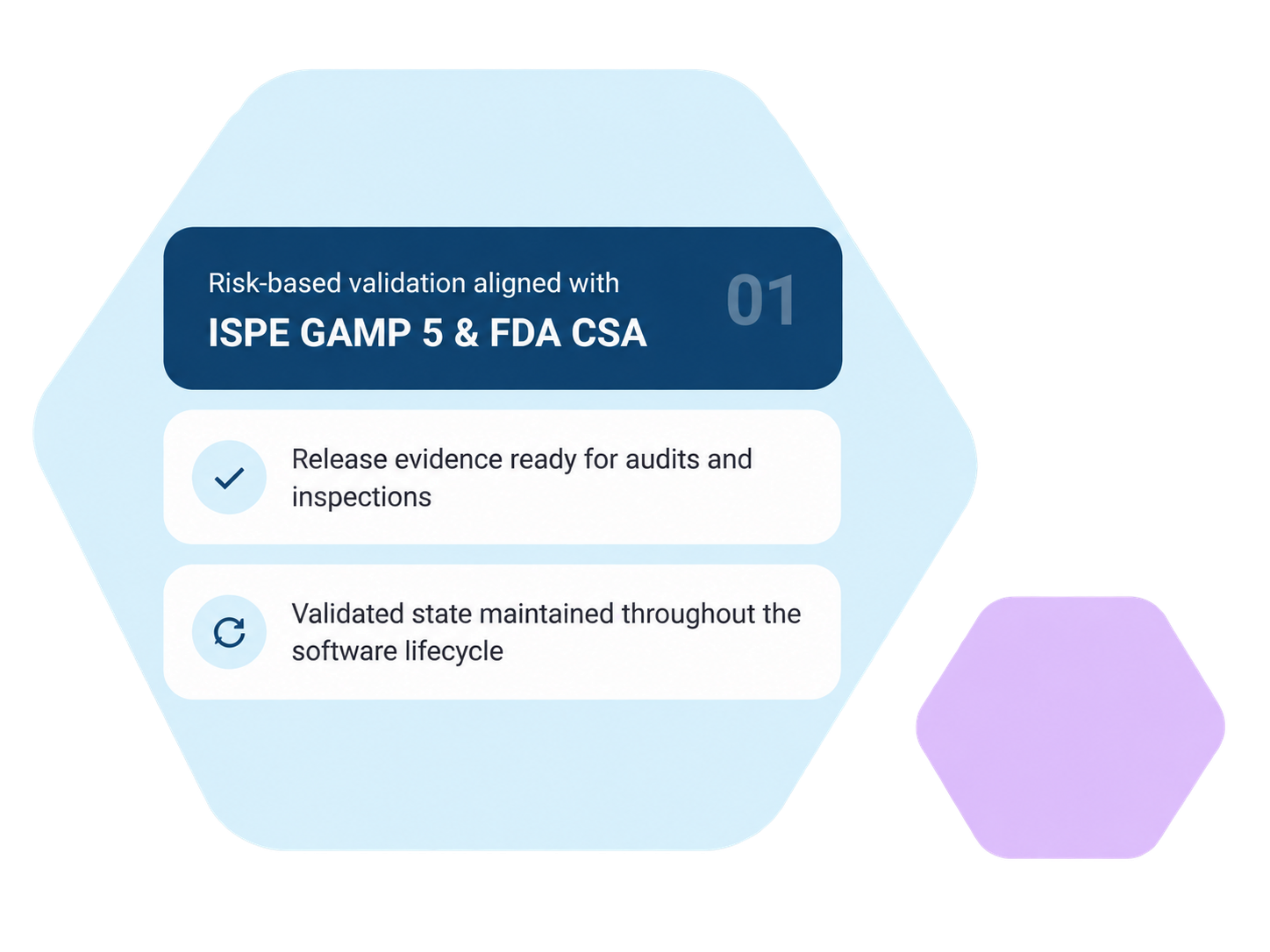
SimplerQMS applies a risk-based Computer Software Assurance approach aligned with FDA CSA and ISPE GAMP 5 Second Edition. Testing and evidence are determined through critical thinking based on intended use and risk.
Validation According to ISPE GAMP 5
SimplerQMS follows the lifecycle and risk-based assurance principles of ISPE GAMP 5 Second Edition. Core SimplerQMS software is typically classified as GAMP 5 Category 5, with assurance levels determined through risk assessment and critical thinking rather than automatically assigning the highest level to all code changes.
Documentation from qualified infrastructure suppliers may support infrastructure assurance, while SimplerQMS remains responsible for validating the platform and maintaining its validated state.
Continuous Revalidation After Software Updates
Every SimplerQMS software change follows formal change control and a Regulatory Criticality Assessment. Major and minor releases affecting the validated baseline undergo the applicable validation lifecycle, while patch and maintenance releases receive risk-based verification and additional validation when required.
SimplerQMS Validation Lifecycle
Every validation lifecycle is governed through Change Control, maintaining traceability between each system change, its risk assessment, and the validation evidence produced.
Phase 1 · RCA
Regulatory Criticality Assessment
Phase 2 · VAL-01
Validation Planning
Phase 3 · VAL-02
Verification & Testing
Phase 4 · VAL-03
Validation Summary
Phase 5 · VAL-04
Validation Closure
Phase 6 · Ongoing
Archiving and Maintaining Validated State
| Phase | Purpose | Result | Assurance Level |
|---|---|---|---|
| RCA Regulatory Criticality Assessment | Determines whether validation is required and evaluates the level of risk. | Go or no-go decision and assigned assurance level. | AL1–AL3 assigned |
| VAL-01 Validation Planning | Defines the scope, testing strategy, and assurance activities. | Signed validation plan covering scope, testing approach, and document list. | Assigned level documented |
| VAL-02 Verification and Testing | Executes validation activities and collects objective evidence. | Test records and a pass or fail outcome for each applicable requirement. | Testing depth is based on the assigned assurance level. |
| VAL-03 Validation Summary | Summarizes the results and concludes the validated state. | Signed validation summary report confirming the validation outcome. | Not applicable |
| VAL-04 Validation Closure | Formally closes the validation project and completes the handover to operations. | Approved Project End Report covering outcomes, lessons learned, and operational handover. May be omitted for minor changes where formal closure is not required. | Based on project scope |
| Archiving and Maintaining Validated State | Maintains assurance throughout operation through change control, periodic review, incident monitoring, and data-integrity controls. | Maintained validated-state records and revalidation when triggered by risk assessment or major change. | Risk-based |
Risk-Based Assurance Levels
SimplerQMS applies FDA Computer Software Assurance (CSA) principles by scaling validation and evidence based on intended use, risk, and impact, with greater assurance for higher-risk functionality.
Low impact with no direct effect on product quality or regulatory compliance
Configuration review, automated verification, supplier evidence, or unscripted assurance activities, as justified
Assurance level
AL1
Moderate or indirect impact on intended use
Targeted functional or regression testing with documented acceptance criteria and evidence
Assurance level
AL2
High impact on intended use, data integrity, or compliance controls
Full validation lifecycle with formal traceability, risk assessment, testing, QA approval, and an updated Validation Certificate
Assurance level
AL3
What Validation Documentation Does SimplerQMS Provide?
SimplerQMS maintains controlled validation documentation within its Quality Management System (QMS). The records made available to customers depend on the type, risk, and assurance level of the software release.
Validation Procedure
Defines the validation lifecycle, governance, responsibilities, risk and assurance-level determination, acceptable testing methods, evidence requirements, approvals, and maintenance activities.
Validation Plan
Defines the validation scope, assurance level, risk-based testing strategy, responsibilities, acceptance criteria, and evidence. The detailed risk assessment is reflected in the associated Change Request Plan.
Validation Report
Summarizes validation activities, test results, deviations, outstanding risks, and conclusions. Supporting evidence is maintained in applicable test protocols listed in both the Validation Plan and Validation Report.

Validation Certificate
Confirms the approved validation outcome and the validated baseline for the applicable SimplerQMS release.
IQ, OQ, and PQ Documentation
Depending on the platform, release type, and assigned assurance level, the validation package may include Installation Qualification, Operational Qualification, Performance Qualification, and other CSA-equivalent evidence.
Lower-risk changes may rely on targeted, automated, or supplier-supported evidence where justified and approved by QA.
-
IQ
Confirms that the applicable system environment and installation requirements are correctly established.
-
OQ
Verifies that system functions operate according to defined requirements.
-
PQ
Demonstrates that the system supports its intended use under expected operating conditions.
Validation Support for Audits and Inspections
SimplerQMS validation documentation is designed to support supplier qualification, customer audits, and regulatory inspections. When additional support is needed, SimplerQMS may provide clarification or participate in audit discussions upon reasonable request and prior notice.
Supporting Life Science Computer System Validation Requirements
The SimplerQMS User Requirements Specification (URS) consolidates expectations from standards and guidance relevant to an electronic Quality Management System (eQMS). These requirements form the regulatory design baseline for the platform.
FDA 21 CFR Part 11
Supports electronic records and signatures, audit trails, authentication, access control, record integrity, and version control.
EU GMP Annex 11
Supports risk-based validation, supplier oversight, data integrity, access control, backup and recovery, and lifecycle management.
ISO 13485:2016
Supports risk-proportionate validation of software used within the QMS, documented evidence, and controlled changes.
FDA Computer Software Assurance (CSA)
Applies critical thinking and assurance activities proportionate to intended use and risk.
SimplerQMS provides validated functionality that supports compliance. Each customer remains responsible for its procedures, configuration, access controls, training, and compliant use of the system.
Customer Responsibilities When Using a Vendor Validated eQMS
SimplerQMS validates the standard application. Customers remain responsible for its intended use and how it is configured and operated within their QMS.
R
Responsible – does the work
A
Accountable – owns the decision and signs off
C
Consulted – provides input
I
Informed – kept aware of the outcome
Exact responsibilities should be confirmed through the applicable Customer Quality Agreement, internal procedures, and the customer’s risk-based assessment.
Frequently Asked Questions About SimplerQMS Validation
Listed below are frequently asked questions about SimplerQMS validation.
Is SimplerQMS a Validated System?
Yes. SimplerQMS is delivered as a fully validated eQMS, with system-level validation performed and maintained in line with ISPE GAMP 5 and FDA CSA principles.
Do Customers Need to Validate SimplerQMS Separately?
No, customers do not need to repeat the product-level validation performed by SimplerQMS. Customer environments are deployed from a pre-validated system template and verified through applicable installation and configuration records.
Customers remain responsible for supplier evaluation, intended use, internal procedures, user access, training, and operational controls.
What Validation Documents Can Customers Access?
Available evidence may include validation plans and reports, release statements, validation certificates, test documentation, and IQ, OQ, and PQ documentation for major releases.
Availability depends on the assurance level and applicable confidentiality controls.
How Is the Validated State Maintained After Updates?
Changes are managed through formal change control, impact assessment, risk-based verification, approval, and validation documentation appropriate to the assigned assurance level.
How Are Customer Specific Configurations Handled?
Standard functionality supporting configuration is validated by SimplerQMS.
Customers assess whether their configured workflows, metadata, document structures, roles, and permissions support their intended use and internal procedures.
Does SimplerQMS Validation Cost Extra?
No, system-level validation of SimplerQMS and release validation evidence are included in the subscription. Customer-specific validation activities or extended audit support may depend on the requested scope and applicable agreement.
Can SimplerQMS Support Audits or Inspections?
Yes. Validation documentation is designed to help customers explain the vendor-validation model.
Additional clarification or participation may be available upon reasonable request and prior notice.
How Does the SimplerQMS Validation Approach Compare With Other eQMS Vendors?
Unlike some eQMS vendors that provide only partial validation and leave significant system validation work to the customer, SimplerQMS is delivered as a fully validated eQMS.
We perform and maintain system-level validation in line with GAMP 5 and provide risk-based validation documentation, including IQ, OQ, and PQ documentation for major releases.
This allows customers to focus their validation activities on intended use, configuration, procedures, and operational controls.
See SimplerQMS in Action
See how SimplerQMS supports document control and other interconnected quality processes in a single, integrated eQMS.
