A Master Batch Record (MBR) is a controlled, pre-approved Good Manufacturing Practice (GMP) document that defines how a specific product batch must be manufactured, tested, packaged, and controlled under validated conditions. In regulated manufacturing, the Master Batch Record (MBR) serves as the authoritative reference for batch production. The MBR standardizes execution, embeds required in-process controls, and ensures that each batch is produced consistently and in compliance with approved requirements.
In GMP-regulated environments, the primary purpose of the master batch record is to translate validated processes, quality standards, and regulatory expectations into clear, repeatable instructions for manufacturing. The instructions are followed during production and objectively verified during batch review, deviation investigations, audits, and regulatory inspections.
A complete MBR is structured to support both execution and compliance. MBR includes product identification details, approved materials and Bill of Materials, equipment and tooling requirements, step-by-step manufacturing instructions, in-process controls and sampling plans, environmental and safety requirements, packaging and labeling controls, quality testing references, and formal approval and revision controls that preserve document integrity throughout the product lifecycle.
Master Batch Records are governed by regulatory and quality system requirements across life-science industries. Pharmaceutical and biotech manufacturers must comply with frameworks such as FDA 21 CFR Part 211, EU GMP (EudraLex Volume 4), and relevant ICH guidelines addressing GMP documentation and lifecycle management. In medical device and combination-product environments, comparable master documentation expectations exist under FDA 21 CFR Part 820 (QMSR) and ISO 13485, particularly where batch-based manufacturing is involved.
To maintain accuracy, control, and inspection readiness, pharmaceutical, biotech, and medical device manufacturers rely on specialized software to create and manage MBRs. Common solutions include Electronic Batch Record (EBR) software, Manufacturing Execution Systems (MES), Electronic Document Management Systems (EDMS), and QMS platforms such as SimplerQMS that support MBR document control and electronic batch record management. These systems help enforce version control, structured change management, approval workflows, and traceability between master instructions and executed batch records.
What Is a Master Batch Record (MBR)?
A Master Batch Record (MBR) is a controlled, pre-approved GMP document that defines the complete and standardized instructions for manufacturing, testing, packaging, and controlling a specific medicinal product batch under defined conditions.
A Master Batch Record specifies approved materials, equipment, process steps, in-process controls, and acceptance criteria to ensure every manufactured batch consistently meets predefined quality, safety, and regulatory requirements.
Other names used for a Master Batch Record depend on regulatory context and industry practice. The term Master Production Record (MPR) is used in FDA-regulated environments and is referenced under FDA 21 CFR Part 211. The term Master Manufacturing Record (MMR) is used in pharmaceutical and biologics manufacturing to emphasize the manufacturing scope of the document. Master Formula Record (MFR) appears in some GMP texts and legacy systems to describe formulation and processing instructions. Production teams may refer to the same controlled document operationally as Manufacturing Instructions.
A Master Batch Record serves several core functions in GMP-regulated manufacturing. It standardizes production by defining the same approved steps for every batch, and it controls process variability by specifying materials, equipment, parameters, and in-process controls. An MBR supports batch traceability by linking each executed batch record to the approved master version used. From a compliance perspective, the MBR provides the documented, approved manufacturing instructions required under GMP. During deviations, investigations, audits, and inspections, it functions as the fixed reference point for assessing what was intended versus what occurred.
The purpose and strategic value of an MBR is to translate regulatory and quality requirements into repeatable and controlled manufacturing execution. The strategic value of an MBR lies in its ability to protect product quality, ensure patient safety, maintain inspection readiness, and reduce manufacturing risk by preventing undocumented or uncontrolled process changes.
The key components included in an MBR are product identification information, Bill of Materials (BOM), equipment requirements, manufacturing instructions, in-process controls, environmental and safety requirements, packaging and labeling instructions, and quality control references.
What Is the Significance of the Master Batch Record?
The significance of the MBR lies in its role as the primary control document ensuring consistent, compliant, and reproducible manufacturing in regulated industries.
The MBR is essential in regulated manufacturing because it converts regulatory requirements, validated processes, and quality standards into approved and repeatable manufacturing instructions that apply to every batch.
The following benefits explain how the MBR delivers operational consistency, embeds GMP controls, and supports quality oversight throughout the product lifecycle.
- Ensures Manufacturing Consistency: The MBR defines identical materials, equipment, and process steps for every batch, reducing batch-to-batch variability.
- Supports Regulatory Compliance: The MBR provides approved and documented manufacturing instructions required by GMP regulations before production begins.
- Reduces Process Variation and Quality Risk: The MBR minimizes uncontrolled process variation and embeds predefined controls that reduce the risk of manufacturing errors and quality defects.
- Preserves Data Integrity: MBR enforces contemporaneous, complete, and attributable record-keeping in the executed batch records, supporting ALCOA+ and GMP data integrity expectations.
- Provides Documented GMP Evidence: The MBR creates auditable evidence that manufacturing activities are executed in compliance with GMP.
- Enables Full Batch Traceability: The MBR links executed batch records to a single approved master document, providing traceability of materials, equipment, process steps, and personnel for each batch produced.
- Serves as an Authoritative Reference: The MBR is used by manufacturers, quality units, and regulatory inspectors to confirm that products are manufactured correctly and consistently.
- Facilitates Audits and Inspections: The MBR supports inspection readiness by providing a controlled reference for regulatory review.
- Supports Deviation Investigation: The MBR serves as the baseline document for identifying deviations and performing root-cause analysis.
- Retains Process Knowledge: The MBR captures and preserves approved process knowledge, reducing reliance on individual expertise.
Are MBR, MMR, and MFR the Same in the Regulated Manufacturing Industry?
No, MBR, MMR, and MFR are not strictly the same terms, but they refer to closely related master manufacturing documents that serve the same core purpose in regulated manufacturing.
MBR, MMR, and MFR are used in different regulatory, regional, and organizational contexts to describe the approved master document that defines how a product is manufactured in compliance with GMP. The practical meaning of MBR, MMR, and MFR is aligned, while the preferred terminology depends on the regulatory framework, industry segment, and historical usage.
The contextual use of each term is explained below.
- Master Batch Record (MBR): MBR is preferred in GMP-regulated manufacturing environments where batch-based production is emphasized. MBR is commonly used in pharmaceutical, biotechnology, and medical device manufacturing to describe the master document from which executed batch records are generated.
- Master Manufacturing Record (MMR): MMR is commonly used in pharmaceutical and biologics manufacturing to emphasize the manufacturing process rather than the individual batch. MMR is frequently used in quality systems and internal documentation to describe comprehensive manufacturing instructions.
- Master Formula Record (MFR): MFR appears in some GMP texts, legacy systems, and formulation-focused environments. MFR emphasizes formulation composition and processing steps and is more commonly encountered in older regulatory guidance or established internal terminology.
Although the terminology differs, MBR, MMR, and MFR all function as controlled, approved master documents that define standardized manufacturing instructions, ensure process consistency, and support regulatory compliance.
What Is the Difference Between a Master Batch Record and a Batch Manufacturing Record?
A Master Batch Record (MBR) and a Batch Manufacturing Record (BMR) are related but distinct documents used in GMP-regulated manufacturing, each serving a different role in the batch lifecycle.
The MBR is the pre-approved, controlled master document that defines how a product must be manufactured. MBR contains standardized instructions, specifications, and controls that apply to every batch of a specific product and must be in place and approved before manufacturing begins. The Batch Manufacturing Record is the executed, batch-specific record that documents how a particular batch was actually manufactured. BMR is generated during production from the approved MBR and captures real-time data, results, signatures, and deviations for that specific batch.
Below are listed the key differences between an MBR and a BMR.
- Purpose: The MBR defines approved manufacturing instructions and controls, while the BMR documents actual execution of those instructions for a specific batch.
- Timing: The MBR is created and approved before production starts, whereas the BMR is completed in real time during manufacturing and reviewed after production is complete.
- Content Type: The MBR contains fixed instructions, specifications, and control parameters. The BMR contains recorded data, observations, test results, operator signatures, and timestamps specific to that batch.
- Change Control: Changes to an MBR require formal change control and regulatory assessment where applicable. A BMR cannot be retrospectively changed, but may contain documented deviations linked to formal investigations or CAPAs.
- Regulatory Role: The MBR demonstrates process design and control, while the BMR provides batch-level evidence of GMP compliance and forms the basis for the product release decision.
- Relationship: Each BMR is generated from a single approved MBR version, creating a direct traceability link between planned manufacturing and actual batch execution.
What Is the Difference Between Master Formula and Batch Formula?
A Master Formula and a Batch Formula are related documents used in GMP-regulated manufacturing, but they serve different roles in defining and recording how a product is produced.
The Master Formula is the approved master document that defines the formulation and processing instructions for a product. The Master Formula specifies the qualitative and quantitative composition, manufacturing steps, equipment, parameters, in-process controls, and acceptance criteria that must be followed for every batch. The master formula exists before manufacturing begins and is maintained under formal change control.
The Batch Formula is the batch-specific version of the master formula that is used during production. The Batch Formula reflects the approved master formula but includes batch-unique details such as batch number, batch size, actual quantities weighed or measured, dates, signatures, and recorded results. The Batch Formula documents how a specific batch was prepared in practice.
Key differences between a Master Formula and a Batch Formula are outlined below.
- Purpose: The master formula defines what must be done, while the batch formula records what was actually done for a specific batch.
- Timing: The master formula is approved before manufacturing, whereas the batch formula is completed in real time during batch execution and finalized after manufacture is complete.
- Content: The master formula contains a fixed, standardized formulation composition and processing instructions. The batch formula contains actual values, observations, operator entries, and deviations for a single batch.
- Change Control: Changes to a master formula require formal change control and approval. A batch formula cannot be retrospectively altered, but deviations from the master formula must be formally documented and investigated.
- Regulatory Role: The master formula demonstrates approved formulation design and process control, while the batch formula provides batch-level GMP evidence to support product release and traceability.
In practice, each batch formula is generated from one approved master formula version, ensuring consistency between the approved formulation and the executed manufacturing record.
What Is the Difference Between a Master Batch Record and a Device Master Record?
A Master Batch Record (MBR) and the master documentation for medical devices (formerly referred to as Device Master Record (DMR) by FDA) are both controlled master documents used in regulated manufacturing, but they apply to different product types and are governed by different regulatory frameworks.
An MBR is a GMP-controlled document used primarily in pharmaceutical and biologics manufacturing. MBR defines the complete, approved instructions for manufacturing a specific product batch, including materials, equipment, process steps, in-process controls, and acceptance criteria. The MBR exists before manufacturing begins and serves as the master template from which executed batch records are generated.
Under the modernized FDA QMSR (aligned with ISO 13485:2016), the traditional FDA term, DMR, is no longer explicitly defined in the regulation itself. Instead, the device master documentation that fulfills the same regulatory intent is maintained as part of the controlled device quality documentation structure, commonly referred to as the Medical Device File. This documentation contains the specifications and controlled instructions required to manufacture a medical device in accordance with the approved design, including device specifications, production process specifications, quality assurance procedures, packaging and labeling specifications, and installation or servicing instructions, where applicable.
Key differences between a Master Batch Record and master documentation for medical devices are as follows.
- Regulatory Framework: The MBR is governed by pharmaceutical GMP regulations (such as FDA 21 CFR Part 211 and EU GMP), while the master documentation for devices is governed by the FDA QMSR for medical devices, which aligns with ISO 13485.
- Product Type: The MBR applies to drugs and biologics manufactured in discrete batches. The device master documentation applies to medical devices, which may be produced in batches, lots, or continuous processes.
- Purpose: The MBR defines how a batch must be manufactured. The device master documentation defines how a medical device must be manufactured and controlled in line with the approved device design.
- Content Focus: The MBR focuses on batch-specific manufacturing instructions, process parameters, and controls. The device master documentation focuses on design-linked manufacturing specifications, product and process controls, quality procedures, labeling, and packaging requirements.
- Execution Records: The MBR is used to generate Batch Manufacturing Records (BMRs) that document actual batch execution. The device master documentation is used to generate Device History Records (DHRs) that document how each device or lot was manufactured.
- Lifecycle Role: The MBR supports batch execution and release decisions, while the device master documentation supports ongoing device manufacturing, quality assurance, and regulatory compliance throughout the device lifecycle.
In summary, while both documents function as authoritative master references, the MBR is specific to batch-based pharmaceutical manufacturing, whereas the device master documentation is a design-linked master record required for medical device production.
What Are the Key Sections Included in a Master Batch Record?
A Master Batch Record must include all GMP-required instructions, specifications, and controls necessary to manufacture a product consistently, safely, and in full compliance with regulatory requirements.
An MBR defines what materials are used, how manufacturing is performed, which controls are applied, and how compliance is demonstrated for every batch of a specific product.
The sections included in an MBR collectively define the essential manufacturing, control, and documentation elements required to produce a batch in a consistent, controlled, and GMP-compliant manner. Below are listed the major sections included in an MBR.
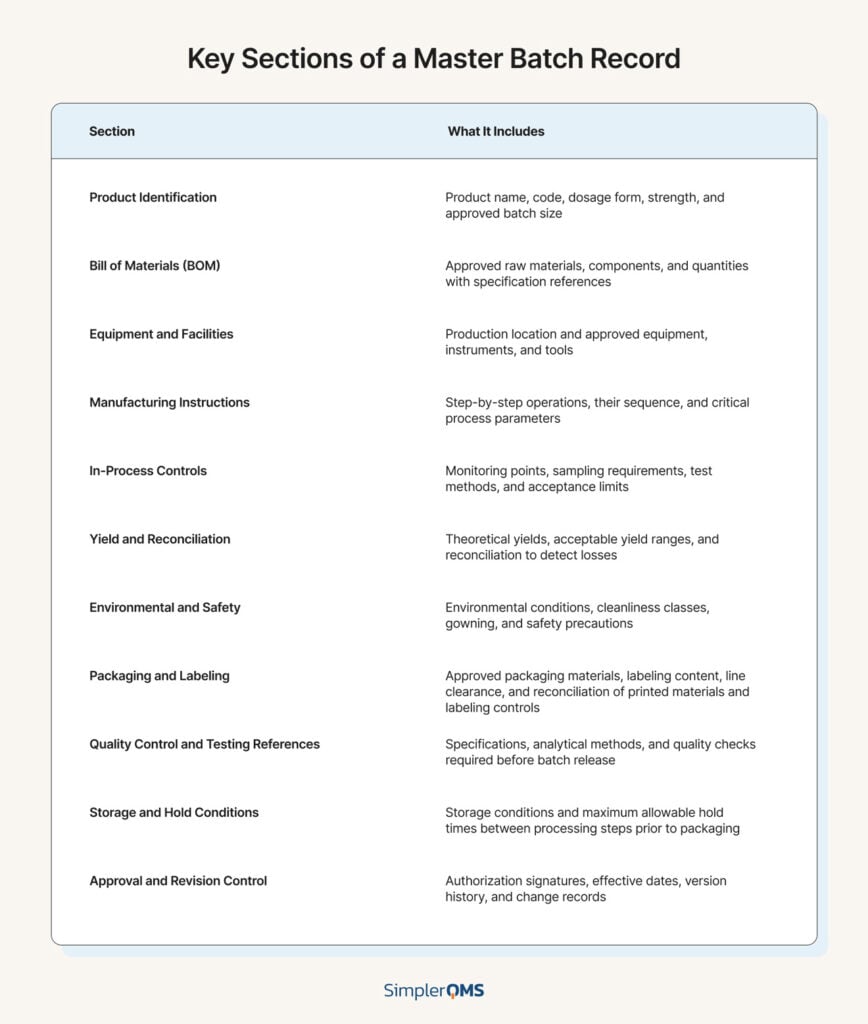
- Product Identification Section: The product identification section defines the product name, product code, dosage form, strength, and approved batch size to ensure correct product identification and prevent mix-ups.
- Bill of Materials (BOM) Section: The BOM section lists all approved raw materials, components, and quantities required for manufacturing, including references to approved material specifications.
- Equipment and Facilities Section: The equipment and facilities section specifies the production location and approved manufacturing equipment, instruments, and tools required to prevent unauthorized or unvalidated equipment use.
- Manufacturing Instructions Section: The manufacturing instructions section documents step-by-step processing instructions, the sequence of operations, and defined critical process parameters to ensure reproducible execution.
- In-process Controls Section: The in-process controls section defines monitoring points, sampling requirements, test methods, and acceptance limits used to control product quality during manufacturing.
- Yield and Reconciliation Requirements: Yield and reconciliation requirements specify theoretical yields, acceptable yield ranges at intermediate and final stages, and reconciliation requirements to detect losses, discrepancies, or potential errors.
- Environmental and Safety Requirements Section: The environmental and safety requirements section specifies environmental conditions, cleanliness classifications, gowning requirements, and safety precautions applicable to the manufacturing process.
- Packaging and Labeling Instructions Section: The packaging and labeling instructions section defines approved packaging materials, labeling content, line clearance, reconciliation of printed materials, and labeling controls to prevent mix-ups and labeling errors.
- Quality Control and Testing References Section: The quality control and testing references section links applicable specifications, analytical methods, and quality checks that must be completed before batch release.
- Storage and Hold Conditions: Storage and hold conditions define storage requirements for bulk product, including environmental conditions and maximum allowable hold times between processing steps, prior to packaging.
- Approval and Revision Control Section: The approval and revision control section documents authorization signatures, effective dates, version history, and change records to ensure controlled document lifecycle management.
Each section of the MBR directly supports manufacturing consistency, batch traceability, and GMP compliance by ensuring that all production activities follow approved and controlled instructions.
A Master Batch Record contains essential sections covering product identification, materials, manufacturing instructions, in-process controls, quality requirements, and document approvals, as shown in the image below.
What Are the Regulatory Requirements for MBR?
Regulatory requirements for an MBR define the mandatory rules, expectations, and controls that govern how an MBR must be created, approved, maintained, and used to ensure compliant manufacturing in regulated industries.
In the context of an MBR, a regulatory requirement represents an obligation to document complete and accurate manufacturing instructions, keep them under formal document control, and demonstrate consistency and traceability for every batch. Health authorities and standards bodies define these expectations to protect product quality and patient safety, preserve data integrity, and enable effective oversight through inspections.
The primary purpose of MBR regulatory requirements is to ensure that manufacturing is performed in accordance with approved processes, deviations are detectable and investigated, and every batch can be objectively evaluated against predefined specifications and standards before release.
The primary regulatory requirements governing Master Batch Records (MBRs) are listed below.
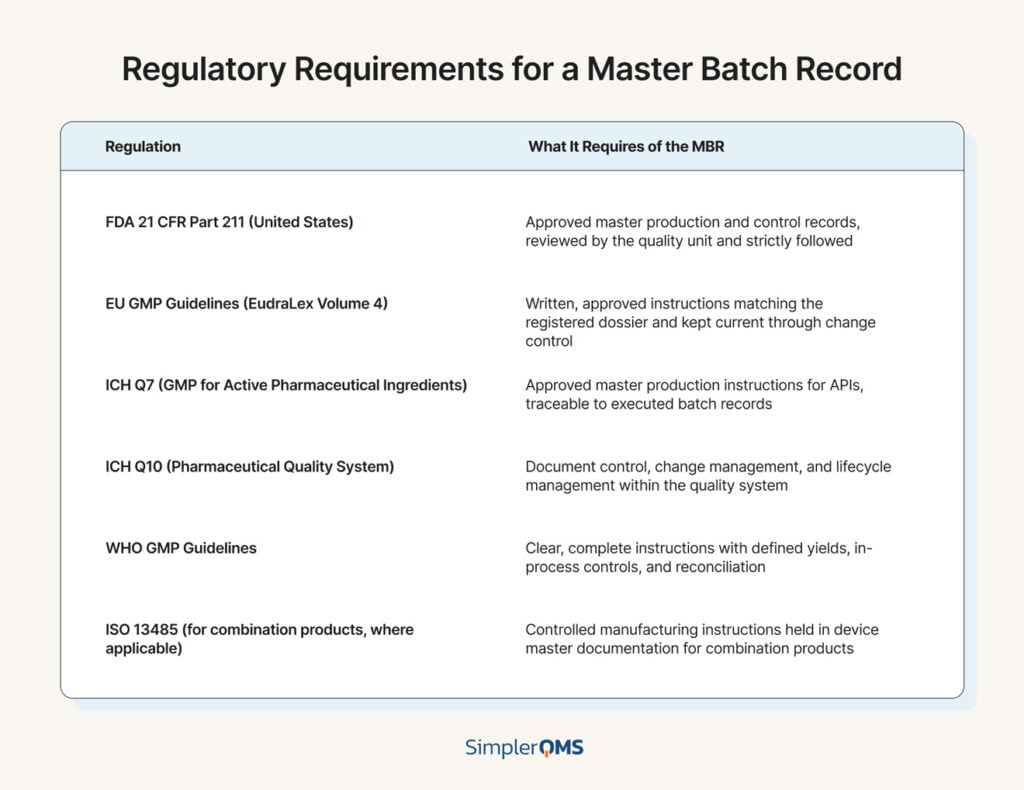
- FDA 21 CFR Part 211 (United States): FDA regulations require the use of approved master production and control records that define complete manufacturing instructions, specifications, sampling plans, and acceptance criteria. The FDA mandates that MBRs be reviewed, approved by quality units, and strictly followed to ensure batch consistency and traceability.
- EU GMP Guidelines (EudraLex Volume 4): EU GMP requires written and approved manufacturing instructions that correspond to the registered dossier. EU authorities mandate that MBRs include detailed processing steps, in-process controls, environmental conditions, and packaging instructions, and that they are kept up to date through formal change control.
- ICH Q7 (GMP for Active Pharmaceutical Ingredients): ICH Q7 requires approved master production instructions for APIs, covering raw materials, equipment, processing steps, controls, and acceptance criteria. The ICH Q7 guideline emphasizes traceability, reproducibility, and linkage between master records and executed batch records.
- ICH Q10 (Pharmaceutical Quality System): ICH Q10 establishes expectations for document control, change management, and lifecycle management of MBRs within the pharmaceutical quality system. While ICH Q10 does not define specific MBR content, it requires MBRs to be managed in a manner that supports process consistency, effective risk management, and continual improvement.
- WHO GMP Guidelines: WHO GMP requires documented, approved, controlled master manufacturing instructions, covering raw materials, equipment, and processing steps, aligned with validated processes. WHO guidance emphasizes clarity, completeness, and suitability of MBRs to ensure consistent manufacturing, including defined yields, in-process controls, and reconciliation procedures.
- ISO 13485 (for combination products where applicable): ISO 13485 requires documented production processes and controlled manufacturing instructions maintained within the device master documentation, which is equivalent to an MBR. When applied to combination products, these documents must demonstrate controlled execution, traceability, and compliance with quality system and applicable GMP requirements.
Each regulatory source requires that the Master Batch Record (MBR) is approved before use, maintained under change control, and used as the authoritative reference for executing and verifying manufacturing activities.
Master Batch Records must meet applicable GMP requirements, with regulatory frameworks and guidelines defining expectations for manufacturing instructions, documentation, approvals, and traceability, as shown in the image below.
How Is a Master Batch Record Created and Managed?
A Master Batch Record is created by translating validated manufacturing and control requirements into a controlled MBR template. The completed MBR then undergoes cross-functional review and Quality approval so it can serve as the authorized master for batch execution and traceability.
Below is the step-by-step process for creating an MBR.
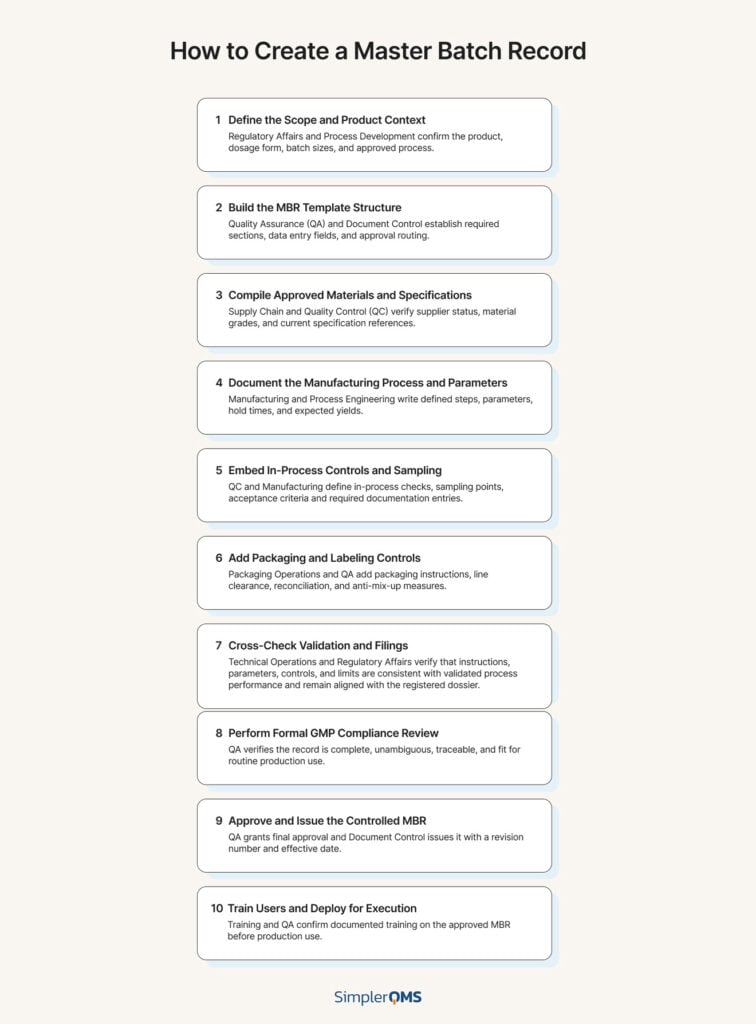
- Define the Scope and Product Context: Confirm the intended product, dosage form, batch size ranges, and the registered or approved manufacturing process the MBR must reflect. Regulatory Affairs and Technical/Process Development must verify that the scope aligns with the current marketing authorization, development data, and manufacturing strategy before drafting begins.
- Build the MBR Template Structure: Establish a controlled MBR template that includes all required sections, formatting standards, data entry fields, and approval routing. Quality Assurance (QA) or Document Control must ensure the template complies with GMP documentation requirements and supports traceability and data integrity.
- Compile Approved Materials and Specifications: Verify that all raw materials, components, and packaging materials are approved and supported by current specifications. Supply Chain/Materials Management and Quality Control (QC) must confirm supplier status, material grades, and specification references before inclusion in the MBR.
- Document the Manufacturing Process and Parameters: Write clear, step-by-step manufacturing instructions that define the sequence of operations, critical process parameters, equipment requirements, defined hold times, and theoretical or expected yields at appropriate stages. Manufacturing/Production and Process Engineering must ensure the instructions accurately reflect validated process conditions.
- Embed In-Process Controls and Sampling Plans: Define in-process checks, sampling points, acceptance criteria, and required documentation entries to control quality during execution. QC and Manufacturing must ensure that controls are practical, measurable, and aligned with process validation data.
- Add Packaging and Labeling Controls: Include detailed packaging instructions, line clearance steps, reconciliation requirements, labeling controls, and anti-mix-up measures. Packaging Operations and QA must confirm that controls prevent product mix-ups and ensure regulatory compliance.
- Cross-Check Alignment With Validation and Filings: Verify that all instructions, parameters, controls, and limits are consistent with validated process performance and remain aligned with the registered dossier or approved manufacturing strategy. Technical Operations/Validation and Regulatory Affairs must confirm consistency with validation reports and regulatory commitments.
- Perform Formal Review and GMP Compliance Check: Conduct a comprehensive review to confirm that the MBR is complete, clear, unambiguous, traceable, and suitable for routine production use. QA must verify that the record meets documentation and data integrity requirements.
- Approve and Issue the Controlled MBR: Approve the final MBR version and authorize it for use. QA must grant final approval, and Document Control must issue the record with an effective date, revision number, and controlled distribution to ensure only the current version is available for use.
- Train Users and Deploy for Execution: Train relevant personnel on the approved MBR and any associated SOPs before production use. The Training function and QA must document training completion to support compliance and consistent execution.
Creating a Master Batch Record (MBR) involves ten key steps, from defining product requirements and manufacturing instructions to GMP review, approval, and implementation, as shown in the image below.
Below are the key steps for managing an MBR throughout its lifecycle.
- Controlled Issuance and Access: Document Control maintains the current effective version, prevents unintended use of obsolete revisions, and manages distribution/availability at the point of use.
- Execution Linkage to Batch Records: Manufacturing uses the approved MBR to generate batch-specific executed records (paper or electronic), maintaining traceability to the master version used.
- Periodic Review and Continuous Alignment: QA and Technical Operations periodically confirm the MBR remains aligned with validated processes, equipment strategy, specifications, and regulatory commitments.
- Ongoing Performance Monitoring: QA and Technical Operations monitor deviations, investigations, yield trends, complaints, and CAPAs to determine whether the MBR requires clarification, correction, or improvement.
- Change Control for Updates: Any revision is initiated through formal change control, including documented impact assessment, risk evaluation, cross-functional approvals, and implementation planning before the MBR is updated.
- Validation and Requalification Support: Validation and Engineering confirm whether MBR changes require process validation updates, equipment requalification, or additional verification activities prior to implementation.
- Training Updates and Effectiveness Checks: Training/QA ensures role-based retraining is completed when revisions affect execution steps, and confirms implementation effectiveness through review or audit.
- Inspection Readiness and Audit Trail Maintenance: QA maintains revision history, approval documentation, and traceability links so the MBR can be defended during inspections, investigations, and audits.
- Archival and Retention: Document Control archives superseded versions under retention rules, ensuring historic versions remain retrievable for batch investigations and regulatory queries.
MBR creation and management is a cross-functional GMP activity that requires defined ownership across Quality, Operations, Technical, and Compliance functions. The key department responsibilities involved in creating, approving, issuing, and maintaining an MBR are listed below.
- Quality Assurance (QA) Department: Lead the GMP compliance review, approve the final MBR, and oversee the MBR lifecycle to maintain inspection readiness.
- Document Control Department: Issue controlled MBR versions, manage revision history and effective dates, and maintain distribution and archival/retention records.
- Manufacturing Department: Draft practical manufacturing instructions, confirm shop-floor usability, and provide execution feedback to support continuous improvement.
- Process Engineering Department: Define critical process parameters and technical rationale, and ensure the MBR reflects the validated manufacturing process design.
- Technical Operations Department: Support process transfer, ensure operational readiness, and confirm the MBR reflects the approved manufacturing strategy.
- Quality Control (QC) Department: Define sampling requirements, in-process controls, and acceptance criteria, and ensure testing references support investigation traceability.
- Validation Department: Confirm alignment with the validated state and determine when MBR changes require verification or revalidation activities.
- Regulatory Affairs Department: Verify that MBR content remains aligned with regulatory requirements, commitments, and approved variations across applicable regions.
- Packaging Department: Define packaging and labeling instructions, include reconciliation steps, and implement controls to prevent mix-ups and labeling errors.
- Training Department: Ensure personnel are trained on the approved MBR and revision updates, and maintain training records to support consistent execution.
- Compliance Department: Monitor adherence to MBR governance rules and ensure training, documentation, and data integrity practices support GMP expectations.
Who Is Authorized to Approve a Master Batch Record?
The Quality Unit (Quality Assurance) is authorized for approval of a Master Batch Record (MBR).
In GMP-regulated manufacturing, the Quality Assurance (QA) department is the function legally responsible for reviewing, approving, and authorizing the Master Batch Record to ensure it complies with regulatory requirements, validated processes, and registered product information.
Depending on the organization and regulatory framework, additional approvals may be required from Manufacturing, Technical Operations, or Regulatory Affairs, but final authorization always rests with the Quality Unit. QA approval confirms that the MBR is complete, accurate, controlled, and suitable for use in routine production.
Only an MBR approved by QA is considered valid for batch execution and regulatory inspection.
How Are Changes to an Approved Master Batch Record Handled in Life Science Companies?
Changes to an approved MBR in life science companies must be handled through a formal, documented change control process to ensure continued compliance with GMP, product quality, and patient safety. Any change to an approved Master Batch Record (MBR) must be formally evaluated, reviewed, approved, implemented, and verified under controlled conditions before it is used in manufacturing. Once the MBR is approved, it cannot be modified informally.
The change control process for an approved MBR includes the following steps.
- Change Initiation: A proposed change to the MBR is formally raised, describing the reason for the change, scope, and affected sections of the MBR.
- Impact Assessment: Cross-functional teams such as Quality, Manufacturing, Engineering, and Regulatory assess the impact of the change on product quality, process validation, regulatory submissions, and patient safety.
- Risk Assessment: Quality risk management tools are applied to identify, analyze, and evaluate potential risks associated with the change and determine required mitigation actions.
- Review and Approval: The proposed change, impact assessment, and risk assessment are reviewed and approved by the Quality Unit and other required stakeholders before implementation.
- MBR Revision and Update: The MBR is revised to incorporate the approved change, assigned a new revision number, and updated under document control.
- Training of Relevant Personnel: All affected personnel are trained on the revised MBR and any associated procedural updates before the new version becomes effective.
- Release and Authorization for Use: Following approval and completion of required training, the revised MBR is formally released under document control and authorized for use in routine production.
- Implementation, Effectiveness Verification, and Closure: The revised MBR is implemented during batch execution. The change is subsequently verified through batch review, monitoring activities, audits, or defined effectiveness criteria to confirm proper implementation and achievement of the intended outcome. Upon satisfactory verification, the change control is formally closed.
The following types of changes to a Master Batch Record require formal change control.
- Raw Material Changes: Changes to approved raw materials, suppliers, material grades, or specifications.
- Equipment or Tooling Changes: Introduction of new equipment, replacement of approved equipment, or changes to equipment settings.
- Manufacturing Process Changes: Modifications to processing steps, sequence of operations, critical process parameters, or in-process controls.
- Formulation Changes: Adjustments to qualitative or quantitative composition, batch size ranges, yield expectations, or formulation instructions.
- Packaging and Labeling Changes: Updates to packaging materials, labeling content, or labeling control steps.
- Analytical or Quality Control Changes: Changes to test methods, acceptance criteria, sampling plans, or release requirements referenced in the MBR.
- Environmental or Safety Requirement Changes: Updates to environmental conditions, cleanroom classifications, or safety precautions.
- Regulatory-Driven Changes: Updates required to align the MBR with regulatory submissions, variations, commitments, or new regulatory guidance.
All such changes must be controlled, approved, and documented to ensure that the Master Batch Record remains an accurate, compliant, and authoritative reference for manufacturing execution.
What Are the Common Challenges in Master Batch Record Management?
The common challenges in MBR management arise from maintaining accuracy, control, traceability, and compliance across complex and frequently changing manufacturing environments.
MBR management becomes challenging when manual processes, fragmented documentation, or inadequate controls are used in regulated manufacturing.
The common challenges in MBR management are listed below.
- Version Control and Document Consistency: Managing multiple revisions of an MBR can lead to the unintended use of outdated or superseded instructions, increasing the risk of deviations and noncompliance.
- Change Control Complexity: Manufacturing changes, process improvements, or regulatory updates require timely MBR revisions. Delays or incomplete change implementation can result in misalignment between approved instructions and actual manufacturing practices.
- Cross-Functional Coordination: MBRs require input from Quality, Manufacturing, Engineering, and Regulatory teams. Poor coordination between functions can cause approval delays, incomplete content, or inconsistent instructions.
- Traceability Between Master and Executed Records: Maintaining a clear link between the approved MBR and executed batch records can be challenging, especially in paper-based systems, reducing transparency during audits and investigations.
- Inspection and Audit Readiness: Incomplete approvals, missing signatures, or unclear revision history can lead to inspection findings and regulatory observations.
- Scalability and Lifecycle Maintenance: As products mature, transfer sites, or expand into additional indications or markets, updating and maintaining multiple MBRs becomes increasingly difficult without structured systems.
- Approval Bottlenecks: Paper-based review and approval workflows slow down MBR release and increase operational inefficiencies.
- Data Integrity Risks: Manual entries and uncontrolled access to MBR templates increase the risk of errors, omissions, and non-compliant data handling.
Master Batch Record management challenges can be effectively mitigated by using electronic solutions such as eQMS software, electronic document management systems (EDMS), or QMS platforms with MBR management capabilities, which provide controlled templates, automated versioning, structured change management, approval workflows, and full audit trails for compliant MBR creation and maintenance.
Which Software Solutions are Used for Creating and Managing the Master Batch Record?
Specialized GMP-compliant software solutions such as electronic batch record (EBR) systems, manufacturing execution systems (MES), and validated QMS platforms with document control and workflow automation are used to create, manage, control, and maintain MBRs in a structured, traceable, and compliant manner throughout the product lifecycle.
Software is used for MBR creation and management because manual or paper-based approaches increase the risk of version errors, uncontrolled changes, delayed approvals, and data integrity issues. GMP-compliant software ensures that MBRs are created from approved structures, maintained under formal change control, and consistently aligned with validated processes and regulatory expectations.
The main categories of software used for MBR management are listed below.
- Electronic Batch Record (EBR) Software: Dedicated EBR software is designed specifically for manufacturing execution and batch record management. EBR systems allow organizations to create and maintain electronic master batch records that directly drive batch execution. These systems enforce step-by-step manufacturing instructions, capture real-time data, and generate executed batch records from the approved master. EBR software typically uses controlled MBR templates to ensure standardized structure and consistent execution across batches.
- Manufacturing Execution Systems (MES): MES platforms manage production workflows and integrate MBRs with shop-floor operations. MES software uses approved master batch records to guide manufacturing activities, enforce process parameters, and collect production data. MES systems support synchronization between the MBR and actual manufacturing execution while ensuring traceability and process control.
- QMS Software With EBR Management Capabilities: QMS software with EBR management capabilities, such as SimplerQMS, supports the creation, approval, and lifecycle management of Master Batch Records within a broader quality system. These platforms provide controlled document management, version control, structured change management, approval workflows, and training linkage for MBRs. While QMS software is not a replacement for fully dedicated Electronic Batch Records software or full MES solutions, it can support light EBR and BMR management and ensure that approved MBR templates remain controlled, current, and inspection-ready.
- Electronic Document Management Systems (EDMS): EDMS platforms manage MBRs as controlled GMP documents. EDMS software supports authoring, review, approval, versioning, and archival of Master Batch Records. These systems ensure that only the current, approved MBR version is available for use and that historical versions are retained for audit and traceability purposes.
- Regulatory and Manufacturing Integration Platforms: Some organizations use integrated platforms that connect quality, manufacturing, and regulatory data. These solutions help align MBR content with registered dossiers, validated processes, and change-control activities, reducing the risk of discrepancies between approved instructions and actual operations.
Together, these software solutions enable organizations to standardize MBR creation, control revisions, enforce compliance, and maintain audit readiness. Selecting the appropriate software category depends on manufacturing complexity, execution requirements, and the level of integration needed between quality systems and production operations.
How Does QMS Software Streamline Master Batch Record Management?
QMS software streamlines MBR management by providing a controlled, centralized, and compliant system for creating, approving, maintaining, and updating MBRs throughout their lifecycle.
In the MBR creation and management process, QMS software converts manual documentation into structured digital workflows that improve consistency, visibility, and regulatory control.
QMS software is used for MBR management because regulated manufacturing requires strict document control, version management, approval traceability, and audit readiness, which are difficult to achieve with paper-based or disconnected systems.
The key ways QMS software streamlines MBR management are listed below.
- Standardized MBR Creation: QMS software supports controlled MBR templates, which ensure consistent structure, required GMP content, and standardized formatting across all Master Batch Records.
- Centralized Document Control: QMS software manages MBRs as controlled documents with version control, access restrictions, and archival to prevent the use of obsolete manufacturing instructions.
- Integrated Change Control: QMS software links MBR updates to formal change control workflows, ensuring that all changes are reviewed, approved, risk-assessed, and documented before implementation.
- Faster Approval Workflows: QMS software enables electronic and parallel approvals across departments, which reduces review cycles and minimizes administrative delays.
- End-to-End Traceability: QMS software links MBRs with related deviations, CAPAs, audits, and training records, strengthening traceability and investigation efficiency.
- Improved Compliance and Audit Readiness: QMS software maintains complete audit trails, approval histories, and revision records, supporting efficient regulatory inspections.
QMS software supports cross-functional visibility by allowing Manufacturing, Quality Assurance, Quality Control, Regulatory Affairs, and Engineering teams to access the current approved version of the MBR in real time.
Faster approvals are achieved by replacing sequential, paper-based reviews with automated workflows and electronic signatures.
QMS platforms integrate with other software solutions used in MBR creation and management, including Electronic Batch Record (EBR) systems, Manufacturing Execution Systems (MES), Document Management Systems (DMS), and Enterprise Resource Planning (ERP) systems. These integrations ensure that approved MBRs remain aligned with manufacturing execution, material management, and production planning.
QMS software strengthens compliance and audit readiness by enforcing data integrity controls, maintaining secure access, and supporting requirements such as FDA 21 CFR Part 211, EU GMP, ISO 13485, and others.
SimplerQMS is an eQMS software solution that supports MBR creation and management as part of an integrated quality management system.
SimplerQMS supports the management of Master Batch Records (MBRs) through document control, version tracking, change control, approval workflows, and audit trails. Its integrated QMS modules, including Document Control, Change Control, Training Management, CAPA Management, and Audit Management, help life science organizations maintain controlled documentation, traceability, and support compliance with applicable regulatory requirements.
SimplerQMS is not designed to replace dedicated Electronic Batch Record (EBR) or full Batch Manufacturing Record (BMR) execution systems.
However, SimplerQMS can be used effectively for light EBR and BMR management when organizations require controlled documentation, approvals, and traceability rather than full manufacturing execution functionality.
