Management responsibilities in quality systems refer to the duties of top management to establish, implement, maintain, and continuously improve the Quality Management System (QMS) while ensuring alignment with regulatory requirements and business objectives. The primary purpose of management responsibility is to ensure that the QMS is effective, adequately resourced, consistently followed, and capable of delivering compliant, safe, and high-quality products or services.
Top management is responsible for defining the quality policy and objectives, assigning roles and authorities, allocating resources, ensuring regulatory and customer focus, conducting management reviews, overseeing risk management and CAPA processes, maintaining effective communication, and ensuring control over suppliers and outsourced activities. These responsibilities ensure that quality is integrated into strategic decision-making and daily operations.
Management responsibilities are broadly consistent across major standards and regulations, but they differ in emphasis and terminology. ISO 9001 focuses on leadership, customer satisfaction, and process performance, while ISO 13485 emphasizes regulatory compliance and risk management in medical devices. FDA QMSR (21 CFR Part 820) highlights management responsibility, quality policy, and executive accountability. EU MDR introduces stricter requirements for regulatory oversight and a person responsible for regulatory compliance (PRRC). ICH Q10 focuses on pharmaceutical quality systems and lifecycle management, while EU GMP and WHO GMP emphasize product quality, patient safety, and management oversight of manufacturing and quality processes.
QMS software such as SimplerQMS supports top management by providing centralized control, visibility, and traceability across quality processes. It enables leadership to monitor performance metrics, manage documents, oversee CAPA and deviations, ensure training compliance, and maintain audit readiness. SimplerQMS digitizes and standardizes quality workflows, helping management fulfill responsibilities more effectively and improving decision-making, compliance, and continuous quality improvement.
What Do Management Responsibilities Mean in a Quality System?
Management responsibilities in a quality system refer to the duties of top management to establish, support, monitor, and continuously improve the Quality Management System (QMS). The primary management responsibilities include defining quality policies and objectives, allocating resources, ensuring regulatory compliance, fostering a quality culture, and conducting management reviews to assess system performance.
Management responsibilities keep the QMS effective, compliant, and aligned with business goals. Top management achieves this alignment by providing strategic direction, oversight, and accountability. Top management ensures consistency across processes, including document control, training, and CAPA workflows. Top management ensures that risks are addressed proactively and integrates quality into organizational decision-making.
Management responsibility differs from employee responsibility in 2 areas: scope and authority. Top management is responsible for setting direction, providing resources, and ensuring system effectiveness, which strengthens QMS oversight and long-term compliance. Employees and quality personnel are responsible for executing processes, following procedures, and maintaining quality standards in daily activities, which sustains operational control and consistent product quality.
Why Is Management Responsibility Important in Quality Systems?
Management responsibility is important in quality systems because leadership determines whether the QMS is properly implemented, adequately resourced, consistently followed, and continually improved. Top management sets the direction, ensures accountability, and creates the conditions necessary for the QMS to function effectively and meet regulatory and business requirements.
The main reasons management responsibility is important in quality systems are listed below.
- Effective QMS Implementation: Effective QMS implementation begins when management establishes quality policies, objectives, and processes that define how the QMS operates across the organization.
- Adequate Resource Allocation: Adequate resource allocation ensures that personnel, training, infrastructure, and technology are available to support quality activities and maintain compliance.
- Regulatory Compliance: Regulatory compliance is achieved when management ensures adherence to applicable standards and regulations such as ISO 9001, ISO 13485, and FDA requirements.
- Customer Focus: Customer focus is achieved when management ensures that customer requirements are understood, communicated, and consistently met, while using customer feedback to improve products, services, and the effectiveness of the QMS.
- Quality Culture Promotion: Quality culture promotion occurs when leadership reinforces the importance of quality, compliance, and continuous improvement in daily operations.
- Process Consistency: Process consistency is maintained when management ensures that procedures are followed uniformly, reducing variability and preventing quality issues.
- Risk Management Support: Risk management support is demonstrated when leadership ensures that risks are identified, evaluated, and mitigated through structured quality processes such as CAPA and internal audits.
- Continuous Improvement Enablement: Continuous improvement enablement occurs when management reviews performance data, audit results, and quality metrics to drive ongoing improvements in the QMS.
What Are the Responsibilities of Top Management in Quality Systems?
Top management responsibilities in quality systems refer to the duties of senior leadership to establish, direct, and maintain an effective QMS that ensures product quality, regulatory compliance, and continuous improvement. These responsibilities ensure that quality objectives are aligned with business goals and consistently implemented across the organization.
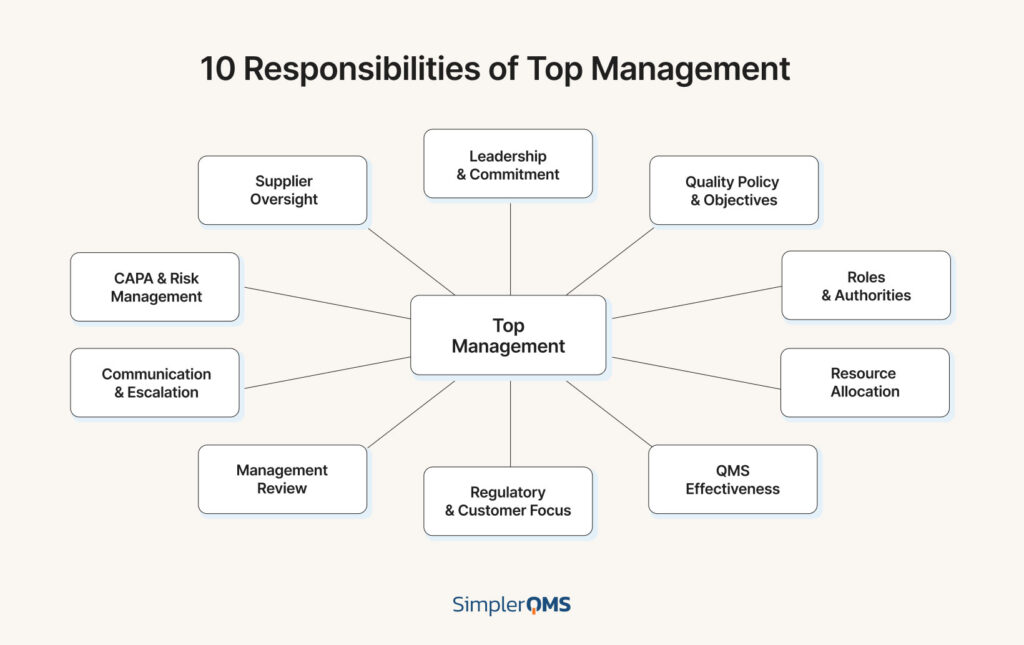
The 10 primary responsibilities of top management in a quality system are listed below.
- Leadership and Commitment: Top management demonstrates commitment by promoting quality as a strategic priority, leading by example, and ensuring alignment between quality objectives and business goals.
- Quality Policy and Objectives: Management defines and communicates the quality policy and establishes measurable quality objectives that guide organizational performance.
- Roles and Authorities: Leadership ensures that roles, responsibilities, and authorities are clearly defined, documented, and communicated across the organization.
- Resource Allocation: Top management provides adequate resources, including personnel, training, infrastructure, and technology, to support QMS implementation and maintenance.
- QMS Effectiveness: Management monitors and evaluates the performance of the QMS to ensure it achieves intended outcomes and remains compliant with applicable standards.
- Customer and Regulatory Focus: Leadership ensures that customer requirements and regulatory expectations are understood, integrated, and consistently met.
- Management Review: Top management conducts regular management reviews to assess QMS performance, identify gaps, and drive strategic improvements.
- Communication and Escalation: Management establishes effective communication channels to ensure that quality issues, risks, and performance updates are reported and addressed promptly.
- CAPA, Risk Management, and Improvement: Leadership ensures that corrective and preventive actions, risk management processes, and continuous improvement initiatives are effectively implemented.
- Supplier and Outsourcing Oversight: Management ensures that suppliers and outsourced processes are properly evaluated, controlled, and monitored to maintain product quality and compliance.
Top management plays a critical role in ensuring QMS effectiveness through leadership, quality objectives, resource allocation, regulatory compliance, management review, and continuous improvement, as shown in the image below.
Leadership and Commitment
Leadership and commitment refer to the active involvement of top management in establishing quality as a strategic priority, ensuring that the QMS is effectively implemented, maintained, and continuously improved across the organization.
Leadership and commitment are the responsibility of top management because organizational priorities, culture, and resource allocation are defined at the executive level. Without visible leadership support, quality initiatives lack direction, authority, and consistency, which can weaken QMS effectiveness.
Top management fulfills leadership and commitment through the following actions.
- Establish Quality as a Strategic Priority: Establish quality as a strategic priority by defining quality objectives aligned with business goals and using those objectives to guide decision-making.
- Demonstrate Visible Leadership Involvement: Demonstrate visible leadership involvement by participating in management reviews, quality discussions, and improvement initiatives.
- Promote a Quality Culture: Promote a quality culture by encouraging accountability, open communication, and proactive problem-solving across all levels.
- Ensure Alignment Across Departments: Ensure alignment across departments by integrating quality requirements into operational, regulatory, and business processes.
- Lead by Example: Lead by example by following procedures, supporting compliance, and reinforcing the importance of quality in daily activities.
Effective leadership reinforces compliance, stabilizes process performance, and enables early identification and control of risks. It supports continual improvement by ensuring that performance data and quality outcomes lead to meaningful system enhancements.
Insufficient leadership involvement can result in inconsistent execution, reduced employee engagement, and unaddressed risks, increasing the likelihood of deviations, nonconformances, and compliance issues.
The effectiveness of leadership involvement can be evaluated through management review outputs, quality performance indicators, audit results, and employee feedback. Strengthening governance structures and increasing leadership participation help maintain alignment with quality objectives.
Quality Policy and Objectives
Quality policy and objectives define the organization’s overall direction, intentions, and measurable goals related to quality. Quality policy and objectives ensure that quality expectations are clearly established and aligned with regulatory requirements and business strategy.
Quality policy and objectives are the responsibility of top management because leadership defines organizational priorities and ensures alignment between quality goals and business objectives. Without clear direction from management, quality efforts may become inconsistent or disconnected from operational needs.
Top management ensures effective quality policy and objectives through the following actions.
- Define a Quality Policy: Define a quality policy that reflects the organization’s commitment to quality, compliance, and continuous improvement.
- Set Measurable Quality Objectives: Set measurable quality objectives by defining specific goals related to product quality, compliance, and process performance.
- Align Objectives With Business Strategy: Align quality objectives with business strategy by connecting quality goals to organizational objectives and risk management priorities.
- Communicate Across the Organization: Communicate the quality policy and objectives across the organization, so employees understand how the requirements apply to their roles.
- Review and Update Objectives: Review and update quality objectives by evaluating performance results and adjusting objectives based on changing requirements.
A clear quality policy and objectives improve compliance by aligning activities with regulatory expectations. They enhance performance by providing measurable targets and guiding decision-making. A clear quality policy and objectives support risk control by focusing efforts on critical quality areas and drive continual improvement through structured goal-setting.
Unclear or poorly defined objectives lead to inconsistent performance, weak alignment, and reduced accountability. Employees may not understand expectations, which increases variability and compliance risks.
Quality policy and objectives should be monitored through KPI tracking, management reviews, and audit results. Continuous improvement involves updating objectives based on performance data, regulatory changes, and organizational priorities.
Roles and Authorities
Roles and authorities define responsibilities, reporting structures, and decision-making authority within the QMS. They ensure that quality activities are clearly assigned and properly managed.
Roles and authorities are the responsibility of top management because leadership defines organizational structure and accountability. Without a clear assignment of responsibilities, quality tasks may be duplicated, delayed, or overlooked.
Top management must define and maintain roles and authorities through the following actions.
- Define Organizational Structure: Define the organizational structure by establishing reporting lines and functional responsibilities.
- Assign Quality Responsibilities: Assign quality responsibilities by defining who is responsible for each QMS activity.
- Document Roles, Responsibilities, and Competence Requirements: Document roles, responsibilities, and required competencies in SOPs, job descriptions, training matrices, and other quality documents to ensure personnel are qualified for their assigned tasks.
- Ensure Authority for Decision-Making: Ensure decision-making authority by giving personnel the authority needed to perform quality-related tasks.
- Communicate Responsibilities: Communicate responsibilities so employees understand their roles and expectations.
Clear roles improve compliance by ensuring responsibilities are fulfilled and documented. They enhance performance by reducing confusion,improving efficiency, and ensuring quality decisions are made by appropriately qualified personnel. Clear roles support risk control by ensuring accountability for critical tasks and enable improvement through clear ownership.
Unclear roles lead to gaps in responsibility, delayed actions, and inconsistent execution. This increases the likelihood of compliance failures and quality issues.
Roles and authorities should be reviewed through audits, performance evaluations, management reviews, and organizational change processes. Improvements include updating documentation and clarifying responsibilities as processes evolve.
Resource Allocation
Resource allocation ensures that sufficient personnel, infrastructure, training, and financial resources are available to support the QMS.
Resource allocation is the responsibility of top management because leadership controls budgeting and strategic planning. Without adequate resources, quality processes cannot be effectively implemented or maintained.
Top management must ensure proper resource allocation through the following actions.
- Provide Qualified Personnel: Provide qualified personnel by ensuring sufficient staffing with appropriate skills and training.
- Allocate Budget for Quality Activities: Allocate budget for quality activities by funding training, audits, systems, and improvement initiatives.
- Maintain Infrastructure and Equipment: Maintain infrastructure and equipment that support quality requirements.
- Support Training and Competency: Support training and competency by providing ongoing training and development programs.
- Invest in Quality Systems: Invest in quality systems by implementing tools such as QMS software to support operations.
Adequate resources improve compliance by ensuring requirements are met, and quality activities are properly staffed, equipped, and supported. They enhance performance by enabling efficient processes and reduce risks by supporting proper controls. Resource allocation supports continual improvement through investment in optimization initiatives.
Insufficient resources lead to process delays, errors, and increased compliance risks. Employees may be overburdened, reducing quality and consistency.
Resource allocation should be monitored through performance metrics, audit findings, and workload analysis. Improvements involve adjusting resources based on operational needs, performance gaps, and management review outputs.
QMS Effectiveness
QMS effectiveness refers to the ability of the Quality Management System to consistently achieve its intended results, including regulatory compliance, product quality, process control, and continuous improvement. An effective QMS ensures that processes are properly implemented, monitored, and continuously improved based on performance data.
QMS effectiveness is the responsibility of top management because leadership ensures that the system is not only implemented but also functioning as intended. Without executive oversight, the QMS may become a documentation exercise rather than a performance-driven system that delivers measurable results.
Top management must ensure QMS effectiveness through the following actions.
- Define QMS Performance Criteria: Establish measurable indicators such as defect rates, deviation trends, audit outcomes, and CAPA effectiveness to evaluate system performance.
- Monitor and Analyze Quality Data: Monitor and analyze quality data, including quality metrics, internal audit results, customer feedback, deviations, complaints, CAPAs, and other performance indicators, to identify trends, inefficiencies, compliance gaps, and areas of risk.
- Conduct Management Reviews: Conduct management reviews to evaluate whether the QMS remains suitable, adequate, and effective in meeting organizational and regulatory requirements.
- Ensure Implementation of Corrective Actions: Ensure corrective action implementation by verifying that nonconformities are addressed through effective CAPA processes.
- Drive Continuous Improvement: Drive continuous improvement by using performance insights to enhance processes, controls, and system effectiveness.
Strong QMS effectiveness improves regulatory compliance by ensuring that processes consistently meet requirements. It enhances quality performance by reducing variability and improving consistency. It strengthens risk control by identifying and addressing issues early and supports continual improvement through structured evaluation and optimization of processes.
Weak QMS effectiveness results in recurring deviations and nonconformances, inconsistent processes, and poor system performance. The QMS may fail to detect or prevent issues, increasing the likelihood of compliance failures, audit findings, and product quality problems.
QMS effectiveness should be monitored through key performance indicators, audit results, CAPA effectiveness reviews, and management review outputs. Continuous improvement can be achieved by refining metrics, improving data analysis, and ensuring that leadership takes action based on system performance insights.
Customer and Regulatory Focus
Customer and regulatory focus refer to the organization’s ability to consistently meet customer expectations and comply with applicable regulatory requirements through controlled processes and quality management practices. This focus ensures that products and services are safe, effective, and aligned with both market needs and legal obligations.
Customer and regulatory focus are the responsibility of top management because leadership defines strategic priorities and ensures alignment with external requirements. Without a strong leadership focus, organizations risk noncompliance, customer dissatisfaction, and reputational damage.
Top management must ensure customer and regulatory focus through the following actions.
- Identify Customer and Regulatory Requirements: Identify customer and regulatory requirements by defining applicable customer specifications, regulatory standards, and compliance obligations.
- Integrate Requirements Into QMS Processes: Integrate requirements into QMS processes by ensuring procedures, controls, and workflows reflect customer and regulatory expectations.
- Monitor Customer Feedback and Complaints: Monitor customer feedback and complaints by evaluating customer input, complaints, and product performance data to identify improvement opportunities.
- Ensure Regulatory Compliance Oversight: Ensure regulatory compliance oversight by monitoring changing regulations and updating processes accordingly.
- Align Quality Objectives With Customer and Regulatory Needs: Align quality objectives with customer and regulatory needs by connecting quality goals to customer satisfaction and compliance requirements.
Strong customer and regulatory focus improves compliance by ensuring adherence to applicable standards such as ISO 9001, ISO 13485, FDA 21 CFR Part 820, and EU GMP. It enhances quality performance by aligning processes with customer expectations and reduces risk by proactively addressing compliance and product-related issues. It supports continual improvement by incorporating feedback and regulatory updates into system enhancements.
Weak customer and regulatory focus leads to noncompliance, increased complaints, and potential product failures. Organizations may fail audits, lose customer trust, and face regulatory actions due to inadequate alignment with requirements.
Customer and regulatory focus should be monitored through customer feedback trends, complaint analysis, audit findings, and regulatory inspections. Improvements can be achieved by updating processes, strengthening feedback mechanisms, and ensuring ongoing alignment with evolving customer and regulatory expectations.
Management Review
Management review refers to the formal and systematic evaluation of the QMS by top management to ensure its continued suitability, adequacy, effectiveness, and alignment with organizational objectives. It involves reviewing quality performance data, audit results, CAPA status, and regulatory compliance indicators.
Management review is the responsibility of top management because leadership must ensure that the QMS remains effective and aligned with both regulatory requirements and business goals. Without executive oversight, quality issues may remain unresolved, improvement opportunities may be overlooked, and resource needs may not be addressed.
Top management must actively conduct and support management reviews through the following actions.
- Review Quality Performance Metrics: Review quality performance metrics by evaluating key indicators such as deviations, audit findings, CAPA effectiveness, process performance, and customer feedback.
- Assess Compliance Status: Assess compliance status by reviewing regulatory requirements and audit outcomes to ensure continued compliance with applicable standards.
- Evaluate CAPA and Risk Management Activities: Evaluate CAPA and risk management activities by analyzing corrective actions and risk mitigation efforts to confirm their effectiveness.
- Identify Improvement Opportunities and Resource Needs: Identify opportunities to improve processes, controls, and system effectiveness, and determine whether additional personnel, training, infrastructure, technology, or other resources are required to maintain and improve the QMS.
- Document and Communicate Outcomes: Document and communicate outcomes by recording decisions, assigning responsibilities, and ensuring follow-up on action items.
Effective management review strengthens regulatory compliance by ensuring that gaps are identified and addressed. It improves quality performance by aligning processes with objectives and enhances risk control by ensuring that issues are systematically evaluated. Management review also drives continual improvement by converting performance data into actionable improvements.
Weak or inconsistent management review results in missed risks, delayed corrective actions, and lack of strategic direction. Quality issues may persist, and compliance gaps may remain unaddressed, increasing the likelihood of audit findings and product defects.
Management review should be monitored through scheduled review meetings, documented outputs, and follow-up actions. Continuous improvement can be achieved by refining review inputs, improving data analysis, and ensuring leadership actively participates in decision-making.
Communication and Escalation
Communication and escalation refer to the structured processes that ensure quality-related information, risks, and issues are effectively shared across the organization and escalated to appropriate levels of management when necessary.
Communication and escalation are the responsibility of top management because leadership establishes the communication framework, promotes transparency, and ensures that critical quality issues receive timely attention. Without clear communication structures, important information may be delayed, misinterpreted, or ignored.
Top management must establish and maintain effective communication and escalation processes through the following actions.
- Define Communication Channels: Define communication channels by establishing formal pathways for sharing quality information across departments.
- Promote Transparent Reporting: Promote transparent reporting by encouraging employees to report deviations, nonconformances, risks, and concerns without delay.
- Establish Escalation Procedures:Establish escalation procedures by defining when and how issues are escalated to higher management levels.
- Ensure Cross-Functional Coordination: Ensure cross-functional coordination by facilitating communication between quality, operations, regulatory, and other departments.
- Monitor Communication Effectiveness: Monitor communication effectiveness by evaluating whether information is shared accurately and promptly across the organization.
Effective communication improves compliance by ensuring that quality issues are reported and documented. It enhances quality performance by enabling faster problem resolution and strengthens risk control through timely escalation of critical issues. It supports continual improvement by enabling knowledge sharing and collaboration.
Weak communication leads to delayed reporting, ineffective investigations, and unresolved quality issues. Poor escalation practices may allow risks to grow, resulting in compliance failures and operational disruptions.
Communication and escalation should be monitored through audit findings, reporting trends, and employee feedback. Improvements can be achieved by refining communication processes, training employees, and strengthening escalation protocols.
CAPA, Risk Management, and Improvement
CAPA, risk management, and improvement refer to the systematic processes used to identify, analyze, and eliminate the root causes of quality issues while proactively managing risks and enhancing system performance.
CAPA, risk management, and improvement activities are the responsibility of top management because leadership ensures that structured problem-solving and risk-based thinking are integrated into the QMS. Without effective management oversight, corrective actions may be ineffective, risks may not be properly controlled, and improvement opportunities may be missed.
Top management must ensure effective CAPA, risk management, and improvement through the following actions.
- Establish CAPA Processes: Establish CAPA processes by implementing structured procedures for identifying, investigating, and correcting quality issues.
- Promote Risk-Based Thinking: Promote risk-based thinking by identifying, assessing, and controlling risks across all processes.
- Support Root Cause Analysis: Support root cause analysis by encouraging thorough investigations that identify the true causes of problems.
- Monitor CAPA Effectiveness: Monitor CAPA effectiveness by verifying that corrective and preventive actions eliminate root causes and prevent recurrence.
- Drive Continuous Improvement Initiatives: Drive continuous improvement initiatives by using performance data and risk analysis to improve processes and system performance.
Strong CAPA and risk management improve compliance by ensuring that issues are properly addressed and documented. They enhance quality performance by reducing recurring problems and strengthen risk control by proactively identifying potential failures. These processes drive continual improvement by ensuring that lessons learned are applied across the organization.
Weak CAPA and risk management lead to recurring deviations and nonconformances, ineffective corrective actions, and unmanaged risks. This increases the likelihood of compliance failures, product defects, and operational inefficiencies.
CAPA and risk management should be monitored through effectiveness checks, audit results, and trend analysis. Improvements can be achieved by strengthening root cause analysis, enhancing risk assessment methods, and ensuring consistent follow-up on actions.
Supplier and Outsourcing Oversight
Supplier and outsourcing oversight refers to the processes used to evaluate, select, monitor, and control external providers to ensure that products and services meet defined quality and regulatory requirements.
Supplier oversight is the responsibility of top management because leadership ensures that robust supplier controls are integrated into the QMS, preventing external partners from introducing quality or compliance risks into the organization. Without proper oversight, supplier-related issues can directly impact product quality and regulatory compliance.
Top management must ensure effective supplier and outsourcing oversight through the following actions.
- Establish Supplier Qualification Processes: Establish supplier qualification processes by defining criteria for selecting and approving suppliers based on quality and compliance requirements.
- Define Quality Agreements: Define quality agreements by establishing expectations for quality, responsibilities, and regulatory compliance with suppliers.
- Monitor Supplier Performance: Monitor supplier performance by tracking supplier metrics such as defect rates, delivery performance, nonconformances, and audit results.
- Conduct Supplier Audits: Conduct supplier audits by evaluating supplier processes to ensure compliance with applicable standards.
- Control Outsourced Processes: Control outsourced processes by ensuring outsourced activities are managed and integrated into the QMS.
Strong supplier and outsourcing oversight improves compliance by ensuring that external providers meet regulatory requirements. It enhances quality performance by maintaining consistent input quality and strengthens risk control by identifying supplier-related risks early. It supports continual improvement through supplier evaluation and development.
Weak supplier oversight leads to inconsistent material or service quality, increased defects, and compliance risks. Supplier failures may result in product recalls, audit findings, and customer dissatisfaction.
Supplier oversight should be monitored through supplier performance metrics, audits, and periodic reviews. Improvements can be achieved by strengthening supplier qualification processes, improving communication, and implementing effective corrective actions for supplier issues.
How Do Management Responsibilities Differ Across Quality Standards and Regulations?
Management responsibilities differ across quality standards and regulations based on documentation requirements, regulatory enforceability, risk management focus, and oversight obligations. The level of detail, implementation approach, and required evidence of management involvement vary depending on the applicable standard or regulatory framework, including management review records, quality policy approvals, CAPA oversight, and resource allocation evidence.
These differences exist because quality standards and regulations are designed for different industries, product risks, and regulatory environments, such as medical devices, pharmaceuticals, general manufacturing, and regulated life sciences.
Medical device and pharmaceutical regulations place stronger emphasis on patient safety, formal risk management, and regulatory compliance. Broader quality management standards focus more on operational efficiency, process control, and customer satisfaction.
The main differences in management responsibilities across major quality standards and regulations are outlined below.
- ISO 9001:2015: ISO 9001:2015 focuses on leadership accountability, customer satisfaction, and risk-based thinking. Top management must demonstrate leadership, integrate the QMS into business processes, and promote continual improvement, but documentation requirements are relatively flexible.
- ISO 13485:2016: ISO 13485:2016 places stronger emphasis on regulatory compliance, formal risk management, and maintaining documented procedures. Management is required to ensure the effectiveness of the QMS, maintain documented procedures and records, assign responsibilities, and support product safety and traceability.
- FDA QMSR (21 CFR Part 820): FDA QMSR (21 CFR Part 820), which is harmonized with ISO 13485, requires legally enforceable management responsibility, including executive responsibility for quality policy, management review, adequate resources, defined responsibilities, and quality system effectiveness. The FDA expects clear evidence of management oversight, accountability, and compliance with regulatory requirements.
- EU MDR 2017/745: EU MDR 2017/745 expands management responsibility to include regulatory compliance, clinical safety, and post-market surveillance. Top management must ensure the availability of a Person Responsible for Regulatory Compliance (PRRC) and maintain oversight of product lifecycle performance.
- ICH Q10: ICH Q10 emphasizes a pharmaceutical quality system lifecycle approach, where management is responsible for continual improvement, knowledge management, and risk management across product development and manufacturing stages.
- EU GMP Chapter 1: EU GMP Chapter 1 requires strong leadership involvement in pharmaceutical quality systems, including ensuring product quality, patient safety, and compliance with Good Manufacturing Practice. Management must ensure resources, oversight, and a robust quality culture that supports continual improvement.
- WHO GMP: WHO GMP aligns with EU GMP but focuses on global applicability, particularly in developing regulatory environments. Management must ensure quality systems are implemented, maintained, and continuously improved with an emphasis on product safety and consistency.
Overall, while the core responsibilities of top management remain consistent across frameworks, the level of regulatory control, required documentation, and focus areas such as risk management, patient safety, or customer satisfaction vary depending on the applicable standard or regulation.
How Does QMS Software Support Management Responsibility in a Quality System?
QMS software (eQMS) supports management responsibility by providing leadership with enhanced visibility, control, traceability, and documented oversight across all quality management system processes. It enables top management to monitor performance, ensure compliance, track quality activities, and make data-driven decisions that improve system effectiveness.
QMS software supports key management responsibilities in the quality system by structuring, automating, and centralizing quality processes. The main responsibilities supported by an eQMS are listed below.
- Leadership Oversight and Visibility: Leadership oversight and visibility improve when eQMS platforms provide dashboards and reports that allow management to monitor quality metrics, audit results, deviations, nonconformances, and CAPA status in real time.
- Document and Policy Control: Document and policy control depend on centralized document management that ensures quality policies, procedures, and records are controlled, approved, and accessible, supporting compliance and consistency.
- Management Review and Performance Monitoring: Management review and performance monitoring improve when eQMS systems aggregate performance data and generate reports that support structured management reviews and strategic decision-making.
- CAPA and Risk Management: CAPA and risk management improve when automated workflows ensure that deviations, nonconformities, and risks are properly documented, investigated, and resolved, with full traceability.
- Training and Competency Management: Training and competency management improve when training modules track employee qualifications and ensure that personnel meet competency requirements for assigned roles.
- Audit and Compliance Management: Audit and compliance management improve when eQMS supports planning, execution, and documentation of internal and external audits, ensuring regulatory readiness and traceability.
- Supplier and Change Management: Supplier and change management improve when systems manage supplier qualification, performance monitoring, and controlled changes to processes, systems, and documentation.
An eQMS solves several key challenges faced by management in maintaining an effective quality system. An eQMS eliminates fragmented data and manual processes by centralizing quality information in a single system. It improves traceability by linking documents, records, deviations, and CAPAs across processes. It reduces the risk of noncompliance by enforcing standardized workflows and approval processes. It enhances decision-making by providing real-time access to performance data and quality metrics.
However, an eQMS has limitations in supporting management responsibility. It cannot replace leadership accountability, decision-making, or quality culture. The effectiveness of an eQMS depends on proper implementation, user adoption, and data accuracy. Without active leadership involvement, even the most advanced system cannot ensure compliance or continuous improvement.
SimplerQMS supports management responsibilities in life science organizations by providing a structured and validated eQMS platform that centralizes and controls quality processes. Its key features and capabilities include.
- Document Management: Supports document lifecycle control through version management, review and approval workflows, and compliance with regulatory requirements.
- Training Management: Tracks employee training, qualifications, and competency assessments to ensure compliance with role-based requirements.
- Deviation and Non-Conformance Management: Enables structured reporting, investigation, and resolution of deviations and nonconformities.
- CAPA Management: Supports root cause analysis, corrective and preventive actions, and effectiveness checks.
- Change Management: Supports controlled implementation of changes to processes, systems, and documentation with full traceability and approval workflows.
- Audit Management: Facilitates planning, execution, and documentation of audits with clear visibility of findings and actions.
- Supplier Management: Supports supplier qualification, evaluation, and monitoring to ensure consistent quality across the supply chain.
These capabilities enable top management to maintain control over the QMS, ensure regulatory compliance, improve quality performance, and support continuous improvement through structured and traceable processes.
