Quality Management System (QMS) software is a digital platform designed to manage, centralize, and automate quality-related processes within a company. QMS software’s main purpose is to improve efficiency, data integrity, and traceability, while maintaining compliance with applicable requirements, such as FDA 21 CFR Part 11 and EU GMP Annex 11. In life sciences, QMS software replaces paper-based or disconnected systems with a unified environment that manages core quality processes like document control, training, CAPA, change control, audits, and others.
The eleven best QMS software solutions for life sciences in 2026 are listed below.
- SimplerQMS: SimplerQMS is a fully validated, cloud-based QMS software built specifically for life sciences. SimplerQMS is best for small to mid-sized companies needing rapid deployment while maintaining compliance with major life science requirements.
- Qualio: Qualio is a cloud-based eQMS ideal for small to mid-sized life sciences companies and startups. Qualio provides essential QMS functions with a user-friendly interface, making it suitable for early growth-stage companies replacing manual systems.
- MasterControl: MasterControl is an enterprise-level QMS for regulated companies requiring deep configuration and integration capabilities. MasterControl is ideal for large pharma, biotech, and medical device companies with established quality departments.
- TrackWise: TrackWise is an eQMS for large enterprises in pharma, biotech, and medical devices. TrackWise offers on-premise and cloud versions, supports multi-site operations, and integrates with major enterprise systems.
- Veeva Vault QMS: Veeva QMS is a cloud-based platform built on the Veeva Vault architecture. Veeva is ideal for large enterprises in life sciences, needing integrated regulatory, clinical, medical, safety, commercial, and quality operations.
- Ideagen: Ideagen eQMS serves life sciences and other regulated industries. Ideagen is best for mid to large companies requiring compliance tools and audit management capabilities.
- Greenlight Guru: Greenlight Guru is an eQMS built exclusively for medical device companies. Greenlight Guru is best suited for small to mid-sized medical device firms needing support to achieve FDA and EU MDR/IVDR compliance.
- Dot Compliance: Dot Compliance is a Salesforce-based eQMS that serves small to mid-sized pharma, biotech, and medical device companies. Dot Compliance offers rapid deployment, integrated modules, and a scalable architecture.
- QT9 QMS: QT9 is a cost-effective, cloud or on-premise solution for small to mid-sized life science organizations. QT9 offers quick onboarding with strong compliance support and basic integration capabilities.
- Scilife: Scilife is a cloud-based QMS suited for life science companies of any size, with a focus on small and medium-sized growing companies. Scilife provides a user-friendly interface and pre-configured workflows.
- ZenQMS: ZenQMS is a cloud-based QMS with an all-inclusive licensing model and unlimited users. ZenQMS is ideal for small to mid-sized life science teams wanting predictable costs, minimal configuration, and strong compliance support.
When selecting a QMS, life science companies should consider compliance requirements, operational complexity, validation requirements, integration needs, scalability, usability, vendor expertise, and total cost of ownership.
SimplerQMS is a top choice for life science companies due to its unique combination of full validation according to GAMP 5, pre-configured life-science-specific workflows, rapid onboarding (6–8 weeks), and all-inclusive pricing that covers validation, training, and support. Unlike configurable enterprise platforms, SimplerQMS minimizes internal validation burdens, making it especially attractive for small to mid-sized life sciences companies. Modules are interconnected for seamless traceability, and Office 365 integration enhances efficiency. The system scales with company growth while maintaining compliance, ensuring it remains suitable even as organizations expand operations.
1. SimplerQMS
SimplerQMS is a cloud-based electronic Quality Management System (eQMS) designed for life science companies. SimplerQMS is deployed as a SaaS solution hosted on Amazon Web Services, giving life science teams secure access to their QMS from any location without maintaining on-premise infrastructure.
Examples of the SimplerQMS user interface are shown below.
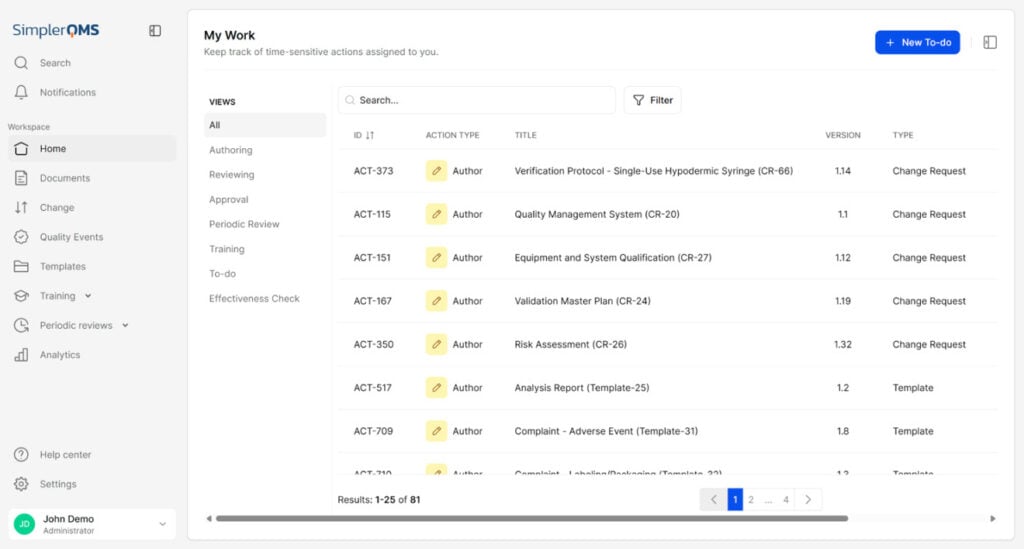
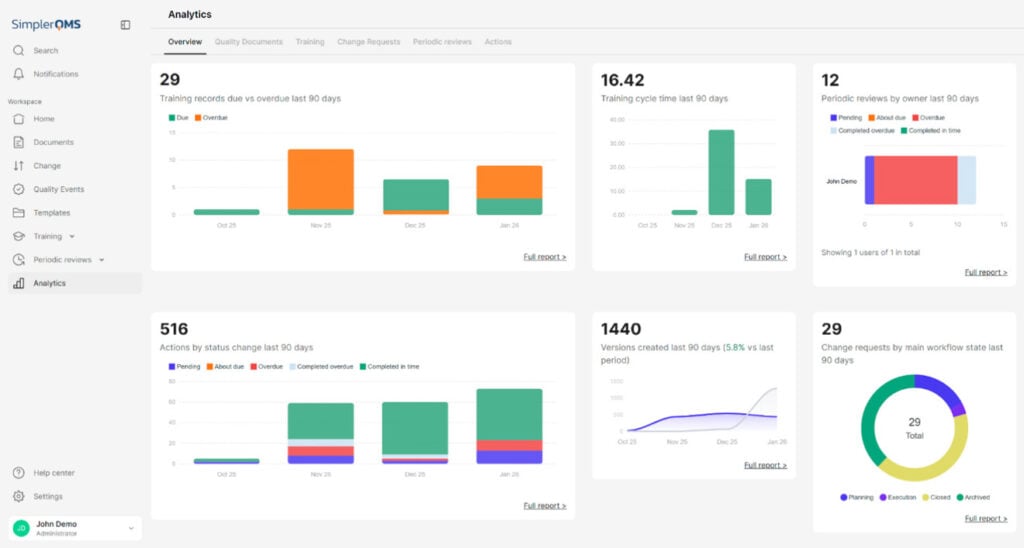
SimplerQMS serves medical devices, pharmaceuticals, biotechnology, laboratories, Contract Manufacturing Organizations (CMOs), Contract Development and Manufacturing Organizations (CDMOs), and Contract Research Organizations (CROs) that operate under strict regulatory requirements in global markets. SimplerQMS is designed for small to mid-sized companies with 11 to 500 employees and supports larger enterprises when needed.
SimplerQMS provides a unique value proposition, as it is delivered fully validated at no additional cost. SimplerQMS best fits companies that want a ready-to-use, life-science-specific platform with predefined workflows aligned to FDA, EU, and ISO requirements, reducing configuration time and compliance risks.
SimplerQMS includes integrated modules for document control, change management, training management, non-conformance and CAPA management, audit management, supplier management, equipment management, complaint management, risk management, design control, and product management. All modules work as a unified system that can connect quality processes for full traceability, ensuring that related records, such as a deviation leading to a CAPA, are directly linked.
SimplerQMS supports compliance with major life science requirements, including FDA 21 CFR Part 820, 210–211, EU MDR, IVDR, EU GMP, ISO 13485:2016, ISO 9001:2015, and ICH Q10. SimplerQMS is fully validated according to the GAMP 5 industry guide and is compliant with both Part 11 and Annex 11.
SimplerQMS offers integration with Microsoft Office 365, enabling users to create, review, and approve documents in Word and Excel format. SimplerQMS can be integrated with other systems like Enterprise Resource Planning (ERP), Customer Relationship Management (CRM), Product Lifecycle Management (PLM), and Warehouse Management System (WMS). Mobile access to SimplerQMS supports distributed teams, and customization is kept minimal to preserve validation compliance.
SimplerQMS implementation follows a structured six-to-eight-week onboarding program that includes analysis, configuration, data migration, and user training at no extra charge. A dedicated project manager guides the rollout and ensures alignment with regulatory expectations.
SimplerQMS uses a subscription-based pricing model that includes the selected QMS modules, validation, implementation and onboarding, cloud hosting, unlimited training, and ongoing support. Prospective customers can request a live demo, and pricing remains transparent to support planning and financial predictability.
SimplerQMS offers scalability that supports small teams and growing organizations, ensuring that increased documentation volumes, new facilities, or added regulatory requirements do not require system replacement. The platform maintains performance and compliance as companies expand processes or add new product lines.
Customers describe SimplerQMS as compliant with life science requirements, highlighting its seamless Office 365 integration across G2, Capterra, GetApp, and Software Advice. Users often emphasize rapid implementation, knowledgeable support, and responsiveness.
2. Qualio
Qualio is a cloud-based eQMS designed for life sciences. Qualio is deployed as a SaaS solution, enabling teams to access the platform from anywhere without managing local infrastructure.
An example of the Qualio user interface is shown below.
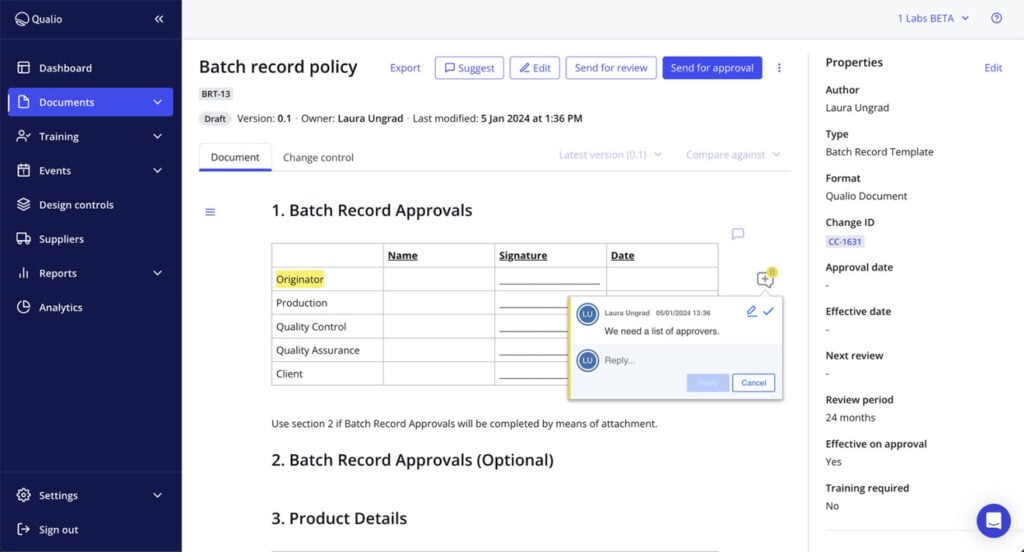
Qualio is used by pharmaceuticals, medical devices, biotechnology, contract research, and contract manufacturing companies. Qualio targets small to mid-sized companies, with a focus on growing organizations and start-ups.
Qualio’s key differentiator is its focus on ease of use, offering a more lightweight experience than complex enterprise systems, such as TrackWise and Veeva. Companies best suited for Qualio are early-stage to mid-growth life science firms preparing for audits, building their initial QMS, or replacing paper-based processes.
Qualio provides core QMS capabilities that include document control, training management, design control, supplier management, change control, CAPA, and non-conformance management. The system uses a unified workspace to link documents and quality activities, giving teams basic visibility into connected records, such as procedures, with change controls and training assignments.
Qualio is not delivered as a fully validated system, and customers must perform testing for the system configurations they build into Qualio. Customers can use Qualio’s provided validation templates, which reduces some validation effort. The platform supports compliance with FDA 21 CFR Part 11, ISO 13485, and EU MDR/IVDR requirements, and Qualio’s validation follows FDA guidance on Computer Software Assurance.
Qualio integrates with common business systems such as Jira and OneDrive, product development systems, like Asana and Azure DevOps, and customer support systems, including Salesforce and Zendesk. Access to each system integration group is tied to the subscription tier, with all Qualio customers having access to the core system integrations group.
Qualio provides a clean interface that focuses on simplicity and rapid adoption, reducing training time for new users. Teams can access the platform on desktop or mobile devices, and customization options remain limited to maintain ease of use and avoid validation burden.
Qualio onboarding includes guided implementation, QMS templates, and support from Qualio’s customer success team, typically spanning between 30 and 60 days, depending on company readiness. Document migration is handled by the customer, with a guide provided by Qualio.
Qualio uses a subscription-based licensing model with tiers, with differences in the number of users and AI assistance. Customers can request a demo to evaluate the system. Pricing is transparent, though system customization or data migration may introduce additional costs.
Qualio scales with small and mid-sized organizations as their QMS matures, supporting more users, documents, and quality workflows over time. Flexibility is sufficient for early-stage and growth-stage companies.
Customers describe Qualio as easy to use, intuitive, and well-suited for small life science organizations on platforms such as G2, Capterra, GetApp, and Software Advice. Reviews frequently highlight responsive support and fast onboarding, while some customers note limitations in document editing and template customization.
3. MasterControl
MasterControl is an enterprise-level electronic quality management system used by regulated companies with complex regulatory requirements and extensive integration needs. MasterControl is deployed as a cloud-based SaaS platform.
An example of the MasterControl user interface is shown below.
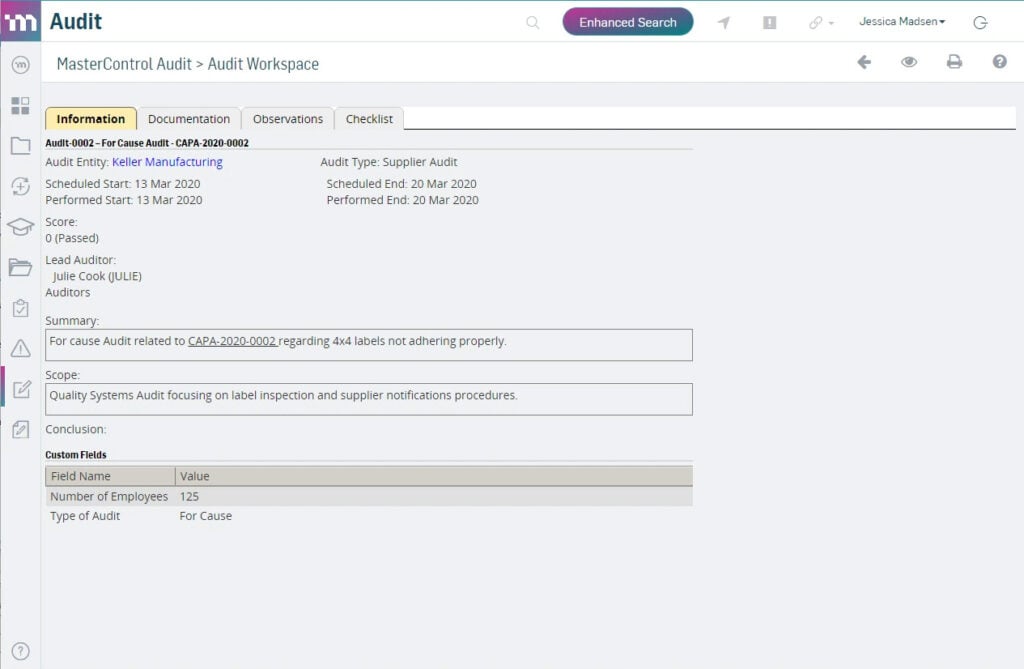
MasterControl serves pharmaceutical, biotechnology, medical device, diagnostics, and other regulated industries, such as food and beverage and dietary supplements. MasterControl is ideal for mid-sized to large enterprises that require extensive configurability and integration depth. The software can support preconfigured solutions for smaller companies.
MasterControl’s key differentiator is its enterprise-grade architecture that supports large-scale implementations. Companies best suited for MasterControl include organizations with established quality departments, large user bases, and multi-system integration requirements.
MasterControl provides a wide range of QMS modules, including document management, training management, quality event management, change control, risk and audit management, supplier management, and analytics and business intelligence.
MasterControl is not delivered as a fully validated system, and customers must conduct part of the computer system validation in accordance with regulatory expectations. MasterControl provides validation toolkits, including the Validation Excellence Tool (VxT) and Validation on Demand (VoD), which are available for Manufacturing Excellence (Mx) and Advanced Data and Process Technology (ADAPT) platform products. Validation costs vary depending on the level of support needed, while VxT and VoD are included in the price.
MasterControl QMS meets FDA and ISO 9001 requirements. MasterControl’s validation tools support users in generating and collecting the documentation they need for regulatory, certification, and customer audits.
MasterControl integrates with Enterprise Resource Planning (ERP), Manufacturing Execution System (MES), Customer Relationship Management (CRM), Product Lifecycle Management (PLM), Laboratory Information Management System (LIMS), and various enterprise systems using MasterControl’s API Toolkit. MasterControl’s API Toolkit is purchased at an additional cost, and it is updated for every major version of MasterControl. Companies can outsource technical scripting or programming activities to specialists from the MasterControl integration services team.
MasterControl offers a robust interface built for enterprise environments, balancing advanced capabilities with a structured user experience. The platform includes mobile access and extensive configuration options.
MasterControl implementation has six steps, including planning, discovery, configuration, validation, deployment, and onboarding. The average implementation time based on user reviews is around 7 months. Migration services are available at an additional cost.
MasterControl pricing follows a named-user license model, with different rights and access levels available based on user needs. For Quality Excellence, there are three different plans, including basic, standard, and complete. The system does not offer a free trial, and additional costs may arise from integration, validation, and training support, or advanced configurations. Enterprise pricing reflects the platform’s scale and is typically higher than small and medium-sized-focused QMS solutions.
MasterControl supports significant scalability for multi-site, global companies needing robust infrastructure to manage many users, high document volume, and extensive compliance obligations. Flexibility is strong at enterprise scale, allowing teams to expand with new modules and integrations as operations grow.
Customers on G2, Capterra, GetApp, and Software Advice describe MasterControl as comprehensive and suited for teams that require enterprise-level control. Users highlight the breadth of features and strong compliance capabilities, while some note difficulties in training and the higher cost associated with configuration, validation, and ongoing system management.
4. TrackWise
TrackWise is an enterprise-quality management system used by large, highly regulated organizations. TrackWise is deployed as a cloud-based SaaS solution (TrackWise Digital) or as an on-premise system (TrackWise QMS).
An example of the TrackWise Digital user interface is shown below.
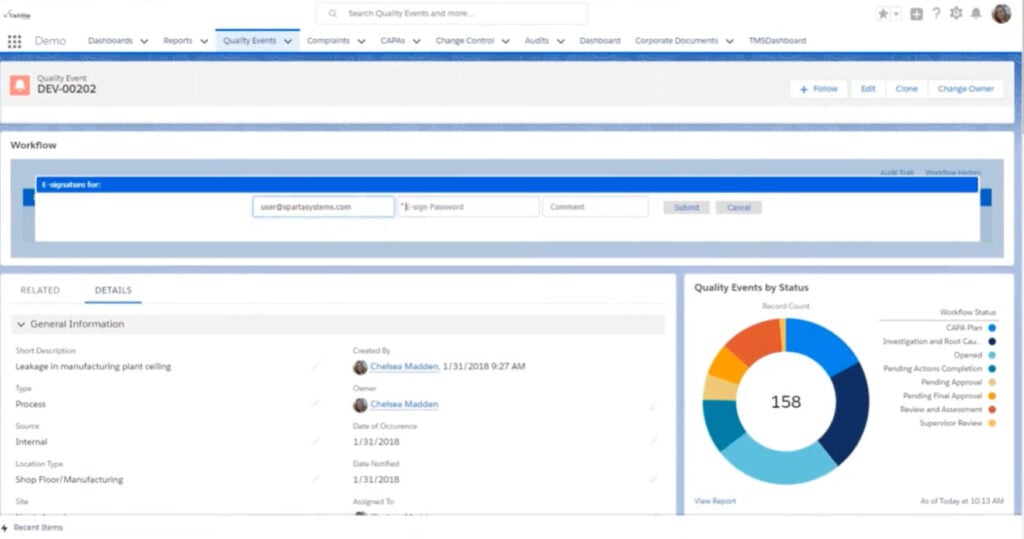
TrackWise serves multiple life science industries, such as pharmaceuticals, biotechnology, medical devices, and diagnostics. TrackWise is ideal for medium-sized to large enterprises that manage multi-site operations, complex regulatory requirements, and high document and user volumes.
TrackWise’s key differentiator is its enterprise configurability and ability to support highly customized, interconnected quality processes across global environments. Companies best suited for TrackWise include established manufacturers with mature quality systems.
TrackWise provides broad QMS capabilities, including document management, CAPA, change management, deviations and quality events, non-conformances, Out-Of-Specification (OOS), complaint management, audit management, supplier quality management, quality risk management, and training management.
TrackWise Digital delivers pre-validated quality processes, the Quality Process Accelerators (QPAs), enabling quick implementation and minimizing the validation burden. Sparta System Inc. is ISO 9001:2015 certified. TrackWise supports customers to comply with 21 CFR Part 11 and EU Annex 11.
TrackWise QMS integrates with major enterprise systems such as ERP, MES, PLM, LIMS, and CRM platforms. TrackWise Digital is built on the Salesforce platform. Salesforce’s extensive API library makes it easy to integrate TrackWise Digital with ERP, manufacturing, and other systems.
TrackWise provides an interface designed for structured quality workflows. TrackWise Digital offers mobile accessibility. TrackWise supports customization options and provides training programs.
TrackWise implementation timeframe depends on configuration, validation, and multi-site coordination. Implementation and onboarding support is provided by Subject Matter Experts (SMEs), providing a detailed assessment of current QMS processes compared to TrackWise or TrackWise Digital capabilities, to expedite quality management systems and validation.
TrackWise pricing follows a subscription-based or perpetual licensing model depending on deployment type, and organizations can request a demo to evaluate system capabilities. Costs increase with modules, users, and implementation requirements, and no free trial is typically offered, additional expenses often arise from integrations and validation.
TrackWise offers strong scalability for global enterprises needing to support many users, expansive document libraries, and complex quality processes across multiple facilities. Flexibility is extensive due to customization capabilities, though this can increase long-term maintenance complexity.
Customers on G2, Capterra, GetApp, and Software Advice describe TrackWise as configurable and suited for enterprise environments with advanced regulatory needs. Reviews note strong audit support and process control, while some users mention steep learning curves, complexity, and higher implementation and maintenance costs.
5. Veeva
Veeva QualityOne is a cloud-based QMS and document management platform built specifically for regulated industries. Veeva is deployed as a multi-tenant cloud SaaS platform built on the Veeva Vault architecture.
An example of the Veeva Vault QMS user interface is shown below.
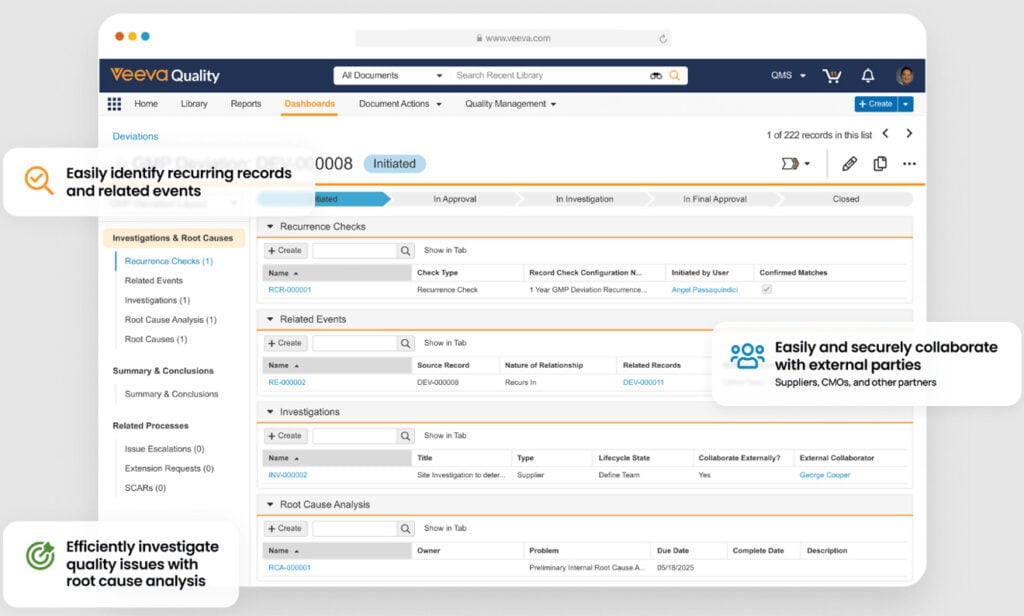
Veeva serves life sciences, medical technology, and industries like food and beverage, consumer-packaged goods, and specialty chemicals. Veeva is ideal for mid-sized to large global enterprises needing a unified platform that connects quality, regulatory, and product lifecycle processes.
Veeva’s key differentiator is its Vault-based ecosystem, which centralizes quality, clinical, regulatory, medical, and commercial data in a single cloud architecture. Companies best suited for Veeva include complex organizations with extensive documentation and multi-site operations.
Veeva QMS includes modules for non-conformances, internal and external audits, complaints, lab investigations, change control, quality risk management, supplier quality management, annual product quality review, and CAPAs. The document control module is included in Veeva QualityDocs, and the training management module is included in Veeva Training. Veeva QMS is unified with other quality cloud applications, like QualityDocs and Training, and offers end-to-end connectivity within regulatory, safety, and clinical applications.
Veeva is not delivered as a fully validated system. Veeva undertakes Installation Qualification (IQ) and Operational Qualification (OQ) to qualify the hosted environments and the functionality of core software. Customers undertake User Acceptance Testing (UAT) and PQ to validate the specific configurations and integrations implemented within their Veeva Vault environments. Veeva provides FDA Part 11 and EU Annex 11 compliance assessment in ComplianceDocs.
Veeva integrates with enterprise platforms, including ERP, MES, PLM, LIMS, and CRM systems, through the open, published Vault API.
Veeva provides a modern interface designed for enterprise use, with structured navigation and intuitive Vault-based components. Usability improves over time, though teams may require training during onboarding because of the system’s depth. Mobile accessibility is supported through the Vault mobile environment.
Veeva implementations vary in duration depending on system scope and applicability. Veeva provides a range of services to its customers, including professional services during system deployment, managed services during the operational phase, technical services for integration, migration, and custom applications, and educational services.
Veeva uses an enterprise subscription-based pricing model with annual licensing that scales by user count and additional Vault applications. Organizations can request a demo, but do not receive a free trial, and additional costs may arise from services and customers’ validation obligations.
Veeva supports scalability for global enterprises with large documentation volumes, distributed teams, and complex operations. Flexibility is strong across the Vault suite, enabling companies to expand into additional applications as their operations grow.
Customers on G2, Capterra, GetApp, and Software Advice describe Veeva as well-suited for large, complex organizations that require integrated quality, clinical, and regulatory operations. Reviews highlight strong compliance capabilities and reliable performance, while noting that the system’s cost, complexity, and implementation effort may be high for smaller teams.
6. Ideagen
Ideagen Quality Management is a modular quality management platform primarily delivered as a cloud-based SaaS solution. On-premise deployment options remain available for existing customers, but are being transitioned to the cloud.
An example of the Ideagen Quality Management user interface is shown below.
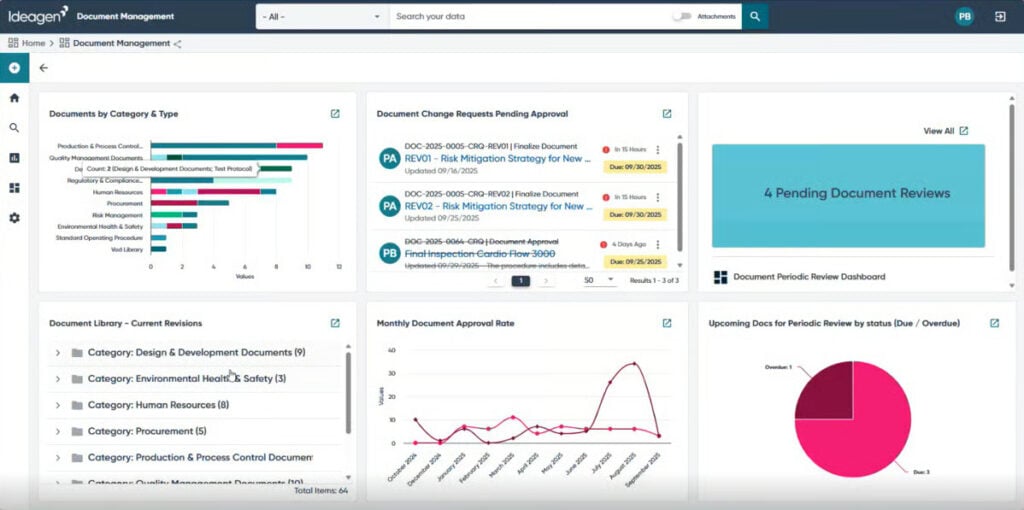
Ideagen serves life sciences, healthcare, manufacturing, laboratories, food and beverage, aviation, and public sector organizations. Ideagen customers span from midsize to large companies.
Ideagen’s key differentiator is its broad multi-industry compliance coverage. Companies best suited for Ideagen include organizations with complex operations and rigorous audit requirements.
Ideagen provides a wide set of QMS modules, including document control, supplier Management, training management, CAPA, change management, and audit management.
Ideagen is not delivered as a fully validated system, and customers must perform the PQ for their configured environment. Ideagen provides templates and documentation support for validation activities that may reduce some effort. If required, Ideagen can provide its customers with software validation services. The platform supports compliance with ISO 9001, ISO 13485, and ISO 15189 standards, among others.
Ideagen’s ease of use depends on configuration depth. Mobile access is available for the cloud-based edition through a mobile application.
Ideagen implementation timelines vary widely based on configuration complexity, with a typical implementation timeframe of 5 months. Onboarding is supported through professional services teams that help with training and configuration.
Ideagen primarily uses subscription-based pricing for cloud deployments, while on-premise licensing depends on the specific product and agreement. Organizations can request a demo, and additional costs may arise from configuration, validation, integration, and implementation services.
Ideagen supports scalability, allowing expansion into additional modules and users as operations grow. The Ideagen Hub unifies EHS, quality, risk, and compliance management in one central digital platform. Flexibility is strong across configuration and modular add-ons, though deeper customization may add long-term maintenance effort.
Customers on G2, Capterra, GetApp, and Software Advice describe Ideagen as reliable, structured, and well-suited for companies with formal governance and auditable operations. Reviews highlight strong audit and document control features, while noting that usability, interface complexity, and configuration effort may require training and ongoing administrative oversight.
7. Greenlight Guru
Greenlight Guru is a cloud-based QMS designed exclusively for medical device companies. Greenlight Guru is deployed as a SaaS cloud solution accessible from any location without internal hosting requirements. Greenlight Guru’s software is hosted on Amazon Web Services.
An example of the Greenlight Guru user interface is shown below.
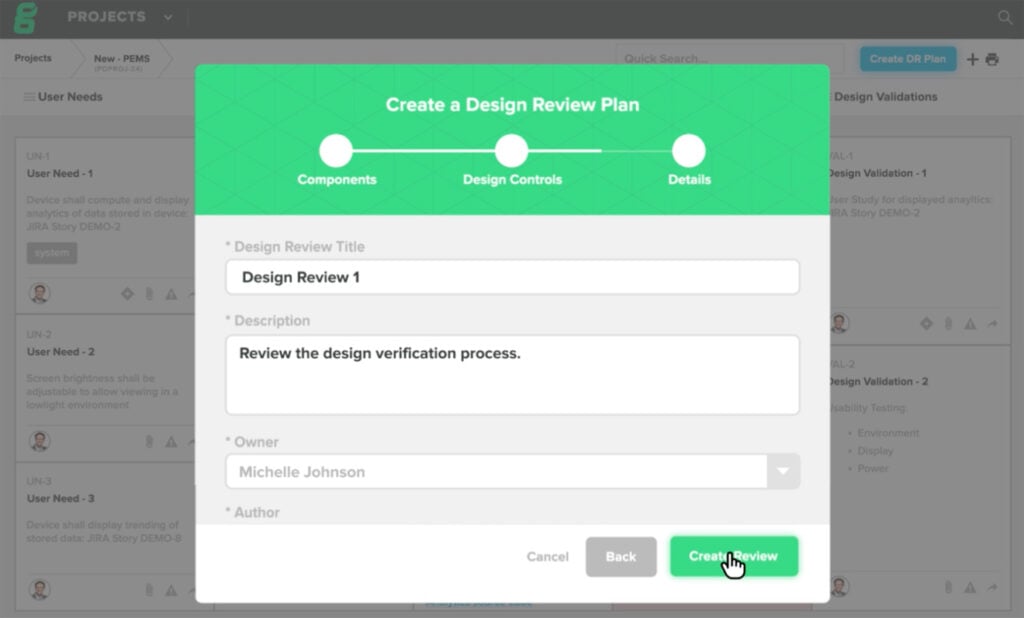
Greenlight Guru serves medical device, diagnostics, and MedTech companies. Greenlight Guru is ideal for small to mid-sized medical device companies that want an intuitive QMS aligned with FDA and EU medical device regulations and ISO requirements.
Greenlight Guru’s key differentiator is its exclusive focus on medical devices, offering built-in controls and functionalities that mirror medical device lifecycle requirements.
Greenlight Guru provides modules for document control, design control, and Design History File (DHF), risk management, change management, CAPA and nonconformance management, training management, audit management, supplier management, quality events, and parts and inventory/BOM.
Greenlight Guru’s validation approach follows the FDA Computer Software Assurance guidance. Greenlight Guru provides automated testing as part of QMS software development, a complete validation package with automated test results, summaries, memos, and templates, and continuous support with each update.
The platform includes Part 11-compliant review and approval workflows, fully integrated ISO 14971 risk management standards, and supports compliance with both 21 CFR Part 820 and ISO 13485:2016.
Greenlight Guru integrates with tools like Jira, and API access enables additional integration options.
Greenlight Guru provides a medical device-focused interface that emphasizes usability for quality teams. Customization is limited to preserve compliance and avoid revalidation burdens.
Greenlight Guru’s implementation process typically ranges from 2 to 8 weeks. Onboarding includes guided setup and training sessions. Migration services can be provided by Greenlight Guru, and the core subscription includes the migration of 300 documents.
Greenlight Guru uses a subscription-based pricing model with tiers aligned to the number of users and modules selected. A demo is available for prospective customers, although a free trial is not typically offered.
Greenlight Guru supports scalability for small and mid-sized device companies expanding their product lines, development teams, and post-market operations. Flexibility is strong within the medical device industry, though companies with multi-industry operations may outgrow the platform.
Customers on G2, Capterra, GetApp, and Software Advice describe Greenlight Guru as intuitive, supportive, and well-suited for regulated activities in the medical device industry. Reviews praise its design control and risk modules, while noting limited customization for companies needing broader or non-device-specific workflows.
8. Dot Compliance
Dot Compliance is a cloud-based QMS, offering an out-of-the-box, pre-configured eQMS for life science organizations. Dot Compliance is deployed entirely as a SaaS solution on the Salesforce cloud infrastructure.
An example of the Dot Compliance user interface is shown below.
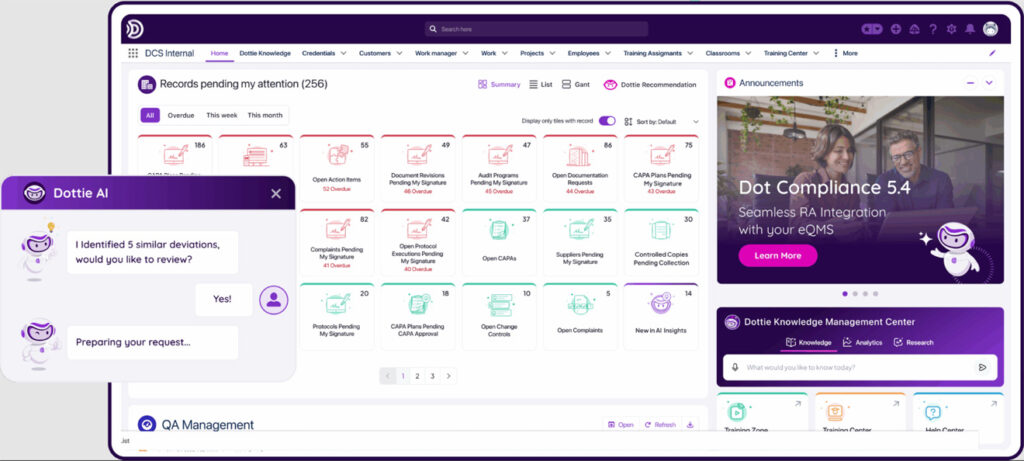
Dot Compliance serves the pharmaceutical, biotechnology, medical device, and cosmetic industries. Dot Compliance is ideal for small to mid-sized companies looking for an eQMS built on a widely trusted enterprise platform.
Dot Compliance’s key differentiator is that it provides a pre-configured eQMS, allowing rapid deployment and reducing validation effort. Companies best suited for Dot Compliance include organizations that want a validated, scalable quality solution without building customized workflows.
Dot Compliance provides core QMS modules, including document management, training management, quality event management, change management, audit management, complaint management, CAPA management, risk management, supplier quality management, and equipment management.
Dot Compliance is delivered with full validation packages and meets 21 CFR Part 11 and EU Annex 11 requirements. The platform supports compliance with FDA 21 CFR Part 820, ISO 13485, ISO 9001, and GxP requirements.
Dot Compliance integrates seamlessly with Salesforce applications and can connect to ERP, CRM, and other enterprise systems through Salesforce APIs.
Dot Compliance offers a familiar Salesforce interface that supports quick adoption for users already accustomed to the platform. Usability is enhanced by guided workflows and dashboards, while mobile access is supported through Salesforce mobile applications. Customization is available within Salesforce configuration rules, but is limited to avoid additional validation activities.
Dot Compliance implementation is typically faster than many enterprise QMS platforms, often completing in weeks to a few months. Onboarding includes structured deployment and training. Dot Compliance can provide migration services.
Dot Compliance uses a subscription-based licensing model with pricing dependent on modules and users. Organizations can request a demo, though a free trial is uncommon, and additional costs may arise from integrations or customer-led validation efforts.
Dot Compliance supports scalability for small to mid-sized life science companies that need to add users or adopt new eQMS modules. Flexibility is strong within the Salesforce configuration environment, but it may be constrained for companies that require extensive custom workflows.
Customers on G2, Capterra, GetApp, and Software Advice describe Dot Compliance as user-friendly, fast to implement, and well-suited for organizations seeking pre-configured quality workflows. Reviews highlight strong Salesforce integration and ease of adoption, while noting that customization limitations and dependency on the Salesforce platform may be challenging for highly complex environments.
9. QT9
QT9 QMS is a cloud-based and on-premise quality management platform designed for quality-focused organizations. QT9 serves a wide range of industries, from FDA-regulated life sciences to ISO-certified manufacturers.
An example of the QT9 QMS user interface is shown below.
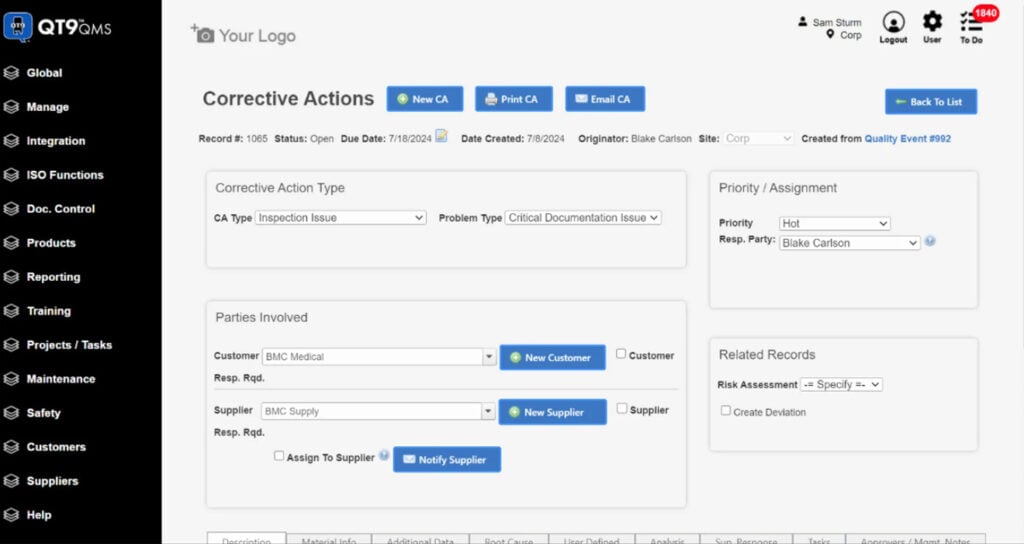
QT9 is ideal for small to mid-sized companies. QT9’s key differentiator is its simplicity and cost-effectiveness. Companies best suited for QT9 include those seeking fast implementation and minimal system administration.
QT9 QMS for medical devices and pharmaceuticals includes core modules for document control, employee training, nonconformance reporting, CAPA management, change management, audit management, risk management, complaint handling, and supplier quality.
QT9 is pre-validated and provides customers with IQ, OQ, and PQ executed protocols. The platform supports compliance with FDA 21 CFR Part 210/ 211, 820, and Part 11, EU MDR, ISO 9001, ISO 13485, and ISO 17025.
QT9 integrates with existing customer systems using APIs. QT9 provides ERP and MRP software solutions, along with the QMS software, in one integrated platform.
QT9 offers a clean, simple interface designed for ease of use with minimal training. The system provides training materials and onboarding guides to help teams adopt the system quickly.
QT9 implementations are typically shorter than enterprise QMSs, often taking a few weeks to a few months, depending on migration volume and customer needs. Users report that the software implementation time is around 3 months. Onboarding includes training sessions, implementation services, and data migration support.
QT9 follows a subscription-based licensing model, and organizations can request a demo or a free trial to evaluate the system.
QT9 supports scalability for small and mid-sized organizations expanding their quality processes or users. Flexibility is strong within the system’s simple configuration model, though companies needing deep customization may outgrow it.
Customers on G2, Capterra, GetApp, and Software Advice describe QT9 as easy to use, affordable, and efficient for small and mid-sized operations. Reviews highlight quick implementation and strong customer support, while noting limited customization and basic workflow capabilities compared to larger enterprise QMS platforms.
10. Scilife
Scilife is a cloud-based QMS platform built for life science companies. Scilife is deployed as a SaaS solution hosted on Amazon AWS.
An example of the Scilife user interface is shown below.
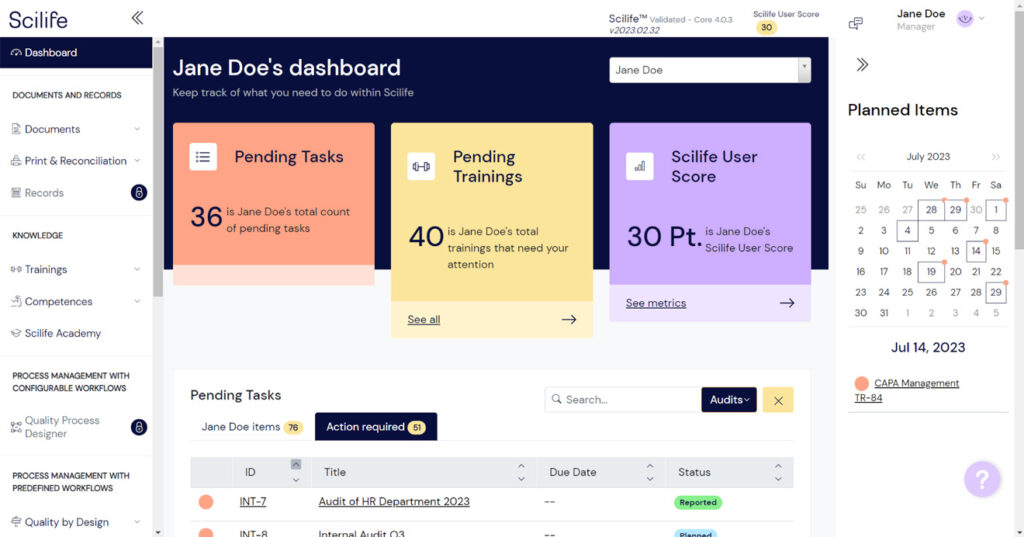
Scilife serves biotechnology, pharmaceutical, advanced therapy medicinal product, medical device, medicinal cannabis, CRO, and CMO organizations. Scilife fits life science companies of any size, with a focus on small and medium-sized companies.
Scilife’s key differentiator is that it comes with out-of-the-box functionalities that serve the majority of the life science industry’s requirements. Companies best suited for Scilife include growing life science teams aiming to digitize their quality processes.
Scilife provides modules for document control and training management in the essential plan. Beyond the essential plan modules, the platform includes CAPA, change control, and quality event modules in the core plan. Scilife provides the core plan modules along with audit management, supplier management, risk management, and equipment management in the core+ plan.
Although Scilife is validated according to GAMP5 and 21 CFR Part 11, customers must conduct validation activities to support their own specific processes and configurations. Scilife provides a validation package that includes drafted, executed, and signed-off validation documentation that customers can use as the basis for the validation of Scilife on their end.
The platform supports compliance with life science requirements, including FDA 21 CFR Part 11, EU Annex 11, GxP, ISO 13485, ISO 14971, ISO 15189, and ISO 17025.
Scilife integrates with Microsoft Office, Active Directory, and Azure AD, with further integration possible using APIs.
Scilife offers a modern, user-friendly interface, supporting fast adoption across quality and operational teams. The Scilife implementation timeline is typically 4 months, according to users’ reviews. During onboarding, weekly meetings are held between Scilife and the customer on the progress of the project from start to completion. Onboarding includes optimization support, training sessions, document migration assistance, and integration setup, while customers contribute internal resources to complete validation. The platform offers additional training programs on demand.
Scilife follows a subscription-based tiered pricing model, and organizations can request a demo or a free trial. Scilife supports scalability for small and mid-sized life science companies, expanding documentation volume or the number of modules used.
Customers on G2, Capterra, GetApp, and Software Advice describe Scilife as easy to use, visually intuitive, and well-suited for growing life science teams. Reviews highlight helpful support and a clear user interface, while reporting some minor bugs and module-specific gaps.
11. ZenQMS
ZenQMS is a cloud-based quality management platform built for life science companies. ZenQMS is deployed as a SaaS cloud platform hosted by Amazon Web Services.
An example of the ZenQMS user interface is shown below.
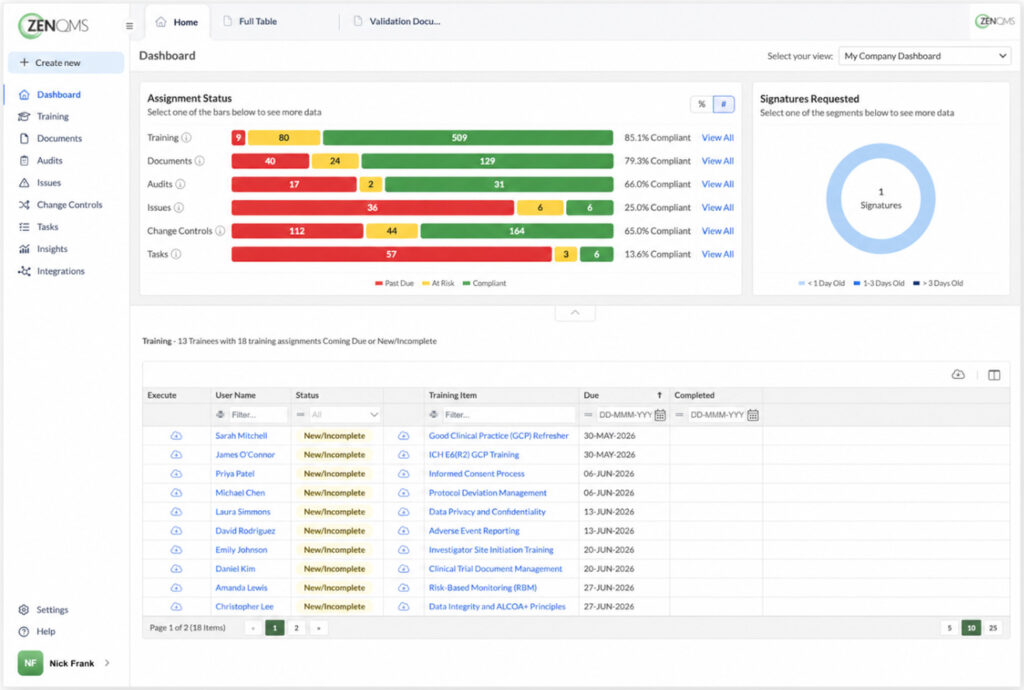
ZenQMS serves biopharmaceuticals, CDMOs, CROs, and laboratories. ZenQMS is ideal for small to mid-sized companies that want predictable pricing and straightforward quality workflows.
ZenQMS’s key differentiator is its all-inclusive licensing model with unlimited users, making it cost-efficient as teams grow. Companies best suited for ZenQMS include scaling life science firms seeking simplicity with strong compliance capabilities.
ZenQMS provides modules for document control, training, audits, quality issues, change control, and insights.
ZenQMS is fully validated per GAMP 5 guidelines for a Category 4 system, and FDA General Principles of System Validation. Every new release is managed by ZenQMS following its change control process and includes a full complement of validation documentation.
Electronic signatures used in ZenQMS are compliant with Part 11 and Annex 11 requirements. ZenQMS is ISO 9001:2015 and ISO 27001:2022 certified.
ZenQMS offers a clean, minimal interface designed for rapid onboarding and day-to-day ease of use. Customization options are limited to preserve system simplicity and reduce revalidation needs.
ZenQMS implementation is typically short, ranging from a few weeks to a few months. Onboarding includes guided setup and user training. User training is provided for the length of the contractual engagement.
ZenQMS follows a subscription-based pricing model that includes unlimited users and access to all modules, offering strong budget predictability. A demo is available for prospective customers, and hidden costs are minimal.
ZenQMS supports scalability for small and mid-sized life science organizations expanding their teams, documentation volume, and process maturity. Flexibility remains within standardized workflows, but organizations needing highly customized processes may require a more configurable system.
Customers on G2, Capterra, GetApp, and Software Advice describe ZenQMS as simple, affordable, and effective for growing life science teams. Reviews highlight strong customer support, predictable pricing, and ease of deployment, while noting that limited customization may not suit larger enterprises or companies seeking advanced automation.
What Are the Best QMS Software for the Pharmaceutical Industry?
The best QMS software solutions for the pharmaceutical industry are listed below.
- SimplerQMS: SimplerQMS provides a fully validated eQMS tailored to life science industries, including pharmaceuticals. Pharmaceutical companies benefit from pre-configured workflows for processes like document control, change management, training management, deviation, CAPA management, and more. SimplerQMS complies with FDA Part 11 and EU Annex 11 requirements and supports pharmaceutical companies to comply with EU GMP, FDA 21 CFR Parts 210–211, and ICH Q10. The main characteristics of SimplerQMS that are useful to pharmaceutical companies include full computer system validation according to ISPE GAMP5, compliant electronic signatures, and life-science-specific workflows.
- TrackWise: TrackWise and TrackWise Digital provide enterprise pharmaceutical QMS software that centralizes quality processes such as quality events, CAPAs, OOS, change management, and PQR. Pharmaceutical companies select TrackWise to centralize core GMP processes and manage complex global quality workflows with strong configuration capabilities.
- Veeva Vault QMS: Veeva Vault QMS unifies pharmaceutical quality processes across CAPA, change control, deviations, complaints, and audits, among others. Pharmaceutical organizations use Veeva to connect quality with clinical, regulatory, and commercial data, which is valuable for complex supply chains.
- Dot Compliance: Dot Compliance is a pharmaceutical QMS software that offers pre-built, pre-validated eQMS solutions. Pharmaceutical companies choose Dot Compliance for ready-to-deploy workflows that cover document management, training, quality events, CAPA, change control, and more.
Pharmaceutical QMS software must support strict regulatory frameworks such as FDA 21 CFR Parts 210–211, EU GMP, and ICH Q10, and must comply with Part 11 and Annex 11 requirements. QMS software used by pharmaceutical companies must be validated and have strong data integrity controls. Pharmaceutical QMS software should provide integration capabilities with manufacturing, lab, and ERP systems.
What Are the Best QMS Software for the Medical Device Industry?
The best QMS software solutions for the medical device industry are given below.
- SimplerQMS: SimplerQMS is a fully validated cloud QMS designed for life science companies, including medical device manufacturers. SimplerQMS is well-suited for medical device firms because it supports FDA 21 CFR Part 820, ISO 13485, ISO 14971, EU MDR, EU IVDR, and is compliant with FDA Part 11. Key medical device features include design control, product and risk management modules, compliant electronic signatures, links across quality records, and more.
- Greenlight Guru: Greenlight Guru is a QMS platform focused exclusively on medical devices, including functionalities such as design controls, risk management, document control, and post-market surveillance. Greenlight Guru is best suited for medical device manufacturers who aim to support their compliance and operational needs.
- MasterControl: MasterControl offers an enterprise-level QMS capable of supporting large medical device companies with extensive global operations. MasterControl is well-suited for medical device companies that require configurable workflows, multi-site deployment, and integration with PLM, ERP, and MES systems.
- Scilife: Scilife is an eQMS with a focus on life science industries. Scilife is best for small and mid-sized medical device companies requiring modules for document control, training, quality events, and CAPA management, among others.
Medical device companies require QMS solutions that support mandatory design controls, risk management, and post-market surveillance. A QMS software for medical devices is necessary because it includes workflows, built-in controls, and electronic signatures aligned with FDA, EU MDR/IVDR, and ISO 13485 requirements.
What Are the Best QMS Software for the Biotech Industry?
The best QMS software solutions for the biotechnology industry are the following.
- SimplerQMS: SimplerQMS is designed specifically for life science organizations, making it highly suited for biotech companies that need standardized and compliant workflows. SimplerQMS includes modules for document control, change control, training, supplier management, audit management, and more. SimplerQMS is provided with full computer system validation according to GAMP5, integrated audit trails, and the capability to link quality processes for complete traceability across records.
- Veeva Vault QMS: Veeva Vault QMS is widely used in biotechnology due to its strong integration with regulatory, quality, and clinical software provided by Veeva. Veeva Vault QMS is suited for mid-sized and enterprise biotech organizations that need unified data across development, submissions, and manufacturing. Key features include document control, CAPA, change control, training, and seamless connectivity with Veeva Regulatory and Clinical applications.
- ZenQMS: ZenQMS provides a cloud QMS designed for GxP environments and used by biotech firms seeking predictable pricing and unlimited users. ZenQMS is suited for growing biotech companies digitizing SOPs, training, audits, and change controls.
- QT9 QMS: QT9 serves biotech organizations that need a simple, cost-effective QMS with rapid onboarding. QT9 is suited for small biotech companies standardizing core QMS processes. Key features include document control, training, change management, and electronic signatures aligned with Part 11.
Biotech companies require QMS systems that support rigorous documentation control, data integrity, and traceability across processes. QMS software specializing in biotech is necessary because these platforms have structured workflows in alignment with industry best practices, and compliant electronic signatures and audit trails.
What Are the Best Life Science eQMS Solutions Based on Company Size?
Life Science eQMS solutions differ in suitability depending on an organization’s size, workflow complexity, QMS maturity, and available resources. Company size strongly influences whether a pre-configured, validated eQMS or a highly configurable enterprise platform is the better fit.
The categorization based on companies’ sizes is as follows.
- Startups and Small-Sized Companies: Startups and small life science companies typically require a pre-configured, easy-to-use eQMS with minimal validation effort and fast deployment. Small organizations prefer software that provides a full validation package and pre-configured workflows, because quality teams are small and processes are still developing.
- Medium-Sized Companies: Medium-sized companies require a balance of configurability, scalability, and regulatory coverage as they expand product lines, enter new markets, and undergo more frequent audits. Medium-sized organizations require more advanced QMS capabilities, integration options, and more configurable workflows to support cross-functional teams and multi-site operations.
- Large Enterprises: Large life science enterprises require highly configurable QMS platforms capable of supporting global operations, multi-level approvals, and complex QMS workflows. Large companies prefer enterprise systems that offer extensive customization, advanced integration capabilities, and the ability to support intricate processes across functions, departments, and regions.
Company size directly influences which eQMS software is the best choice. Larger companies have more complex workflows and therefore require QMS solutions with advanced configuration capabilities, more integration options, and broader scalability. Smaller companies typically follow simpler workflows and do not require heavy configuration. Smaller companies also may not have the resources to manage the strict validation requirements associated with highly configurable enterprise systems. The higher software configurability increases risk and, therefore, demands stricter validation. Smaller companies benefit most from pre-configured, pre-validated eQMS platforms, while large enterprises gain more value from configurable systems that support their operational complexity and integration needs.
Best eQMS for Life Science Startups and Small-Sized Companies
Life science startups and small-sized companies prefer eQMS solutions that are pre-configured, pre-validated, quick to implement, and easy to maintain. Small-sized organizations typically operate with limited quality and IT resources, so they require systems that minimize validation workload, reduce administrative complexity, and provide ready-to-use workflows aligned with FDA, EU, and ISO requirements.
Some of the best eQMS solutions for life science startups and small-sized companies are listed below.
- SimplerQMS: SimplerQMS is a fully validated, pre-configured eQMS designed specifically for life sciences, making it ideal for small teams that need rapid deployment and minimal validation effort. SimplerQMS offers rapid implementation, transparent pricing, integrated modules, and QMS documentation templates, suited for early-stage and growing companies.
- Greenlight Guru: Greenlight Guru focuses on medical device companies that require design control and risk management tools aligned with FDA, EU MDR/IVDR, and ISO expectations. Greenlight Guru is suited for small medical device companies seeking an intuitive interface, quick setup, and workflows specifically built for the medical device industry.
- Dot Compliance: Dot Compliance provides an eQMS with pre-built workflows that reduce setup time and fit the configuration needs of small, regulated companies. Dot Compliance is suitable for early-stage pharmaceutical, biotech, and medical device organizations looking for a structured, scalable QMS.
- Qualio: Qualio offers a simple, lightweight eQMS designed for small life science teams. Qualio’s ease of use, straightforward document and training management, and quick onboarding make it accessible for organizations with minimal quality infrastructure.
Best eQMS for Medium-Sized Life Science Organizations
Medium-sized life science organizations search for an eQMS that balances scalability, compliance, and more configurable workflows while still minimizing validation and maintenance burden. Medium-sized companies need systems that support growing teams, expanding product pipelines, and increasingly complex audits, while offering stronger integration capabilities and supporting more advanced quality process control than small-company solutions.
The best eQMS solutions for medium-sized life science organizations include the following.
- SimplerQMS: SimplerQMS provides a fully validated, pre-configured eQMS ideal for medium-sized companies that need to scale quality processes without investing heavily in validation or IT resources. SimplerQMS provides interconnection capabilities between the core quality documents and processes, supporting more complex operations while reducing implementation time and enabling consistent, compliant workflows.
- Dot Compliance: Dot Compliance offers a Salesforce-native eQMS suitable for mid-sized organizations that need structured, pre-built workflows with the ability to extend capabilities through Salesforce integrations.
- Scilife: Scilife supports medium-sized biotech, pharma, and medical device companies with a flexible, cloud-based quality management platform. Scilife’s scalability makes it well-suited for teams expanding their eQMS processes.
- TrackWise: TrackWise is appropriate for medium-sized companies that are rapidly scaling or preparing for enterprise-level operations. TrackWise pre-configured Quality Process Accelerators (QPAs) allow organizations to adopt pre-validated, industry-aligned workflows while retaining the ability to expand into fully customized enterprise configurations as they grow.
Best eQMS for Life Science Enterprises
Life science enterprises require eQMS platforms with high configurability, extensive integration capabilities, and the ability to support global, multi-site operations under strict regulatory oversight. Large life science organizations manage high volumes of documents, complex workflows, and cross-functional processes, which demand an eQMS that can be configured and integrated with other systems.
The best eQMS solutions for life science enterprises are listed below.
- Veeva Vault QMS: Veeva provides a unified quality platform built for global pharmaceutical, biotech, and medical device enterprises that need deep integration across regulatory, clinical, quality, safety, medical, and commercial systems. Veeva’s highly scalable Vault architecture supports complex workflows, global collaboration, and enterprise-wide interconnections.
- MasterControl: MasterControl offers a robust, configurable enterprise QMS platform suitable for large organizations requiring advanced compliance management, integration with other systems, and support for extensive operations. MasterControl’s broad suite of modules and add-ons makes it ideal for high-volume, global environments.
- TrackWise: TrackWise is designed for enterprise-scale manufacturers with multi-site, multi-product operations and highly customized workflows. TrackWise configuration and integration capabilities make it suitable for companies needing to improve visibility and transparency across processes.
- SimplerQMS: SimplerQMS is suitable for organizations of all sizes, including large enterprises. SimplerQMS enables efficient multi-site management, with each site accessing location-specific documentation while adhering to standardized workflows across the entire organization.
How Is SimplerQMS Different Compared To Other Life Science QMS Software Solutions?
SimplerQMS differentiates itself through providing a full validation package, pre-configured compliant workflows, rapid implementation, and all-inclusive licensing that removes hidden costs. These strengths make SimplerQMS easier to adopt, easier to maintain, and more compliant for small and mid-sized Life Science companies compared to traditional, highly configurable enterprise QMS systems. SimplerQMS is built entirely on life science expertise, and this expertise continues throughout implementation, unlimited training, and ongoing support delivered by teams with real industry experience.
The main differentiators of SimplerQMS are presented in the table below.
| Criteria | SimplerQMS | Other Life Science QMS Vendors | Impact on Life Science Companies |
|---|---|---|---|
| Life Science Specialization | Built exclusively for Life Sciences with deep industry expertise across medical devices, pharma, and biotech. | Many serve multiple industries or require customization to fit Life Science processes. | Higher alignment with regulatory expectations and faster adoption due to industry-specific workflows. |
| Validation Approach | Fully validated according to ISPE GAMP5, with validation included and maintained continuously. | Validation is often partially provided or fully customer-driven, requiring significant internal effort. | Reduces validation workload, cost, and compliance risk, especially for teams with limited QA/IT resources. |
| Workflow Configuration | Pre-configured, compliant workflows ready to use from day one. | High configuration required before use, increasing complexity and validation scope. | Faster go-live, reduced project risk, and validation depth. |
| Implementation Speed | Typical implementation in 6–8 weeks with guided onboarding. | Implementations may take several months due to customization and system complexity. | Accelerates digital transformation and reduces operational disruption. |
| Training & Support | Unlimited training, onboarding, and ongoing support delivered by life science experts. | Training is often limited or add-on; support may not include deep life science expertise. | Ensures higher compliance, stronger user adoption, and long-term system success. |
| Cost Structure | All-inclusive subscription with validation, hosting, support, and upgrades included. | Add-on fees for validation, integrations, and support are common. | Predictable budgeting and significantly reduced total cost of ownership. |
| Ease of Use | Intuitive interface with Microsoft Office integration designed for life science teams. | Interfaces may be complex due to extensive configurability. | Faster user adoption and fewer training barriers. |
| Scalability for SMB Life Science Companies | Purpose-built to scale with small and mid-sized life science organizations. | SMBs often outgrow initially chosen systems. Enterprise systems are usually overly complex and pricey for SMB needs. | Companies grow without outgrowing the system, reducing future migration risk. |
| Audit Readiness | Embedded audit trails, compliant eSignatures, standardized workflows, and linked records ensure inspection readiness. | Audit readiness often depends on customer configuration and validation documentation. | Stronger compliance and reduced audit preparation time. |
| Interconnected QMS Modules | Fully integrated modules for document control, training, nonconformance, CAPA, change control, audits, supplier management, and more. | Modules may require additional configuration to achieve full integration. | Ensures seamless traceability and reduces compliance gaps. |
What Is Quality Management System (QMS) Software?
Quality Management System (QMS) software is a digital platform that centralizes and streamlines quality processes across an organization. QMS software solves problems related to manual documentation errors, inconsistent processes, poor visibility into quality data, slow approval cycles, and difficulty maintaining traceability of quality-related actions. eQMS replaces paper-based or disconnected systems with a unified, controlled environment.
Key components of QMS software typically include document control, training management, change control, CAPA, deviations/non-conformances, audit management, risk management, supplier management, and complaint handling. Many systems also include design controls, batch records, equipment management, and reporting dashboards, depending on industry needs.
Primary benefits of using quality management system software include improved compliance, reduced human error, faster and more efficient workflows, stronger audit readiness, and complete traceability across quality processes. An eQMS enables teams to work more collaboratively, maintain data integrity, and scale operations while ensuring regulatory compliance.
What Are the Common Features of Life Science eQMS Solutions?
The common features of life science eQMS solutions are given below.
- Compliant Electronic Records Management: An eQMS software provides centralized record storage, version control, and traceability for controlled documentation to meet FDA, EMA, and ISO requirements.
- Compliant Electronic Signatures: A QMS software supports compliant approvals aligned with FDA 21 CFR Part 11 and EU Annex 11, ensuring signatures are secure, traceable, and equivalent to handwritten signatures.
- Core Quality Process Management: An electronic QMS includes modules for core quality management processes like change control, CAPA, quality events, training, supplier management, and audit management to streamline quality workflows.
- Standardized Workflows: An eQMS ensures processes follow predefined, validated, compliant steps that reduce errors, enforce consistency, and support inspection readiness.
- Role-Based Access Controls: A QMS software restricts user permissions based on job responsibilities, ensuring only authorized individuals can view, edit, or approve specific records.
- Audit Trails: Within an eQMS, every system action, including creation, modification, deletion, rejection, or approval, is automatically recorded to maintain complete traceability and support compliance.
- Data Integrity Controls: QMS solutions have controls to prevent unauthorized alteration of records, maintain complete history tracking, and support data integrity throughout the retention period.
- System Security Controls: An eQMS must protect quality data through encryption and backup procedures, ensuring compliance with industry security requirements.
- Integration and Configuration Capabilities: A QMS software usually allows controlled interoperability with other systems like MES or ERP, and provides configuration capabilities to adapt processes to organizational needs while maintaining compliance.
How Much Does Life Science eQMS Software Cost?
Life science eQMS software costs vary widely depending on company size, process complexity, customization, and validation requirements. The cost of eQMS could be in a general range from $5,000 to $15,000 for a company with 5 to 10 employees. For larger organizations with 50 to 200 employees or more, costs can range between $25,000 and $100,000 or higher.
Life science eQMS vendors use the following pricing models.
- Tiered: Tier pricing follows a structured model where companies choose from predefined packages based on features and the number of users.
- Per-Module: In pricing per module, costs depend on the specific QMS modules selected, allowing companies to pay only for functionalities they need.
- Per User Licensing: Pricing per user licensing is based on the number of system users.
- Flat Rate: Flat rate is a single subscription fee covering all modules and users, typically favored by small companies that want predictable budgeting.
- Custom: Fully tailored pricing typically for enterprise deployments requiring advanced configuration, multi-site coordination, or integration with other platforms.
The main factors that affect the total cost of eQMS ownership are listed below.
- Number of Users: More users typically increase subscription or licensing fees, especially in per-user pricing models.
- Included QMS Modules: Adding CAPA management, change control, training management, or advanced modules such as design controls, batch records, or equipment management can raise costs.
- Implementation and Validation Services: Complex quality processes and extensive configuration will increase validation needs and can substantially increase costs.
- Training and Ongoing Support: Vendors vary in whether training is included, metered, or billed separately, influencing long-term operational costs.
- Scalability and Integration: Integrations with ERP, LIMS, MES, or PLM systems may require additional fees for APIs or validation.
- Level of Regulatory Support: Enhanced compliance features, validation documentation, or industry-specific templates can increase pricing depending on vendor offerings.
How Is QMS Software Implemented?
To implement QMS software in the life science industry, the following nine steps are required.
- Strategy and Planning: Life science organizations define project goals, timelines, budgets, and regulatory expectations to ensure the QMS software implementation aligns with business and compliance needs.
- Supplier Selection: Companies evaluate and select a QMS software vendor based on their qualifications, QMS features, validation support, industry expertise, and alignment with regulatory requirements.
- Gap Analysis and URS Definition: Life science teams assess current processes and eQMS functionalities and develop User Requirement Specifications (URS) that outline what the eQMS must achieve to fulfill operational and compliance needs.
- System Design or Configuration: The chosen eQMS is configured or designed to match the approved URS.
- System Testing and Validation: The eQMS undergoes IQ/OQ/PQ to ensure it functions as intended and meets regulatory, industry, and operational requirements before use.
- Personnel Training: Users receive structured training on system use and functionalities to ensure correct and consistent operational use.
- Data Migration: Existing documents, records, and quality data are migrated into the new QMS using controlled migration processes to maintain data integrity.
- System Deployment and Go-Live: The validated eQMS is released for operational use.
- System Maintenance and Periodic Review: The eQMS is periodically reviewed to confirm continued compliance and suitability for intended use.
What Is a Validated QMS Software?
A validated QMS software is a quality management system that has undergone documented, evidence-based testing to confirm it functions as intended and complies with regulatory, quality, and operational requirements. In life sciences, QMS software validation ensures the system is reliable, consistent, and capable of supporting quality operations without introducing compliance risks.
The different types of validated QMS software are the following.
- Validated by Vendor: The vendor performs QMS software validation and provides a complete validation package for customer use. The regulated company must still review, approve, and accept the vendor’s validation documentation, because final responsibility always remains with the user.
- Validated by User: The regulated organization performs the entire validation process internally. This approach is uncommon because vendors typically provide substantial documentation that users can rely upon once the vendor has been qualified.
- Shared Validation: The vendor performs IQ and OQ, while the regulated company completes PQ. Shared validation is common and ensures vendor accountability for core system functionality while the user confirms the suitability for operational use and fulfillment of compliance obligations.
The stages of QMS software validation are listed below.
- IQ (Installation Qualification): Confirms that the QMS software is installed correctly in the designated environment with all required components, versions, and configurations.
- OQ (Operational Qualification): Verifies that the system’s core functions operate as intended under expected conditions based on predefined test cases.
- PQ (Performance Qualification): Ensures the system performs reliably for actual business processes within the life science organization.
What Is the Difference Between Pre-Validated and Fully Validated QMS Software?
The difference between pre-validated QMS software and fully validated QMS software is the level of validation activities performed by the vendor versus the regulated user. Pre-validated QMS software is delivered with partial validation documents, such as IQ and OQ protocols and test evidence, while requiring the user to complete PQ validation tasks, including running tests and documenting results. Fully validated QMS software, on the other hand, is delivered with complete vendor-executed validation, meaning the user only needs to review and approve the validation package rather than perform system testing themselves.
The responsibility for validation always remains with the regulated user, even when using a fully validated eQMS, but the workload is significantly reduced. The more a system requires customization or configuration, the greater the validation effort for the user, since any changes, integrations, or additional workflows must be validated to maintain compliance.
How To Choose QMS Software For Life Science Companies?
To choose a QMS software for a life science company, the following steps should be taken.
- Assess Your Requirements: Organizations must evaluate their regulatory obligations and operational requirements. Clear requirements prevent overspending on overly complex systems or selecting inadequate solutions that cannot support compliance or operational needs.
- Research and Compare QMS Software Vendors: Researching and comparing vendors includes requesting key information, such as product features, pricing structure, implementation process, and support services. Deep research ensures companies focus on vendors aligned with their requirements.
- Select Relevant QMS Software Vendors: Narrow the list to vendors that match regulatory needs and company size. During the selection of relevant vendors, it is important to consider vendor reputation and customer feedback. This step ensures only compliant, industry-focused solutions remain under consideration.
- Get Demos and Have Meetings: Requesting system demonstrations allows teams to assess the user interface, the capabilities of the QMS software, and the suitability for the company’s needs. Demos reveal whether the system can realistically support day-to-day operations.
- Consider Getting a Trial: Trials enable users to test the system’s interface and ease of use with real scenarios. A trial helps identify potential adoption barriers early.
- Shortlist QMS Software Vendors: Shortlisting is influenced by the eQMS’s overall value to customer quality management processes. The companies can ask for references and case studies from similar companies operating in the same industry. Companies benefit from focusing on vendors that best align with their compliance and operational priorities.
- Get a Demonstration of Specific Use Cases: Use-case walkthroughs show how the core quality process workflows are handled within the eQMS, supporting a comprehensive overview of the system’s capabilities.
- Negotiate With Shortlisted QMS Providers: Negotiating terms with shortlisted vendors helps compare pricing, contract terms, implementation timelines, training and support services, customization needs, total cost of ownership, service level agreement, and compliance issues. Clear negotiation conclusions reduce long-term cost and compliance risk.
- Make Final Decision: The final decision is made after considering all gathered information, including demonstrations, trials, and negotiations, and upon achieving consensus among key stakeholders, reviewing the proposed implementation plan, and evaluating the scalability of the system and the flexibility of contract terms. Selecting the right solution supports continuous compliance, operational efficiency, and scalability as the organization grows.
