A medical device quality management system (QMS) software is a validated electronic system used to manage quality processes, records, and compliance activities across the medical device lifecycle. Medical device QMS software supports compliance with ISO 13485, EU MDR, FDA 21 CFR Part 820 and Part 11, and related medical device requirements by providing control over documentation, workflows, traceability, and audit-ready evidence within a centralized software system.
The primary purpose of medical device QMS software is to ensure regulatory compliance, maintain data integrity, and enable consistent execution of quality processes from design and development through post-market surveillance (PMS).
The 8 best QMS software solutions for the medical device industry in 2026 are listed below.
- SimplerQMS: SimplerQMS is a fully validated eQMS built specifically for life sciences, including medical device companies. SimplerQMS is best suited for startups and small to mid-sized medical device companies seeking rapid implementation, streamlined compliance, and strong audit readiness without the complexity and cost of enterprise-level systems.
- Greenlight Guru: Greenlight Guru is a medical-device-focused QMS with strong design control capabilities and an emphasis on product development traceability. Greenlight Guru is best suited for startups and growing medical device companies with a strong design and development focus and internal validation expertise to support system validation.
- MasterControl: MasterControl is an enterprise-grade QMS with integrated manufacturing quality management capabilities. MasterControl is best suited for large and enterprise-level medical device manufacturers with dedicated QA and IT resources.
- Scilife: Scilife is a cloud-based QMS platform for regulated life science companies. Scilife is best suited for startups and small to mid-sized medical device companies seeking out-of-the-box workflows and tiered modules.
- Qualio: Qualio is a user-friendly QMS designed for early-stage and growing life science companies. Qualio emphasizes simplicity and fast onboarding. Qualio is best suited for medical device startups and small manufacturers building their first formal QMS.
- QT9: QT9 is a multi-industry QMS designed for regulated manufacturing environments. QT9 is best suited for small to mid-sized medical device manufacturers with moderate regulatory complexity seeking competitive pricing.
- TrackWise Digital: TrackWise Digital is an enterprise QMS platform designed for highly regulated environments with strong capabilities in managing quality events. TrackWise is best suited for global medical device manufacturers with mature quality systems and complex governance needs.
- Dot Compliance: Dot Compliance is a Salesforce-native QMS platform that integrates quality processes with CRM and broader business processes. Dot Compliance is best suited for small to mid-sized companies already standardized on Salesforce.
Medical device companies should evaluate QMS software based on factors such as regulatory coverage, validation responsibility, scalability, usability, implementation effort, integration needs, audit readiness, total cost of ownership, and vendor expertise in medical devices.
SimplerQMS stands out by combining deep expertise in medical devices and life sciences with a fully validated, all-inclusive eQMS platform. SimplerQMS reduces validation burden for customers, includes all QMS modules by default, integrates with familiar Microsoft tools, and provides unlimited training and ongoing life-science-specific support. SimplerQMS enables medical device companies to achieve compliance faster, reduce regulatory risk, and sustain audit readiness as they grow.
1. SimplerQMS
SimplerQMS is a cloud-based, validated electronic Quality Management System built for regulated life science organizations such as pharmaceutical, medical devices, and biotechnology. SimplerQMS provides secure, remote access to quality management tools by deploying as a SaaS solution on Amazon Web Services, eliminating the need for on-premise infrastructure and reducing IT overhead.
Examples of the SimplerQMS user interface are shown below.
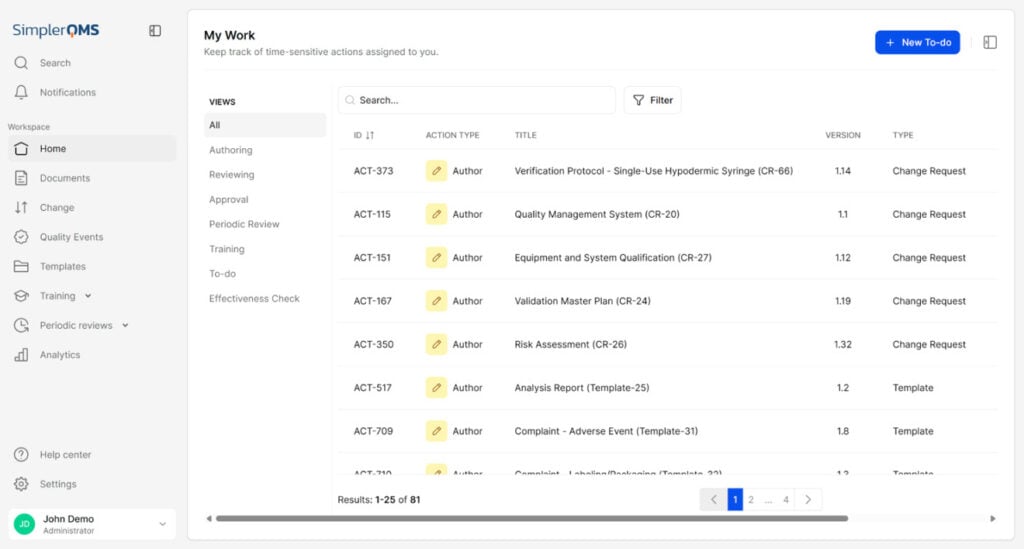
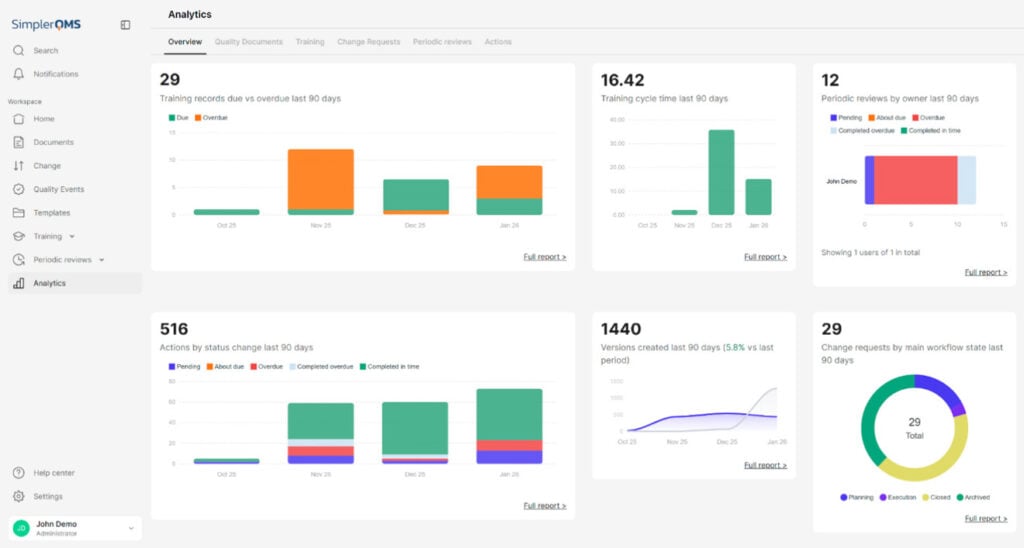
SimplerQMS is most suitable for medical devices, pharmaceuticals, biotechnology, laboratories, contract manufacturing organizations (CMOs), and contract research organizations (CROs) operating under strict global regulatory requirements. SimplerQMS targets small to mid-sized companies with 11 to 500 employees and scales to support larger enterprises when required.
SimplerQMS offers a unique value proposition as it is fully validated and aligned with ISPE GAMP 5. SimplerQMS maintains validation through controlled updates using shared IQ, OQ, and PQ evidence, with validation responsibility retained by SimplerQMS, eliminating customer-side computer system validation (CSV) effort. SimplerQMS has predefined workflows for quality management processes aligned with FDA, EU, and ISO requirements, reducing configuration time and compliance risk.
SimplerQMS operates on a single platform, with all quality management processes fully integrated. Native Microsoft 365 integration lets users create, review, and approve Word/Excel documents within a compliant environment. SimplerQMS also integrates with ERP, CRM, PLM, and WMS systems, provides mobile access for distributed teams, and limits customization to preserve the system’s validated state.
SimplerQMS includes integrated modules for document control, change control, training, CAPA, audits, suppliers, equipment, complaints, risk, nonconformance, design control, and product management.
SimplerQMS is ideal for companies seeking a fast go-live, minimal internal QA resources, and strong support under high regulatory pressure. SimplerQMS aligns well with startups, growing SMEs, and organizations preparing for FDA, notified body, or customer audits. Implementation follows a structured 6 to 8 week onboarding covering analysis, configuration, data migration, and user training at no additional charge, led by a dedicated project manager to align with regulatory expectations.
SimplerQMS reviews on G2, Capterra, GetApp, and Software Advice highlight rapid implementation, strong validation support, and confidence in audit readiness. Other reviews of SimplerQMS emphasize responsive support, predictable costs, and suitability for life science SMEs.
2. Greenlight Guru
Greenlight Guru is an eQMS designed for medical device quality management. Greenlight Guru provides a cloud-based SaaS platform delivered under a subscription model with browser-based access.
An example of the Greenlight Guru user interface is shown below.
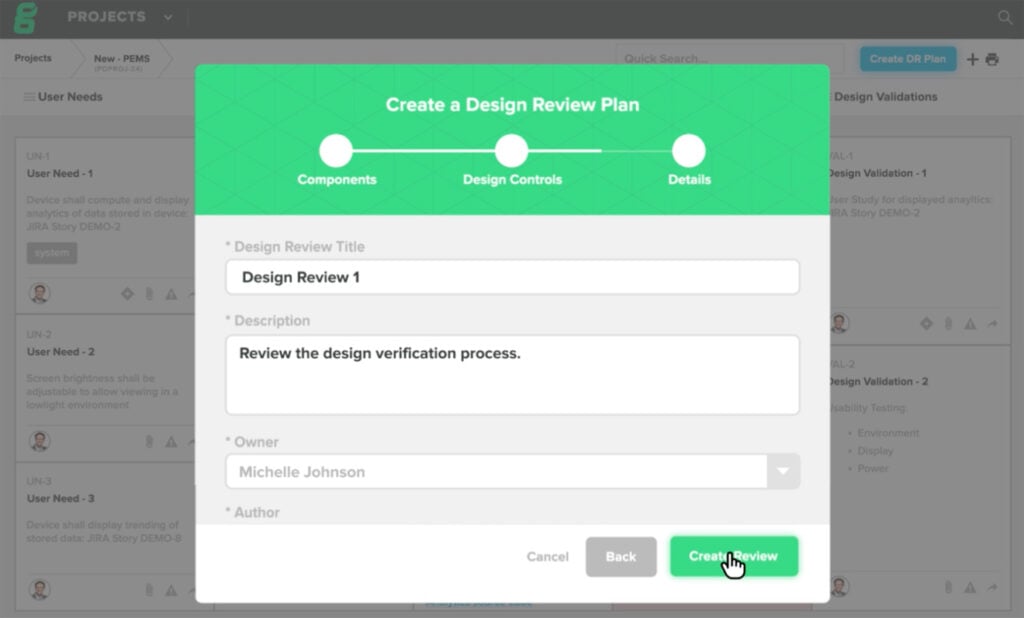
Greenlight Guru supports compliance with FDA and EU medical device regulations through its exclusive focus on medical devices. Greenlight Guru offers built-in controls and functionalities that mirror medical device lifecycle requirements. The platform positions its quality management around product development by integrating requirements, risk, and design workflows into a unified system tailored to medical device companies operating under global regulatory frameworks.
Greenlight Guru serves small to mid-sized, early-stage, and growth-phase medical device companies with strong design documentation and traceability needs. Core functionality includes design control, risk management, document control, change management, training, nonconformance and CAPA, audit management, and supplier management, with particular emphasis on traceability, design controls, and risk management.
Greenlight Guru supports FDA 21 CFR Part 820, ISO 13485:2016, 21 CFR Part 11, and ISO 14971 standards. Greenlight Guru provides a complete validation package for the software. The system integrates with tools like Jira and API. Native ERP and enterprise system integrations remain limited.
Greenlight Guru’s implementation process typically ranges from 2 to 8 weeks. Onboarding includes guided setup and training sessions. The pricing of Greenlight Guru is subscription-based by user or tier, with a demo provided. Greenlight Guru provides migration services, and the core subscription includes migrating 300 documents.
Greenlight Guru scales well within medical device development environments. Greenlight Guru shows limited flexibility for non-device or enterprise-wide QMS expansion. Greenlight Guru customization focuses on development and regulatory workflows rather than cross-functional quality operations.
Customer reviews highlight strong design control and traceability capabilities, effective FDA alignment, and particular value for startups and growing medical device firms, while noting limited customization for companies needing broader or non-device-specific workflows.
3. MasterControl
MasterControl is a cloud-based eQMS that supports quality and compliance processes across global regulated organizations. MasterControl enables centralized control of documents, quality events, manufacturing quality metrics, and regulatory adherence. MasterControl is deployed as a SaaS solution hosted in validated cloud infrastructure, providing global access with role-based permissions and enterprise-grade security controls.
An example of the MasterControl user interface is shown below.
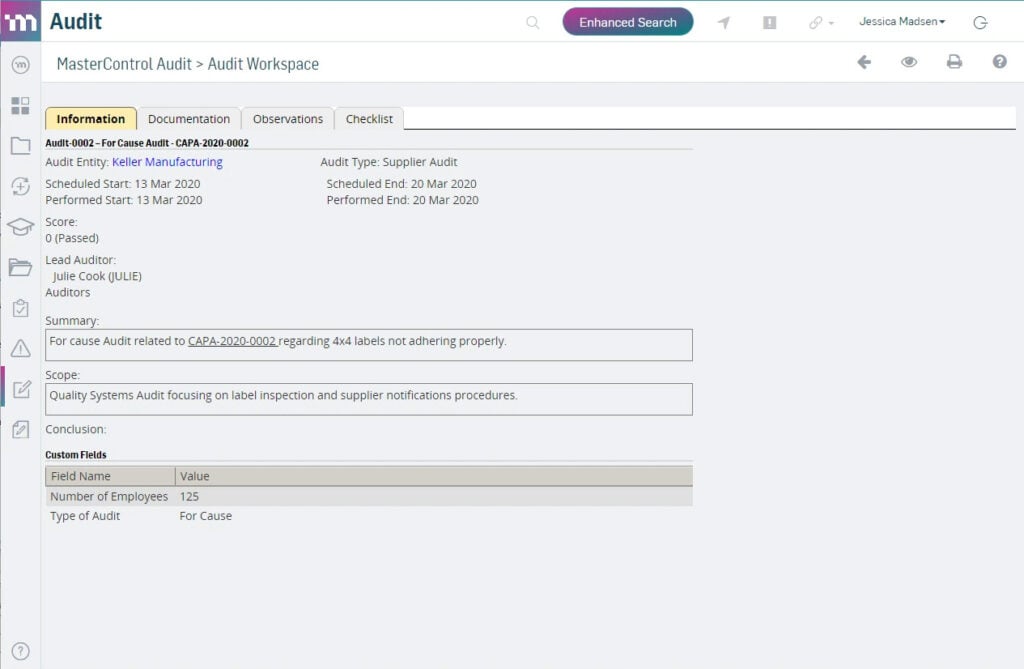
MasterControl serves highly regulated industries, including pharmaceuticals, medical devices, and biotechnology. MasterControl extends into related regulated sectors such as food and nutraceuticals. MasterControl is designed to support mid-sized to large enterprises, including large global manufacturers. The system supports mature quality systems and enables centralized control across multiple regions and sites.
MasterControl provides an integrated quality and compliance platform that combines core QMS functionality with manufacturing execution capabilities and analytics. MasterControl includes modules for document control, training management, change control, quality events, CAPA, audit management, supplier quality, and risk management. The system supports optional analytics and configurable quality workflows.
MasterControl supports FDA 21 CFR Parts 11, 820, and 210/211, ISO 13485:2016, ISO 9001:2015, EU GMP Annex 11, and ICH Q10. MasterControl is not delivered as a fully validated system, and customers must conduct part of the computer system validation in accordance with regulatory expectations. MasterControl provides validation toolkits, including the Validation Excellence Tool (VxT) and Validation on Demand (VoD), which are available for Manufacturing Excellence (Mx) and Advanced Data and Process Technology (ADAPT) platform products. Validation costs vary depending on the level of support needed, while VxT and VoD are included in the price.
MasterControl implementation has six steps, including planning, discovery, configuration, validation, deployment, and onboarding. The average implementation time, based on user reviews, is approximately 7 months. Migration services are available at an additional cost.
MasterControl pricing uses a named-user license model with tiered access levels – basic, standard, and complete – for Quality Excellence users. The system does not offer a free trial. Additional costs include integration, validation, training, and advanced configurations. Enterprise pricing is typically higher than QMS platforms aimed at small and medium-sized businesses.
Customer reviews on G2, Capterra, GetApp, and Software Advice highlight strong compliance features and enterprise control, while noting training difficulty and higher ongoing costs.
4. Scilife
Scilife is a cloud-based eQMS for life sciences. Scilife is delivered as a SaaS platform on Amazon AWS.
Scilife serves biotechnology, pharmaceutical, advanced therapy medicinal product (ATMP), medical device, medicinal cannabis, CRO, and CMO organizations, and is well-suited for small and mid-sized teams digitizing quality processes.
An example of the Scilife user interface is shown below.
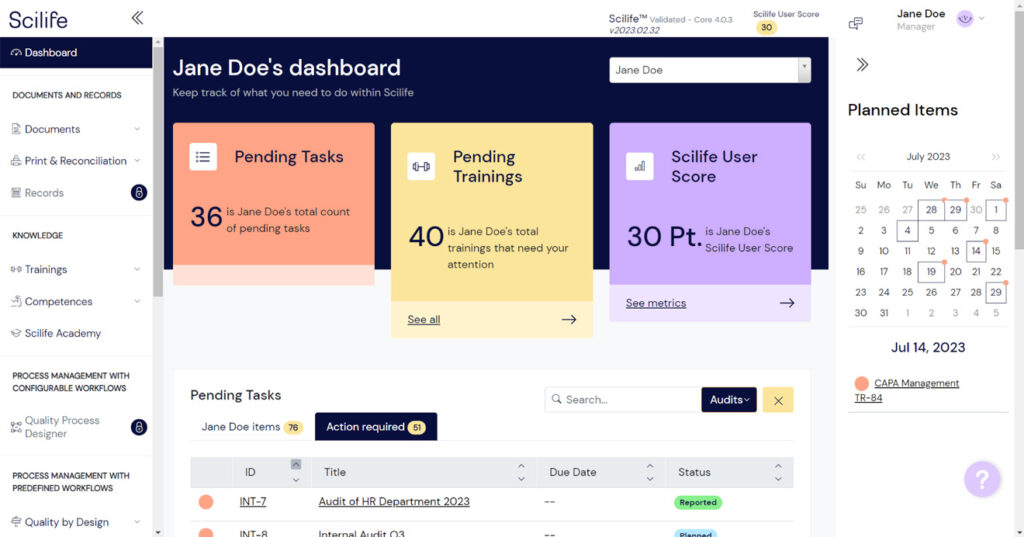
Scilife’s key differentiator is its out-of-the-box functionality that addresses the majority of the life sciences industry’s requirements. The system supports compliance with FDA 21 CFR Part 11, EU Annex 11, GxP, ISO 13485, ISO 14971, ISO 15189, and ISO 17025.
Although Scilife is validated according to GAMP5 and 21 CFR Part 11, customers must conduct validation activities to support their own specific processes and configurations. Scilife provides customers with a validation package they can use as the basis for their validation.
Scilife supports integration with Microsoft Entra ID, with additional API access. The platform allows import and export of Microsoft Office documents. Scilife implementation typically takes four months and includes onboarding meetings, training, document migration, and setup. Customers provide resources to complete their own validation activities, with optional additional training available.
Scilife pricing is tiered and subscription-based, and organizations can request a demo or a free trial. The Scilife platform can scale for small to mid-sized companies by increasing document volume and modules.
The essential plan for Scilife includes document control and training. The core plan adds CAPA, change control, and quality event modules. Core+ includes audit, supplier, risk, and equipment management.
Customer reviews on G2, Capterra, GetApp, and Software Advice highlight ease of use, support, and the interface, though some reviewers report minor bugs and module-specific gaps.
5. Qualio
Qualio is a cloud-based eQMS for life sciences. Qualio is deployed as a SaaS solution.
Qualio serves pharmaceutical, biotech, medical device, CRO, and CMO organizations. Qualio platform is best suited for startups and small to mid-sized teams building a QMS. Qualio includes document control, training, design control, supplier management, change control, CAPA, and nonconformance. The platform links documents and quality actions for traceability.
An example of the Qualio user interface is shown below.
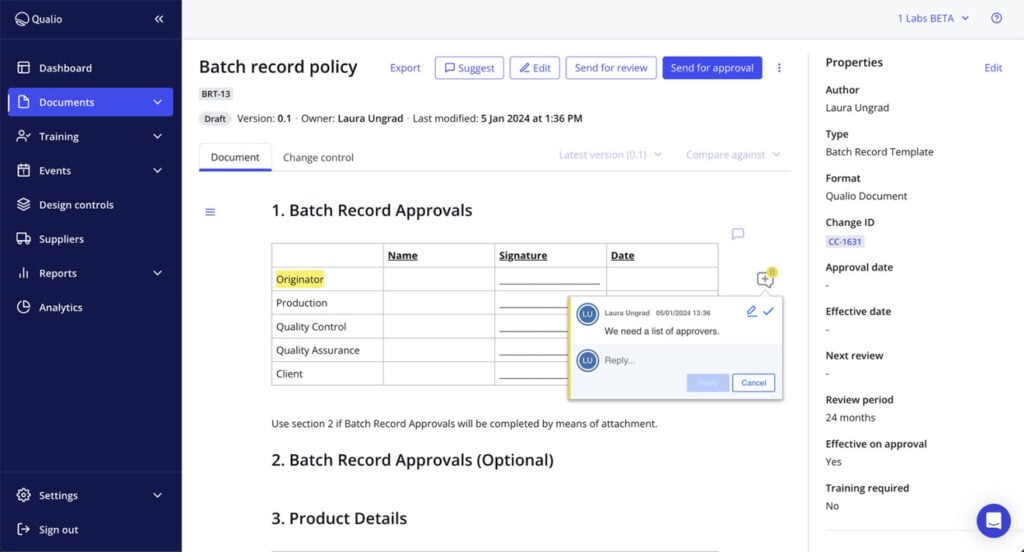
As Qualio is not delivered as a fully validated system, customers must validate their own configurations using templates provided by Qualio. These templates align with FDA Computer Software Assurance.
Qualio platform supports FDA 21 CFR Part 11, ISO 13485, and EU MDR/IVDR compliance. Qualio integrates with Jira, OneDrive, Asana, Azure DevOps, Salesforce, and Zendesk. Integration access depends on the subscription tier.
Qualio uses a subscription-based licensing model with tiers based on the number of users and AI assistance. Qualio scales with organizations as their QMS matures, supporting more users, documents, and workflows.
The system prioritizes simplicity and rapid adoption. Customization is limited to reduce the validation burden. Onboarding typically takes 30 to 60 days with implementation support and guidance provided by Scilife, although customers are responsible for leading document migration.
Qualio reviews on G2 highlight ease of use and fast onboarding. Qualio reviews on Capterra, GetApp, and Software Advice reference usability and responsive customer support while noting the effort involved in executing validation workflows.
6. QT9
QT9 QMS is a cloud-based and on-premise quality management platform. QT9 serves a wide range of industries, including FDA-regulated and ISO-certified industries.
The QT9 platform is ideal for small to mid-sized organizations. QT9’s distinguishing feature is its simplicity and cost-effectiveness.
An example of the QT9 QMS user interface is shown below.
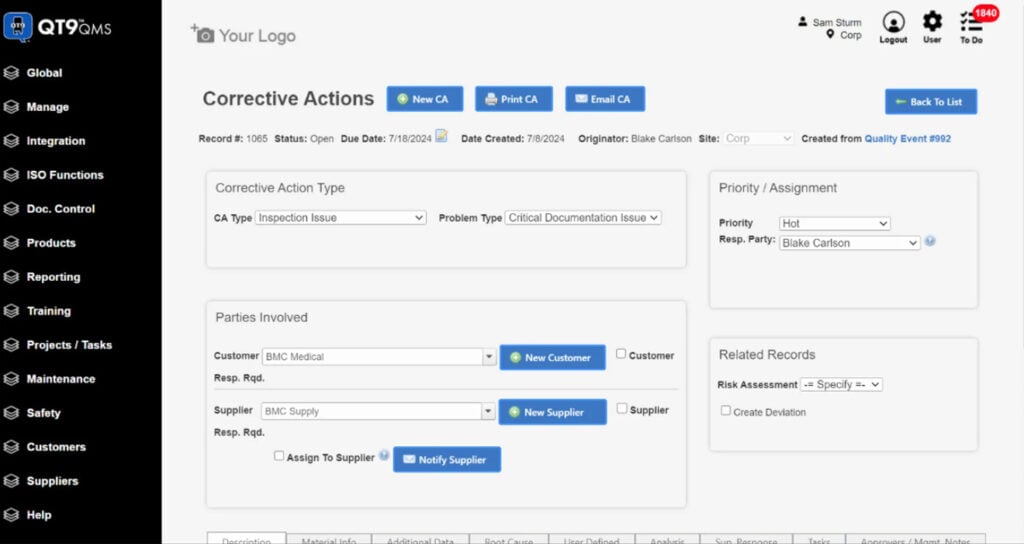
QT9 includes modules for document control, employee training, nonconformance, CAPA, change management, audits, risk management, complaint handling, and supplier quality. QT9 is pre-validated with executed IQ, OQ, and PQ protocols provided to the customer. The QT9 platform supports FDA 21 CFR Parts 210, 211, 820, and 11, EU MDR, ISO 9001, ISO 13485, and ISO 17025 compliance.
QT9 integrates with existing customer systems using APIs. QT9 provides a unified suite that includes ERP and MRP software in addition to the QMS software.
Users report that QT9 implementation takes up to three months. Onboarding includes training, implementation services, and data migration.
QT9 uses a subscription licensing model, and organizations can request a demo or a free trial to evaluate the system.
Reviews on G2, Capterra, GetApp, and Software Advice describe ease of use, affordability, strong support, but note limited customization of the QT9 software.
7. TrackWise
TrackWise is an enterprise QMS platform available in cloud or on-premise deployment.
TrackWise serves the pharmaceutical, biotechnology, medical device, and diagnostic industries. The TrackWise platform is designed for medium to large enterprises managing global or multi-site operations.
An example of the TrackWise Digital user interface is shown below.
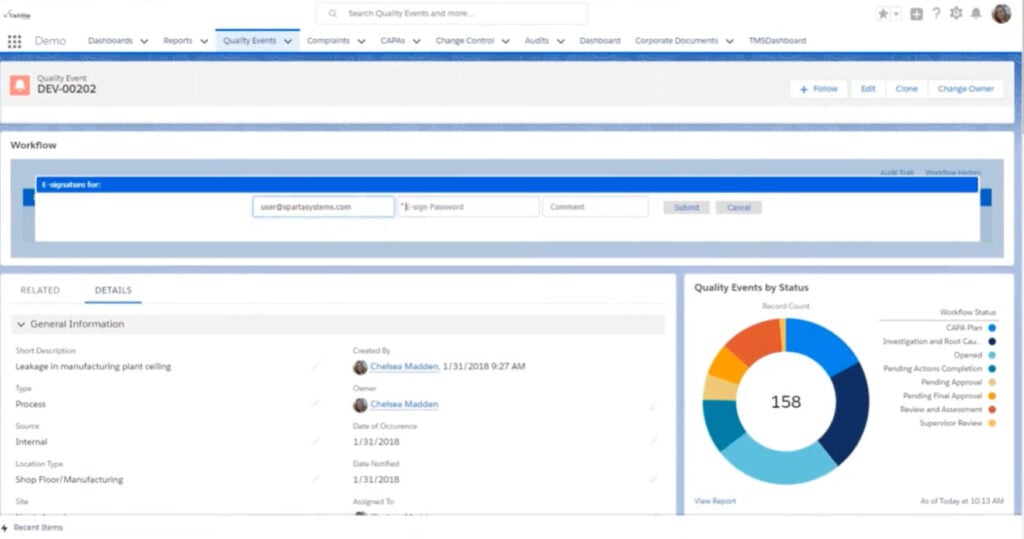
TrackWise’s distinguishable attribute is its enterprise configurability and ability to support highly customized, interconnected quality processes across global sites.
The TrackWise platform includes modules for document management, CAPA, change control, deviations, non-conformances, OOS, complaint management, audits, supplier control, risk management, and training.
TrackWise delivers pre-validated quality processes, the Quality Process Accelerators (QPAs), enabling quick implementation and minimizing the validation burden. Sparta Systems is ISO 9001:2015 certified. The platform also supports 21 CFR Part 11 and EU Annex 11 compliance. TrackWise integrates with ERP, MES, PLM, LIMS, and CRM systems. TrackWise Digital uses the Salesforce platform with API access.
TrackWise implementation timeframe depends on configuration, validation, and multi-site coordination. Implementation and onboarding support is provided by Subject Matter Experts (SMEs), who conduct a detailed assessment of current QMS processes against TrackWise or TrackWise Digital capabilities to expedite quality management systems and validation.
TrackWise pricing follows a subscription-based or perpetual model depending on deployment type, and organizations can request a demo to evaluate system capabilities.
Customer reviews on G2, Capterra, GetApp, and Software Advice highlight configurability, audit support, and process control. Other reviews mention complexity, steep learning curve, and high costs for implementation and maintenance.
8. Dot Compliance
Dot Compliance is a cloud-based, preconfigured eQMS for life sciences organizations. It is deployed entirely as a SaaS solution on the Salesforce platform. Dot Compliance’s key differentiator is its preconfigured eQMS, which enables rapid deployment and reduces validation effort.
The Dot Compliance platform serves small to mid-sized pharmaceutical, biotechnology, medical device, and cosmetic companies.
An example of the Dot Compliance user interface is shown below.
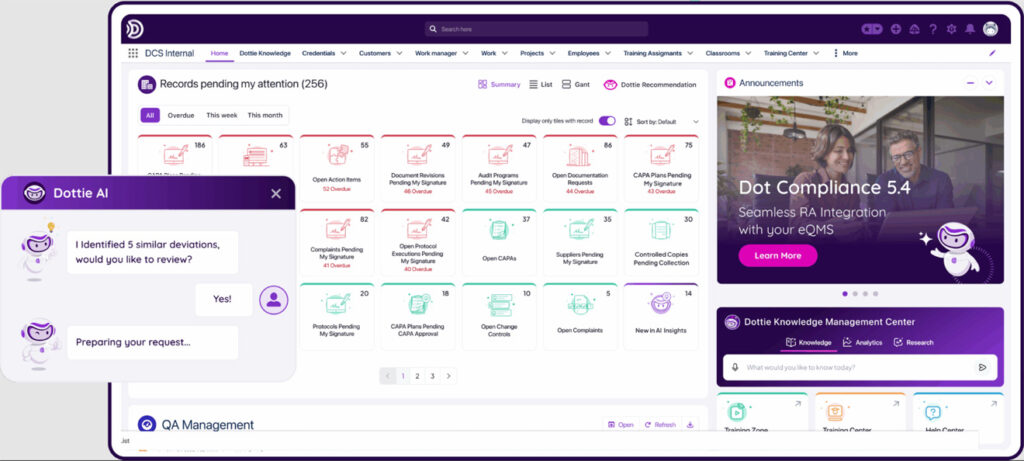
Dot Compliance offers a pre-configured, validated deployment. The Dot Compliance platform includes modules for document control, training, risk management, audits, complaint handling, CAPA, supplier management, change control, quality events, and equipment management. The platform supports 21 CFR Part 11, Part 820, EU Annex 11, ISO 13485, ISO 9001, and GxP.
Dot Compliance integrates with Salesforce apps, ERP, CRM, and other enterprise systems via Salesforce APIs.
The interface of Dot Compliance uses Salesforce UI, with guided workflows and mobile access. Customization is limited to Salesforce configurations. Implementation takes weeks to months. Onboarding includes deployment, training, and optional migration.
Dot Compliance uses a subscription-based model with pricing dependent on users and modules. The platform scales with growing teams, but customization limits apply.
Reviews on G2, Capterra, GetApp, and Software Advice cite ease of use, rapid deployment, and the value of Salesforce integration, while other reviews note issues with platform dependency and customization constraints.
What Are the Best Medical Device eQMS Solutions Based on Company Size?
The best medical device eQMS solution depends on company size because organizational scale affects regulatory needs, validation complexity, and resource capacity. Different company sizes tend to align with specific QMS characteristics, impacting vendor fit, deployment model, and total cost of ownership.
The following outlines company size categories for medical device organizations and eQMS requirements associated with each.
- Startups and Early-Stage Companies (1–25 employees): Startups and early-stage medical device companies need medical device eQMS software that accelerates regulatory readiness for FDA, ISO 13485, EU MDR, and EU IVDR compliance with minimal internal quality assurance resources. At this stage, the best medical device eQMS solutions emphasize cloud-based deployment, document control, training management, basic CAPA workflows and design control, and audit preparation aligned with 21 CFR Part 11/EU Annex 11. eQMS platforms with pre-configured templates, low validation effort, and rapid onboarding help ensure regulatory readiness without operational overhead.
- Small Companies and Scale-Ups (25–100 employees): Small medical device companies in active development and early commercialization require scalable medical device eQMS solutions that fully support relevant requirements and design control requirements. At this stage, eQMS platforms must manage design documentation/technical files, supplier quality management, change control, and end-to-end traceability, in addition to the core eQMS modules of document control, training, and CAPA management. The best eQMS solutions for small companies balance structured quality workflows, risk management (e.g., ISO 14971), and manageable computer system validation (CSV).
- Mid-sized Companies (100–500 employees): Mid-sized medical device organizations manage multiple products, cross-functional teams, and expanding regulatory markets. The best medical device eQMS solutions for mid-sized companies provide integrated quality management processes, role-based access control, cross-departmental workflows, and real-time quality reporting dashboards. These platforms support audit readiness, post-market surveillance (PMS), and system scalability without introducing unnecessary enterprise complexity.
- Large and Enterprise Organizations (500+ employees): Large and enterprise medical device companies operate global, multi-site quality management systems with complex regulatory obligations. Enterprise-grade medical device eQMS platforms must support advanced configuration, formalized validation control, risk-based governance, and deep integrations with ERP and PLM systems. The best eQMS solutions for enterprise organizations enable centralized quality oversight, multi-site compliance management, and scalable digital quality transformation.
Company size affects QMS software selection by shaping implementation timelines, validation responsibilities, and scalability needs. Smaller firms prioritize fast deployment, ease of use, and minimal operational overhead. Mid-sized companies seek a balance between control and operational flexibility. Large enterprises require integration with other systems, governance, and customization. Matching QMS capabilities to company size ensures compliance and sustainable, scalable quality management.
SimplerQMS serves companies of all sizes with a scalable, cloud-based QMS platform that adapts to each organization’s complexity, regulatory scope, and resource capacity. Smaller companies benefit from preconfigured, ready-to-use workflows and low IT overhead, while larger enterprises can expand with role-based access, modular functionality, and integration capabilities.
Best QMS for Medical Device Startups and Small Manufacturers
The best eQMS for a medical device startup or small manufacturer focuses on rapid implementation, ease of use, and built-in regulatory compliance. These companies prefer fully validated, cloud-based systems with guided workflows to meet relevant requirements such as ISO 13485, FDA 21 CFR Part 820, and 21 CFR Part 11.
The recommended best eQMS solutions for medical device startups and small manufacturers are listed below.
- SimplerQMS: SimplerQMS suits medical device startups and small manufacturers that require a cloud-based, fully validated medical device eQMS with rapid onboarding and unlimited training and support. SimplerQMS supports ISO 13485, FDA 21 CFR Part 11, and 21 CFR Part 820 in a single integrated platform. By using a vendor-managed validation model, SimplerQMS reduces validation cost and accelerates audit readiness for small QA and regulatory teams.
- Qualio: Qualio is well-suited to early-stage medical device startups focused on usability, fast onboarding, and rapid quality system adoption. Qualio supports core QMS processes, such as document control, training, and CAPA, making it suitable for teams implementing their first formal medical device quality management system. Qualio provides validation documentation and guidance, but follows a customer-executed validation approach, requiring organizations to plan, execute, and maintain their own CSV documentation.
- Greenlight Guru: Greenlight Guru focuses on medical device companies that require design control and risk management tools aligned with FDA, EU MDR/IVDR, and ISO expectations. Greenlight Guru is suited for small medical device companies seeking an intuitive interface, quick setup, and workflows specifically built for the medical device industry.
- Scilife: Scilife is well-suited to medical device startups and small manufacturers seeking pre-configured quality workflows without enterprise-level complexity. Scilife supports core medical device QMS functionality, including document control, CAPA management, and supplier quality processes, while enabling gradual system expansion as regulatory needs grow. Scilife requires customers to execute part of the validation internally.
- QT9: QT9 is well-suited to small manufacturers in regulated environments seeking a cost-effective, easy-to-use QMS solution. QT9 provides broad quality management functionality, including document control, nonconformance, and CAPA, but offers less depth in medical-device-specific design controls than life-science-focused eQMS platforms. QT9 is often selected by organizations balancing budget constraints with baseline compliance requirements.
Best QMS for Mid-Sized Medical Device Companies
The best QMS for mid-sized medical device companies should be capable of evolving alongside organizational growth while preserving speed, regulatory compliance, and ease of management. Choosing a flexible, audit-ready QMS reduces compliance risk, supports long-term scalability, and enables seamless integration of end-to-end processes and systems.
Several recommended QMS solutions for mid-sized medical device companies are outlined below.
- SimplerQMS: SimplerQMS is well-suited for mid-sized medical device companies seeking a cloud-based, fully validated medical device eQMS with predefined workflows and closed-loop quality processes. SimplerQMS supports ISO 13485, FDA 21 CFR Part 11, and 21 CFR Part 820 through a vendor-managed validation model, significantly reducing internal CSV workload. The platform enables scalable quality processes, including document control, training management, CAPA workflows, and audit readiness, across multiple teams and sites without enterprise-level overhead.
- Greenlight Guru: Greenlight Guru suits mid-sized medical device companies with a strong product development, integrated risk management, and design control focus. Greenlight Guru is suited for mid-sized medical device companies that require an intuitive interface and rapid implementation.
- MasterControl: MasterControl is best suited to upper mid-sized medical device organizations approaching enterprise-level quality system complexity. MasterControl provides robust regulatory coverage, extensive configuration capabilities, and strong scalability to support global operations. However, MasterControl requires a higher implementation effort, with a greater total cost of ownership, and relies on customer-managed validation. As a result, it is better suited for organizations with mature quality and IT resources.
- TrackWise: TrackWise suits mid-sized medical device companies managing complex quality processes and high volumes of quality events, including CAPAs, deviations, and nonconformances. TrackWise delivers enterprise-grade robustness, advanced workflow configuration, and strong quality event tracking. These capabilities come with longer deployment timelines, higher administrative overhead, and increased system governance requirements.
- Dot Compliance: Dot Compliance is suited to mid-sized medical device companies standardized on Salesforce as their core business platform. Dot Compliance enables the convergence of quality and business data by embedding QMS functionality directly within the Salesforce ecosystem.
Best QMS for Enterprise Medical Device Manufacturers
The best QMS for enterprise medical device manufacturers prioritizes global governance, extensive configurability, and integration with enterprise systems. These organizations require full compliance with global regulations, centralized control across multiple sites, and seamless connectivity across quality, manufacturing, and business platforms.
The most preferred QMS platforms for enterprise medical device manufacturers are listed below.
- TrackWise / TrackWise Digital: TrackWise is well suited for enterprise medical device manufacturers managing high volumes of deviations, CAPA, complaints, and quality events across global operations. TrackWise offers extensive workflow configurability, centralized quality governance, and mature quality event management capabilities suitable for complex regulatory environments. The platform follows a customer-owned validation model and typically involves longer implementation timelines, higher administrative overhead, and formalized system governance.
- MasterControl: MasterControl suits large medical device enterprises seeking a comprehensive end-to-end enterprise eQMS platform spanning quality, manufacturing, and compliance processes. MasterControl delivers broad regulatory coverage, robust ERP and PLM integration options, and enterprise-grade scalability across sites and regions. These capabilities come with significant configuration effort, customer-managed validation (CSV), and a higher total cost of ownership.
How Is SimplerQMS Different from Other Medical Device QMS Software?
SimplerQMS differs from other medical device QMS software in that it is designed by life science experts, which reduces the customer’s compliance burden by assuming responsibility for regulatory system requirements. SimplerQMS embeds compliance knowledge into the software, with implementation and ongoing support, including unlimited training to ensure sustained usability and regulatory alignment without added complexity.
The main differentiators of SimplerQMS compared with other medical device eQMS vendors are presented in the table below.
| Criteria | SimplerQMS | Other Medical Device eQMS Vendors | Impact on Medical Device Companies |
|---|---|---|---|
| Life science focus | SimplerQMS is purpose-built specifically for life sciences and medical devices | Many vendors serve multiple industries | Medical device processes align directly with ISO 13485 and EU MDR, EU IVDR, and FDA expectations |
| Validation ownership | SimplerQMS delivers a fully validated system | Validation is typically customer-owned | Reduced CSV effort, lower cost, faster compliance |
| Regulatory coverage | SimplerQMS supports ISO 13485, FDA 21 CFR Part 11, Part 820, EU MDR/IVDR, EU GMP | Coverage varies and often requires configuration | Fewer compliance gaps and audit findings |
| Implementation approach | SimplerQMS includes structured implementation at no extra cost | Implementation often charged separately | Predictable timelines and lower total cost |
| Training model | SimplerQMS provides unlimited training | Training often limited or billable | Faster user adoption and sustained compliance |
| Audit readiness | SimplerQMS embeds audit-ready structures by design | Audit readiness depends on customer setup | Reduced inspection stress and preparation time |
| QMS scope | SimplerQMS includes all QMS modules by default | Modules often licensed separately | Complete QMS without hidden expansion costs |
| Usability | SimplerQMS integrates natively with Microsoft Word and Excel | Proprietary editors are common | Faster document authoring and fewer user errors |
| Ongoing support | SimplerQMS provides unlimited, life-science-specific support | Support tiers and limits are common | Continuous compliance support beyond go-live |
| Life science expertise | SimplerQMS is designed and supported by medical device and life science specialists. | Expertise is often generic or partner-based | Higher confidence during audits and regulatory interactions |
What Is Medical Device QMS Software?
Medical device QMS software is a specialized electronic platform that manages quality processes to ensure compliance with relevant medical device requirements, including ISO 13485, FDA 21 CFR Part 820, EU MDR, EU IVDR, and other requirements. Medical device QMS software replaces manual or fragmented systems by centralizing documents and quality processes, such as training, CAPA, risk, and audit readiness, into a structured, traceable environment.
Medical device QMS software eliminates paper-based risks, centralizes training, documentation, CAPA management, and change control, and ensures end-to-end traceability across the product lifecycle. Medical device QMS software enables consistent quality across distributed teams and accelerates audit and inspection readiness.
The core components of medical device QMS software include document control, training management, design control, change control, CAPA, nonconformance management, risk management, supplier quality, audit management, and complaint handling. Together, these features cover the full quality lifecycle, from design and training to issue resolution and post-market oversight.
The primary benefits of a medical device QMS software include enhancing audit readiness, increasing operational efficiency, enforcing global compliance, and scaling with organizational growth. A medical device QMS software provides the foundation for long-term quality assurance and regulatory success in the medical device industry.
How Is Medical Device QMS Software Different from Generic QMS Software?
Medical device QMS software differs from generic QMS software by embedding industry-specific regulatory requirements for medical devices, such as ISO 13485 and FDA 21 CFR Part 820, directly into workflows and system architecture. Unlike generic platforms, medical device QMS ensures lifecycle traceability, design control, and audit readiness tailored to medical device compliance.
The key differences between medical device QMS software and generic QMS software are listed below.
- Regulatory Alignment: Medical device QMS software is purpose-built around medical device requirements such as ISO 13485, FDA 21 CFR Part 820, EU MDR, and ISO 14971, supporting regulatory compliance across the full medical device lifecycle. Generic QMS software typically centers on ISO 9001 and lacks native structures for device-specific regulatory requirements, making it insufficient for regulated medical device environments.
- Design Control Support: Medical device QMS software includes dedicated design control workflows, management of design documentation and technical files, requirements traceability matrices (RTM), and verification and validation processes aligned with regulatory expectations. Generic QMS software often lacks formal design and development control structures, requiring manual workarounds.
- Risk Management Integration: Medical device QMS software embeds ISO 14971 risk management throughout design, production, change control, and post-market activities, ensuring continuous risk traceability. Generic QMS software typically treats risk as a high-level or isolated concept, without lifecycle-wide integration.
- Traceability Depth: Medical device QMS software provides end-to-end traceability linking requirements, risks, design documents, changes, CAPA, and complaints within a single system. Generic QMS software usually offers limited, fragmented, or manual traceability, increasing compliance risk.
- Validation and Data Integrity: Medical device QMS software supports GAMP 5–aligned computer system validation, audit trails, electronic records, and electronic signatures compliant with FDA 21 CFR Part 11/EU Annex 11. Generic QMS software often lacks validated-system expectations and inspection-ready data integrity controls.
- Post-market Surveillance and Vigilance: Medical device QMS software supports complaint handling workflows, trend analysis, and regulatory reporting aligned with EU MDR vigilance and FDA post-market requirements. Generic QMS software rarely includes dedicated post-market surveillance functionality.
- Audit and Inspection Readiness: Medical device QMS software structures records, workflows, and evidence to support FDA inspections and notified body audits, enabling rapid retrieval of inspection-ready documentation. Generic QMS software is primarily designed for internal audits and ISO certification audits, not regulatory inspections.
- Supplier Quality Management: Medical device QMS software includes supplier qualification, supplier risk classification, monitoring, and change control aligned with regulatory expectations. Generic QMS software typically provides basic supplier tracking without medical device–specific regulatory depth.
Should Medical Device Companies Choose Cloud-Based or On-Premise QMS Software?
Medical device companies should, in most cases, choose cloud-based QMS software, as it offers faster deployment, lower IT burden, built-in validation support, and easier scalability. On-premises QMS software can be appropriate for enterprises with strict data control requirements, legacy infrastructure constraints, and internal IT and validation capabilities.
The key differences between cloud-based and on-premise QMS software are listed below.
- Deployment and Infrastructure Responsibility: Cloud-based medical device QMS platforms use vendor-hosted infrastructure, where the provider manages servers, security controls, backups, monitoring, and system availability. On-premise medical device QMS systems rely on customer-managed infrastructure, requiring internal ownership of hardware, storage, operating systems, updates, and disaster recovery planning.
- Validation and Change Management: Cloud-based medical device QMS software typically includes vendor-managed CSV packages and controlled software updates aligned with ISPE GAMP 5 expectations. On-premise systems place full responsibility for validation execution, upgrade testing, change control governance, and revalidation on the customer, significantly increasing internal CSV workload.
- Regulatory Compliance and Audit Readiness: Cloud-based QMS vendors design platforms to meet medical device requirements by default, with standardized documentation and inspection-ready controls. On-premises QMS solutions can achieve compliance but depend heavily on customer configuration, documentation practices, and ongoing maintenance, which can introduce variability during audits.
- Scalability and Flexibility: Cloud-based QMS software scales efficiently as organizations grow in users, sites, product lines, and regulatory scope, without infrastructure disruption. On-premise QMS systems scale more slowly and often require hardware expansion, infrastructure revalidation, and planned system downtime.
- Cost Structure and Predictability: Cloud-based medical device QMS platforms usually operate on a subscription-based pricing model, enabling predictable operating expenses (OpEx) and reduced upfront investment. On-premise QMS software involves capital expenditures (CapEx) for licenses, hardware, IT staffing, and long-term maintenance, resulting in a higher and less predictable total cost of ownership (TCO).
- Accessibility and Collaboration: Cloud-based QMS platforms support secure global access for distributed teams, suppliers, notified bodies, and auditors, enabling real-time collaboration. On-premise systems often restrict access to internal networks or require complex VPN configurations, limiting external collaboration and inspection efficiency.
- Security and Availability: Cloud-based QMS vendors typically operate on enterprise-grade infrastructure with redundancy, continuous monitoring, certified security controls, and tested business continuity plans. On-premise system security, uptime, and availability depend entirely on internal IT capability, investment level, and disaster recovery testing maturity.
What Capabilities Should Medical Device QMS Software Support?
Medical device QMS software must support regulated quality processes end-to-end and provide validated technical controls to ensure compliance, data integrity, and audit readiness across the medical device lifecycle.
Medical device QMS software serves as the quality backbone and validated system. The platform embeds traceable processes for document control, training, design control, change management, quality events, CAPA, risk management, supplier quality, audits, and complaint handling. The medical device system must support 21 CFR Part 11 and EU Annex 11 requirements, including e-signatures, audit trails, and role-based access control.
The medical device QMS software must enable full traceability and provide CSV/GAMP-aligned validation. The infrastructure of the medical device QMS software must include secure data storage, backup, disaster recovery, and scalability across multiple sites, as required. Lastly, the platform should integrate with enterprise systems such as ERP, PLM, MES, and LIMS. The platform should also preferably provide reporting and KPIs for management review where feasible.
Quality Management Processes
Quality management processes define how a medical device company plans, executes, controls, and improves activities that affect product quality, patient safety, and regulatory compliance.
Key quality management processes for the medical device industry are outlined below.
- Document Control: Document and record control governs the creation, review, approval, distribution, versioning, and retention of SOPs, policies, and quality records. Effective document control ensures employees use current, approved procedures and provides objective evidence for regulatory inspections and audits.
- Training Management: Training and competency management ensure personnel are trained, qualified, and competent for assigned roles. Training records demonstrate compliance with regulatory requirements and confirm employees understand applicable quality system procedures.
- Design Control: Design control manages medical device development from user needs and design inputs through verification, validation, and design transfer. Design control ensures safety, performance, and compliance, maintaining full traceability within the design documentation/technical files.
- Risk Management: Risk management identifies, evaluates, controls, and monitors product and process risks in accordance with ISO 14971. Risk management links hazards, risk controls, design decisions, and post-market feedback, enabling risk-based decision-making throughout the product lifecycle.
- Change Control: Change control governs changes to products, processes, documents, and systems. The change control process ensures proposed changes are assessed for quality, validation, regulatory, and risk impact before approval and implementation.
- Nonconformance and Deviation Management: Nonconformance management controls products or processes that do not meet requirements, ensuring proper identification, investigation, and disposition. Deviation handling documents approved exceptions, ensuring proper evaluation, disposition, and traceability.
- Corrective Action and Preventive Action (CAPA) Management: CAPA addresses systemic quality issues through root cause analysis, corrective actions, preventive actions, and effectiveness checks to prevent recurrence.
- Supplier Management: Supplier quality management governs supplier qualification, monitoring, performance evaluation, and change control. Effective supplier controls reduce supply chain risk and ensure purchased materials and services meet specifications.
- Audit Management: Audit management covers internal audits, supplier audits, and regulatory inspection readiness. Audits assess QMS effectiveness, identify gaps, and verify compliance before FDA or notified body inspections.
- Complaint handling and Post-Market Surveillance: Complaint handling captures customer feedback, complaints, and adverse events. Post-market surveillance supports trend analysis, regulatory reporting, and ongoing product improvement in line with EU MDR and FDA requirements.
- Management Review: Management review evaluates overall QMS performance using inputs such as quality metrics, audit results, CAPA status, supplier performance, and risk trends. Management review ensures leadership oversight, strategic alignment, and adequate resource allocation.
System and Technical Capabilities
System and technical capabilities in medical device QMS software enforce data integrity, access control, and compliance through validated system architecture. These capabilities ensure alignment with ISO 13485, FDA 21 CFR Part 11, EU MDR, and EU GMP Annex 11 by controlling system behavior, traceability, and electronic record requirements.
The core system and technical capabilities for medical device QMS software are listed below.
- Electronic Records Management: Electronic records management governs the creation, storage, versioning, retention, and retrieval of medical device quality records. The electronic records management capability ensures records are complete, legible, accurate, and readily retrievable during FDA inspections and notified body audits.
- Electronic Signatures: Electronic signatures provide secure, traceable approvals that link user identity, intent, and timestamp to regulated actions. Electronic signatures support FDA 21 CFR Part 11 and EU Annex 11 requirements for electronic records and signatures (ERES).
- Standardized Workflows: Standardized workflows enforce consistent, repeatable execution of quality processes such as document approval, CAPA, nonconformance handling, and change control. Workflow standardization reduces human error, improves process adherence, and increases inspection confidence.
- Role-based Access Controls: Role-based access controls (RBAC) restrict system access based on job role, responsibility, and authorization level. RBAC supports segregation of duties and prevents unauthorized creation, modification, or deletion of regulated records.
- Audit Trails: Audit trails automatically capture who performed an action, what changed, when the change occurred, and the previous state. Immutable audit logs provide objective evidence of compliance and are essential for regulatory inspections and forensic review.
- Data Integrity Controls: Data integrity controls ensure quality records remain accurate, complete, consistent, enduring, and available throughout their lifecycle. These controls support ALCOA+ principles, which are explicitly expected by FDA and EU regulators.
- System Security: System security includes user authentication, authorization, encryption in transit and at rest, backup and restore testing, and disaster recovery planning. These controls protect regulated quality data from loss, corruption, or unauthorized access while supporting business continuity.
- Integration Capabilities: Integration capabilities enable the QMS to exchange data with ERP, PLM, MES, LIMS, and identity and access management (IAM) systems using API-based integrations. Integration reduces data duplication, maintains cross-system consistency, and supports end-to-end lifecycle traceability.
- Configuration and Scalability Controls: Configuration controls allow workflow logic, metadata, and forms to be adjusted without compromising validation or compliance, distinguishing configuration from customization. Scalability controls support growth in users, sites, products, and regulatory scope, enabling long-term system adoption.
What Requirements Should Medical Device QMS Software Support?
Medical device QMS software must support ISO 13485, FDA 21 CFR Part 820, FDA 21 CFR Part 11, EU MDR/IVDR, and EU GMP Annex 11requirements. These standards govern quality management, product safety, electronic records, data integrity, and lifecycle traceability for regulatory compliance.
The requirements that medical device QMS software supports are the following.
- ISO 13485:2016: ISO 13485:2016 defines the global quality management system (QMS) standard for medical device organizations. Medical device QMS software should support clause-level compliance with ISO 13485, including document and record control, training and competency management, design control, risk management (ISO 14971), supplier quality management, CAPA, audit management, and management review.
- FDA 21 CFR Part 820 (Quality Management System Regulation): FDA 21 CFR Part 820 (QMSR) establishes mandatory quality system requirements for medical devices marketed in the United States. Following the transition to the QMSR, US requirements have been harmonized more closely with ISO 13485. Medical device QMS software should support design controls and documentation, production and process controls, CAPA, complaint handling workflows, purchasing controls, and record retention to meet FDA inspection and enforcement expectations under FDA 21 CFR Part 820.
- EU Medical Device Regulation (EU MDR): EU MDR defines regulatory requirements for medical devices placed on the European Union (EU) market. Medical device QMS software should support technical documentation management, clinical evaluation, PMS, vigilance reporting, risk management, and UDI-driven traceability aligned with EU MDR requirements. These capabilities enable ongoing regulatory compliance throughout the product lifecycle.
- EU In Vitro Diagnostic Regulation (EU IVDR): EU IVDR defines regulatory requirements for in vitro diagnostic (IVD) devices in the European Union. Medical device QMS software should support management of technical documentation, performance evaluation documentation, post-market performance follow-up (PMPF), risk management, and regulatory evidence generation required under EU IVDR, supporting both initial conformity assessment and ongoing compliance.
- FDA 21 CFR Part 11: FDA 21 CFR Part 11 defines requirements for electronic records and electronic signatures (ERES). Medical device QMS software that complies with FDA 21 CFR Part 11 should support secure user authentication, role-based access controls, electronic signatures, audit trails, and record integrity controls to ensure the trustworthiness, reliability, and inspection readiness of electronic records.
- EU Annex 11: EU Annex 11 defines requirements for computerized systems used in GMP-regulated environments. Medical device QMS software should support CSV aligned with GAMP 5 principles, including access control, audit trails, data integrity (ALCOA+), backup and recovery, and change management under EU Annex 11. These controls ensure systems remain validated, secure, and compliant throughout their operational lifecycle.
How Much Does Medical Device QMS Software Cost?
A medical device QMS software cost ranges from $10,000 to over $500,000 per year, depending on company size, regulatory complexity, and required functionality. Small companies typically spend $10,000–$40,000 annually, mid-sized organizations $40,000–$150,000, and large enterprises $150,000–$500,000+ for full-scale, validated solutions.
The common pricing models for medical device QMS software are listed below.
- Tiered Pricing: Tiered pricing offers predefined subscription packages based on company size, user count, or feature sets. Entry-level tiers allow smaller medical device organizations to start with a lower upfront cost, while higher tiers unlock additional users, modules, integrations, and scalability. This model offers moderate predictability but may require upgrades as the regulatory scope expands.
- Per-module Pricing: Per-module pricing charges separately for each QMS module, such as document control, CAPA, training, audits, or supplier quality management. While the per-module model allows selective adoption, costs increase as regulatory requirements grow, often leading to module sprawl and unpredictable long-term spend for medical device companies.
- Per-user Licensing: Per-user licensing scales pricing based on the number of named or active users within the QMS. The per-user licensing model is common across eQMS platforms, but can become expensive as organizations add cross-functional users, manufacturing personnel, suppliers, or external auditors. User-based cost scaling can limit system adoption across teams.
- Flat-rate Pricing: Flat-rate pricing provides a single subscription fee covering all users and all QMS modules. A flat-rate model offers high cost predictability, simplified budgeting, and strong alignment for growing medical device companies that expect expanding user bases and regulatory scope. Flat-rate pricing is often preferred where compliance breadth matters more than user count.
- Custom Pricing: Custom pricing is typically used for complex or enterprise medical device deployments. Pricing is negotiated based on the number of sites, users, integrations, global regulatory requirements, and validation scope. While flexible, custom pricing often involves a higher total cost of ownership, longer sales cycles, and greater dependence on contractual terms.
The main factors that affect the total cost of a medical device QMS software ownership are listed below.
- Number of Users: The number of named or concurrent users directly affects medical device eQMS subscription fees, particularly in per-user licensing models. Costs can increase rapidly as organizations add cross-functional teams, manufacturing personnel, suppliers, or external auditors.
- Included QMS Modules: The scope of included QMS modules significantly impacts cost. Adding capabilities such as CAPA management, change control, training management, or advanced modules like design controls, batch records, or equipment management increases pricing, especially under module-based pricing QMS software models.
- Implementation and Validation Services: Implementation complexity and CSV requirements are major cost drivers. Highly configurable quality processes, custom workflows, and extensive integrations increase GAMP 5–aligned validation effort, often resulting in substantial professional services costs.
- Training and Ongoing Support: Vendor-provided training, onboarding, and ongoing support vary widely. Some vendors include training in the subscription, while others meter it or bill separately. Support SLAs, response times, and access to regulatory expertise all influence long-term operating costs.
- Scalability and Integration: System scalability and integration with ERP, LIMS, MES, or PLM systems can introduce additional costs. Fees may apply for API access, middleware, and integration validation, increasing both initial implementation and ongoing maintenance expenses.
- Level of Regulatory Support: The depth of regulatory compliance support affects pricing. Vendors offering inspection-ready templates, validation documentation, regulated workflows, and medical-device–specific configurations may charge higher fees but often reduce internal compliance workload and audit risk.
How Is QMS Software Implemented in Medical Device Companies?
QMS software implementation in medical device companies follows a structured, regulatory-aligned process that ensures both operational readiness and computer system compliance. Implementation of QMS software includes planning, configuration, validation, training, and go-live activities aligned with ISO 13485, FDA 21 CFR Part 820, and other relevant requirements.
To implement QMS software in the life science industry, the following 9 steps are recommended.
- Strategy and Planning: Strategy and planning define the implementation objectives, regulatory scope, intended use, timelines, resources, and success criteria. The strategy and planning step aligns the eQMS implementation lifecycle with business goals, quality system maturity, and applicable regulatory obligations.
- Supplier Selection: Supplier selection evaluates medical device eQMS vendors based on key factors such as regulatory fit, validation ownership model, industry expertise, scalability, security features, and total cost of ownership (TCO). Supplier qualification and due diligence are critical regulatory activities supporting compliance and audit readiness.
- Gap Analysis and URS Definition: Gap analysis compares current-state quality processes against regulatory requirements and the desired future-state QMS. The User Requirements Specification (URS) documents functional, regulatory, technical, and data integrity requirements, forming the foundation for validation and system acceptance.
- System Design or Configuration: System design or configuration maps quality management processes into the QMS software using configuration (not customization) where possible. Activities include workflow definition, metadata setup, role-based access control, segregation of duties, and approval hierarchies aligned with regulatory expectations.
- System Testing and Validation: System testing and validation generate documented evidence that the QMS software performs as intended. Validation typically follows a risk-based GAMP 5 approach, including Installation Qualification (IQ), Operational Qualification (OQ), and Performance Qualification (PQ), supported by test traceability matrices.
- Personnel Training: Personnel training ensures users are qualified and competent to perform assigned roles within the QMS. Training records provide regulatory evidence of system readiness, role authorization, and compliance with ISO and FDA requirements.
- Data Migration: Data migration transfers controlled documents, quality records, and historical data from legacy systems into the new eQMS. Migration activities are planned, verified, and documented, with data integrity verification to ensure accuracy, completeness, and traceability.
- System Deployment and Go-Live: System deployment releases the validated QMS software into production use. Go-live includes final validation approval, management authorization, user access enablement, and formal transition from legacy systems to controlled system operation.
- System Maintenance and Periodic Review: System maintenance ensures the QMS remains validated and compliant after go-live. Periodic system review includes a review of change control, validation, maintenance, performance monitoring, audit results, and regulatory updates to maintain the system in a validated and inspection-ready state.
What Is a Validated QMS Software for Medical Devices?
A validated QMS software for medical devices is a computerized system with documented evidence proving it consistently performs as intended and complies with regulatory standards.
Validated QMS software has undergone CSV to confirm it meets user requirements and regulatory expectations. Validation involves IQ, OQ, and PQ to demonstrate that the system functions reliably under normal operating conditions.
Validation ensures the QMS software supports quality processes without compromising product quality, patient safety, or data integrity, in alignment with medical device-relevant requirements such as ISO 13485, FDA 21 CFR Parts 11 and 820, and EU Annex 11.
The different states of medical device QMS software when it comes to validation are as follows.
- Fully Validated Software by the Vendor: Fully validated medical device QMS software is validated by the vendor prior to customer use. The vendor provides complete, inspection-ready validation documentation, including IQ, OQ, PQ, validation reports, and validation certificates. This fully validated vendor model significantly reduces total validation cost, shortens implementation timelines, and lowers regulatory risk. In most cases, the user reviews and approves the vendor validation package and retains final responsibility for acceptance and intended use.
- Validated by the Customer: Customer-validated QMS software places full CSV responsibility on the medical device company. The customer must plan, execute, document, approve, and maintain all IQ, OQ, and PQ activities, including risk assessments, test execution, and validation summary reporting. This approach requires substantial internal validation expertise or reliance on external consultants, resulting in higher cost, longer deployment timelines, and increased ongoing validation burden.
- Partially Validated (Shared Vendor and Customer Responsibility): Partially validated QMS software follows a shared validation responsibility model. The vendor provides baseline validation documentation, templates, or reference protocols, while the customer executes validation, performs site-specific testing, and finalizes reporting. Although this model reduces initial effort, validation of ownership and ongoing revalidation remain primarily the customer’s responsibility, and total validation cost and risk are often closer to those of a fully customer-validated model than a fully vendor-validated solution.
The different types of QMS software validations required are listed below.
- Installation Qualification (IQ): Installation Qualification (IQ) verifies that the medical device QMS software, underlying infrastructure, and system components are installed correctly in the intended operating environment according to approved specifications. IQ confirms system configuration, environment setup, version control, and prerequisite conditions, providing baseline evidence that the system is ready for operational testing.
- Operational Qualification (OQ): Operational Qualification (OQ) verifies that the QMS software operates as intended under defined and controlled conditions. OQ testing confirms that regulated functions, such as electronic records, electronic signatures, audit trails, role-based access controls, and workflows, perform correctly and consistently. OQ demonstrates that the system operates according to the requirements defined in the URS.
- Performance Qualification (PQ): Performance Qualification (PQ) verifies that the QMS software consistently performs as intended in real-world use. PQ testing is executed using actual quality processes, real users, and representative data, confirming the system supports day-to-day quality operations such as document control, CAPA, training, and change management. PQ provides evidence that the system is fit for intended use in production.
IQ, OQ, and PQ together form the core validation lifecycle for medical device QMS software. These activities are supported by risk assessments, test protocols, traceability matrices, and a validation summary report, and must be maintained through change control and periodic review to remain compliant over time.
SimplerQMS uses a fully validated delivery model with complete IQ, OQ, and PQ documentation, eliminating the need for customers to perform their own CSV. Validation reports, certificates, and ongoing controlled updates ensure the system remains in a validated state, reducing regulatory risk and supporting audit readiness.
A validated QMS software benefits medical device organizations by reducing regulatory risk, lowering validation costs, and improving audit readiness with complete, inspection-ready documentation. Validated QMS software enables faster implementation, strengthens confidence in electronic records and signatures, and allows teams to focus on product quality and patient safety instead of maintaining complex validation programs.
How To Choose QMS Software for Medical Device Companies?
Medical device companies should select QMS software through a structured process that prioritizes regulatory alignment, system validation, scalability, and audit readiness. The selected software must support all regulatory and quality requirements applicable to the medical device, integrate with quality processes, and reduce long-term operational risk through proven implementation and support.
To choose QMS software for a medical device company, the following steps are recommended.
- Assess Your Requirements: Medical device organizations must evaluate their regulatory obligations, quality management processes, and operational requirements. Clearly defining medical device eQMS requirements, including applicable standards, prevents overspending on overly complex systems or selecting solutions that cannot sustain compliance.
- Research and Compare Medical Device QMS Software Vendors: Researching and comparing vendors includes requesting detailed information on product capabilities, pricing models, implementation approach, validation approach, and support services. Robust research ensures companies focus on vendors aligned with their requirements.
- Select Relevant Medical Device QMS Software Vendors: Narrow the vendor list to those aligned with company size, quality system maturity, and regulatory scope. During this step, consider vendor reputation, customer references, and experience in the medical device industry to ensure only compliant, inspection-ready solutions remain under consideration.
- Get Demos and Have Meetings: Requesting live system demonstrations allows cross-functional teams to assess the user interface, workflow usability, role-based access controls, and realistic day-to-day usability of the QMS software. Demos help confirm whether the system can support high-quality operations in practice.
- Consider Getting a Trial: Trials allow users to test the system interface, navigation, and ease of use using real quality scenarios. A hands-on trial helps identify user adoption barriers, configuration limitations, and workflow gaps early in the selection process.
- Shortlist Medical Device QMS Software Vendors: Shortlisting should be based on the eQMS’s overall value to core quality management processes, regulatory alignment, and scalability. Organizations should request case studies and references from similar medical device companies to validate real-world performance.
- Get Demonstrations of Specific Use Cases: Use-case-focused demonstrations walk through core quality workflows, such as document control, CAPA, change management, training, and complaint handling. These walkthroughs validate how the eQMS supports end-to-end quality processes, not just surface features.
- Negotiate with Shortlisted QMS Providers: Negotiation should address pricing structure, contract terms, implementation timelines, training and support, validation responsibilities, customization vs configuration, total cost of ownership, SLA, and regulatory commitments. Clear negotiation outcomes reduce long-term cost and compliance risk. Vague contract terms can lead to misunderstandings, increased costs, and potential compliance issues down the line.
- Make the Final Decision: The final decision is made after reviewing demonstrations, trial feedback, and commercial terms, and achieving consensus among quality, regulatory, IT, and leadership stakeholders. The selected QMS should support continuous compliance, operational efficiency, and scalability, with flexible contract terms that align with organizational growth.
What Are the Key Questions to Ask Before Selecting a Medical Device QMS Software?
The key questions to ask before selecting a medical device QMS Software are listed below.
- What are our regulatory obligations, quality processes, and operational needs for a medical-device eQMS?
- Which vendors align with required capabilities, pricing, implementation/validation approach, and support?
- Which vendors fit our size, QMS maturity, and regulatory scope, with solid references and industry experience?
- Do live demos show usable workflows, role-based access, and day-to-day practicality?
- Can a trial confirm ease of use, configuration limits, and adoption risks with real scenarios?
- Which options deliver the best value, regulatory alignment, and scalability, validated by case studies?
- Do use-case demos (docs, CAPA, change, training, complaints) prove end-to-end process support?
- Do negotiated terms cover price, timeline, training/support, validation roles, TCO, SLAs, and regulatory commitments?
- Does the final choice meet continuous compliance, efficiency, and scalability needs and have stakeholder consensus?
Asking these questions ensures that medical device organizations select QMS software that supports regulatory compliance, validated system use, audit readiness, and long-term scalability, while minimizing hidden risks, implementation delays, or future rework.
What Are Common Mistakes Medical Device Companies Make When Choosing QMS Software?
The common mistakes medical device companies make when choosing QMS software are listed below.
- Selecting Generic QMS Software Instead of Medical Device-Specific Systems: Generic QMS platforms often lack workflows aligned with medical device requirements, design control support, ISO 14971-based risk management, and end-to-end regulatory traceability required for medical devices, increasing audit risk and manual workaround dependence.
- Underestimating Computer System Validation Effort: Many companies fail to account for the time, cost, and expertise required for CSV, particularly when validation responsibility is customer-owned. This oversight delays go-live and inflates the implementation cost.
- Focusing on License Price Instead of Total Cost of Ownership: Low subscription fees often mask hidden costs related to validation, implementation services, training, integrations, change control, and long-term system administration. A five- to ten-year TCO perspective is essential for informed decision-making.
- Ignoring Future Scalability Requirements: QMS systems that meet current needs may not scale to support additional products, sites, users, or regulatory markets. Poor scalability forces early replacement and revalidation.
- Over-customizing the System: Heavy customization increases validation scope, change management burden, and audit risk without improving compliance outcomes. Regulatory best practice emphasizes configuration over customization.
- Underestimating User Adoption and Usability Impact: Complex user interfaces, proprietary editors, or non-intuitive workflows reduce user adoption, data quality, and process adherence, particularly among non-QA users such as engineering and manufacturing.
- Choosing Vendors Without Medical Device Audit Experience: Vendors lacking real-world FDA and notified body inspection experience may struggle to support customers during audits, increasing the risk of inspection findings and remediation costs.
- Not Performing a Formal Gap Analysis or URS Definition: Skipping gap analysis and URS development leads to misalignment between software capabilities, intended use, and regulatory requirements, complicating validation and inspections.
- Assuming Cloud Deployment Eliminates Validation Responsibility: Cloud-based QMS software still requires validation and intended-use confirmation. Misunderstanding this creates compliance gaps and false security around regulatory obligations.
- Overlooking Ongoing Support and Training Limitations: Limited training programs, weak support SLAs, or a lack of regulatory guidance increase long-term compliance risk as personnel change and regulations evolve.
Avoiding these mistakes helps medical device companies select QMS software that supports sustained compliance, audit readiness, and efficient quality operations throughout the product lifecycle.
