Quality Management System (QMS) software for small life science companies is an electronic platform that automates and manages quality processes. QMS software’s primary purpose, in the life science context, is to help companies meet regulatory and standard requirements, such as FDA 21 CFR Parts 210/211 and 820, EU GMP, ICH Q10, ISO 13485, EU MDR/IVDR, and ISO 9001. A QMS software supports life science teams in document control, training management, deviations/non-conformances management, CAPAs management, changes management, and more, while staying audit-ready with traceable records, audit trails, and e-signatures.
Small life science companies are in the early-to-growth stage, where teams are resource-constrained and need predictable costs and low admin burden. In vendor pricing and implementation terms, “small” commonly means 11–50 employees and sometimes extends up to 500 employees. Very early startups with 1–10 employees may still adopt QMS software when preparing for regulatory milestones.
The 10 best QMS software solutions for small life science companies in 2026 are listed below.
- SimplerQMS: SimplerQMS is the best-fit QMS for small life science companies because it combines a cloud-based, life-science-specialized eQMS with full validation documentation aligned to International Society for Pharmaceutical Engineering (ISPE) GAMP 5 guidance (Good Automated Manufacturing Practice, version 5). SimplerQMS gives small and mid-sized life science teams a ready-to-use quality system built for their regulatory needs, with less validation effort and faster adoption. SimplerQMS is designed to digitalize quality workflows quickly and connect core QMS modules, such as document control, change control, training, Corrective Actions and Preventive Actions (CAPA), deviations/non-conformances, audits, suppliers, complaints, risk management, design control, and equipment management.
- Qualio: Qualio is a user-friendly cloud-based QMS software aimed at startups and small teams, building their first QMS or replacing paper-based systems. Qualio offers quick adoption and core quality workflows, including document control, training, non-conformance and CAPA management, change control, supplier management, and design control.
- Greenlight Guru: Greenlight Guru is a medical-device-focused cloud-based eQMS with deep alignment to medical device lifecycle needs. Greenlight Guru’s core modules include document control, design control, and Design History File (DHF), risk management, parts and inventory/bill of materials (BOM), making it a strong fit for teams that want device-native workflows.
- QT9 QMS: QT9 QMS is a cost-effective QMS software popular among smaller manufacturers needing straightforward compliance support. QT9 includes modules such as document control, CAPA, audits, training, risk management, complaints, and supplier management. QT9 is positioned as simple and pre-validated, appealing to small teams seeking faster rollout and less admin.
- Scilife: Scilife is a software-as-a-service (SaaS) QMS with predefined, out-of-the-box workflows and tiered plans that can start small with document control and training and expand into CAPA, change control, quality events, audit management, and more. Scilife is best for growing life science teams that want structured workflows, while still owning validation activities for their specific configurations.
- Dot Compliance: Dot Compliance is a Salesforce-based, pre-configured, and pre-validated eQMS emphasizing ready-to-use quality workflows, including document control, training, CAPA, changes, audits, complaints, and more, to reduce setup time. Dot compliance fits small-to-mid teams that want rapid implementation and standardization inside the Salesforce ecosystem with limited customization to preserve validation status.
- ZenQMS: ZenQMS is a cloud-based QMS platform known for an all-inclusive licensing approach, including unlimited users and validation support. ZenQMS suits small life science companies that want predictable budgeting and simple quality workflows without the burden of managing user licenses.
- MasterControl: MasterControl is an enterprise-grade eQMS that can still work for small companies scaling quickly, especially via the “starter” pack. MasterControl is a good choice when a small company expects rapid growth and can accept longer implementations, higher cost, a steeper learning curve, and additional validation workload.
- ComplianceQuest: ComplianceQuest is a Salesforce-native eQMS that suits rapidly scaling small-to-mid life science manufacturers who want quality tightly connected to customer relationship management (CRM) and enterprise resource planning (ERP) data. ComplianceQuest is strong for broader operational alignment but typically involves longer implementations.
- Intellect QMS: Intellect QMS is a flexible platform with a library of pre-built apps and a no-code workflow designer. Intellect QMS suits small life science manufacturers that want to tailor processes and expand over time, but where increased configurability may raise validation effort and require a capable internal system owner.
When choosing a QMS for a small life science company, the main factors to consider are the total cost of ownership, including any add-ons such as onboarding, validation support, migration, training, and support services. Other important considerations include validation approach, regulatory fit, implementation timeline, ease of use and adoption, included modules and traceability across workflows, integration needs, and scalability as headcount and product scope grow.
SimplerQMS is a strong choice for small life science companies that want life-science specialization with full validation documentation for installation qualification (IQ), operational qualification (OQ), and performance qualification (PQ) according to ISPE GAMP 5. SimplerQMS embeds FDA 21 CFR Part 11 and EU GMP Annex 11 controls for audit trails, e-signatures, and role-based access. The software provides an integrated set of quality modules with linked records for end-to-end traceability and supports practical adoption via Microsoft Office 365 integration. SimplerQMS bundles key services in a subscription, which helps small teams maintain budget predictability.
1. SimplerQMS
SimplerQMS software is a cloud-based electronic quality management system tailored for life science small and medium-sized businesses (SMBs) that need a compliant, ready-to-use platform without the cost, complexity, and validation burden of larger enterprise QMS solutions. SimplerQMS best fits small and growing companies because it combines life science-specific workflows, full validation documentation, rapid onboarding, and bundled support in one subscription. SimplerQMS runs as a SaaS solution hosted on Amazon Web Services (AWS).
Examples of the SimplerQMS user interface are shown below.
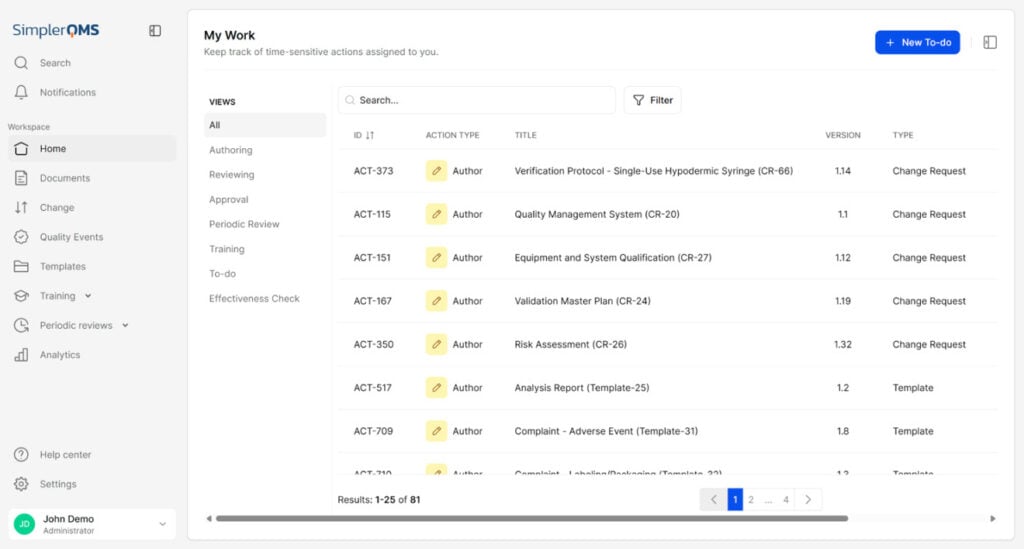
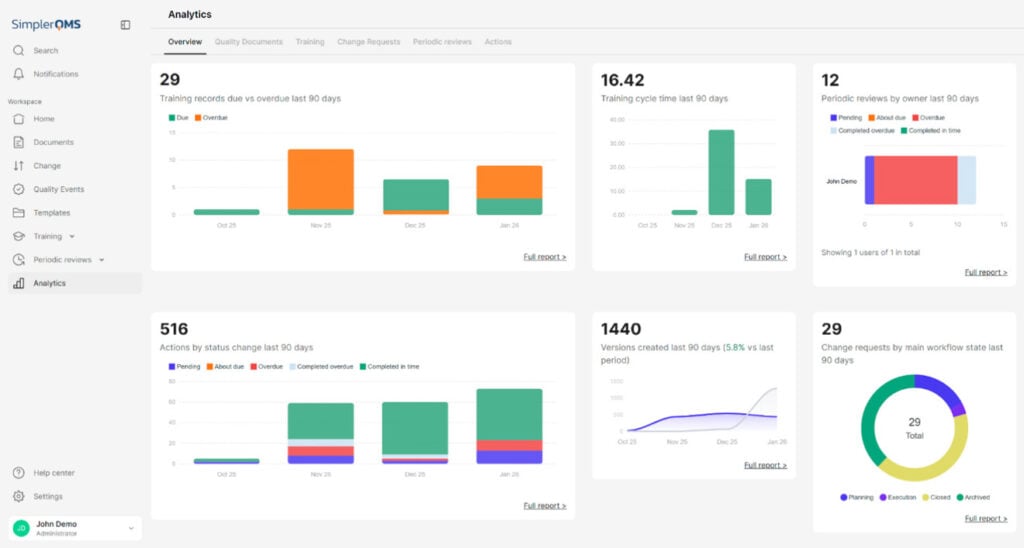
SimplerQMS is suited for small life science companies in medical devices, biotech, pharmaceuticals, laboratories, Contract Manufacturing Organizations (CMOs), Contract Development and Manufacturing Organizations (CDMOs), and Contract Research Organizations (CROs) that need to digitalize their regulated workflows without heavy internal validation resources. SimplerQMS supports small to mid-sized life science organizations, in the 11 to 500 employee range, where quality teams need greater control, faster processes, stronger traceability, and a reliable alternative to spreadsheets and shared drives.
SimplerQMS’s value proposition centers on life science specialization and a fully validated delivery model. SimplerQMS platform is validated according to ISPE GAMP 5, and it is delivered with full validation documentation (IQ/OQ/PQ), which reduces customer computer system validation (CSV) workload and supports compliance.
SimplerQMS core QMS functionalities cover the quality workflows that small, regulated teams run daily in one connected system. SimplerQMS modules include document control, change management, training management, CAPA management, non-conformance/ deviation management, audit management, supplier management, complaint management, risk management, design control, equipment management, product-related records, and reporting, with record linking for traceability across processes.
SimplerQMS validation and compliance coverage targets life science requirements. SimplerQMS embeds FDA 21 CFR Part 11 and EU Annex 11 controls, such as role-based access, audit trails, and electronic signatures, and supports compliance with life science standards and regulatory frameworks, including FDA 21 CFR Parts 210/211 and Part 820, EU GMP, EU MDR, IVDR, ISO 13485:2016, ISO 9001:2015, and ICH Q10. SimplerQMS validation approach includes ongoing validation support for software updates, which reduces recurring re-validation effort for small teams that lack dedicated CSV staff.
SimplerQMS integration and interoperability focus on common tools used by small life science companies. SimplerQMS integrates with Microsoft Office 365 so teams keep authoring in Word and Excel while controlling versions and approvals on the platform. SimplerQMS integration scope extends to business systems such as Enterprise Resource Planning (ERP), Customer Relationship Management (CRM), and Product Lifecycle Management (PLM) when companies need cross-system connection for product, inventory, customer, supplier, and quality data.
SimplerQMS user experience suits small teams that need fast adoption and low training burden. SimplerQMS workflow design keeps configuration limited to protect validation status, which reduces long-term maintenance and audit risk when resources are constrained. SimplerQMS access model supports distributed teams through cloud access, while permission controls restrict records by role.
SimplerQMS implementation and onboarding follow a structured rollout that fits small company timelines. SimplerQMS implementation commonly runs in a 6-to-8-week onboarding program that includes configuration, data migration, and unlimited training and support, guided by a dedicated project manager. SimplerQMS offers ongoing support during operations, which matters when quality teams lack internal resources.
SimplerQMS pricing and licensing use a subscription model that protects budgeting for small life science companies. SimplerQMS subscription includes cloud hosting, selected modules, onboarding, implementation, validation, data migration, training, and support, which reduces budgeting risk from add-on fees.
SimplerQMS scalability fits companies that start small and add products, sites, suppliers, and regulatory scope over time. SimplerQMS platform structure supports expanding record volumes and adding modules without replacing the QMS, which reduces disruption during growth phases such as new product lines or market expansion.
SimplerQMS reviews from third-party platforms frequently mention usability, compliance fit, and support quality for smaller organizations. SimplerQMS reviewers on G2 describe user-friendly operation, straightforward implementation, and excellent support in regulated life science contexts, including small-business users. SimplerQMS reviews on Software Advice highlight strong ratings for ease of use, value for money, and customer support in verified review sets.
2. Qualio
Qualio is a cloud-based QMS software for life science companies. Qualio fits start-up and small life science companies that need to digitalize their core quality processes in one system.
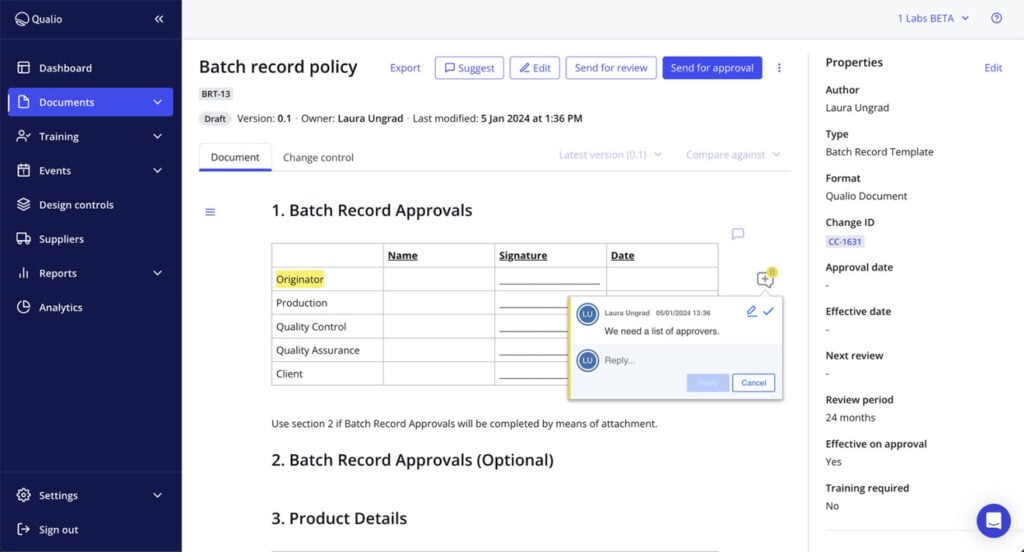
An example of the Qualio user interface is shown below.
Qualio’s deployment model is cloud-based and supports distributed access without on-premise infrastructure.
Qualio’s key differentiator is its focus on ease of use. Qualio is suitable for small teams with limited resources, preparing for audits, building their initial QMS, or replacing paper-based processes.
Qualio core QMS functionality includes document control, training management, non-conformance and CAPA management, change control, supplier management, and design controls.
Qualio is not delivered as a fully validated system, and customers must perform testing for the system configurations they build into Qualio. Customers can use Qualio’s provided validation templates, which reduces some validation effort. The platform supports compliance with FDA 21 CFR Part 11, ISO 13485, and EU MDR/IVDR requirements, and Qualio’s validation follows FDA guidance on Computer Software Assurance.
Qualio integrates with common business systems such as Jira and OneDrive, product development systems, like Asana and Azure DevOps, and customer support systems, including Salesforce and Zendesk. Access to each system integration group is tied to the subscription tier, with all Qualio customers having access to the core system integrations group.
Qualio user experience centers on a web interface with dashboards, navigation by workspace, and controlled record views. Qualio user workflow design supports task reminders and structured approvals.
Implementation and onboarding are guided by Qualio’s customer success team. Qualio onboarding timeline is between 30 and 60 days. Timelines extend when the document migration scope is large or when teams need additional configurations. In Qualio Docs, an 8-week onboarding program is described. Document migration is handled by the customer, with guidance and a migration tool provided by Qualio.
Qualio uses a subscription-based licensing model with tiers, with differences in the number of users and artificial intelligence (AI) assistance. System customization or data migration may introduce additional costs. Customers can request a demo to evaluate the system.
Qualio scales with small and mid-sized organizations as their QMS matures, supporting more users and quality workflows over time. Different pricing plans cover different company needs. The system’s flexibility covers early-stage and growth-stage companies.
Qualio reviews on G2 describe an easy-to-use and intuitive eQMS. Qualio reviews on Software Advice highlight ease of use and task reminders, with some reviewer feedback on built-in document formatting limits.
3. Greenlight Guru
Greenlight Guru is a cloud-based QMS software focused on the medical device industry, targeting medical device, diagnostics, and medical technology (MedTech) companies. Greenlight Guru software best suits small to mid-sized medical device companies and MedTech startups that need an intuitive eQMS aligned with FDA and EU medical device regulations and ISO requirements.
An example of the Greenlight Guru user interface is shown below.
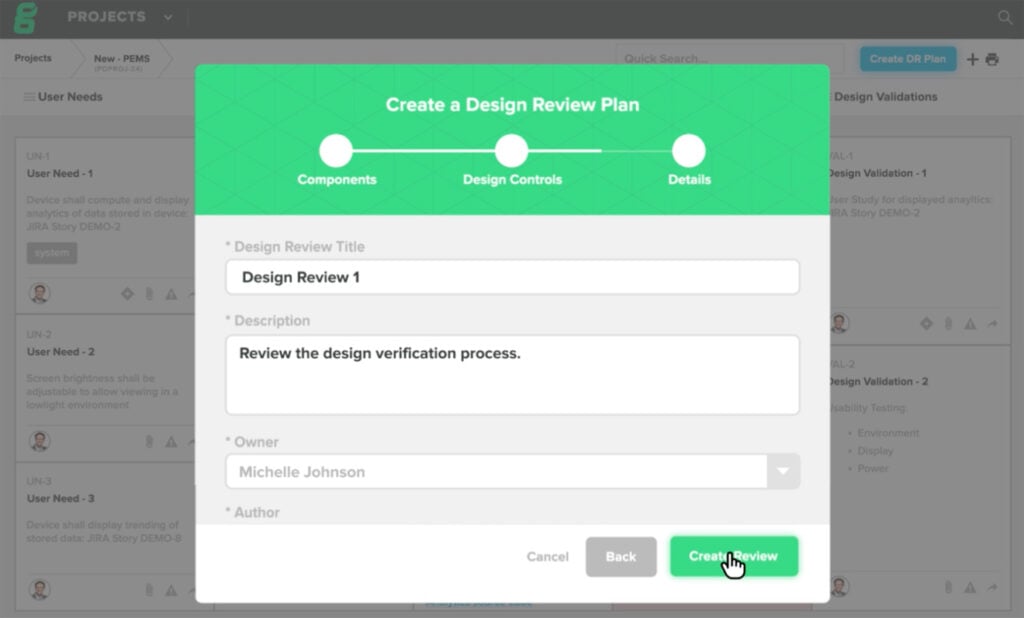
Greenlight Guru is deployed as a SaaS, and it supports remote collaboration without on-premises installation.
Greenlight Guru’s unique value proposition is its exclusive focus on medical devices, offering built-in controls and functionalities that mirror medical device lifecycle requirements.
Greenlight Guru QMS modules cover document control, design control, and DHF, risk management, change management, CAPA and non-conformance management, training management, audit management, supplier management, quality events, and parts and inventory/BOM.
Greenlight Guru compliance fit centers on medical device QMS requirements, such as ISO 13485 and FDA Quality Management System Regulation (QMSR) expectations. The platform includes Part 11-compliant review and approval workflows and fully supports ISO 14971 requirements for risk management.
Greenlight Guru’s validation approach follows the FDA Computer Software Assurance guidance. Greenlight Guru provides automated testing as part of QMS software development, a complete validation package with automated test results, summaries, memos, and templates, and continuous support with each update. The customer is responsible for the periodic review of updated software validation reports.
Greenlight Guru integrates with tools like Jira, and API access enables additional integration options.
Greenlight Guru user experience feedback on review platforms highlights an intuitive interface with workflows tailored to the medical device industry.
Greenlight Guru’s implementation process typically ranges from 2 to 8 weeks. Onboarding includes guided setup and training sessions. Migration services can be provided by Greenlight Guru, and the core subscription includes the migration of 300 documents, per current terms.
Greenlight Guru pricing and licensing use subscription packages. All packages require the core subscription, which includes document management, change management, and training management. From there, each customer can choose one or more of the add-ons.
Greenlight Guru scalability supports adding users and expanding module scope across product development and post-market quality processes. Flexibility is strong within the medical device industry, though companies with multi-industry operations may outgrow the platform.
Greenlight Guru reviews on Capterra show a turnkey setup and successful external audits. Greenlight Guru reviews on Software Advice express mixed sentiment, with positive comments about compliance and process support alongside criticism related to support quality, learning curve, and cost for smaller teams.
4. QT9 QMS
QT9 is a QMS software that helps quality-focused industries, including small life science companies, simplify audits, reduce risk, and meet global standards. QT9 software supports both cloud and on-premise deployment options, which gives small companies flexibility based on their IT and compliance needs.
An example of the QT9 QMS user interface is shown below.
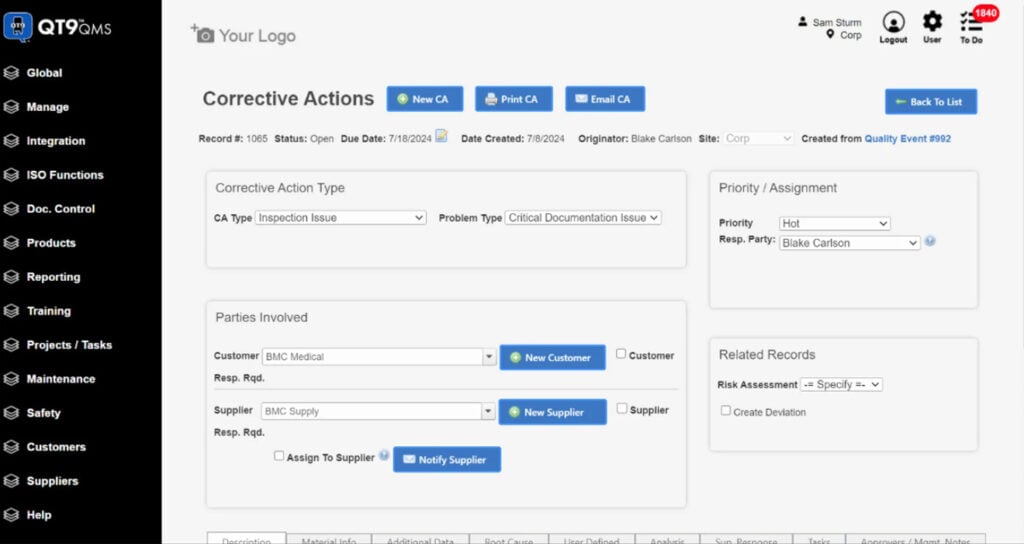
QT9 QMS fits small companies, with a focus on manufacturers, that need to comply with ISO and FDA expectations. The system’s key differentiator centers on simplicity and cost-effectiveness. Small companies seeking fast implementation and minimal system administration are well-suited for QT9.
QT9 QMS modules for medical devices and pharmaceuticals cover document control, non-conformance reporting, CAPA management, audit management, employee training, risk management, change management, complaint handling, and supplier quality.
QT9 QMS is pre-validated and provides customers with IQ, OQ, and PQ executed protocols. The platform supports compliance with FDA 21 CFR Part 210/ 211, 820, and Part 11, EU MDR, ISO 9001, ISO 13485, and ISO 17025.
QT9 QMS integration support includes API-based integration options. The broader QT9 vendor ecosystem includes QT9 ERP and MRP solutions, supporting connectivity between quality records and operational data.
QT9 offers a clean, simple interface designed for ease of use with minimal training. The system provides training materials and onboarding guides to help teams adopt the system quickly.
QT9 QMS implementation timeline varies by migration volume and customer needs. Users report that the software implementation time is around 3 months. Capterra reviewers describe QT9 QMS onboarding as structured and supportive for newer QMS teams.
QT9 QMS pricing uses subscription licensing, and a demo and a free trial are available. QT9 QMS offers access to 25+ modules during the trial, including document control, CAPA, audit management, training management, and risk management.
QT9 QMS scalability supports adding modules and expanding users. QT9 QMS flexibility is strong within the system’s simple configuration model, though companies needing deep customization may outgrow it.
QT9 QMS reviews on G2 describe reduced administrative burden versus paper processes. QT9 QMS reviews on Capterra describe a “user-friendly” experience and strong customer support.
5. Scilife
Scilife is a cloud-based QMS software for life science SMBs that need structured quality processes and controlled records without building a complex system from scratch. Scilife is deployed as a SaaS solution hosted on Amazon AWS.
An example of the Scilife user interface is shown below.
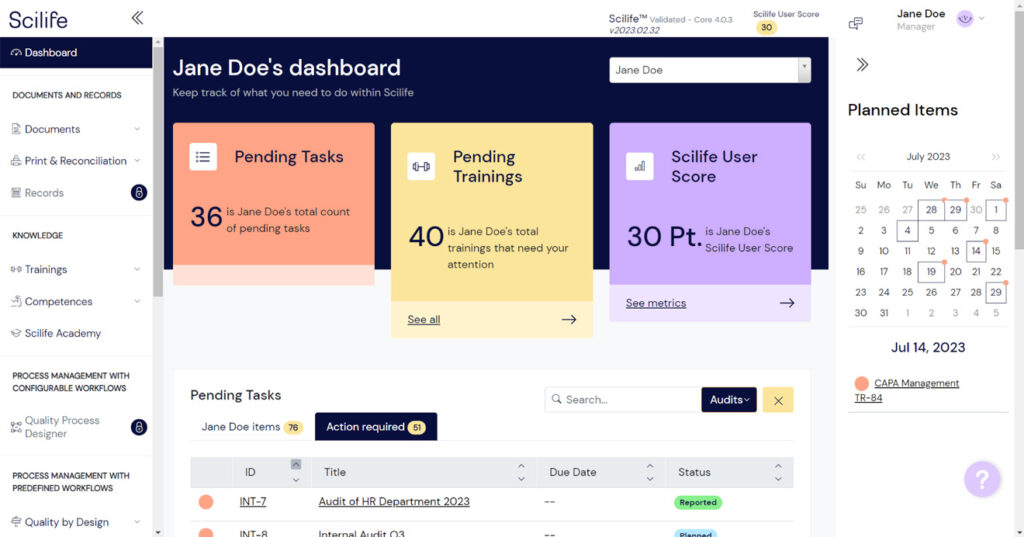
Scilife software fits small life science companies in biotechnology, pharmaceutical, advanced therapy medicinal product, medical device, medicinal cannabis, CRO, and CMO that need structured out-of-the-box workflows.
Scilife’s key differentiator is predefined workflows aligned with life science requirements. Companies best suited for Scilife include growing life science teams aiming to digitalize their quality processes.
Scilife provides QMS modules tied to different plans, including Free, Essential, Core, and Core+ plan tiers. Document control and training management are included in the Essential plan. Beyond the Essential plan modules, the Core plan includes CAPA, change control, and quality event management. In the Core+ plan, Scilife provides the Core plan modules along with audit management, supplier management, risk management, and equipment management. The Free plan functions as a trial tier.
Although Scilife is validated according to GAMP5 and 21 CFR Part 11, customers must conduct validation activities to support their own specific processes and configurations. Scilife provides a validation package that includes drafted, executed, and signed-off validation documentation that customers can use as the basis for the validation of Scilife on their end.
The platform supports compliance with life science requirements, including FDA 21 CFR Part 11, EU Annex 11, GxP, ISO 13485, ISO 14971, ISO 15189, and ISO 17025.
Scilife offers API-based connectivity to integrate with existing business systems. The system also provides Single Sign-On (SSO) using Microsoft Entra ID (formerly Azure Active Directory), so users can authenticate with their existing corporate credentials.
Scilife’s user experience centers on a web-based interface with easy navigation, dashboards, and list views for controlled records and tasks, supporting small QA teams that need fast user adoption and improved visibility on daily tasks.
Users report an implementation timeline of about 4 months. During onboarding, weekly meetings are held between Scilife and the customer on the progress of the project from start to completion. Onboarding includes optimization support, training sessions, document migration assistance, and integration setup, while customers contribute internal resources to complete validation. The platform offers additional training programs on demand.
Scilife follows a subscription-based tiered pricing model. The platform’s scalability and flexibility support additional modules and users.
Customers on G2, Capterra, GetApp, and Software Advice describe Scilife as easy to use, visually intuitive, and well-suited for growing life science teams. Reviews highlight helpful support and a clear user interface, while mentioning occasional minor bugs and gaps in specific modules.
6. Dot Compliance
Dot Compliance is a cloud-based electronic quality management system built on the Salesforce platform for life science SMBs that need a ready-to-use eQMS with controlled workflows and less setup effort. Dot Compliance uses pre-configured workflows for core quality processes and controlled approvals inside a Salesforce-native interface.
An example of the Dot Compliance user interface is shown below.
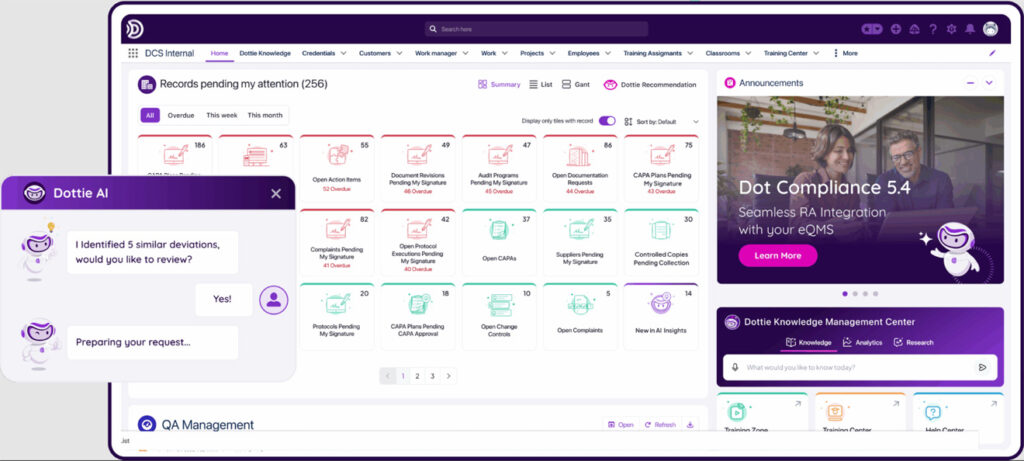
Dot Compliance targets small to mid-sized life science companies in pharmaceutical, biotechnology, medical devices, and regulated manufacturing that need a ready-to-use eQMS without heavy customization. Dot Compliance focuses on emerging regulated teams that want standard workflows and faster deployment.
Dot Compliance deployment model is SaaS on Salesforce cloud infrastructure. The platform supports access through standard Salesforce security and administration controls.
Dot Compliance’s differentiator is the Salesforce-native, pre-validated, pre-configured eQMS design. Dot Compliance’s value proposition emphasizes out-of-the-box workflows to reduce setup time and validation effort, which are important factors for small teams.
Dot Compliance core QMS functionality includes document management, training management, quality event management, CAPA, change management, audit management, complaint management, risk management, supplier quality management, and equipment management.
Dot Compliance embeds built-in controls for FDA 21 CFR Part 11 and EU Annex 11 electronic signatures, including authentication, signature meaning, and time-stamped audit trails. Dot Compliance supports compliance with major life science requirements, such as FDA 21 CFR Part 820, ISO 13485, ISO 9001, and GxP. Dot Compliance is delivered with full validation packages that meet 21 CFR Part 11 and EU Annex 11 requirements.
Dot Compliance integration and interoperability align with Salesforce applications and Salesforce APIs. Dot Compliance integration model fits small teams that already run Salesforce and want shared data across systems.
Dot Compliance user experience follows Salesforce UI patterns such as list views and dashboards. Dot Compliance usability feedback on Software Advice mentions strong document linking, with some reviewer notes on dashboard layout and visual density.
Dot Compliance implementation and onboarding expectations vary by process scope and migration volume. Dot Compliance emphasizes rapid rollout for ready-to-use workflows, often completing in weeks to a few months. Onboarding includes structured deployment and training. Dot Compliance provides migration services.
Dot Compliance uses subscription licensing with pricing dependent on the included modules and the number of users. Demos are available, and free trials are described as uncommon on review listings.
Dot Compliance scalability supports adding modules and users over time through the modular platform model. Dot Compliance flexibility remains strong inside the Salesforce environment, while deeper customization is limited to preserve validation status.
Dot Compliance reviews on Capterra mention ease of use and user interface. Reviews on G2 describe the consolidation of documents, training, audits, CAPAs, and change controls into one connected system.
7. ZenQMS
ZenQMS is a cloud-based QMS software for life science SMBs that need straightforward quality workflows, predictable pricing, and user access without seat-by-seat planning. ZenQMS is hosted by Amazon Web Services.
An example of the ZenQMS user interface is shown below.
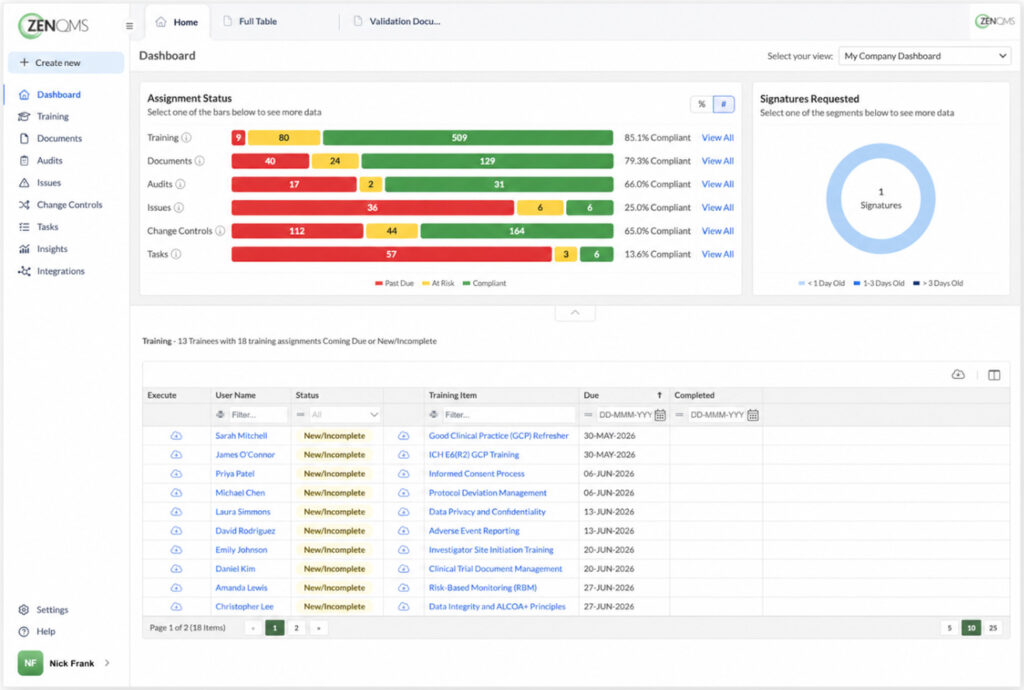
ZenQMS fits small to mid-sized life science organizations, including biopharma teams, CDMOs, CROs, and laboratories. ZenQMS supports small teams with full-module access for all staff without seat-by-seat planning, supporting predictable costs.
ZenQMS differentiates itself through an all-inclusive licensing model with unlimited users and validation support.
ZenQMS modules support the main quality processes used by small life science teams. The core QMS modules include document control, training, quality issues, change control, audits, and insights. ZenQMS insights module provides trend analysis and reporting capabilities to support faster QA decisions in small teams.
ZenQMS is fully validated per GAMP 5 guidelines for a Category 4 system. ZenQMS validation also aligns with the FDA General Principles of Software Validation. To maintain this validated state, ZenQMS manages every system update through its change control procedure.
ZenQMS notifies customers in advance of each release and provides a detailed list of updates, validation documentation, and a test environment specific to each account.
ZenQMS electronic signatures meet FDA 21 CFR Part 11 and EU Annex 11 requirements. The company is ISO 9001:2015 and ISO 27001:2022 certified.
ZenQMS user experience emphasizes a clean interface and rapid onboarding for daily operations. This interface design supports efficient daily use by small quality teams. ZenQMS workflow standardization reduces validation needs for small teams, but the same standardization limits deep customization.
ZenQMS implementation and onboarding are typically short. ZenQMS calculates implementation cost based on the amount and complexity of the customer’s existing data and training needs. A dedicated project manager and an implementation specialist are assigned to each customer and guide them from demo through data import and configuration to team training.
This all-inclusive pricing model gives ZenQMS customers unlimited users and access to all modules, which supports strong budget predictability for small companies. The price is calculated based on the size and complexity of managing and supporting the customer account. ZenQMS pricing includes production and sandbox environments, release deployments, and local backups.
ZenQMS scalability supports growth in headcount without seat expansion planning. This growth capacity helps small teams add users without changing their licensing model.
User reviews on Capterra describe ZenQMS as easy to use and affordable. Reviews on G2 describe implementation as easy, but some reviews report feature limitations and module issues.
8. MasterControl
MasterControl offers a cloud-based eQMS, called Quality Excellence, for regulated SMBs that are scaling fast and need strong process control, extensive configuration, and room for enterprise-level growth.
An example of the MasterControl user interface is shown below.
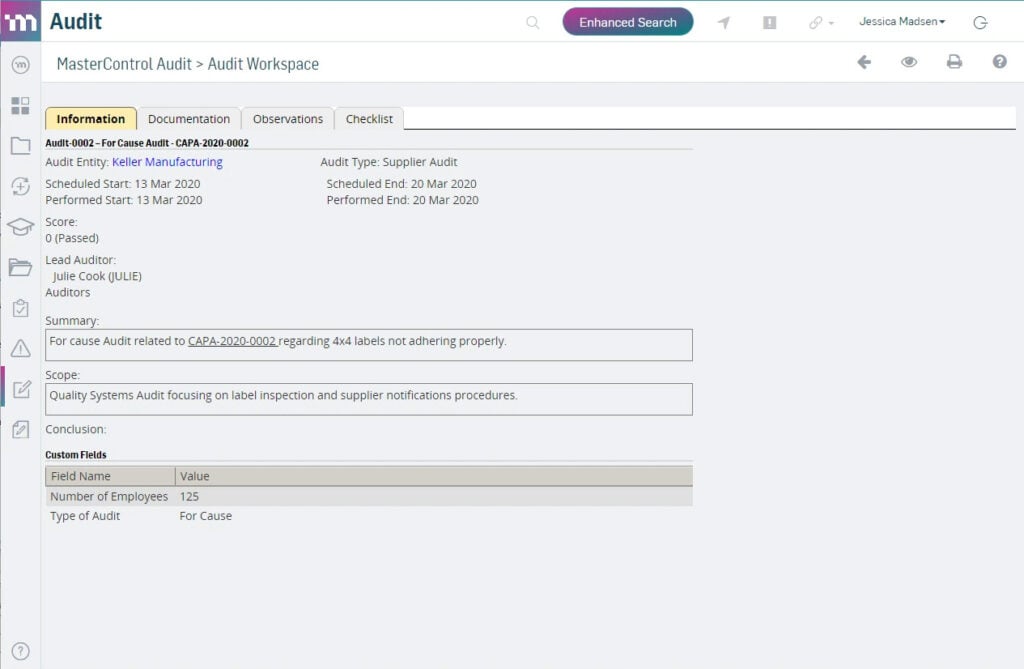
MasterControl QMS suits regulated life science organizations, including pharmaceutical, biotech, medical device, diagnostics, and other life science companies that need more configuration options than the usual small-team platforms offer. MasterControl QMS fits small life science companies during rapid growth, especially when expansion creates multi-site operations, more complex workflows, and higher document volumes.
MasterControl’s main differentiator is its enterprise-grade architecture, which supports large-scale implementations and complex quality processes in one connected system. Within this enterprise architecture, MasterControl’s pre-configured solution, Quality Excellence Starter, supports smaller teams that want a faster start and later expansion into more modules as complexity grows.
MasterControl QMS modules include document control, training, CAPA, change control, quality event management, audit and risk management, and analytics and business intelligence. These connected modules make MasterControl suitable for small teams that want fewer disconnected systems.
MasterControl is not delivered as a fully validated system. Customers must complete part of the computer system validation to meet regulatory expectations. MasterControl provides validation toolkits, including the Validation Excellence Tool (VxT) and Validation on Demand (VoD), for Manufacturing Excellence (Mx) and Advanced Data and Process Technology (ADAPT) products. Validation costs vary with the level of support needed, but VxT and VoD are included in the base price.
MasterControl QMS meets FDA and ISO 9001 requirements. MasterControl’s validation tools support users in generating and collecting the documentation they need for regulatory, certification, and customer audits.
MasterControl integration fits environments that need connections across enterprise systems. MasterControl integrates with Enterprise Resource Planning (ERP), Manufacturing Execution System (MES), Customer Relationship Management (CRM), Product Lifecycle Management (PLM), Laboratory Information Management System (LIMS), and related enterprise systems using MasterControl’s API Toolkit. Customers purchase MasterControl’s API Toolkit at an additional cost, and MasterControl updates the toolkit for every major version. Companies can outsource technical scripting or programming activities to specialists from the MasterControl integration services team when internal resources are limited.
MasterControl user experience reflects an enterprise interface with structured navigation, role-based access, and dashboards. User reviews on G2 highlight strong document management and training modules, while recurring negative feedback mentions the learning curve and complex setup for smaller teams.
MasterControl implementation and onboarding follow a staged approach tied to planning, configuration, validation activities, deployment, and onboarding. Based on user reviews, the average implementation time is around 7 months. Migration services are available at an additional cost.
MasterControl pricing follows a named-user license model, with different rights and access levels available based on user needs. For Quality Excellence, there are three different plans, including basic, standard, and complete. MasterControl trial access is not standard, so small teams usually start through a demo and quote process.
MasterControl scalability supports multi-site growth, higher record volume, and expanded module coverage as quality operations mature. MasterControl flexibility supports deeper configuration, but that configuration depth increases validation workload for small teams.
User reviews on G2 describe value in consolidating document management, training, quality events, and complaints into one system. User reviews on Capterra describe strong capability after implementation, but some users note implementation and end-user training can require significant effort.
9. ComplianceQuest
ComplianceQuest is a cloud-based eQMS built on the Salesforce platform. ComplianceQuest is positioned to help businesses of all sizes, including small companies, increase quality, safety, and efficiency across product lifecycle workflows. ComplianceQuest software serves multiple regulated industries, such as life sciences, manufacturing, and food and beverage.
An example of the ComplianceQuest user interface is shown below.
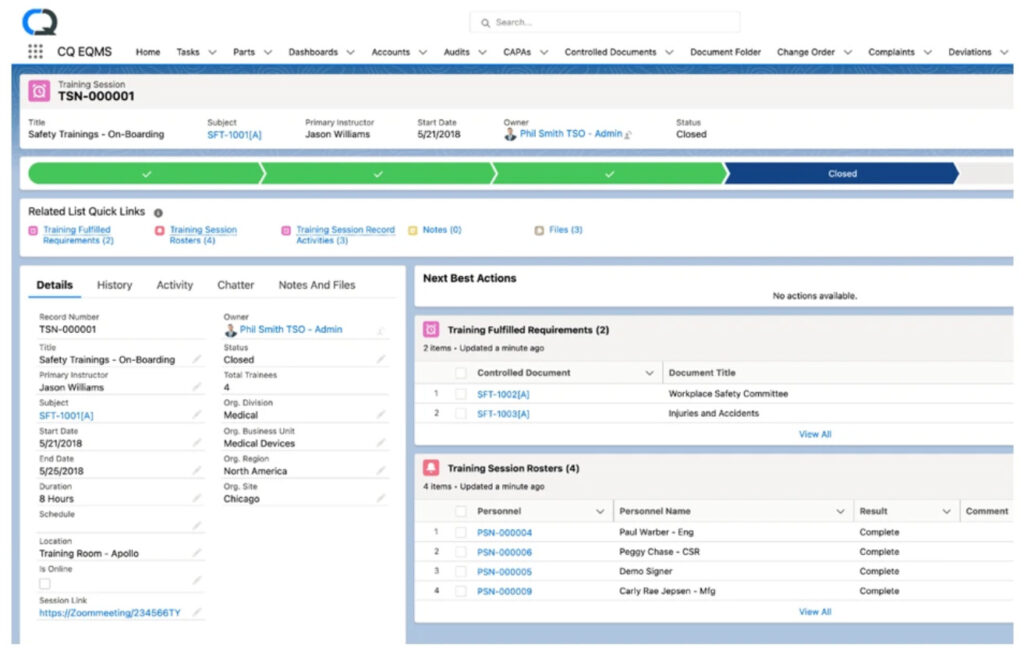
ComplianceQuest QMS software fits small to mid-sized life science companies that are rapidly scaling and want a single platform for quality, product management, and health and safety. ComplianceQuest’s environmental, health, and safety (EHS) solutions are particularly relevant for manufacturers.
ComplianceQuest is hosted on the Salesforce platform and inherits Salesforce’s attributes such as multi-tenant infrastructure, authentication and security controls, and configuration and integration options.
ComplianceQuest’s differentiator is a Salesforce-native architecture that reduces integration friction when quality data must connect to Customer Relationship Management (CRM) or Enterprise Resource Planning (ERP) systems. ComplianceQuest’s value proposition includes AI features branded as CQ.AI for summarization and routing assistance inside quality workflows.
ComplianceQuest core QMS functionality includes CAPA, change management, audit management, equipment management, laboratory investigations, management review, non-conformance, and product inspection.
ComplianceQuest supports compliance with the major life science and manufacturing requirements, including GMP, FDA 21 CFR Part 820, ISO 13485, EU MDR, EU IVDR, ISO 9001, and computerized system controls described in FDA 21 CFR Part 11 and EU GMP Annex 11. ComplianceQuest is pre-validated, although the ownership of validation remains with the regulated company. The customers must conduct validation activities to support the specific processes and configurations they build on the system. ComplianceQuest supports its customers throughout the validation processes by assisting in IQ, OQ, PQ, and Functional Requirement Specifications (FRS). Validation packages are provided with every update.
ComplianceQuest user experience is built on Salesforce user interface (UI) patterns, including list views, dashboards, and record pages, which benefit teams with existing Salesforce users and admins.
ComplianceQuest implementation and onboarding typically follow a vendor-led rollout by an onboarding and implementation expert. Reviewers commonly report implementation timelines of about 5 months.
ComplianceQuest uses a subscription licensing model, and the pricing plan is tailored to customer requirements.
ComplianceQuest scalability aligns with Salesforce capabilities for adding users or modules as the quality system expands. ComplianceQuest’s flexibility centers on configuration on the Salesforce platform, which supports broad process coverage.
Capterra reviewers cite flexibility as a strength, while permissions management is a recurring friction point. G2 reviewers describe replacing paper processes and improving complaint and change handling workflows. ComplianceQuest reviews on Software Advice describe improved compliance process efficiency and adaptability.
10. Intellect QMS
Intellect QMS is a quality management platform built for regulated industries, including life sciences, process manufacturing, and discrete manufacturing. Intellect fits small companies in rapid growth that want to start with essential modules and add more functionality over time.
An example of the Intellect user interface is shown below.
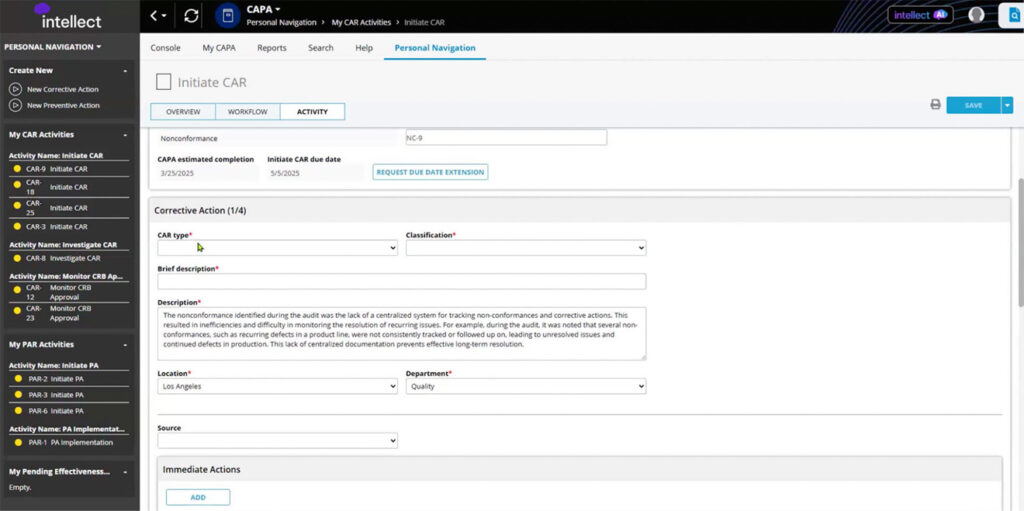
Intellect QMS suits life science companies, especially life science manufacturing teams, that want to automate their workflows and replace paper, Excel, and manual shop-floor processes. Intellect’s main focus is on mid-market and enterprise organizations.
Intellect QMS deployment supports multiple models, including cloud, on-premise, and hybrid options. All deployment models include data encryption, user authentication, and audit tracking. Intellect meets the requirements of ISO 9001, FDA 21 CFR Part 11, General Data Protection Regulation (GDPR), and more.
Intellect QMS differentiates itself through a library of pre-built apps and a no-code workflow designer for tailoring quality processes.
Intellect QMS modules cover document control, employee training, nonconformance, CAPA, and audit management. Additional add-on apps, such as supplier management, change management, and risk management, support the core modules.
Intellect QMS supports customer validation activities, but the regulated company retains validation responsibility. Intellect QMS provides professional services, including initial validation and ongoing validation support.
Intellect QMS integration uses SOAP and REST API architecture and supports bidirectional integration with third-party systems. Intellect QMS interoperability supports links to ERP, MES, and CRM.
Intellect QMS uses a console-style landing page with navigation to apps, dashboards, record views, and open tasks. User reviews on Software Advice highlight ease of use and strong support, while some reviewers note that the workflow designer is harder for beginners without a dedicated system owner.
Intellect QMS implementation and onboarding follow a services-led model shaped by factors such as configuration, app selection, and migration scope. Intellect uses annual subscription tiers, and extended implementation, training, and support packages carry separate service costs.
Intellect QMS scalability supports adding apps, workflows, integrations, and analytics as the company grows. Intellect QMS flexibility supports deeper configuration, but that configuration depth increases validation effort for small teams.
User reviews on G2 describe Intellect QMS as one connected system for core QMS activity with strong workflow visibility. User reviews on Capterra describe strong system flexibility, but one reviewer notes that some workflows and configurations do not reflect typical pharmaceutical and medical device QMS workflows.
Why Do Small Life Science Businesses Choose SimplerQMS Over Other eQMS Solutions?
Small life science companies choose SimplerQMS because it combines life science expertise and regulatory coverage with pre-configured QMS workflows and vendor-led validation. SimplerQMS uses a subscription-based pricing model. The subscription includes QMS modules, implementation, onboarding, validation, unlimited training, cloud hosting, document templates, data migration, and 24/7 expert support. This bundled model reduces rollout effort and budget risk. SimplerQMS is a QMS software designed for life science companies.
The main reasons to choose SimplerQMS over other eQMS solutions are outlined below, along with the impact of each reason on small life science companies.
| Criteria | SimplerQMS | Other Life Science QMS Vendors | Impact on Life Science Companies |
|---|---|---|---|
| Life science focus | SimplerQMS platform is designed for life sciences quality processes and regulated workflows. | Other vendors are often generic QMS platforms that require adaptation and configurations to cover life science needs. | Life science teams reduce compliance gaps and ensure faster adoption. |
| Validation approach | SimplerQMS is delivered fully validated (IQ, OQ, PQ) according to ISPE GAMP 5 at no extra cost. | Other vendors often provide partial validation documentation (IQ, OQ), or the validation is fully customer-driven, or a paid service. | Teams reduce compliance risk and cost, and have faster roll-out, especially with limited QA/IT resources. |
| Implementation timeline | SimplerQMS onboarding typically takes 6 to 8 weeks. | Other vendors often run longer projects due to configuration and validation needs. | Startups and small companies accelerate digital transformation and reduce operational disruption. |
| Training model | SimplerQMS training is unlimited during onboarding and after go-live. | Other vendors often cap training hours or charge per session, seat, or package. | Adoption improves across small teams, which reduces nonconformances/deviations caused by misuse. |
| Ongoing support | SimplerQMS customer support continues after go-live. | Other vendors often separate support into tiers or charge separately for administrator help. | QA teams reduce downtime and leverage supplier expertise. |
| Scalability for SMB Life Science Companies | SimplerQMS is purpose-built to scale with small and mid-sized life science organizations. | SMBs often outgrow initially chosen systems. Enterprise systems are usually overly complex and pricey for SMB needs. | Companies scale without requiring replacing the system, which reduces future migration risk. |
| Hidden service costs | SimplerQMS subscription bundles validation, onboarding, training, hosting, and support. | Other vendors often add costs for validation support, migration, training, integrations, and premium support. | Small teams maintain predictable budgets. |
| Audit readiness | SimplerQMS embeds audit trails, compliant e-signatures, standardized life science workflows, and linked records to ensure inspection readiness. | Other vendors often require extra setup or configurations to support life science audits. | Small teams improve compliance and reduce audit preparation time. |
| Interconnected QMS Modules | SimplerQMS offers fully integrated modules for document control, training, nonconformance, CAPA, change control, audits, supplier management, and more. | Modules often require additional configuration to achieve full integration. | Companies ensure seamless traceability and reduce compliance gaps. |
| Life science expertise in services | SimplerQMS provides life science expertise during implementation, training, and support. | Other vendors often deliver services through generalist teams or partner networks. | Small life science businesses reduce interpretation risk across FDA, EU, and ISO expectations. |
What Should Small Life Science Organizations Consider Before Buying a QMS Software?
Small life science organizations should consider QMS software selection as a structured buying process that evaluates compliance fit, user adoption, service scope, and total cost before contract commitment.
Small life science organizations should consider the following steps when choosing a QMS software.
- Assess Your Requirements: Assess regulatory scope, quality processes, validation expectations, integration needs, user roles, and budget limits. QMS requirements assessment prevents small teams from buying an overly complex enterprise platform that drives admin burden or a simple tool that increases compliance risk.
- Research and Compare QMS Software Vendors: Compare QMS modules, deployment models, validation approaches, implementation services, training and support coverage, security, and pricing structure. QMS vendor research helps eliminate vendors that do not meet life science requirements or lack transparency in service costs.
- Select Relevant QMS Software Vendors: Select vendors that match the company’s operational needs and compliance requirements. Narrowing QMS vendor list based on relevance removes generic platforms that require heavy adaptation and extra validation effort.
- Attend Demos and Vendor Meetings: Review interface usability, workflows, and software capabilities during demos and vendor meetings. QMS demos expose daily friction points that drive low adoption in small teams.
- Consider Getting a Trial: Test real document approvals, training assignments, deviation-to-CAPA linkage, change control routing, audit preparation, and signature flows in the trial. QMS trials identify adoption barriers and reveal whether configuration changes will increase validation workload.
- Shortlist QMS Software Vendors: Shortlist vendors based on compliance fit, usability, service scope, and total cost. QMS shortlist creation ensures focus on vendors that best align with compliance and operational priorities of the organization.
- Get a Demonstration of Specific Use Cases: Review how the eQMS handles core quality process workflows in specific use-case demonstrations.
- Negotiate With Shortlisted QMS Providers: Compare total cost of ownership, contract terms, implementation timelines, training and support services, customization needs, service-level agreement terms, and compliance obligations. The contract negotiation helps avoid unexpected costs, such as add-ons, that small companies did not budget for.
- Make Final Decision: Align quality, operations, and IT stakeholders on the system’s compliance, usability, implementation plan, scalability, and contract terms. The selected quality management software must support continuous compliance, operational efficiency, and scalability as the organization grows.
