Pharmaceutical QMS (Quality Management System) software is a digital platform, often referred to as an eQMS, that standardizes, automates, and controls quality processes within a pharmaceutical company. The primary purpose of pharmaceutical QMS software is to support pharmaceutical companies in complying with applicable requirements, such as FDA 21 CFR Parts 210–211 and Part 11, EU GMP and Annex 11, and ICH Q10. The eQMS supports core pharmaceutical quality processes, including document control, training, deviations, corrective and preventive actions (CAPA), Out-Of-Specifications (OOS) management, change control, audits, supplier management, risk management, equipment management, and complaints, using secure access, audit trails, e-signatures, and end-to-end traceability.
In 2026, the 8 best pharmaceutical QMS software solutions are the following.
- SimplerQMS: SimplerQMS is a cloud-based QMS software tailored for life sciences and delivered fully validated to GAMP 5, with predefined GMP- aligned workflows. SimplerQMS is best for small to mid-sized pharma companies that want fast deployment and low internal validation effort, while still supporting larger companies that prefer standardized workflows.
- TrackWise: TrackWise is an enterprise eQMS, available on cloud or on-premise, with strong configurability and interconnected workflows. TrackWise fits mid-sized to large pharma companies with multi-site operations, high record volumes, and mature quality systems that can handle heavier configuration, integration, and validation overhead.
- Veeva Vault QMS: Veeva Vault QMS is a cloud QMS software on the Vault platform that connects quality with other Vault applications. Veeva suits mid-sized to large global pharma companies needing a unified ecosystem across quality, clinical, regulatory, and more, and is able to perform customer-side validation activities.
- Dot Compliance: Dot Compliance is a Salesforce-based eQMS offering pre-configured and pre-validated workflows designed for the life science industry. Dot Compliance’s best fit is small to mid-sized pharma companies that want fast implementation, controlled customization, and scalability in the Salesforce environment.
- Qualio: Qualio is an eQMS focused on usability and quick adoption, supporting early-stage and scaling pharma teams building a first QMS or transitioning from paper-based systems.
- QT9: QT9 is a QMS platform with cloud or on-premise options. QT9 is positioned as simple and cost-effective, and it is provided with a full validation package. QT9 is best for small to mid-sized pharma manufacturers that want core modules and fast rollout without enterprise complexity.
- Scilife: Scilife is a QMS software on the Amazon Web Services (AWS) platform with out-of-the-box workflows and tiered modules. Scilife is best for small and mid-sized life science companies that want to start with document/training and expand into CAPA, change control, events, audits, suppliers, risk, and equipment, while completing part of the validation internally.
- MasterControl: MasterControl is an enterprise-grade eQMS suite with broad modules and analytics. MasterControl suits mid-sized to large pharma needing deep configuration and integrations, with customer-owned validation supported by vendor toolkits and typically longer implementations.
When choosing a QMS for a pharmaceutical company, the main factors to consider include regulatory fit, validation approach, required modules, audit support, integration needs, scalability, usability, training, implementation, migration support, and total cost of ownership.
SimplerQMS can be the best choice for many pharmaceutical companies because it combines life-science-specific, predefined workflows with full validation aligned to GAMP 5. SimplerQMS includes validation in the subscription, which reduces CSV burden, cost, and compliance risk. SimplerQMS further supports audit readiness through closed-loop traceability that links records across quality processes. SimplerQMS provides native Microsoft Office 365 integration for controlled Word and Excel document authoring and supports API-based integration with common enterprise systems. SimplerQMS follows a structured 6-to-8-week onboarding program with migration support and includes unlimited training and ongoing support to speed adoption.
1. SimplerQMS
SimplerQMS is a cloud-based electronic Quality Management System (eQMS) designed for life science companies. SimplerQMS deployment uses a Software-as-a-Service (SaaS) model with cloud hosting on Amazon Web Services.
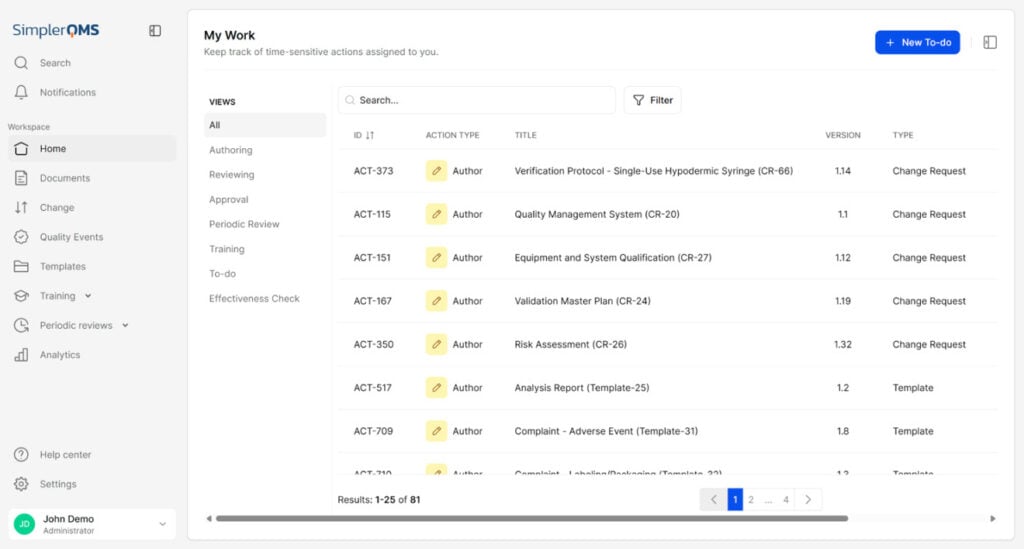
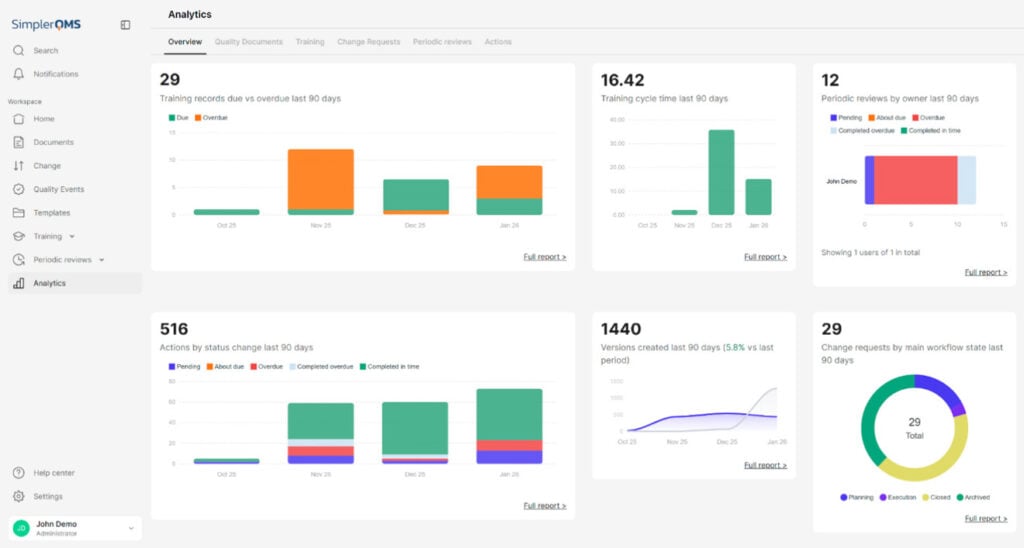
Examples of the SimplerQMS user interface are shown below.
SimplerQMS target industries include pharmaceuticals, biotechnology, medical devices, laboratories, Contract Manufacturing Organizations (CMOs), Contract Development and Manufacturing Organizations (CDMOs), and Contract Research Organizations (CROs). SimplerQMS is particularly suited to small to mid-sized life science companies, including organizations in the 11 to 500 employee range, with the capability to support larger enterprises.
A key differentiator of SimplerQMS is that it is delivered fully validated according to GAMP 5. Full validation is part of the subscription, along with unlimited training and support. This approach makes SimplerQMS particularly suitable for companies, including life science organizations, that want a ready-to-use platform with predefined workflows aligned with life science regulatory and quality expectations.
SimplerQMS provides integrated QMS modules covering core quality processes including document control, change control, training management, deviation management, OOS management, CAPA management, audit management, supplier management, equipment management, complaint management, and risk management. In SimplerQMS, records can be linked across quality processes, providing full traceability.
SimplerQMS supports compliance with major pharmaceutical requirements such as FDA 21 CFR Parts 210–211, EU GMP, and ICH Q10, and complies with 21 CFR Part 11 and EU GMP Annex 11.
SimplerQMS validation approach follows ISPE GAMP 5 guidance and provides full validation documentation, reducing customer validation workload and cost. SimplerQMS supports audit readiness with standardized workflows, audit trails, access control, and Part 11 and Annex 11-compliant e-signatures.
SimplerQMS integration and interoperability include native Microsoft Office 365 integration, so teams create, review, and approve controlled documents in familiar Word and Excel formats within the QMS workflows. SimplerQMS supports API-based connectivity and can integrate with Enterprise Resource Planning (ERP), Laboratory Information Management System (LIMS), Electronic Laboratory Notebook (ELN), Product Lifecycle Management (PLM), Customer Relationship Management (CRM), and Manufacturing Execution System (MES).
SimplerQMS supports mobile access for distributed teams and offers a few configuration options that keep customization limited to protect validation status. SimplerQMS improves usability with subscription-included unlimited training and guided adoption, reducing the learning curve for QA and operations teams as they move from paper to electronic QMS.
SimplerQMS implementation and onboarding follow a structured 6-to-8-week rollout that covers kickoff, analysis, configuration, data migration, training, and go-live support guided by a dedicated project manager. SimplerQMS migration support includes document migration across common file formats, preserving data integrity while saving customers time and effort.
SimplerQMS pricing uses a subscription-based model that includes selected QMS modules, system validation, implementation and onboarding, cloud hosting, data migration, unlimited training, updates, and ongoing support. Prospective customers can request a live demo, and pricing remains transparent to support planning and financial predictability.
SimplerQMS scalability supports small teams and growing organizations. The platform can handle increased documentation volume and regulatory requirements, new users, new sites, new lines, and new products, supporting customer needs as the quality system expands.
User feedback on G2, Capterra, GetApp, and Software Advice highlights life-science expertise, reduced validation burden, and knowledgeable and responsive customer support teams.
2. TrackWise
TrackWise is an enterprise-level eQMS used by large, highly regulated organizations that run complex quality workflows across sites and teams. TrackWise deployment supports a cloud-based SaaS option named TrackWise Digital and an on-premise option referred to as TrackWise QMS.
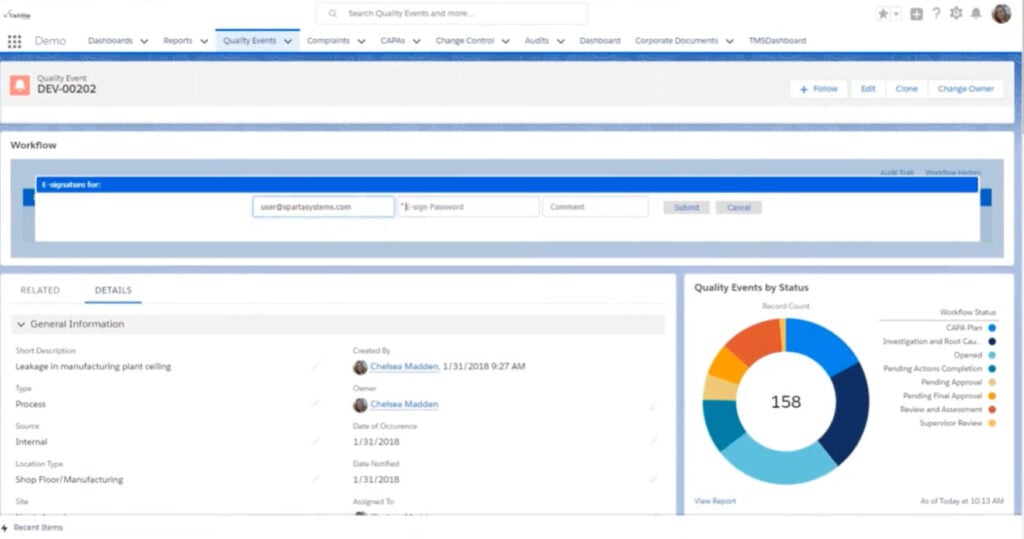
An example of the TrackWise Digital user interface is shown below.
TrackWise targets highly regulated industries, including pharmaceuticals, biotechnology, medical devices, and diagnostics, within regulated life sciences. TrackWise is ideal for medium-sized to large enterprises that manage multi-site operations, complex compliance needs, and high user and record volumes.
TrackWise’s key differentiator is enterprise configurability that supports interconnected quality processes across global environments. Companies best suited for TrackWise include established manufacturers with mature quality systems that need a highly configurable enterprise eQMS.
TrackWise QMS modules that support the pharmaceutical industry include document management, CAPA management, change management, deviations and quality events, Out-Of-Specification handling, complaint management, audit management, supplier quality management, quality risk management, and training management. The TrackWise process architecture supports linked records, for instance, enabling quality events to be linked to investigations or CAPAs.
TrackWise Digital includes the pre-built Quality Process Accelerators (QPAs), which are pre-validated quality processes, enabling faster deployment and lower validation workload. TrackWise is aligned with FDA 21 CFR Part 11 and EU Annex 11 requirements. The system supports audit readiness with controlled workflows and built-in electronic records and signature controls.
TrackWise Digital leverages the Salesforce platform, including Salesforce’s extensive API library, to offer integration options and connect to other enterprise systems. TrackWise supports integration with ERP, MES, PLM, LIMS, and CRM.
TrackWise user experience emphasizes structured quality workflows. TrackWise Digital offers mobile accessibility supporting distributed teams.
TrackWise implementation and onboarding timelines depend on configuration, validation, and integration needs. TrackWise onboarding support is provided by subject matter experts, who map current processes to TrackWise capabilities and guide configuration and validation. TrackWise offers training programs that support structured user onboarding.
TrackWise pricing and licensing follow a subscription-based model for SaaS deployments and a perpetual licensing model for some on-premise deployments, with cost driven by the number of users, QMS processes, and configuration depth. TrackWise costs often increase with integration and configuration services.
TrackWise scalability supports global enterprises that need many users, large document volumes, and complex workflows across facilities and regions. TrackWise has extensive customization options, while maintenance and validation efforts tend to rise as customization and integrations grow over time.
TrackWise customer feedback on G2, Capterra, GetApp, and Software Advice highlights strong configuration capabilities and audit support, paired with concerns about usability and training effort in some environments.
3. Veeva Vault QMS
Veeva Vault QMS, named Veeva QualityOne, is a cloud-based QMS built for regulated industries. Veeva Vault QMS deployment uses a multi-tenant cloud SaaS platform built on the Veeva Vault architecture.
An example of the Veeva Vault QMS user interface is shown below.
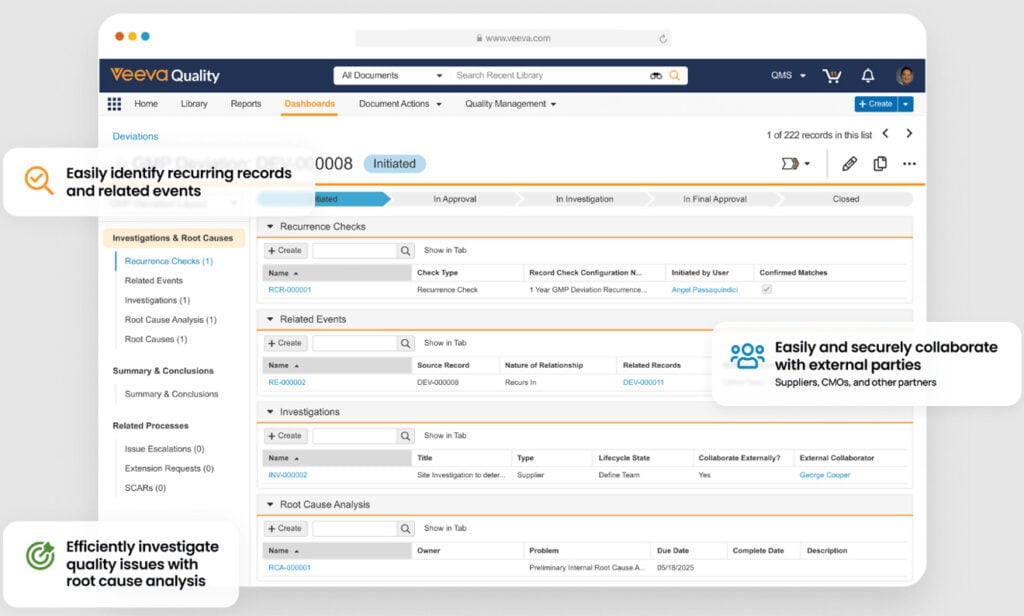
Veeva Vault QMS target industries are life sciences, including the pharmaceutical industry, and other regulated industries such as consumer-packaged goods and specialty chemicals. Veeva Vault QMS is best suited for mid-sized to large global enterprises that need one platform connecting quality, regulatory, medical, and clinical processes.
Veeva’s key differentiator is the Vault ecosystem that centralizes quality, clinical, regulatory, medical, and commercial in one cloud platform. Veeva Vault QMS fits complex organizations with high documentation volumes and multi-site operations.
Veeva QualityOne core modules cover deviations, complaints, change control, audits, quality risk management, and supplier quality management. Veeva Vault QMS document control runs through Veeva QualityDocs. Veeva Vault QMS training management is handled through Veeva Training. Veeva Vault QMS applications are unified and offer end-to-end connectivity.
For Veeva Vault QMS, validation responsibilities are shared between the vendor and the customer. Veeva qualifies the hosted infrastructure and core system functionality, providing the Installation Qualification (IQ) and Operational Qualification (OQ) documentation. However, customers remain responsible for validating the system within their specific operational environment through User Acceptance Testing (UAT) and Performance Qualification (PQ).
Veeva Vault QMS assists its customers in meeting Part 11 and EU Annex 11 requirements and includes the relevant compliance assessments in Veeva ComplianceDocs. Veeva Vault QMS supports audit readiness by enforcing controlled workflows and compliant audit trails.
Veeva Vault QMS integration uses the published Vault API for data import, update, and retrieval. Veeva Vault QMS integration covers ERP, MES, PLM, LIMS, and CRM connectivity.
Veeva provides a modern interface designed for enterprise use, with structured navigation and intuitive Vault-based components. Veeva Vault QMS onboarding often needs more extensive training because of the platform’s complexity. Veeva Vault QMS mobile access uses the Vault mobile environment.
Veeva Vault QMS implementation timelines vary depending on included modules and applications, and validation approach. Veeva provides a range of services to its customers, including professional services during system deployment and the operational phase, technical services for integration, migration, and custom applications, and educational services.
Veeva Vault QMS pricing uses a subscription model that scales by user volume and added Vault applications. Veeva Vault QMS runs vendor-led demos rather than free trials. Additional costs can arise from services, integrations, and customer validation obligations.
Veeva Vault QMS supports scalability for global enterprises with large documentation volumes and distributed teams on one cloud platform. Veeva Vault QMS expands in functionality through additional Vault applications across the Vault suite as operations grow.
Veeva Vault QMS customer feedback on G2, Capterra, GetApp, and Software Advice mentions easy integrations and usability, while some report poor search functionality. Customers report positive ratings for controlled workflows, with notes on the system’s cost and complexity.
4. Dot Compliance
Dot Compliance is a cloud-based QMS software that provides an out-of-the-box, pre-configured solution for life science organizations. Dot Compliance is deployed entirely as a SaaS solution on the Salesforce cloud infrastructure.
An example of the Dot Compliance user interface is shown below.
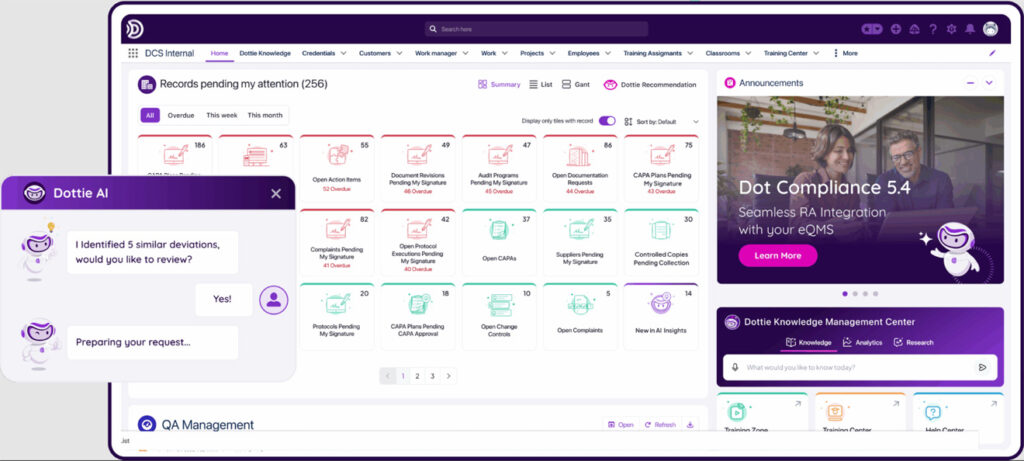
Dot Compliance target industries include pharmaceuticals, biotechnology, medical devices, and cosmetics. Dot Compliance is ideal for small to mid-sized organizations.
Dot Compliance’s key differentiator is pre-configured, pre-validated workflows that support rapid deployment and reduce customer validation effort. Dot Compliance’s best-fit is pharmaceutical companies that want a pre-configured solution, avoiding highly customized workflows that increase validation effort.
Dot Compliance core QMS functionalities include document management, training management, quality event management, change management, audit management, complaint management, CAPA management, risk management, supplier quality management, and equipment management. Dot Compliance provides linking capabilities between records, improving traceability.
Dot Compliance is delivered with a full validation package. Version control, access management, and electronic signatures meet FDA 21 CFR Part 11 and EU GMP Annex 11 requirements. Dot Compliance supports pharmaceutical companies in complying with GxP, ISO, and ICH expectations.
Dot Compliance integration and interoperability use the Salesforce platform foundation and provide broad integrations through Salesforce APIs, supporting connections to ERP, CRM, and other enterprise systems.
Dot Compliance is hosted on the Salesforce interface, and it has guided workflows and dashboards that support easy adoption for teams already using Salesforce. Dot Compliance mobile accessibility uses Salesforce mobile capabilities, supporting distributed teams.
Dot Compliance implementation and onboarding are faster than many enterprise QMS platforms, with a common duration from weeks to a few months. Dot Compliance onboarding support includes structured deployment and training, with optional migration services based on customer needs.
Dot Compliance pricing uses a subscription model, with pricing driven by the chosen QMS modules and the number of users. Demos are available, and free trials are described as uncommon on review listings. Dot Compliance additional costs often come from integrations and any customer-led validation work tied to unique configurations.
Dot Compliance’s scalability and flexibility support small to mid-sized pharmaceutical companies that need to add users, sites, and modules over time, while staying in the Salesforce environment. Dot Compliance is flexible within Salesforce configuration options, with constraints for organizations that require extensively customized workflows beyond the pre-configured and pre-validated model.
User feedback on G2, Capterra, GetApp, and Software Advice highlights the ease of use and support during implementation, with some reviews noting customization limitations and rigidity due to dependency on the Salesforce platform.
5. Qualio
Qualio is a cloud-based eQMS designed for life sciences teams. Qualio deployment uses a SaaS model, so teams access the platform without needing a local infrastructure.
An example of the Qualio user interface is shown below.
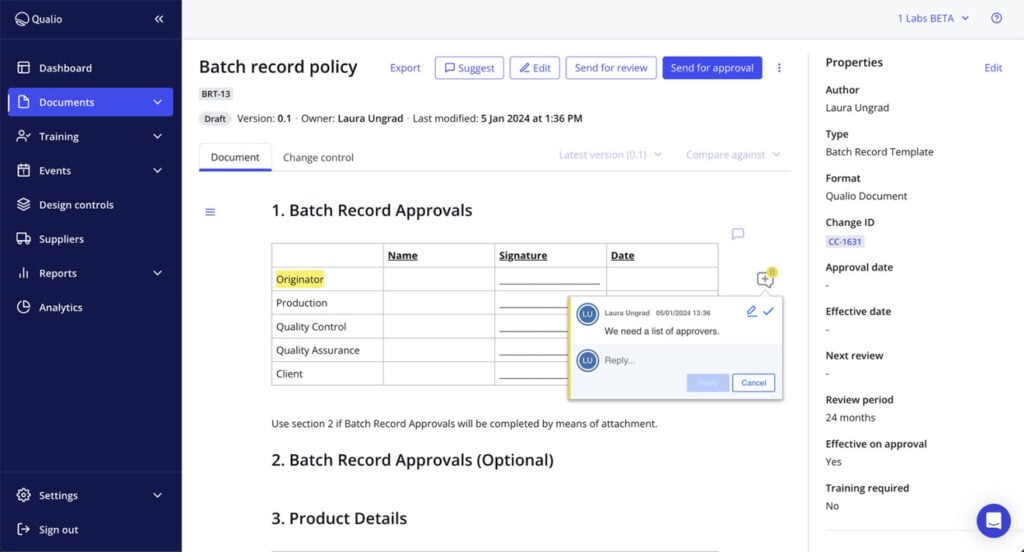
Qualio target industries include pharmaceuticals, medical devices, biotechnology, contract research, and contract manufacturing organizations across the life sciences. Qualio focuses on small to mid-sized and scaling organizations that are building a first QMS or transitioning from a paper-based QMS to an eQMS.
Qualio’s key differentiator is the ease of use, without requiring heavy configuration or intense validation efforts. Qualio best-fit companies include early-stage to mid-growth life science companies, such as pharmaceutical companies, preparing for audits, standardizing their procedures, and replacing paper-based processes.
Qualio QMS modules include document control, training management, supplier management, risk management, audit management, CAPA and nonconformance management, and change control. Qualio provides a unified workspace to link documents and quality activities, giving teams basic visibility into connected records, such as procedures, with change controls and training assignments.
Qualio is not delivered as a fully validated system, and customers must perform testing for the system configurations they build into Qualio. Qualio validation support includes downloadable validation templates intended to reduce validation effort. Qualio is aligned with pharmaceutical regulatory requirements, such as FDA 21 CFR Part 11, ICH Q10, and GxP.
Qualio integrates with Jira and OneDrive in the core integrations group, plus product development integrations such as Asana and Azure DevOps, and customer support and CRM tools such as Salesforce and Zendesk. Qualio integration access ties to subscription tier, with all customers receiving core system integrations, and higher tiers unlocking a wider range of integrations.
Qualio user experience emphasizes a clean interface and simpler navigation intended to reduce training time for new users. Teams can access the platform on desktop or mobile devices. Qualio customization stays limited compared with highly customized enterprise QMS implementations, which helps control system complexity and validation workload.
Qualio implementation and onboarding support includes guided onboarding and customer success support, with an average implementation range stated as 30–60 days. Document migration is handled by the customer, supported by vendor guidance and structured onboarding steps.
Qualio uses a subscription-based model with tiers, with tier differences tied to user counts and added capabilities such as AI assistance for core quality processes. Qualio offers vendor-led demos. Added costs typically come from optional services and internal effort tied to configuration, migration, and customer validation obligations.
Qualio scalability supports small and mid-sized organizations as documentation volume, users, and QMS module needs grow. Qualio’s flexibility fits early-stage and growth-stage quality systems, while highly bespoke enterprise process designs may push teams toward heavier platforms.
Customer feedback on G2, Capterra, GetApp, and Software Advice emphasizes ease of use, with mentions of fast onboarding and responsive support, with some users noting limitations on document editing.
6. QT9
QT9 is a quality management platform designed for quality-focused organizations that need controlled workflows and audit-ready records in a unified system. QT9 deployment supports cloud-based hosting or on-premise installation, depending on customer requirements.
An example of the QT9 QMS user interface is shown below.
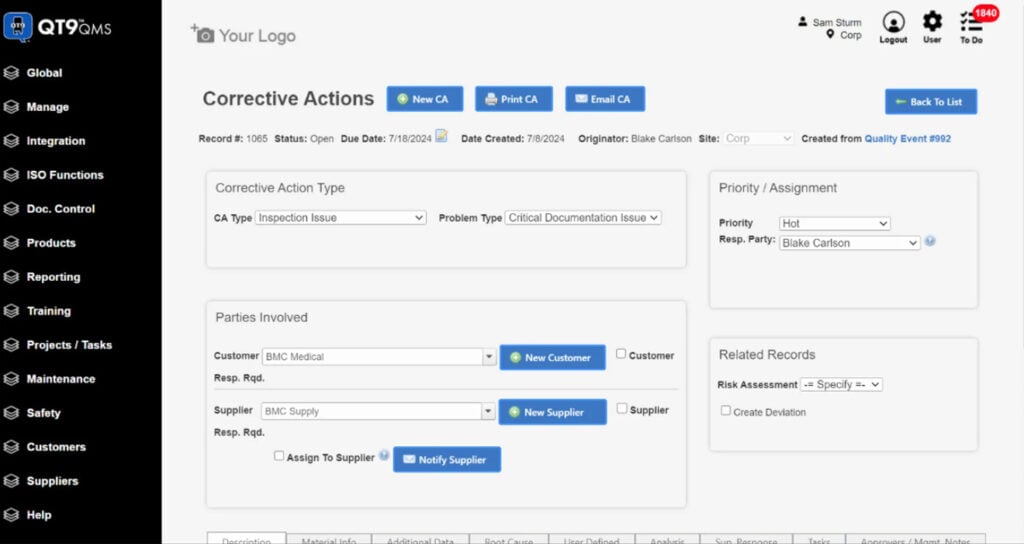
QT9 target industries include FDA-regulated life sciences, including pharmaceuticals, and ISO-certified manufacturers across regulated manufacturing. QT9 is ideal for small to mid-sized companies that want a faster rollout and lower administrative workload.
QT9’s key differentiator is its simplicity and cost-effectiveness. QT9 is best suited for companies seeking fast implementation and minimal system administration.
QT9 QMS functionalities for pharmaceuticals include document control, employee training, electronic batch records, CAPA management, change management, audit management, risk management, complaint handling, and supplier quality workflows aligned to common pharma quality operations.
QT9 is pre-validated with a validation package, including IQ, OQ, and PQ executed protocols. QT9 supports compliance with pharma requirements, including support for FDA 21 CFR Parts 210-211 and Part 11.
QT9 uses APIs for integration with customer systems. The QT9 platform includes ERP and MRP offerings from the same vendor ecosystem, which may reduce integration effort when customers adopt multiple QT9 products.
QT9 user experience and usability focus on a clean interface and intuitive workflows intended to reduce training needs for small teams.
QT9 implementation and onboarding timelines vary by migration volume and scope, with review sources describing the implementation time as around three months. QT9 onboarding support includes training, implementation services, and data migration support.
QT9 follows a subscription-based model, with vendor-led demos and some listings indicating free-trial availability.
QT9 scales to support small and mid-sized organizations, adding users, documents, and workflows over time. The system is flexible within the existing configuration model, though companies needing deep customization may outgrow it.
Customers on G2, Capterra, GetApp, and Software Advice emphasize ease-of-use and customer service, while noting limited customization and basic workflow capabilities.
7. Scilife
Scilife is a QMS platform built for life science companies. Scilife is deployed as a SaaS solution hosted on Amazon AWS, using a virtual private cloud setup.
An example of the Scilife user interface is shown below.
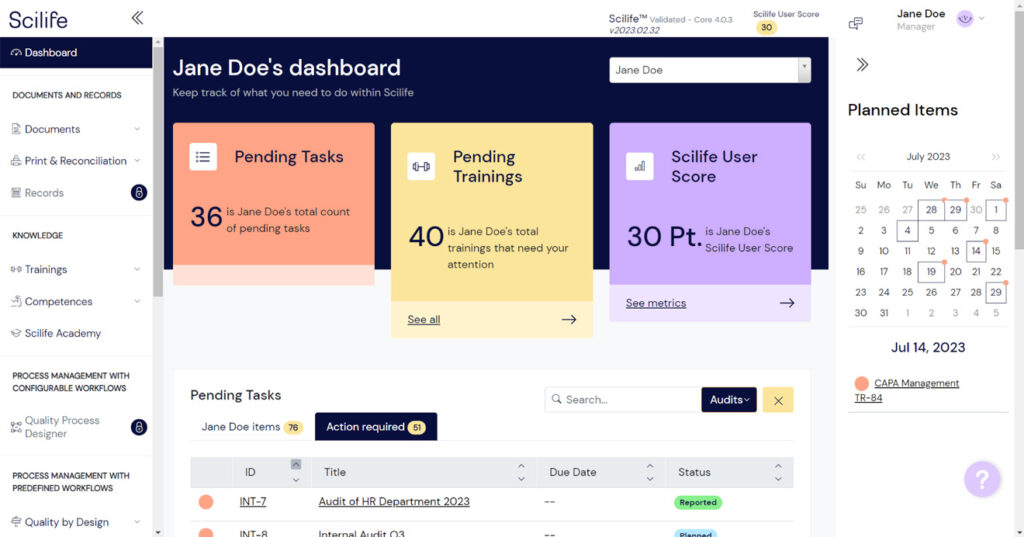
Scilife serves life science industries, including pharmaceuticals, biotechnology, advanced therapy medicinal product programs, medical devices, medicinal cannabis, CROs, and CMOs. Scilife targets companies of any size, with a focus on small and medium-sized teams.
Scilife’s key differentiator is out-of-the-box functionality that maps to common life science quality requirements, reducing initial build and configuration work. Scilife is best suited to growing life science teams that want to digitize quality processes.
Scilife’s QMS modules use plan-based coverage. Scilife’s essential plan includes document control and training management. The core plan adds CAPA, change control, and quality events. Scilife core+ plan adds audit management, supplier management, risk management, and equipment management.
Although Scilife is validated according to GAMP5 and 21 CFR Part 11, customers must conduct validation activities to support their own specific processes and configurations. Scilife provides customers with a validation package they can use as the basis for their validation. Scilife complies with FDA 21 CFR Part 11, EU Annex 11, and GxP expectations.
Scilife integrates with Microsoft Office and SSO options, such as Microsoft Entra ID and Active Directory. Scilife offers additional API-driven integrations for other systems.
Scilife uses a modern interface designed for fast adoption across quality and operational teams. Scilife training support includes Scilife Academy learning content and optional training programs.
Scilife implementation and onboarding are described in customer feedback as a structured project with recurring touchpoints, with review-reported timelines often landing around four months, depending on scope, migration, integrations, and customer validation work. Scilife onboarding support includes optimization, training sessions, document migration assistance, and initial setup, while customers contribute internal resources to complete validation.
Scilife pricing and licensing use a subscription model with tiered plans, and organizations can request a demo or a free trial. Scilife scales to support added users or modules through tier expansion across plans.
Customer feedback on G2, Capterra, GetApp, and Software Advice reports life science fit, ease-of-use, and practical support during adoption, while some customers report minor bugs and module-specific gaps.
8. MasterControl
MasterControl is an enterprise-level electronic quality management system built for regulated industries. MasterControl is deployed as a cloud-based SaaS platform for its Quality Excellence suite.
An example of the MasterControl user interface is shown below.
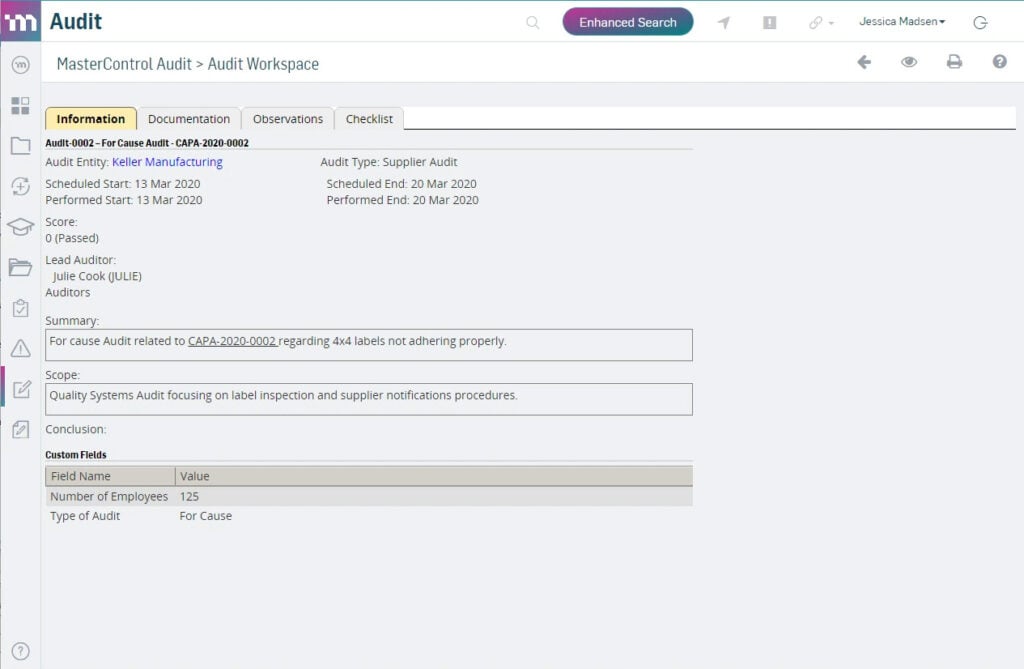
MasterControl target industries include pharmaceuticals, biotechnology, medical devices, diagnostics, dietary supplements, and food and beverage. MasterControl is ideal for mid-sized to large enterprises that need configurability and integration depth. MasterControl offers pre-configured options to support smaller teams.
MasterControl’s key differentiator is an enterprise-grade architecture designed for large-scale implementations across many users and sites. Companies best suited for MasterControl include organizations with established quality departments, large user bases, and multi-system integration requirements.
MasterControl QMS modules include document management, training management, quality events, change control, audit and risk management, supplier management, and analytics and business intelligence tools.
MasterControl is not delivered as a fully validated system, and customers must conduct part of the computer system validation in accordance with regulatory expectations. MasterControl provides validation toolkits, including the Validation Excellence Tool (VxT) and Validation on Demand (VoD), which are available for Manufacturing Excellence (Mx) and Advanced Data and Process Technology (ADAPT) platform products.
MasterControl supports integrations to ERP, MES, CRM, PLM, LIMS, and other enterprise systems through the MasterControl API Toolkit. MasterControl API Toolkit is available as a separate toolkit, with guidance and support offered by MasterControl teams.
MasterControl targets enterprise users, giving mobile access options and extensive configuration capabilities for different process needs.
MasterControl implementation and onboarding uses a six-step approach, including planning, discovery, configuration, validation, deployment, and onboarding. MasterControl implementation duration varies, with user feedback on review platforms reporting an average implementation time of 7 months. MasterControl migration services are offered through separate service programs, with an extra cost.
MasterControl pricing follows a named-user license model, with different rights and access levels available based on user needs. For Quality Excellence, there are three levels of users, including basic, standard, and complete. The system does not offer a free trial, and additional costs may arise from integration, validation, and training support, or advanced configurations. Enterprise pricing reflects the platform’s scale and is typically higher than small and medium-sized-focused QMS solutions.
MasterControl’s scalability supports large enterprises with large document volumes and complex quality processes. MasterControl has strong flexibility, with validation workload increasing as configuration and connected systems expand.
MasterControl customer feedback on G2 Capterra, GetApp, and Software Advice highlights strong compliance capabilities, with notes about the learning curve and configuration complexity.
What Are the Best Pharmaceutical eQMS Solutions Based on Company Size?
Pharmaceutical eQMS solutions differ in suitability based on organization size, workflow complexity, QMS maturity, and available resources. Pharmaceutical company size influences whether a pre-configured, validated eQMS or a highly configurable enterprise platform is a better fit.
Below are the company size categorization groups of pharmaceutical organizations and the common eQMS needs.
- Startups and Small-Sized Pharma Companies: Pharmaceutical startups and small pharma companies need a GMP-compliant eQMS, with audit-ready, pre-configured workflows, and a limited validation workload. Small pharma companies prefer eQMS solutions that provide pre-configured workflows, guided onboarding, and full validation packages to reduce internal effort and leverage supplier expertise.
- Medium-Sized Pharma Companies: Medium-sized pharma companies require a balance of configurability, scalability, and regulatory and validation coverage. Medium-sized pharma companies expand product lines, enter new markets, and face more frequent audits, so eQMS flexibility and more advanced capabilities matter.
- Large Pharma Enterprises: Large pharma enterprises need highly configurable QMS platforms that support global operations, multi-level approvals, and complex QMS workflows. Large pharma enterprises require broad integration capabilities and extensive customization to cover their sites and functions.
Company size directly influences which eQMS software is the best choice. Larger pharmaceutical companies run more complex workflows, so QMS selection shifts toward advanced configuration, deeper integration options, and scalability for high-volume and multi-site operations. Smaller pharmaceutical companies run simpler workflows, so QMS selection shifts toward pre-configured processes and faster adoption. Smaller companies often lack resources to meet validation obligations tied to highly configurable enterprise systems, since the higher configurability increases the software risk. Smaller pharmaceutical companies gain most value from pre-configured, pre-validated eQMS platforms, while large enterprises gain most value from configurable systems that support their operational complexity.
Best eQMS for Pharmaceutical Startups and Small Manufacturers
Pharmaceutical startups and small manufacturers prefer QMS software that provides pre-configured, GMP-compliant workflows, fast onboarding, and full validation documentation to support their quality operations and compliance obligations without requiring extensive resources.
The best eQMS solutions for pharmaceutical startups and small manufacturers are given below.
- SimplerQMS: SimplerQMS is a fully validated, pharma-specific eQMS that suits small teams needing rapid deployment with low internal validation effort. SimplerQMS offers rapid implementation, transparent pricing, unlimited training and support, integrated modules, and QMS documentation templates, suited for early-stage and growing companies.
- Dot Compliance: Dot Compliance provides an eQMS with pre-configured workflows that reduce setup time and support structured adoption in the pharmaceutical industry. Dot Compliance suits small organizations that want a scalable platform without building custom workflows that increase validation effort.
- QT9: QT9 provides QMS software with cloud or on-premise deployment options and a focus on cost control and fast rollout. QT9 suits small manufacturers that want core QMS modules without enterprise platform complexity.
- Qualio: Qualio provides a cloud eQMS solution focused on ease of use for early-stage pharmaceutical teams building an initial QMS or replacing paper processes. Qualio fits small organizations that want to digitalize their QMS with a short learning curve and guided onboarding.
Best eQMS for Mid-Sized Pharma Companies
Mid-sized pharma companies prefer eQMS platforms that support compliance as audit frequency increases and can scale to accommodate expanding operations across multiple products, sites, and partners. Mid-sized pharma companies prefer QMS software that offers cross-module linking capabilities, integrations with ERP and LIMS, and validation support that reduces workload during upgrades or configuration changes.
The best eQMS solutions for mid-sized pharma companies are listed below.
- SimplerQMS: SimplerQMS suits mid-sized pharmaceutical companies that want a life-science-specific eQMS with predefined workflows and closed-loop quality processes. SimplerQMS’s full validation documentation, provided with every system update, suits mid-sized companies that need to scale their quality processes without investing heavily in validation or IT resources.
- Dot Compliance: Dot Compliance suits mid-sized pharma organizations that want pre-built workflows with the ability to extend capabilities through Salesforce integrations. Dot Compliance fits teams that need fast deployment and modular expansion, while keeping customization limited to subsequently control any revalidation needs.
- Scilife: Scilife supports mid-sized companies that want out-of-the-box quality workflows with module expansion as process needs grow. Scilife fits pharmaceutical teams that need document and training control first, then add CAPA, change control, quality events, audits, suppliers, risk, and equipment management as maturity increases.
- TrackWise: TrackWise suits fast-growing mid-sized pharma companies that are rapidly scaling or preparing for enterprise-level operations, while accepting a higher cost than small and mid-sized-focused software. TrackWise pre-configured Quality Process Accelerators (QPAs) allow organizations to adopt pre-validated, industry-aligned workflows while retaining the ability to expand into fully customized enterprise configurations as they grow.
Best eQMS for Enterprise Pharmaceutical Organizations
Enterprise pharmaceutical organizations prefer eQMS platforms that support global operations, multi-site governance, complex approval chains, high record volume, and wide integration and configuration options.
The best eQMS solutions for enterprise pharmaceutical organizations are the following.
- Veeva Vault QMS: Veeva Vault QMS is suitable for pharmaceutical enterprises that want integration across regulatory, clinical, quality, safety, medical, and commercial systems. Veeva fits global teams that need structured workflows for their QMS processes, with expansion across other Vault applications.
- MasterControl: MasterControl suits enterprises that need broad module coverage and business analytics supporting cross-site oversight. MasterControl suits organizations that require structured implementation, configuration, and integration capabilities.
- TrackWise: TrackWise is designed for enterprises that require high configurability and connected quality processes across global environments and multi-site operations. TrackWise suits organizations with mature quality systems that can support system maintenance and validation workload that comes with extensive configuration.
How Is SimplerQMS Different from Other Pharmaceutical QMS Software?
SimplerQMS differentiates from other pharmaceutical QMS software by offering a fully validated eQMS designed for life sciences, with pre-configured GMP-compliant workflows. SimplerQMS life science expertise shapes the platform design and continues through implementation, unlimited training, and ongoing support.
The main differentiators of SimplerQMS are presented in the table below.
| Criteria | SimplerQMS | Other Pharmaceutical eQMS Vendors | Impact on Pharmaceutical Companies |
|---|---|---|---|
| Industry focus | SimplerQMS is focused on life sciences, including pharmaceuticals, with predefined workflows aligned to regulatory needs. | Other vendors often serve broader industries or require more configuration to fit in pharma workflows. | Pharmaceutical teams gain faster implementation, with fewer configurations and minimized validation effort. |
| Validation approach | SimplerQMS is delivered fully validated according to GAMP 5, at no extra cost. | Other vendors often provide partial validation (only IQ/OQ), or validation is fully customer-driven, requiring significant internal resources. | Pharmaceutical teams can reduce CSV workload, cost, and compliance risk, by leveraging vendor documentation. |
| Audit Readiness | Embedded audit trails, compliant e- signatures, standardized workflows, and linked records ensure inspection readiness. | Audit readiness often depends on customer configuration and validation documentation. | Stronger compliance and reduced audit preparation time. |
| Implementation model | SimplerQMS onboarding follows a structured six-to-eight-week program with a dedicated project manager, plus migration support. | Other vendors often run longer rollouts due to heavy customization and complex setup. Migration is often provided as a service, at additional cost. | Pharmaceutical teams accelerate implementation time and reduce operational disruption. |
| Training and support | SimplerQMS includes unlimited training and ongoing support in the subscription price. | Other vendors frequently limit training hours, or support may not include deep life science expertise. | Pharmaceutical teams improve user adoption, ensure higher compliance, and minimize operational risks. |
| Workflow design | SimplerQMS delivers predefined, interlinked quality processes that support closed-loop traceability. | Other vendors often rely on a heavier configuration to connect processes. | Pharmaceutical teams improve traceability across their QMS processes. |
| Customization strategy | SimplerQMS limits customization to protect the validated status. The pre-configured workflows are GMP-compliant and ready to use. | High configuration may be required before use, increasing complexity and validation obligations. | Pharmaceutical teams minimize validation effort, reduce project risk, and go-live faster. |
| Microsoft Office productivity | SimplerQMS includes native Microsoft Office 365 integration to work in the familiar Office format inside controlled workflows. | Other vendors often rely on separate authoring tools. | Pharmaceutical teams ensure smoother user adoption. |
| Cost structure | SimplerQMS subscription includes QMS modules, validation, onboarding, cloud hosting, unlimited training, and support. | Other vendors often add costs across licensing, validation services, integrations, and training. | Pharmaceutical teams improve budget predictability and reduce unplanned spend. |
| Best-fit profile | SimplerQMS is best suited for small to mid-sized pharma, or large enterprises that prefer pre-configured workflows across sites. | Other vendors often target enterprise-first or SMB-first with different trade-offs. | Pharmaceutical teams select a platform that matches QMS maturity, resources, and complexity. |
| Expertise through delivery | SimplerQMS leverages life science expertise throughout platform design and extends this expertise through implementation, training, and support. | Other vendors often rely more on partners or generalist customer service teams. | Pharmaceutical teams gain stronger guidance for regulated workflows and improve their audit readiness. |
What Is Pharmaceutical QMS Software?
Pharmaceutical QMS software is a digital platform designed to centrally manage, automate, and control quality processes within a pharmaceutical company.
QMS software addresses errors associated with manual and paper-based processes, reduces inconsistencies across workflows, and replaces fragmented tracking systems, such as separate spreadsheets for CAPA and deviations. QMS software also improves visibility into quality metrics and accelerates review and approval cycles.
The key components of QMS software are document control, training management, change control, CAPA, deviation management, audit management, risk management, supplier management, complaint handling, batch records, equipment management, and reporting dashboards. The QMS software modules depend on industry needs and regulatory expectations.
The primary benefits of using QMS software in the pharmaceutical industry include improved compliance, reduced human error, faster workflows, stronger audit readiness, full traceability across quality processes, proactive risk management, and continuous improvement. Pharmaceutical eQMS supports collaboration, data integrity, and operational efficiency while maintaining regulatory control.
How Is Pharmaceutical QMS Software Different from Generic QMS Software?
Pharmaceutical QMS software differs from generic QMS software because pharmaceutical operations follow stricter regulatory control, formal validation expectations, and industry-specific quality processes.
The main differences between pharmaceutical QMS software and generic QMS software are given below.
- Stronger Regulatory Alignment: Pharmaceutical QMS software aligns directly with FDA 21 CFR Parts 210, 211, and 11, EU GMP, EU Annex 11, and ICH Q10. Generic QMS software targets broader ISO frameworks and lacks built-in controls aligned with pharmaceutical requirements.
- Industry-Specific Processes and Terminology: Pharmaceutical QMS software includes modules such as deviation, CAPA, change control, OOS, complaints, training, supplier management, and equipment management. Generic QMS software includes more general processes or terminology that require adaptation for use in the pharmaceutical industry.
- Validation and Audit Support: Pharmaceutical QMS software provides support in computer system validation through system architecture and vendor-provided documentation. Pharmaceutical QMS software supports compliance with pharmaceutical requirements, improving audit readiness. Generic QMS software needs additional configurations to meet pharmaceutical expectations, raising additional validation obligations, and rarely provides audit support.
- Compliant Built-in Controls: Pharmaceutical QMS software includes electronic signatures, role-based access, audit trails, controlled versioning, and full traceability, designed to meet pharma regulatory expectations. Generic QMS software often requires additional configuration to reach comparable compliance levels.
- Vendor Expertise: Pharmaceutical QMS software vendors bring life science and pharmaceutical domain knowledge into platform design, implementation, training, and support. Generic QMS vendors usually provide broader, cross-industry expertise without specialized focus on pharmaceutical regulations.
Should Pharmaceutical Companies Choose Cloud-Based or On-Premises eQMS?
Pharmaceutical companies today should choose a cloud-based eQMS, since cloud deployment reduces IT burden and supports faster scaling.
Cloud-based eQMS platforms support browser and mobile access for distributed teams, multi-site work, and remote audits. On-premises eQMS deployments depend on internal network access, VPN controls, and site-level infrastructure that limits external collaboration.
Cloud-based eQMS solutions shift the cost structure toward subscription-based pricing and more predictable spend. On-premises eQMS deployments involve higher upfront costs, including licensing, server and infrastructure investment, and internal IT resources.
Cloud-based eQMS reduces the internal resource burden for IT and infrastructure roles, allowing quality teams to focus on process ownership and configuration needs. On-premises eQMS require more internal resources for infrastructure management and technical administration.
Regarding validation, cloud-based eQMS platforms often include vendor qualification of the hosted infrastructure, which reduces customer validation effort. For on-premises eQMS, the customer may have the responsibility for infrastructure qualification, increasing internal workload.
For cloud-based eQMS, maintenance responsibility stays mainly with the vendor, including security patching, backups, hosting monitoring, and platform upgrades. On-premises eQMS maintenance responsibility may fall to the customer.
What Capabilities Should Pharmaceutical QMS Software Support?
Pharmaceutical QMS software capabilities must support both quality management processes and system and technical controls required in regulated pharmaceutical environments. Pharmaceutical QMS process capabilities cover document control, training management, change management, deviation management, CAPA management, complaint management, OOS management, audit management, risk management, equipment management, and supplier management. Pharmaceutical QMS system and technical capabilities cover electronic records management, electronic signatures, standardized workflows, role-based access controls, audit trails, data integrity controls, system security, and integration and configuration capabilities.
Quality Management Processes
The following quality management processes form the foundation of pharmaceutical QMS software.
- Document Control: Document control manages SOPs, policies, specifications, and records through version control, standardized review and approval workflows, audit trails, and controlled access, ensuring only approved documents are used in operations by authorized people.
- Training Management: Training management links the controlled documents and quality processes to role-based training, tracks training completion and effectiveness, and provides evidence that personnel are qualified to perform GMP activities.
- Change Management: Change management controls modifications to processes, documents, systems, and equipment, supporting impact assessment on product quality, validation, and regulatory compliance, and monitoring controlled change implementation and effectiveness verification.
- Deviation Management: Deviation management captures unplanned events and process failures, ensuring timely investigation, root cause and impact analysis, and documented batch release decision.
- CAPA Management: CAPA management refers to the corrective and preventive actions raised from deviations, audits, complaints, and risk assessments, with tracking for closure and effectiveness verification.
- Complaint Management: Complaint management handles product quality complaints, ensuring investigation, traceability to batches, process or product deviations, and CAPAs.
- OOS Management: OOS management supports the investigation of out-of-specification laboratory results, linking lab investigations to deviations, root cause analysis, corrective actions, and batch disposition decisions.
- Audit Management: Audit management supports planning, executing, and tracking internal, customer, supplier audits, and regulatory inspections, including findings/ CAPA closure and follow-up actions.
- Risk Management: Risk management concerns the identification, assessment, and mitigation of quality risks using structured methodologies aligned with ICH Q9 guidelines.
- Equipment Management: Equipment management tracks qualification status, maintenance, and calibration, supporting equipment reliability, operational efficiency, and audit readiness.
- Supplier Management: Supplier management supports initial qualification and ongoing monitoring of suppliers’ performance that impacts product quality and compliance.
System and Technical Capabilities
The following system and technical capabilities ensure pharmaceutical QMS software operates in a compliant, secure, and reliable manner while supporting regulated quality processes.
- Electronic Records Management: Electronic records management controls creation, storage, versioning, retention, and retrieval of quality records, ensuring records remain complete, accurate, and readily available for inspections or quality investigations.
- Electronic Signatures: Electronic signatures support secure review, approval, and sign-off of quality records, linking identity, intent, and timestamp in line with regulatory expectations of the FDA Part 11 and EU Annex 11.
- Standardized Workflows: Standardized workflows enforce consistent execution of quality processes, ensuring reviews, approvals, and escalations follow defined internal procedures.
- Role-Based Access Controls: Role-based access controls restrict system access based on user role, preventing unauthorized actions and protecting sensitive quality data.
- Audit Trails: Audit trails capture all relevant user actions, changes, and deletions, providing traceability and transparency required to maintain data integrity.
- Data Integrity Controls: Data integrity controls protect records from alteration, loss, or unauthorized deletion, supporting ALCOA+ principles across the system.
- System Security: System security includes authentication, authorization, encryption, backup, and disaster recovery controls that protect quality data and system availability.
- Integration and Configuration Capabilities: Integration and configuration capabilities support controlled connectivity with other enterprise systems and allow structured configuration without compromising validation or compliance.
What Requirements Should Pharmaceutical QMS Software Support?
Pharmaceutical QMS software must support the requirements listed below.
- FDA 21 CFR Part 211: FDA 21 CFR Part 211 sets current GMP requirements for finished pharmaceuticals manufactured or marketed in the United States. QMS software must support QMS workflow and documentation requirements, and computerized system requirements included in Part 211. QMS software supports compliance with Part 211 by structuring standardized quality workflows, maintaining controlled documentation, and strengthening evidence of compliance. For instance, the training management module of a QMS software supports personnel qualification requirements of Part 211 through role-based assignments and training completion tracking.
- FDA 21 CFR Part 11: FDA 21 CFR Part 11 establishes rules for electronic records and electronic signatures used in FDA-regulated activities, including medicinal product manufacturing, QC, storage, and distribution. A QMS software must comply with the technical and operational controls specified in Part 11. Part 11-compliant QMS software must provide audit trails, access controls, permanent linking of signatures and associated records, and clear signature manifestations.
- EU GMP (EudraLex Volume 4): EU GMP or EudraLex Volume 4 defines GMP expectations for medicinal products manufactured or imported in the EU. A QMS software must support general QMS expectations outlined in EU GMP, while specialized computerized system requirements are described in Annex 11. A QMS software designed to support compliance with EU GMP maps to the pharmaceutical quality system expectations in Chapter 1, which guides the required QMS process coverage, including deviation management, CAPA management, and change control. Other EU GMP chapters drive modules, such as equipment management (Chapter 3) and supplier management (Chapter 7).
- EU Annex 11: EU Annex 11 sets expectations for computerized systems used in GMP environments, including system validation, data integrity, and security. An EU Annex 11-compliant QMS software must be validated and support audit trails and electronic signatures that carry the same weight as handwritten approvals. An EU Annex 11-compliant QMS software must enforce strong security, backup, and access controls, including strict permissions for batch release approvals.
- ICH Q7: ICH Q7 focuses on GMP for active pharmaceutical ingredients (APIs) and includes provisions for computerized systems and quality systems. A QMS software must support both technical controls and operational quality processes tied to API manufacture. ICH Q7-compliant technical functionalities include a validated computerized system, since it is used in GMP processes, audit trails, and access restrictions. The QMS software modules must include document control, change control, supplier qualification, equipment management, CAPA management, and OOS management.
- ICH Q10: ICH Q10 defines the pharmaceutical quality system model applicable across the entire product lifecycle. QMS software must enable key processes, such as change control, CAPA management, process performance and product quality monitoring, and management review, supporting QMS continuous improvement. The monitoring of process performance and product quality is streamlined through dashboards and trending capabilities provided by an eQMS software.
- GAMP 5: GAMP 5 provides a risk-based framework for validating computerized systems covering the system’s lifecycle, consolidating industry best practices for validation. GAMP 5 suggests leveraging software vendor expertise regarding validation. Where a fully validated pharma QMS software has been selected, the software should be validated following ISPE guidance.
How Much Does Pharmaceutical QMS Software Cost?
The pharmaceutical QMS software cost range varies by company size, process complexity, customization, and validation requirements. Pharmaceutical eQMS cost commonly starts near $5,000–$15,000 for a company with 5–10 employees, while larger organizations with 50–200 employees or more often reach $25,000–$100,000.
Pharmaceutical QMS software pricing typically follows the models listed below.
- Tiered: Tiered pricing uses predefined packages tied to features and the number of users, so companies select a plan that matches their scope and growth stage.
- Per-Module: Per-module pricing ties cost to selected modules, so companies pay for functionalities they need such as CAPA, change control, training, suppliers, and audits.
- Per User Licensing: Per-user pricing scales cost by named or active users, so growth in QA, operations, and site users increases the fees.
- Flat Rate: Flat-rate pricing uses one subscription fee covering modules and users, so small companies gain predictable budgeting.
- Custom: Custom pricing fits enterprise deployments needing advanced configuration, multi-site rollout work, and higher integration.
The main factors affecting a pharmaceutical QMS software’s final cost are the following.
- Number of Users: The number of users drives cost in per-user models and influences tier selection in tiered plans.
- Included QMS Modules: Included modules raise cost as scope expands into CAPA, change control, training, risk management, audits, equipment, or batch records.
- Implementation and Validation Services: Implementation and validation services increase cost when processes require extensive configuration, integrations, and broader testing.
- Training and Ongoing Support: Training and support costs vary by vendor and can be metered or billed separately, influencing long-term costs.
- Scalability and Integration: Scalability and integration increase cost when ERP, LIMS, MES, or PLM connectivity requires paid APIs or integration validation.
- Level of Regulatory Support: Regulatory support and vendor-provided validation documentation increase cost if not included in the subscription price.
How Is QMS Software Implemented in Pharma Companies?
To implement QMS software in a pharmaceutical company, the following nine steps must be taken.
- Strategy and Planning: QMS software implementation planning defines scope, sites, timeline, resources, process priorities, and includes validation strategy and ownership of approvals.
- Supplier Selection: QMS software supplier selection evaluates platform and supplier fit, regulatory support, validation support, security features, technical functionalities, and included services, such as onboarding, training, and support.
- Gap Analysis and URS Definition: QMS gap analysis maps current processes to target workflows and defines the User Requirements Specifications (URS) that outline what the eQMS must achieve to fulfill operational and compliance needs.
- System Design or Configuration: The QMS software is configured or designed to match the approved URS.
- System Testing and Validation: QMS software validation includes testing, according to IQ, OQ, and PQ protocols, and producing evidence that the system functions as intended and meets regulatory and operational requirements before use.
- Personnel Training: QMS software users receive role-based training on system use and functionalities to ensure correct and consistent operational use.
- Data Migration: Existing documents, records, and quality data are migrated from the legacy system into the new QMS software using a controlled migration process to maintain data integrity.
- System Deployment and Go-Live: The validated eQMS is released for operational use.
- System Maintenance and Periodic Review: QMS software is periodically evaluated during the system’s operational phase to maintain a validated and compliant state.
What Is a Validated QMS Software for Pharmaceutical Companies?
A validated QMS software for pharmaceutical companies is a QMS software that has documented, evidence-based testing proving it functions as intended and supports regulatory, quality, and operational requirements for use in the pharmaceutical industry. QMS software validation confirms the system is reliable, consistent, and fit for intended use without introducing compliance risk in GMP quality operations.
Validated QMS software types differ by who performs and owns the validation work and test evidence.
The different types of validated pharmaceutical QMS software are listed below.
- Fully validated software by the vendor: The vendor delivers a complete validation package for customer review and approval, while the regulated user retains final responsibility for acceptance and intended use.
- Validated by the customer: Customer-executed validation places full IQ, OQ, and PQ planning and execution on the regulated organization, including protocol writing, test execution, and evidence collection.
- Partially validated (customer and vendor): Shared validation splits work, where the vendor qualifies the base system and environment (IQ, OQ) and the customer validates configuration and operational use (PQ).
The stages of QMS software validation are listed below.
- IQ: Installation Qualification confirms the QMS software is installed correctly in the intended environment with the required components, versions, and configurations.
- OQ: Operational Qualification verifies core functions operate as intended under expected conditions using predefined test cases tied to requirements.
- PQ: Performance Qualification confirms the system performs reliably for real business processes in the pharmaceutical organization, including configured workflows and integrations.
How To Choose QMS Software for Pharmaceutical Companies
To choose QMS software for a pharmaceutical company, the following steps should be taken.
- Assess Your Requirements: Requirements assessment includes defining regulatory and operational requirements, including compliance obligations, quality processes, validation requirements, integration needs, and budget limits. Clear requirements prevent overspending on overly complex systems or selecting inadequate solutions that cannot support compliance or operational needs.
- Research and Compare QMS Software Vendors: Vendor research compares modules, deployment model, validation approach, implementation and onboarding, training and support, and pricing structure. Robust research ensures companies focus on vendors aligned with their requirements.
- Select Relevant QMS Software Vendors: Vendor selection filters the list of vendors to match company size, considering pharmaceutical expertise, compliance coverage, and customer feedback. This selection process removes generic solutions that require heavy adaptation for pharmaceutical use.
- Get Demos and Have Meetings: Demos and meetings show system usability and workflow structure, revealing whether the system will realistically support QA and operations.
- Consider Getting a Trial: Trials allow users to test the system’s interface and usability with real scenarios, exposing adoption barriers before contract commitment.
- Shortlist QMS Software Vendors: Shortlisting is influenced by the eQMS’s overall value to pharmaceutical quality management processes. The companies can ask for references and case studies from other companies operating in pharma. Companies benefit from focusing on vendors that best align with their compliance and operational priorities.
- Get a Demonstration of Specific Use Cases: Use-case demonstrations test critical workflows such as deviation-to-CAPA-to-change-to-training linkage, audit finding closure, complaint handling, and role-based approvals, which prove process fit and quality data traceability.
- Negotiate With Shortlisted QMS Providers: Negotiating terms with shortlisted vendors helps compare pricing, contract terms, implementation timelines, training and support services, customization needs, total cost of ownership, service level agreement, and compliance issues, which reduces long-term cost surprises and compliance risk.
- Make Final Decision: Final decision aligns stakeholder consensus with system fit, validation approach, implementation plan, included services, scalability, and flexibility. Selecting the right solution supports continuous compliance, operational efficiency, and scalability as the organization grows.
The selection of a pharmaceutical QMS software improves when each step reduces uncertainty about compliance, validation workload, usability, and total cost of ownership. Choosing a QMS software becomes easier when demos, trials, and use-case walkthroughs confirm day-to-day workflow fit, while negotiation locks in included services, implementation plan, and scalability terms.
What Are the Key Questions to Ask Before Selecting a Pharmaceutical QMS Software?
Key questions to ask before selecting pharmaceutical QMS software are the following.
- How does the vendor ensure compliance with the pharmaceutical industry requirements? Vendor compliance support should include GMP and ICH Q10-aligned workflows, and Part 11 and Annex 11 requirements.
- Is the software built specifically for pharmaceutical or life sciences? Life-science specialization reduces customization needs and ensures fit to pharma terminology and workflows.
- Which core pharma processes are supported? Core process coverage should include document control, training, deviations, CAPA, change control, audits, supplier management, risk management, equipment management, complaints, and OOS support.
- Does the system have built-in data integrity controls? Data integrity should include audit trails, access control, version control, record retention controls, and protection against unauthorized change.
- Is the system fully validated? Validation delivery should be clearly defined regarding testing completed by vendor versus customer testing and documentation responsibilities.
- Does the vendor provide audit support? Audit support may cover inspection-ready validation documentation, compliant workflows, or guidance on pharmaceutical requirements.
- Can the software be easily integrated with existing systems? Integration should support APIs and common connections to ERP, LIMS, MES, PLM, or CRM systems.
- What are the software’s configuration options? Configuration should support needed workflows without creating a high validation burden.
- What are the system’s capabilities for growth and scalability to match the business’s expansion? Scalability should support added users, sites, product lines, and higher record volume without system replacement.
- How do the software’s deployment options align with the IT strategy? Deployment choice should match security policy, hosting preferences, and internal IT capacity.
- What happens if I do not have an internet connection? Offline behavior should be defined, including access limits, mobile constraints, and recovery of queued actions after reconnection.
- How long does a typical implementation take, and what is the implementation process like? Implementation should define phases, timeline, responsibilities, validation approach, and go-live readiness criteria.
- Is training included in onboarding services? Training scope should specify role-based sessions, materials, and limits on hours or trainees.
- Is data migration included in onboarding services? Migration scope should define which records and formats are included, plus verification steps and responsibilities.
- What is the total cost of ownership (TCO)? TCO should include licensing, modules, validation services, integrations, migration, training, support, and internal resourcing.
What Are Common Mistakes Pharmaceutical Companies Make When Choosing QMS Software?
Common mistakes when choosing pharmaceutical QMS software are listed below.
- Not Prioritizing Compliance and Industry Fit: Pharma QMS software selection fails when software lacks GMP alignment, Part 11 and Annex 11-compliant controls, and life science workflows, forcing heavy customization and higher validation needs.
- Failing to Define URS: Failing to define URS results in unclear scope and weak requirement-to-test traceability, mismatched workflows, and gaps during validation and audits.
- Underestimating Validation and Resource Needs: Underestimating the CSV workload delays go-live date, increases cost, and leaves quality teams without time to execute planning, testing, documentation, or review obligations.
- Failing to Qualify the Vendor: Vendor qualification gaps weaken confidence in product quality, support responsiveness, security controls, and validation documentation, increasing supplier risk under GMP expectations.
- Ignoring Integration or Scalability Needs: Integration omissions create manual workarounds and fragmented data, while scalability omissions force early replacement when users, sites, or document volume increase.
- Overlooking Hidden Costs: Hidden cost drivers include paid APIs, validation services, migration services, premium support, training limits, and revalidation costs.
