Root Cause Analysis (RCA) is a structured problem-solving approach used to identify the underlying causes of quality issues, process failures, deviations, nonconformances, complaints, and other quality events. Root Cause Analysis (RCA) identifies the fundamental cause of a problem instead of correcting only its symptoms, enabling organizations to implement effective Corrective and Preventive Actions (CAPAs) and reduce the risk of recurrence.
Root cause analysis follows a systematic investigation process. The RCA process begins with defining the problem. The process continues with collecting evidence, analyzing evidence, identifying causal factors, verifying the root cause, implementing CAPAs, and checking CAPA effectiveness.
Different RCA types, methods, and tools are used depending on the complexity of the investigation, the available evidence, and the nature of the quality event. The main RCA approaches are logic-based, experimental, and statistical investigations. Structured RCA methods include the Eight Disciplines (8D) Method, Kepner-Tregoe Analysis, Apollo Root Cause Analysis, and TapRooT® Root Cause Analysis. Common RCA tools include the 5 Whys Analysis, Why-Why Tree, Fishbone (Ishikawa) Diagram, Events and Causal Factors Analysis (ECFA), Change Analysis, Is/Is Not Analysis, Barrier Analysis, and Fault Tree Analysis (FTA).
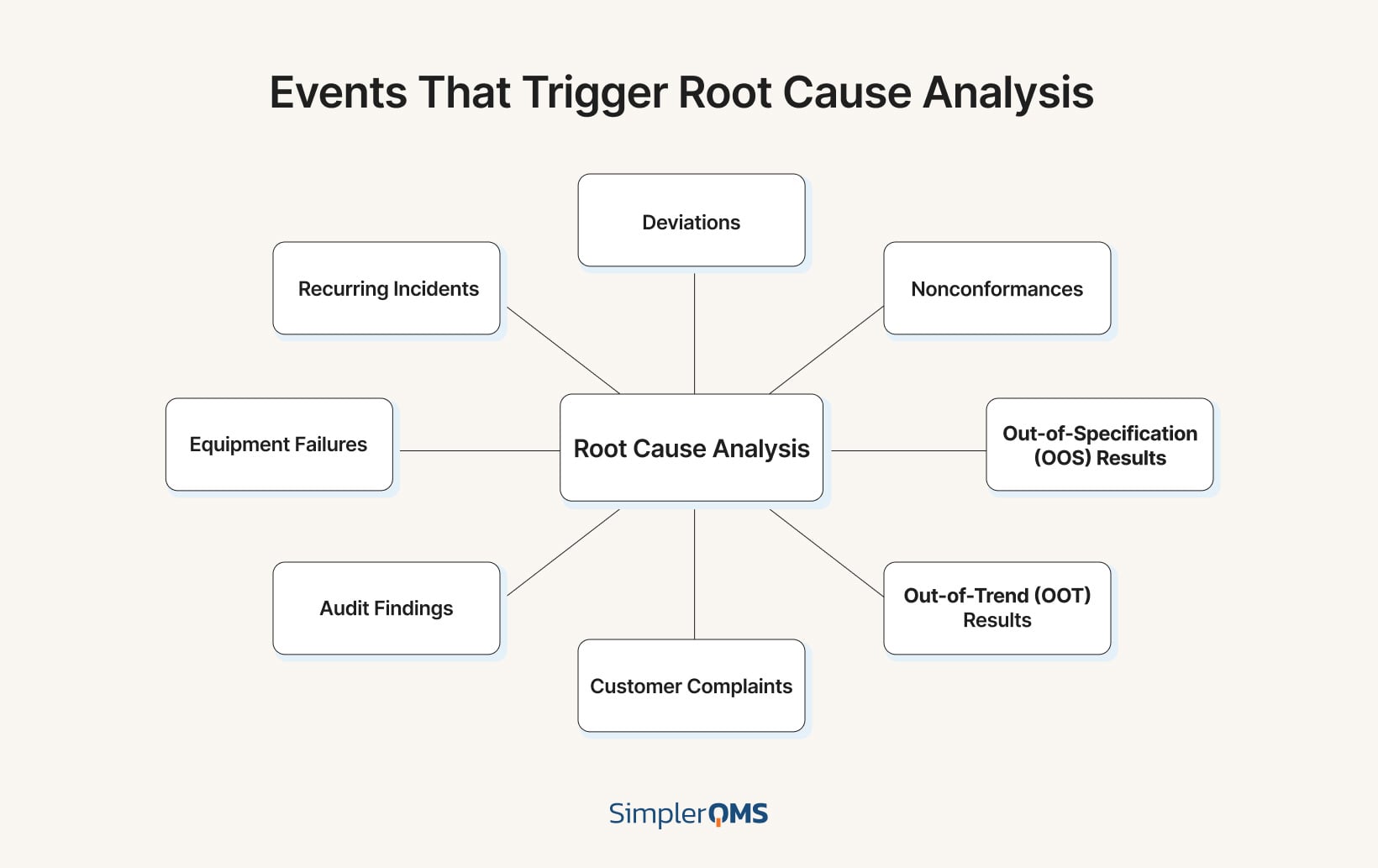
RCA is commonly triggered by deviations, nonconformances, out-of-specification (OOS) and out-of-trend (OOT) results, customer complaints, audit findings, equipment failures, and recurring incidents.
Organizations maintain controlled documentation throughout the RCA investigation. Controlled RCA documentation includes RCA reports, supporting evidence, deviation records, risk assessments, CAPA records, change controls, and records of investigation closure. These records demonstrate regulatory compliance and support inspection readiness.
Root cause analysis applies across pharmaceutical, biotechnology, medical device, laboratory, contract manufacturing organization (CMO), and contract research organization (CRO) environments. RCA helps these organizations investigate quality events, strengthen process performance, protect product quality, and support patient safety.
Modern quality management system (QMS) software, such as SimplerQMS, streamlines RCA by standardizing investigation workflows, centralizing quality records, integrating RCA with CAPA, deviations, complaints, and change control, and maintaining complete traceability throughout the investigation lifecycle.
What Is Root Cause Analysis (RCA)?
Root cause analysis (RCA) is a systematic problem-solving method that identifies the root cause of deviations, nonconformances, failures, complaints, out-of-specification (OOS) results, and other quality issues. Root cause analysis identifies the fundamental cause of a problem rather than its symptoms, enabling organizations to implement effective corrective and preventive actions (CAPAs) and prevent recurrence.
Root cause analysis is a core quality management process in the life sciences industry and is used throughout pharmaceutical, biotechnology, and medical device organizations. Companies perform RCA to investigate quality events such as deviations, nonconformances, complaints, audit findings, out-of-specification (OOS) and out-of-trend (OOT) results, equipment failures, supplier issues, and manufacturing incidents. Regulatory frameworks such as Good Manufacturing Practice (GMP), International Organization for Standardization (ISO) standards, and International Council for Harmonisation (ICH) guidelines require documented investigations and scientifically justified root cause determination to support product quality, patient safety, and regulatory compliance.
Root cause analysis originated in engineering and industrial quality management during the 20th century as organizations sought structured methods for investigating equipment failures, manufacturing defects, and operational incidents. RCA principles were later adopted across industries, including aviation, healthcare, nuclear power, and life sciences. These industries use systematic investigations to manage quality risks, improve process reliability, and meet regulatory requirements.
The primary goal of root cause analysis is to identify the underlying cause of a problem so that CAPAs eliminate the underlying cause rather than temporarily addressing the immediate issue. Effective RCA reduces recurring deviations, improves process performance, strengthens regulatory compliance, and supports continuous improvement through actions such as CAPA implementation, process redesign, procedure updates, and personnel retraining.
Root cause analysis differs from failure analysis because failure analysis focuses on how and why a product, component, or system failed, while RCA identifies the underlying cause that allowed the failure to occur. RCA distinguishes between direct causes, causal factors, and contributing factors. A direct cause is the event or action that immediately produced the problem. Causal factors are conditions or events that contributed to the problem and influenced its occurrence. Contributing factors are organizational, environmental, human, or process-related conditions that increased the likelihood or severity of the event. Direct causes, causal factors, and contributing factors overlap because RCA evaluates all 3 cause categories to determine the true root cause and prevent recurrence.
Why Is Root Cause Analysis Important?
Root cause analysis (RCA) is important because it identifies and eliminates the underlying causes of quality issues instead of repeatedly correcting symptoms. Effective RCA prevents recurring problems, improves process performance, reduces quality risks, and maintains regulatory compliance.
The main reasons why root cause analysis is important are listed below.
- Prevents Recurring Problems: RCA prevents recurring problems by identifying the underlying causes of deviations, nonconformances, complaints, and other quality events. Eliminating root causes reduces the likelihood that the same problem occurs again.
- Improves Product Quality: RCA improves product quality by identifying process weaknesses and quality risks that affect product quality. Correcting these issues improves product consistency and ensures that products meet approved quality specifications.
- Supports Regulatory Compliance: RCA supports regulatory compliance by providing documented investigations, scientifically justified root cause determinations, and effective CAPAs under frameworks such as GMP. This RCA evidence demonstrates that quality investigations are complete, scientifically justified, and properly documented.
- Reduces Quality Risks: RCA reduces quality risk by identifying deficiencies in processes, equipment, materials, documentation, or human activities before they result in additional quality issues. Early identification of root causes reduces operational risks and patient safety risks.
- Strengthens Continuous Improvement: RCA strengthens continuous improvement by providing information that organizations use to improve processes, update procedures, strengthen controls, and optimize quality management systems. These improvements increase operational efficiency and long-term process reliability.
Organizations that focus only on correcting symptoms rather than identifying and addressing root causes experience a higher risk of recurring deviations, repeated CAPAs, product defects, audit findings, and regulatory observations. This can result in production delays, increased investigation costs, and risks to product quality and patient safety. Some isolated issues may not recur, but unresolved systemic causes increase recurrence risk in controlled quality processes. Treating symptoms can resolve the immediate issue in some cases, but only eliminating the root cause prevents the problem from recurring.
What Are the Main Types of Root Cause Analysis?
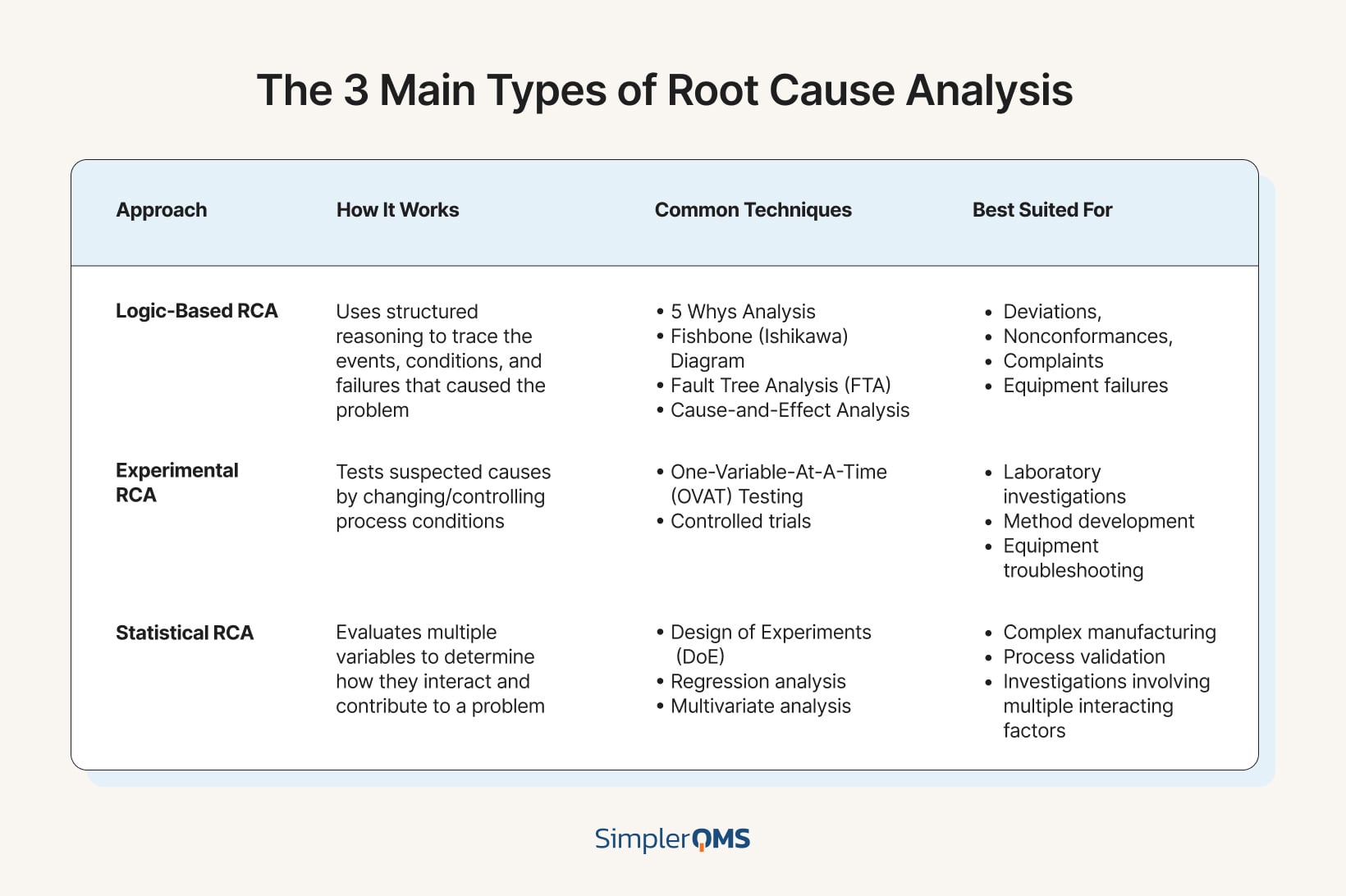
The 3 main approaches to RCA are logic-based, experimental, and statistical investigations. Each approach provides a different method for identifying and verifying root causes, and the most appropriate approach depends on the complexity of the problem, the available evidence, and the number of variables involved. Many quality investigations combine multiple approaches.
The 3 main approaches to root cause analysis are listed below.
- Logic-Based Root Cause Analysis: Logic root cause analysis uses structured reasoning to identify the sequence of events, conditions, and failures that caused a problem. Common RCA tools such as the 5 Whys, Fishbone (Ishikawa) Diagram, Fault Tree Analysis (FTA), and Cause-and-Effect Analysis support Logic RCA. Logic RCA is used to investigate deviations, nonconformances, complaints, equipment failures, and other quality events in life science organizations. More complex investigations may require experimental or statistical methods to confirm suspected causes.
- Experimental Root Cause Analysis: Experimental root cause analysis investigates suspected causes by performing controlled experiments or tests, deliberately changing process conditions to determine whether a specific factor influences the problem. A common experimental approach is One-Variable-At-A-Time (OVAT) testing, where investigators evaluate one factor while keeping all other variables constant. Experimental approaches are frequently used during laboratory investigations, method development, equipment troubleshooting, and process optimization. Experimental RCA is most effective when a limited number of potential causes are plausible.
- Statistical Root Cause Analysis: Statistical root cause analysis uses statistical methods to evaluate multiple variables simultaneously to determine how the variables interact and contribute to a problem. Statistical RCA is applied in complex manufacturing processes, process validation, and investigations involving multiple interacting factors. Statistical RCA uses techniques such as design of experiments (DoE), regression analysis, and multivariate analysis and provides a more comprehensive understanding of complex quality issues than can be obtained through logical reasoning or single-variable testing alone.
The choice of RCA approach depends on the complexity of the problem, the available data, and the investigation objectives. Logic-based RCA and experimental RCA approaches are generally suitable for straightforward investigations with clear cause-and-effect relationships or a limited number of variables. Statistical RCA is better suited for complex investigations involving multiple interacting factors and larger data sets.
Root cause analysis can be approached through three main methods: logic-based, experimental, and statistical RCA, each suited to different investigation needs and levels of complexity, as shown in the image below.
What Is the Difference Between RCA Methods and Tools?
The difference between RCA methods and RCA tools is that an RCA method is a structured approach for investigating and identifying the underlying cause of a problem, whereas an RCA tool is a specific technique or visual aid used to support that investigation.
In practice, the distinction between RCA methods and RCA tools is not always strict. Some organizations use the terms interchangeably. For example, the 5 Whys can function as an RCA method, by providing a structured approach to identifying root causes, and as an RCA tool when it supports a broader RCA process. A Fishbone (Ishikawa) Diagram is generally considered an RCA tool because it helps organize and visualize potential causes. Failure Mode and Effects Analysis (FMEA) is typically regarded as a broader analytical method. Although FMEA can support root cause investigations, it is primarily used to assess and prioritize potential failures before they occur. Regardless of the terminology, the objective remains the same because RCA systematically identifies verified root causes and supports effective corrective or preventive actions.
What Are the Common Root Cause Analysis Methods?
The common RCA methods are Kepner-Tregoe Analysis, the Eight Disciplines (8D) Method, Apollo Root Cause Analysis, and TapRooT® Root Cause Analysis. Each method uses a different investigative approach depending on the complexity of the problem, the available evidence, and the objectives of the investigation.
The common root cause analysis methods are listed below.
- Kepner-Tregoe Analysis: Kepner-Tregoe Analysis uses a structured problem-solving framework to evaluate what happened, where it occurred, when it occurred, and the extent of the problem before identifying the most probable root cause. Kepner-Tregoe Analysis supports objective decision-making during complex quality investigations.
- 8D Method: The Eight Disciplines (8D) Method is a team-based problem-solving approach that guides investigators through problem definition, containment, root cause determination, corrective action implementation, effectiveness verification, and recurrence prevention. Organizations use the 8D Method for complex, recurring, or cross-functional quality problems that require structured investigation and documented team involvement.
- Apollo Root Cause Analysis: Apollo RCA is a commercial RCA methodology that uses cause-and-effect relationships to identify multiple causes and show how they contributed to an event. Organizations use Apollo RCA to analyze complex incidents, avoid single-cause conclusions, and develop corrective actions linked to verified causal relationships.
- TapRooT® Root Cause Analysis: TapRooT® RCA is a commercial RCA methodology that uses structured investigation processes, causal factor analysis, and predefined root cause categories to identify underlying system weaknesses. Organizations use TapRooT® for complex quality, safety, equipment, and operational investigations that require a standardized and repeatable approach.
The choice of RCA method depends on the complexity of the problem, the quality and quantity of available evidence, the number of potential contributing factors, and the objectives of the investigation. Simpler methods may be sufficient for straightforward problems, whereas complex quality events often require more structured methodologies that systematically evaluate multiple causal relationships and support evidence-based decision-making.
What Are the Common RCA Tools?
The common RCA tools are the 5 Whys Analysis, Why-Why Tree, Fishbone (Ishikawa) Diagram, Events and Causal Factors Analysis (ECFA), Change Analysis, Is/Is Not Analysis, Barrier Analysis, and Fault Tree Analysis (FTA). Each tool supports a different aspect of the investigation, such as identifying potential causes, organizing evidence, analyzing causal relationships, or evaluating system failures. Organizations select the most appropriate RCA tool based on the complexity of the problem, the available evidence, and the objectives of the investigation.
The common Root Cause Analysis tools are listed below.
- 5 Whys Analysis: The 5 Whys identifies the underlying cause of a problem by repeatedly asking “Why?” until the investigation reaches a verified root cause. It is best suited for simple to moderately complex problems with a clear cause-and-effect relationship.
- Why-Why Tree: A Why-Why Tree expands the traditional 5 Whys by allowing multiple branches of questioning instead of following a single sequence. This approach is useful when several contributing factors may have caused the same problem.
- Fishbone (Ishikawa) Diagram: A Fishbone Diagram organizes potential causes into categories such as People, Methods, Machines, Materials, Measurement, and Environment. It supports brainstorming and helps investigation teams identify all possible contributing factors before verifying the root cause.
- Events and Causal Factors Analysis (ECFA): Events and Causal Factors Analysis reconstructs the sequence of events leading to an incident and identifies the conditions and actions that contributed to the outcome. It is particularly useful for complex investigations involving multiple events or organizational interactions.
- Change Analysis: Change Analysis compares a process, system, or environment before and after a problem occurred to identify what changed. It is most effective when the issue is associated with recent modifications to equipment, procedures, personnel, materials, or operating conditions.
- Is/Is Not Analysis: Is/Is Not Analysis defines the boundaries of a problem by comparing where, when, and under what conditions it occurs and does not occur. This structured comparison helps investigators narrow the list of potential causes and focus the investigation.
- Barrier Analysis: Barrier Analysis evaluates the preventive or protective controls that should have prevented the problem or reduced its impact. It identifies missing, failed, or ineffective barriers and is widely used in safety, environmental, and quality investigations.
- Fault Tree Analysis (FTA): Fault Tree Analysis uses a logical tree structure to analyze how combinations of failures or events could lead to an undesired outcome. It is commonly applied to complex technical systems, engineering failures, and safety-critical processes where multiple contributing factors interact.
Each RCA tool has different strengths and is selected based on the nature of the problem, the available evidence, and the objectives of the investigation. Organizations frequently combine multiple tools within the same investigation to develop a more complete understanding of the problem and verify the identified root cause before implementing corrective actions.
What Data Analysis and Visualization Tools Are Used in Root Cause Analysis?
The most common data analysis and visualization tools used to support RCA are flowcharts, Pareto Charts, Scatter Diagrams, histograms, Control Charts, check sheets, whiteboards and investigation worksheets, and electronic Quality Management Systems (eQMS).
The most common data analysis and visualization tools are listed below.
- Flowchart: A flowchart visually maps process steps, decision points, and workflows. Flowcharts enable investigators to identify where failures, deviations, or process breakdowns occur.
- Pareto Chart: A Pareto Chart ranks problems by frequency or impact and focuses investigation teams on the issues responsible for the majority of quality events. Pareto chart analysis applies the 80/20 principle to prioritize investigation efforts.
- Scatter Diagram: A Scatter diagram evaluates the relationship between 2 variables to determine whether a potential correlation exists. Scatter diagrams identify possible relationships between process variables and quality outcomes.
- Histogram: A histogram displays the distribution and variation of process or testing data. Histograms help investigation teams identify abnormal distributions, excessive variability, and potential process instability.
- Control Chart: A control chart monitors process performance over time using statistically defined control limits. Control charts distinguish normal process variation from special-cause variation, which indicates that the process may no longer be operating in a state of statistical control and requires investigation.
- Check Sheet: A check sheet provides a structured format for collecting and recording investigation data consistently. Check sheets help investigators identify recurring issues, trends, and defect patterns during RCA.
- Whiteboards and Investigation Worksheets: Whiteboards and structured investigation worksheets support brainstorming, evidence organization, documentation of observations, and visualization of relationships between potential causes during collaborative RCA sessions.
- Electronic Quality Management System (eQMS): An electronic Quality Management System (eQMS) supports Root Cause Analysis by documenting investigations, assigning actions, tracking CAPAs, maintaining audit trails, and storing investigation records.
Investigation teams often combine multiple data analysis and visualization tools to obtain a complete understanding of a quality issue. Selecting the appropriate tools depends on the complexity of the problem, the available evidence, the type of data being analyzed, and the investigation method used.
What Events Trigger Root Cause Analysis?
Root cause analysis is triggered by quality events such as deviations, nonconformances, out-of-specification (OOS) results, out-of-trend (OOT) results, CAPA investigations, customer complaints, audit findings, equipment failures, and recurring incidents.
The most common events that trigger root cause analysis are listed below.
- Deviations: Deviations from approved procedures, manufacturing processes, testing methods, or quality requirements require root cause analysis when the deviation affects product quality, compliance, or process control. Low-risk planned deviations may require documented justification rather than full RCA.
- Nonconformances: Nonconformances involving materials, products, processes, or quality system activities trigger RCA to identify the underlying cause and define appropriate CAPAs. Root cause analysis ensures that nonconformances are corrected systematically rather than through temporary fixes.
- Out-of-Specification (OOS) Results: Out-of-specification (OOS) results occur when laboratory test results fall outside approved specifications. RCA supports OOS investigations by determining whether the OOS result is caused by laboratory error, manufacturing issues, analytical problems, or product quality failures.
- Out-of-Trend (OOT) Results: Out-of-trend (OOT) results remain within specification limits but differ significantly from expected historical trends. RCA determines whether the trend indicates an emerging quality issue that requires corrective action.
- Customer Complaints: Customer complaints involving product quality, adverse trends, or recurring customer issues trigger RCA to determine whether manufacturing, packaging, labeling, distribution, or other quality processes contributed to the reported problem.
- Audit Findings: Audit findings from internal audits, supplier audits, customer audits, and regulatory inspections may identify observations or nonconformities that require RCA to determine the underlying cause and support regulatory compliance.
- Equipment Failures: Equipment failures such as breakdowns, calibration failures, instrument malfunctions, and maintenance-related issues require RCA when they affect product quality or manufacturing performance.
- Recurring Incidents: Recurring incidents such as repeated deviations, complaints, nonconformances, or process failures indicate that previous corrective actions may not have addressed the true root cause. RCA eliminates recurring quality issues by identifying and correcting the underlying cause.
The type of quality event determines the scope of the root cause analysis, but the objective remains the same. RCA identifies the underlying cause, supports effective CAPA implementation, prevents recurrence, and maintains product quality, regulatory compliance, and patient safety.
Root cause analysis may be initiated by quality events such as deviations, nonconformances, out-of-specification (OOS) results, audit findings, equipment failures, and customer complaints, as shown in the image below.
What Are the Steps in the RCA Process?
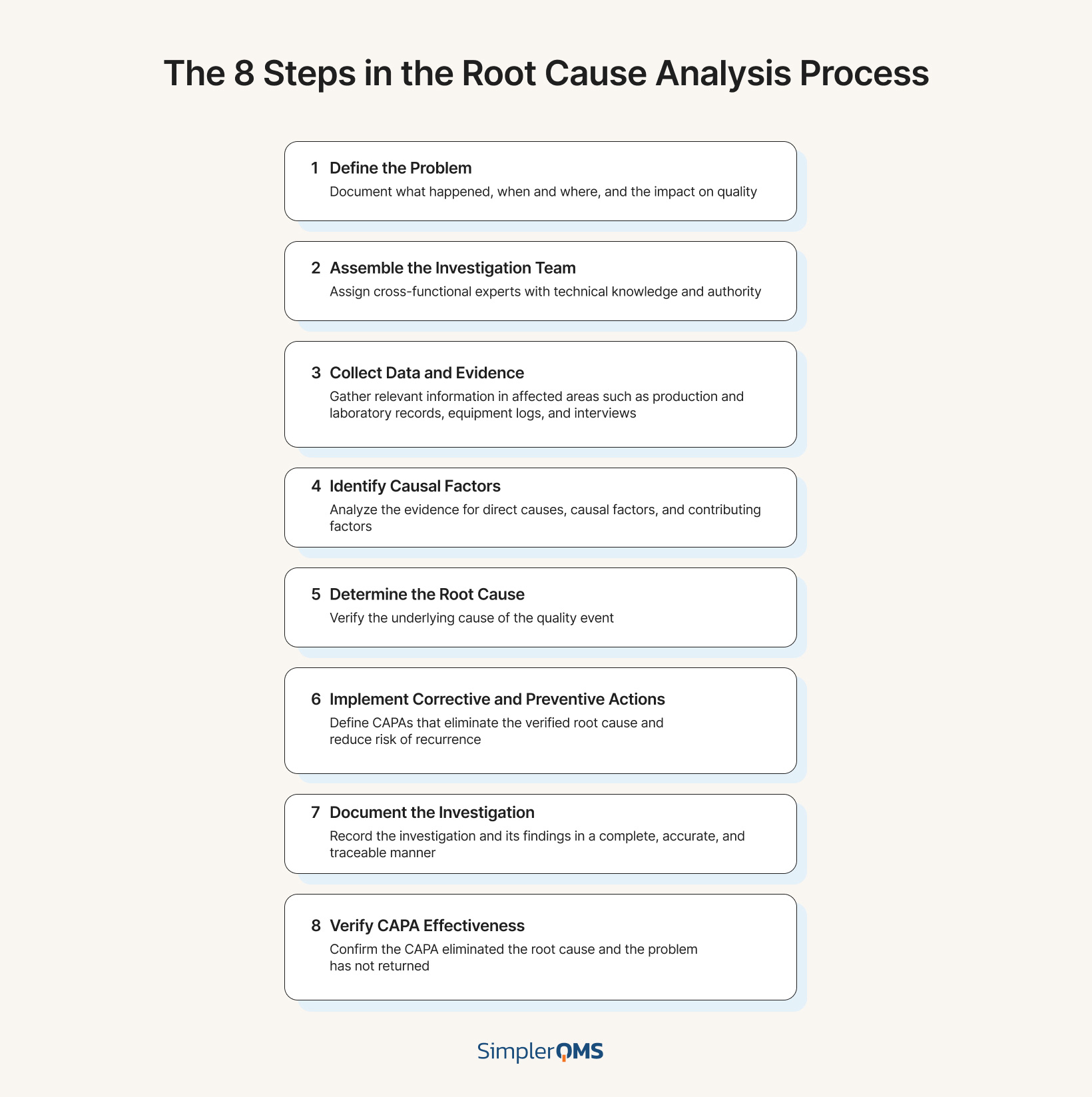
The main steps in the RCA process are to define the problem, assemble the investigation team, collect data and evidence, identify causal factors, determine the root cause, implement CAPAs, document the investigation, and verify CAPA effectiveness.
The main steps in the RCA process are listed below.
- Define the Problem: Clearly define the quality issue, its scope, impact, and when and where it occurred. A well-defined problem establishes the foundation for an effective investigation.
- Assemble the Investigation Team: Assign personnel with the appropriate technical knowledge, process expertise, and decision-making authority to conduct the investigation. Cross-functional teams provide broader perspectives and improve investigation quality.
- Collect Data and Evidence: Gather relevant laboratory records, production records, equipment logs, environmental monitoring data, interviews, and other objective evidence. Complete and reliable evidence supports accurate root cause determination.
- Identify Causal Factors: Analyze the collected evidence to identify direct causes, causal factors, and contributing factors associated with the quality event. Investigation teams use appropriate RCA methods and tools to evaluate potential causes systematically.
- Determine the Root Cause: Evaluate the identified causal factors and verify the underlying cause of the problem using objective evidence. A verified root cause explains why the quality event occurred and provides the basis for effective CAPAs.
- Implement Corrective and Preventive Actions (CAPAs): Develop and implement corrective and preventive actions that eliminate the verified root cause and reduce the risk of recurrence. CAPAs should address both the immediate quality issue and the underlying process weaknesses identified during the investigation.
- Document the Investigation: Record the investigation activities, supporting evidence, analysis, root cause determination, CAPAs, approvals, and conclusions in controlled quality records. Complete documentation provides traceability, supports audits, and demonstrates regulatory compliance.
- Verify CAPA Effectiveness: Evaluate whether the implemented CAPAs successfully eliminated the root cause and prevented recurrence. Effectiveness verification confirms that the investigation achieved its intended outcome and supports continuous improvement.
The root cause analysis process involves eight key steps, from defining the problem and collecting evidence to identifying root causes, implementing corrective and preventive actions (CAPA), and verifying effectiveness, as shown in the image below.
1. Define the Problem
The first step in RCA is to clearly define the problem being investigated. A well-defined problem establishes the scope of the investigation, ensures that all team members have a common understanding of the quality event, and provides the foundation for identifying the underlying cause.
During this step, investigators document what happened, when and where the event occurred, the products, materials, equipment, or processes involved, and the actual or potential impact on product quality, regulatory compliance, or patient safety. The investigation determines whether immediate containment actions are required before the RCA continues.
A quality representative or investigator leads the investigation in most RCA processes. Subject matter experts (SMEs), process owners, laboratory personnel, production personnel, engineering, or other involved functions support the investigation when their technical input is needed. Cross-functional participation ensures relevant technical knowledge is considered during problem definition.
Primary RCA inputs include deviation reports, nonconformance reports, complaint records, OOS results, OOT results, and audit findings. Additional inputs include equipment logs, production records, laboratory data, environmental monitoring records, and other supporting evidence. Organizations use tools such as process flowcharts, check sheets, and preliminary risk assessments to better understand the problem scope when these tools fit the quality event.
The primary output of this step is a clearly documented problem statement that defines the investigation scope, identifies the affected products, processes, or equipment, summarizes the available evidence, and provides the basis for assembling the investigation team and collecting additional data.
2. Assemble the Investigation Team
The second step in root cause analysis (RCA) is to assemble an investigation team with the knowledge and expertise needed to evaluate the quality event. A cross-functional team brings together different perspectives, improves problem analysis, and improves the quality and reliability of the investigation.
During this step, the organization selects qualified personnel, assigns investigation responsibilities, establishes roles, and defines how the investigation will be conducted. The size and composition of the team depend on the complexity, risk, and potential impact of the quality event, such as whether the event involves one process, multiple departments, or a potential patient safety concern.
A quality representative or investigation lead coordinates the investigation in most RCA processes. The investigation team includes subject matter experts (SMEs), process owners, laboratory personnel, production personnel, engineering, maintenance, regulatory affairs, and other functions directly involved in the affected process. Additional specialists participate when the investigation requires specific technical or scientific expertise.
The investigation team uses primary inputs such as the documented problem statement, available quality records, and applicable SOPs to plan the investigation. Additional inputs include product knowledge, process information, and regulatory requirements. Organizations use investigation plans, responsibility matrices, meeting records, and QMS workflows to coordinate activities and assign responsibilities.
The primary output of this step is a formally assigned investigation team with clearly defined roles, responsibilities, and authority to conduct the investigation. Establishing the investigation team ensures that the remaining investigation activities are performed using appropriate expertise, objective evaluation, and cross-functional collaboration.
3. Collect Data and Evidence
The third step in RCA is to collect the data and evidence needed to understand the quality event and support an objective investigation. Complete and reliable evidence improves root cause evaluation by enabling investigators to assess potential causes using verified facts. Incomplete or unreliable evidence weakens root cause evaluation because investigators may rely on assumptions.
During this step, investigators gather and review all information related to the quality event, including when and where it occurred, the products, materials, equipment, personnel, and processes involved, as well as any immediate actions taken. Evidence is evaluated for accuracy, completeness, and relevance before it is used to support the investigation.
The investigation team performs data collection in most RCA processes. Quality personnel, subject matter experts (SMEs), laboratory personnel, production personnel, engineering, maintenance, and other involved functions support data collection when their process knowledge is required. Each participant contributes information within their area of expertise to build a complete understanding of the event.
Primary data collection inputs include batch records, manufacturing records, laboratory data, Certificates of Analysis (CoAs), equipment logs, and calibration and maintenance records. Additional inputs include environmental monitoring results, audit findings, deviation reports, complaint records, electronic audit trails, training records, and other quality documentation. Organizations use interviews, process flowcharts, check sheets, trend analysis, laboratory information management systems (LIMS), and QMS software when these tools fit the investigation scope. These tools organize, review, and analyze the collected information.
The primary output of this step is a complete and verified evidence package that supports the identification of causal factors. The verified evidence package provides the factual basis for determining the root cause during the next investigation stages.
4. Identify Causal Factors
The fourth step in RCA is to identify the direct causes, causal factors, and contributing factors associated with the quality event. Evaluating all potential causes helps investigators understand why the problem occurred and narrows the investigation before determining the verified root cause.
During this step, the investigation team analyzes the collected evidence, evaluates the sequence of events, identifies relationships between different factors, and determines which conditions contributed to the quality issue. Investigators assess technical, process, equipment, material, environmental, documentation, and human factors to ensure that all plausible causes are considered.
The investigation team performs this step in most RCA processes. The team includes quality personnel, SMEs, process owners, laboratory personnel, production personnel, engineering, and other functions with knowledge of the affected process. Cross-functional collaboration ensures causal factors are identified objectively and supported by technical expertise.
Primary inputs for this step include verified evidence, laboratory data, process information, and equipment records. Additional inputs include deviation reports and other supporting documentation. Organizations use Root Cause Analysis methods and tools such as the Fishbone (Ishikawa) Diagram, 5 Whys Analysis, Fault Tree Analysis (FTA), process flowcharts, and Pareto Charts when these tools fit the investigation scope. These RCA tools organize potential causes and evaluate their relationship to the quality event.
The primary output of this step is a documented list of verified direct causes, causal factors, and contributing factors supported by objective evidence. These findings provide the basis for determining the verified root cause during the next step of the investigation.
5. Determine the Root Cause
The fifth step in RCA is to determine and verify the root cause of the quality event. A verified root cause explains why the problem occurred and is supported by objective evidence rather than assumptions or opinions. Identifying the correct root cause provides the basis for effective CAPAs.
During this step, the investigation team evaluates the identified causal factors, verifies the relationship between each potential cause and the quality event, and confirms the underlying cause that allowed the problem to occur. Investigators assess whether the available evidence supports the proposed root cause and whether additional analysis or data collection is required before reaching a conclusion.
The root cause is determined by the investigation team, including quality personnel, SMEs, process owners, laboratory personnel, production personnel, engineering, and other functions with expertise relevant to the investigation. Cross-functional review helps ensure that the identified root cause is technically sound, scientifically justified, and agreed upon by all stakeholders.
Inputs for this step include the documented causal factors, collected evidence, process and laboratory data, equipment records, deviation reports, and applicable regulatory requirements. Organizations may use root cause analysis methods such as the 5 Whys, Fault Tree Analysis (FTA), Kepner-Tregoe Analysis, and Change Analysis to evaluate potential causes and verify the final root cause. Additional risk assessment tools, such as Failure Mode and Effects Analysis (FMEA), may be used to understand failure modes and evaluate potential risks associated with identified causes.
The primary output of this step is a documented and verified root cause supported by objective evidence and technical justification. The verified root cause provides the foundation for developing effective CAPAs that address the underlying cause and prevent the quality event from recurring.
6. Implement Corrective and Preventive Actions (CAPAs)
The sixth step in RCA is to implement Corrective and Preventive Actions that address the verified root cause and reduce the risk of recurrence. Effective CAPAs eliminate the underlying cause of the quality event rather than temporarily correcting its symptoms, helping organizations improve product quality, process performance, and regulatory compliance.
During this step, the investigation team develops CAPAs based on the verified root cause, defines the required actions, assigns responsibilities, establishes implementation timelines, and manages any changes needed to procedures, equipment, processes, training, or documentation. The scope of the CAPA depends on the significance of the quality event, the identified risks, and the complexity of the required improvements.
CAPA implementation is coordinated by quality personnel with support from process owners, department managers, SMEs, laboratory personnel, production personnel, engineering, maintenance, and other functions responsible for implementing the required actions. Management may review and approve CAPAs that have significant quality, regulatory, or business impact.
Inputs for this step include the verified root cause, Root Cause Analysis report, risk assessments, deviation or nonconformance records, applicable SOPs, and regulatory requirements. Organizations may use CAPA management systems, change control procedures, action plans, training records, and QMS software to manage implementation and monitor progress.
The primary output of this step is a fully implemented CAPA plan with documented corrective and preventive actions, assigned responsibilities, implementation records, and supporting evidence. These deliverables provide the basis for verifying CAPA effectiveness during the final step of the root cause analysis process.
7. Document the Investigation
The seventh step in RCA is to document the investigation and its findings in a complete, accurate, and traceable manner. Comprehensive documentation demonstrates that the investigation was conducted systematically, supports regulatory compliance, and provides objective evidence for audits and future reference.
During this step, investigators record the problem statement, investigation activities, collected evidence, identified causal factors, verified root cause, CAPAs, supporting rationale, approvals, and conclusions. Documentation should accurately reflect how the investigation was performed and why specific decisions were made throughout the RCA process.
The investigation documentation is typically prepared by the investigation lead or quality representative with input from SMEs, process owners, laboratory personnel, production personnel, and other team members involved in the investigation. Quality assurance reviews the completed documentation to verify its accuracy, completeness, and compliance with applicable procedures.
Inputs for this step include the root cause analysis report, investigation records, supporting evidence, CAPA documentation, risk assessments, deviation or nonconformance reports, change control records, and applicable SOPs. Organizations use investigation templates, controlled forms, electronic records, and QMS software to maintain complete, consistent, and traceable documentation.
The primary output of this step is a complete, approved, and audit-ready investigation record that documents the Root Cause Analysis from problem definition through CAPA implementation. This record provides the basis for verifying CAPA effectiveness and formally closing the investigation.
8. Verify CAPA Effectiveness
The final step in RCA is to verify the effectiveness of the implemented CAPAs. CAPA effectiveness verification confirms that the actions successfully eliminated the verified root cause, prevented recurrence, and achieved the intended quality improvement.
During this step, investigators evaluate whether the implemented CAPAs resolved the quality issue by reviewing process performance, monitoring quality trends, analyzing follow-up data, and confirming that similar quality events have not recurred. The investigation may be reopened when CAPAs are found to be ineffective, requiring additional root cause analysis or the implementation of new corrective actions.
CAPA effectiveness verification is typically coordinated by quality personnel with participation from process owners, SMEs, laboratory personnel, production personnel, and other functions responsible for implementing the CAPAs. Management may review the effectiveness assessment before approving formal investigation closure.
Inputs for this step include CAPA implementation records, process monitoring data, laboratory results, audit findings, deviation reports, complaint trends, key performance indicators (KPIs), and other quality records collected after CAPA implementation. Organizations may use effectiveness checklists, trend analysis, follow-up audits, management reviews, and QMS software to evaluate CAPA effectiveness and document the results.
The primary output of this step is documented CAPA effectiveness verification and formal investigation closure. A successful effectiveness review demonstrates that the root cause has been eliminated, the quality issue is unlikely to recur, and the root cause analysis has achieved its intended objective.
What Are Root Cause Analysis Best Practices?
Root cause analysis best practices are based on systematic, evidence-driven, and objective investigations that identify the underlying cause of a problem without assigning blame.
The main root cause analysis best practices and their purpose are listed below.
- Define the Problem Clearly: Clearly describe the quality issue, its scope, impact, and when and where it occurred before beginning the investigation. A well-defined problem establishes the foundation for an accurate root cause analysis.
- Collect Objective Evidence: Gather relevant records, laboratory data, process data, equipment logs, interviews, and other supporting evidence before drawing conclusions. Evidence-based investigations produce accurate and defensible root cause determinations.
- Investigate Without Assigning Blame: Focus on understanding process failures rather than identifying individuals to blame. A blameless approach encourages open communication, accurate reporting, and identification of systemic quality issues.
- Evaluate All Potential Causes: Assess direct causes, causal factors, and contributing factors before determining the root cause. A comprehensive evaluation reduces the risk of overlooking critical information.
- Use Appropriate RCA Methods and Tools: Select investigation methods and tools that match the complexity of the quality event. Using appropriate techniques improves investigation quality and increases confidence in the identified root cause.
- Document the Investigation Thoroughly: Record investigation activities, evidence, analysis, conclusions, and supporting rationale in a clear and traceable manner. Complete documentation supports regulatory compliance, audits, and future investigations.
- Implement Effective CAPAs: Develop and implement CAPAs that eliminate the verified root cause rather than temporarily addressing symptoms. Effective CAPAs reduce recurring quality issues and strengthen process performance.
- Verify CAPA Effectiveness: Confirm that implemented CAPAs successfully eliminate the root cause and prevent recurrence. Effectiveness verification demonstrates that the investigation achieved its intended outcome and supports continuous improvement.
Applying root cause analysis best practices improves investigation accuracy, consistency, and defensibility. Systematic investigations supported by objective evidence, appropriate RCA methods, and effective CAPA implementation help organizations reduce recurring quality issues, strengthen regulatory compliance, and promote continuous improvement.
What Are Common Root Cause Analysis Mistakes to Avoid?
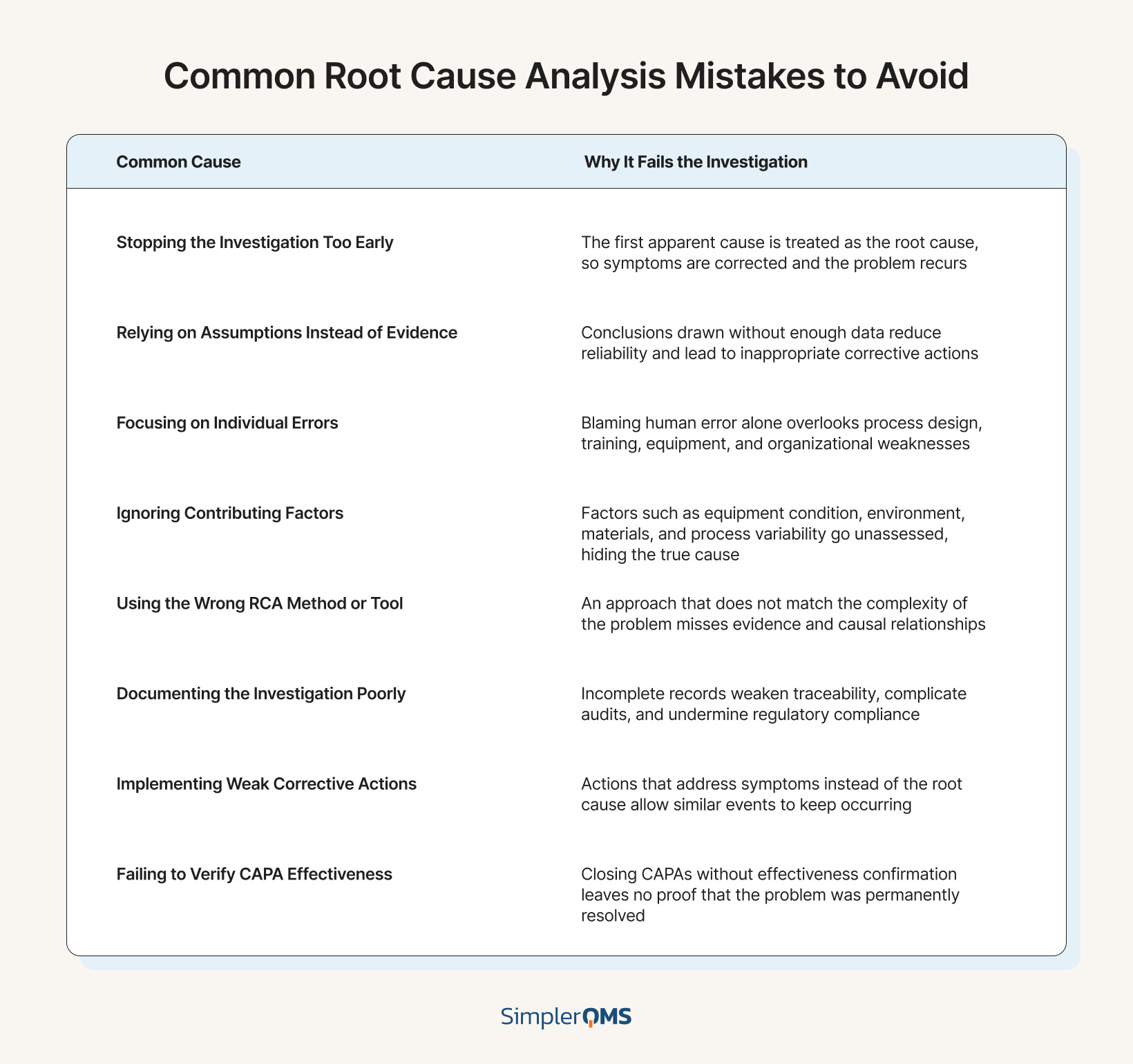
Common RCA mistakes occur when investigations identify symptoms instead of underlying causes, rely on assumptions rather than evidence, or fail to evaluate all contributing factors. These mistakes lead to incorrect conclusions, ineffective CAPAs, recurring quality issues, and increased regulatory risk.
The most common root cause analysis mistakes are listed below.
- Stopping the Investigation Too Early: Early investigation closure occurs when investigation teams identify the first apparent cause and stop the analysis before determining the true root cause. Early investigation closure addresses symptoms rather than the underlying problem and increases the likelihood of recurrence.
- Relying on Assumptions Instead of Evidence: Assumption-based investigation occurs when investigators reach conclusions without sufficient data, documented evidence, or objective analysis. Unsupported conclusions reduce investigation reliability and increase the risk of inappropriate corrective actions.
- Focusing on Individual Errors Instead of System Failures: Focusing on individual errors occurs when investigations attribute problems solely to human error without evaluating process design, training, equipment, procedures, or organizational factors. Individual-error focus overlooks systemic weaknesses that contribute to recurring quality issues.
- Ignoring Contributing Factors: Contributing factor oversight occurs when investigation teams evaluate only the direct cause and fail to assess contributing factors such as equipment condition, environmental conditions, raw materials, supplier performance, or process variability. Incomplete investigations fail to identify the true root cause when contributing factors materially influence the quality event.
- Using the Wrong RCA Method or Tool: Wrong RCA method selection occurs when investigation teams apply a method or tool that is not appropriate for the complexity of the problem. An unsuitable RCA approach increases the risk of overlooking important evidence or failing to identify relationships between multiple contributing factors.
- Documenting the Investigation Poorly: Poor documentation of investigations results in the incomplete or inconsistent recording of findings, supporting evidence, and decision-making. Poor documentation reduces traceability, complicates audits such as internal audits and regulatory inspections, and weakens compliance with applicable quality requirements.
- Implementing Weak Corrective Actions: Weak corrective action implementation occurs when organizations address immediate symptoms instead of eliminating the root cause. As a result, similar deviations, complaints, or nonconformances continue to occur.
- Failing to Verify CAPA Effectiveness: CAPA effectiveness verification failure occurs when investigation teams close CAPAs without confirming that corrective actions have eliminated the root cause. Organizations cannot demonstrate that the problem has been permanently resolved without effectiveness verification.
Avoiding common root cause analysis mistakes improves investigation quality, strengthens root cause analysis outcomes, and helps organizations implement effective CAPAs that prevent recurring quality issues and support continuous improvement.
Common root cause analysis (RCA) mistakes, such as relying on assumptions, overlooking contributing factors, and failing to verify CAPA effectiveness, can undermine investigations and lead to recurring quality issues, as shown in the image below.
What Documents Support Root Cause Analysis?
Root cause analysis (RCA) is supported by controlled documents that record the investigation, provide objective evidence, document decisions, and demonstrate regulatory compliance. Complete and well-maintained documentation ensures that investigations are traceable, scientifically justified, audit-ready, and capable of supporting effective CAPAs.
The main documents that support root cause analysis are listed below.
- Root Cause Analysis (RCA) Report: The RCA report is the primary investigation record that documents the problem statement, investigation scope, investigation team, root cause analysis method, findings, identified root cause, conclusions, and recommended actions. A complete RCA report provides a clear and defensible record of the investigation.
- Evidence Records: Evidence records include laboratory data, production records, equipment logs, calibration records, environmental monitoring results, photographs, interview notes, and other objective evidence collected during the investigation. Supporting evidence demonstrates that investigation conclusions are based on facts rather than assumptions.
- Deviation or Nonconformance Report: Deviation and nonconformance reports describe the quality event that initiated the investigation, including when and where it occurred, the affected products or processes, and the initial impact assessment. Deviation and nonconformance reports establish the starting point for root cause analysis.
- Corrective and Preventive Action (CAPA) Records: CAPA records document the corrective actions, preventive actions, assigned responsibilities, implementation timelines, and effectiveness verification resulting from the investigation. CAPA documentation demonstrates how the identified root cause was eliminated and how recurrence is prevented.
- Risk Assessment Records: Risk assessment records evaluate the impact of the identified root cause on product quality, patient safety, regulatory compliance, and business operations. Risk assessment records help organizations prioritize corrective actions and determine whether additional controls are required.
- Change Control Records: Change control records document approved changes to procedures, equipment, analytical methods, software, materials, or manufacturing processes resulting from the investigation. Change control records demonstrate that improvements are implemented through controlled and approved processes.
- Training Records: Training records demonstrate that affected personnel received training on revised procedures, work instructions, or quality requirements introduced as part of corrective and preventive actions. Training documentation supports consistent implementation of investigation outcomes.
- Investigation Closure and Effectiveness Records: Investigation closure and effectiveness records document management review, approval, CAPA effectiveness verification, and formal investigation closure. These records demonstrate that the investigation was completed, the root cause was addressed, and the implemented actions effectively prevented recurrence.
An audit-ready root cause analysis investigation includes a clearly defined problem statement, objective supporting evidence, documented analysis, an identified root cause, risk assessment, approved CAPAs, effectiveness verification, management approval, and complete, traceable investigation records. Comprehensive documentation demonstrates that the investigation was systematic, scientifically justified, and compliant with applicable regulatory requirements.
What Are Examples of Root Cause Analysis in Life Science Industries?
Root cause analysis is used throughout the life sciences industry to investigate quality events, identify their underlying causes, and implement effective CAPAs. The quality events that trigger investigations vary across life science industries depending on an organization’s products, processes, and regulatory requirements, although the RCA process follows the same principles.
The most common root cause analysis applications in life science industries and the quality events investigated in each industry are listed below.
- Pharmaceutical and Biotechnology Companies: Pharmaceutical and biotechnology companies perform RCA to investigate deviations, out-of-specification (OOS) and out-of-trend (OOT) results, complaints, contamination events, equipment failures, manufacturing process deviations, and batch failures. RCA helps maintain product quality, GMP compliance, and patient safety while supporting effective CAPA implementation.
- Medical Device Industry: Medical device manufacturers use RCA to investigate nonconforming products, production defects, customer complaints, design issues, equipment failures, supplier issues, and post-market surveillance findings. RCA supports compliance with ISO 13485, FDA Quality Management System Regulation (QMSR), and applicable medical device regulations while reducing product quality and patient safety risks.
- Testing and Quality Control Laboratories: Quality control, analytical, microbiology, and testing laboratories use RCA to investigate laboratory deviations, invalid test results, instrument failures, calibration issues, environmental monitoring excursions, and OOS or OOT results. RCA improves laboratory reliability, data integrity, and compliance with laboratory procedures and regulatory requirements, such as test methods, calibration procedures, data review procedures, and GMP documentation expectations.
- Contract Manufacturing Organizations (CMOs): CMOs perform RCA to investigate manufacturing deviations, equipment breakdowns, process variability, supplier-related issues, contamination events, and customer complaints. RCA enables CMOs to maintain consistent manufacturing performance, contractual obligations, and regulatory compliance across multiple client products.
- Contract Research Organizations (CROs): CROs use RCA to investigate protocol deviations, data integrity issues, clinical trial process failures, laboratory errors, audit findings, and regulatory observations. RCA improves study quality, regulatory compliance, and the reliability of clinical and laboratory data generated on behalf of sponsors.
How Does QMS Software Support Root Cause Analysis?
Quality management system (QMS) software supports root cause analysis (RCA) by standardizing investigation workflows, centralizing quality records, and maintaining complete traceability throughout the investigation process. QMS software integrates RCA into deviation management, nonconformance management, complaint handling, and corrective and preventive action (CAPA) workflows, helping ensure that investigations are documented, reviewed, approved, and completed in a controlled and compliant manner.
SimplerQMS is a validated, cloud-based quality management system designed for life science companies, including pharmaceutical, biotechnology, and medical device organizations. SimplerQMS streamlines root cause analysis by connecting investigations with quality events, CAPAs, change control, document management, training, and audit management within a single quality management platform.
The 8 main QMS capabilities that support root cause analysis are listed below.
- Deviation Management: Deviation management records quality events, assigns investigations, tracks root cause analysis activities, and maintains complete investigation records throughout the deviation lifecycle.
- Nonconformance Management: Nonconformance management documents product and process nonconformances, supports structured RCA workflows, and links investigations to corrective and preventive actions.
- Complaint Management: Complaint management captures customer complaints, initiates investigations, and connects root cause analysis with CAPA and complaint resolution activities.
- Corrective and Preventive Action (CAPA) Management: CAPA management links root cause analysis findings to corrective and preventive actions, assigns responsibilities, tracks implementation, and verifies CAPA effectiveness before closure.
- Document Management: Document management controls investigation procedures, root cause analysis reports, Standard Operating Procedures (SOPs), work instructions, and supporting quality records using version control and approval workflows.
- Change Management: Change management controls changes resulting from root cause analysis, including updates to procedures, analytical methods, equipment, specifications, and quality documents through formal review and approval processes.
- Training Management: Training management assigns and documents training on updated procedures and work instructions introduced following root cause analysis and CAPA implementation, helping ensure consistent execution of corrective actions.
- Audit Management: Audit management records investigation findings, verifies compliance with root cause analysis procedures, and provides objective evidence during internal and regulatory audits.
QMS software improves the consistency, traceability, and effectiveness of root cause analysis by providing standardized investigation workflows, centralized documentation, electronic approvals, audit trails, and complete quality records. Validated eQMS solutions such as SimplerQMS support regulatory compliance, inspection readiness, data integrity, and continuous improvement while enabling organizations to perform timely, well-documented, and defensible root cause analysis investigations.
