Risk-based thinking in a Quality Management System (QMS) is the proactive practice of embedding risk awareness into every process. Risk-based thinking helps organizations identify, assess, and address risks and opportunities before they affect products or services. Risk-based thinking is important because it improves decision-making, optimizes resources, builds resilience, enhances customer satisfaction, and strengthens compliance.
ISO 9001 requires organizations to determine risks and opportunities that could affect intended QMS results. ISO 9001 also requires organizations to plan actions, integrate those actions into QMS processes, and evaluate effectiveness.
To apply risk-based thinking in a QMS, organizations can use the following 11-step approach. The process starts with defining the organizational context and QMS scope, then ensuring leadership commitment, and identifying risks and opportunities. The next steps include assessing risks and opportunities against defined criteria, planning and prioritizing actions in proportion to significance, assigning ownership, and implementing controls and improvement actions in QMS workflows. The final steps include monitoring performance and evaluating action effectiveness, and reviewing results during management review. The risk insights must be used to support continual improvement, and the risks and opportunities must be updated when processes or conditions change.
Risk-based thinking appears across major quality standards and regulations. ISO 9001:2015 embeds risk-based thinking into the process approach for all industries. ISO 14971:2019 provides a full lifecycle risk-management framework for medical devices. ISO 13485:2016 applies risk-based decision-making to medical device quality systems with emphasis on safety, performance, and compliance. ICH Q9 establishes quality risk management for the pharmaceutical industry. EU MDR and IVDR require risk analysis, evaluation, control, and post-market surveillance for devices and IVDs. EU GMP links quality risk management to good manufacturing practices for medicinal products. FDA process validation guidance uses a lifecycle approach with controls commensurate with risk, while ISPE GAMP 5 promotes a risk-based approach for computerized systems in GxP environments.
Practical examples show how risk-based thinking works in everyday QMS processes, including supplier management and training management. In supplier management, risk-based thinking addresses risks such as poor supplier performance, delays, defects, and counterfeit materials. Risk-based thinking also supports positive outcomes such as improved supplier reliability and stronger incoming quality performance. Risks and opportunities are addressed through supplier qualification, re-evaluation, monitoring, and incoming checks. In training management, risk-based thinking reduces the risk of unqualified personnel through role-based training, competency assessments, and retraining after changes or long absences. Risk-based thinking also creates opportunities for upskilling through structured training programs.
Common mistakes when applying risk-based thinking include treating risk-based thinking as a one-time activity, failing to integrate it into routine operations, focusing only on threats while ignoring opportunities, applying the same level of effort to every issue, leaving responsibility only to the quality department, lacking top-management involvement, failing to evaluate action effectiveness, excluding risk from management review, and using assessments only for compliance rather than real decision-making.
Several tools can support risk-based thinking effectively, including SWOT analysis, risk matrices, FMEA, process maps and flowcharts, root cause analysis tools, quality KPIs, and trend analysis.
SimplerQMS is an all-in-one, fully validated, electronic Quality Management System (eQMS) for life science companies. SimplerQMS makes risk-based thinking more consistent and actionable by centralizing quality data and workflows. SimplerQMS offers modules for document control, change control, training management, CAPA management, supplier management, nonconformance management, audit management, design control, equipment management, and risk management.
What Is Risk-Based Thinking in QMS?
Risk-based thinking in QMS is the proactive, systematic practice of building risk awareness into every quality management process. Risk-based thinking in QMS enables an organization to identify, assess, and address risks and opportunities before they affect product quality, service quality, or customer satisfaction. Risk-based thinking in a quality management system is not a separate task or one-time exercise, but guides planning, execution, review, and continual improvement across the QMS.
Risk-based thinking in ISO 9001 manages uncertainty in a controlled way. This controlled approach helps the QMS achieve its intended purpose and support continual improvement. Risk-based thinking differs from traditional preventive action because ISO 9001:2015 no longer treats prevention as a separate clause or standalone activity. ISO 9001:2015 instead embeds prevention into risk-based decision-making across the QMS.
Risk-based thinking in QMS covers both risks and opportunities linked to quality objectives and business direction. Risk-based thinking addresses strategic risks such as market access shifts and regulatory changes, compliance risks such as inspection failure or loss of authorization, operational risks such as process instability, equipment failure, and inadequate training, supply chain risks such as shortages, delays, and counterfeit components, and product or service risks such as design flaws or nonconforming output reaching the customer or market. Risk-based thinking should address opportunities such as entry into new markets, new product lines, adoption of new technology such as eQMS solutions, workforce upskilling, supplier development, and improved customer responsiveness. Risk-based thinking, therefore, helps organizations reduce negative outcomes and strengthen positive results through consistent and informed quality decisions.
What Are the Core Principles of Risk-Based Thinking in QMS?
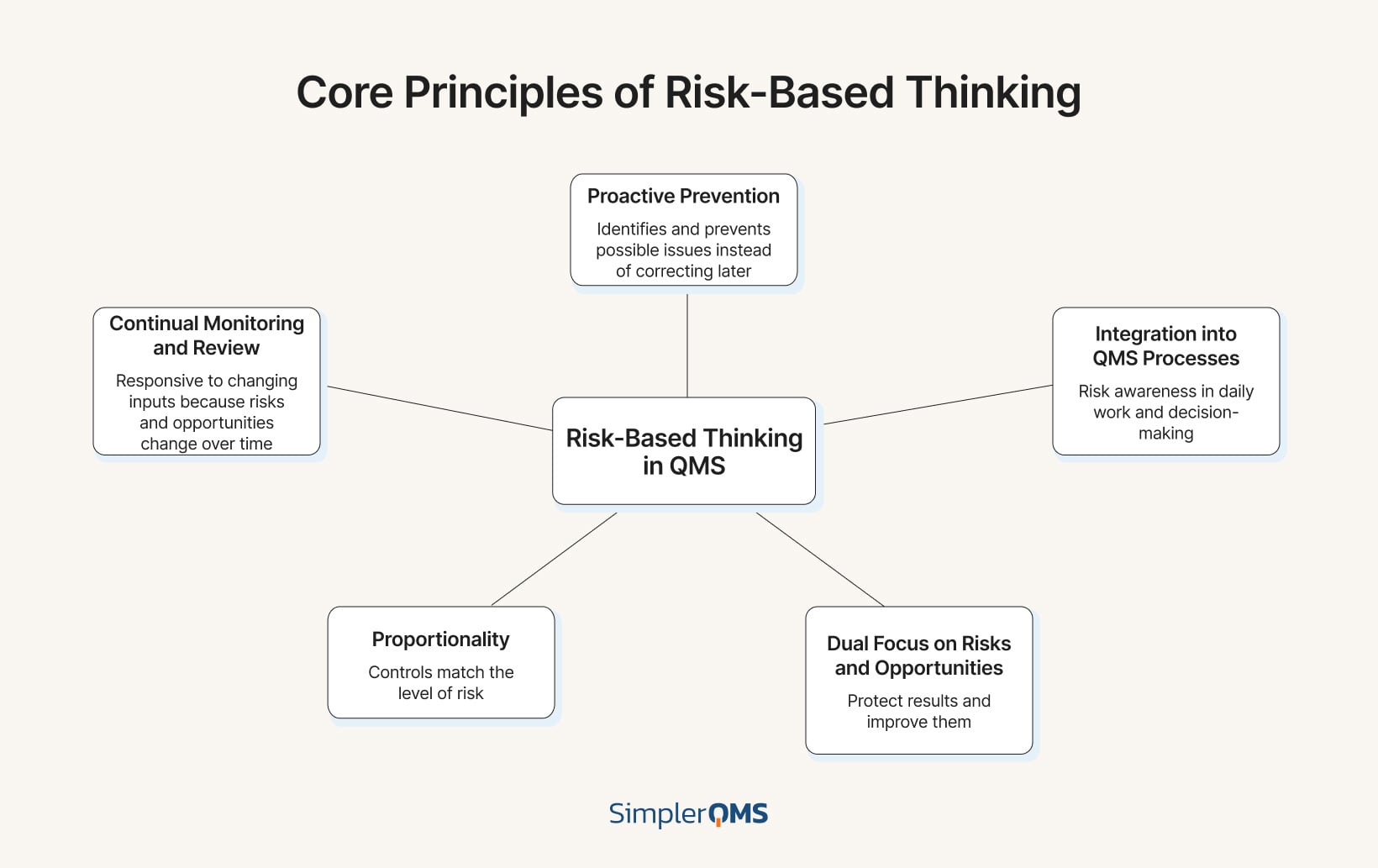
The core principles of risk-based thinking in QMS include embedding risk awareness into all QMS processes to identify uncertainties, prevent negative effects, and seize opportunities. The core principles of risk-based thinking and their impact are described below.
- Proactive Prevention: Risk-based thinking identifies and prevents possible issues proactively before they lead to nonconformities, failures, delays, or customer impact. This proactive prevention approach shifts attention to early action instead of later correction.
- Integration into QMS Processes: Integration of risk-based thinking into QMS processes builds risk awareness into daily quality operations such as training, supplier management, non-conformance, CAPA, change control, and management review. Integration of risk-based thinking into QMS processes makes risk awareness part of quality decision-making.
- Dual Focus on Risks and Opportunities: Dual focus on risks and opportunities addresses threats that could harm quality results, and opportunities that could improve performance, efficiency, compliance, or customer satisfaction. Dual focus supports both protection and growth.
- Proportionality: Risk-based thinking applies proportionality, so controls match the level of risk. Higher-risk activities need more formal analysis, stronger controls, and closer oversight, while lower-risk activities need less complexity.
- Continual Monitoring and Review: Continual monitoring and review are essential because risks and opportunities change over time. Continual monitoring keeps the QMS responsive to changing inputs, including process performance data, audit results, operational changes, customer feedback, and business conditions.
The 5 core principles of risk-based thinking are shown in the image below.
Why Is Risk-Based Thinking Important in QMS?
Risk-based thinking is important in QMS because it helps organizations prevent quality issues, improve process control, reduce uncertainty, and consistently meet customer and regulatory requirements. Risk-based thinking gives the quality management system a forward-looking approach, enabling timely action.
Below are the main reasons why risk-based thinking is essential in QMS.
- Strengthens Compliance: Risk-based thinking helps organizations identify compliance gaps before they lead to regulatory violations, failed inspections, warning letters, or lost authorizations.
- Reduces Non-conformances, Recalls, and Cost of Poor Quality: Risk-based thinking reduces the chance of non-conformances, rework, complaints, and recalls by addressing potential causes before they affect products or services.
- Optimizes Resource Allocation: Risk-based thinking helps organizations direct resources, including time, people, equipment, and budget, toward the areas with the highest quality impact.
- Improves Decision-Making: Risk-based thinking supports decision-making through better visibility into uncertainty, process weaknesses and strengths, and possible outcomes.
- Builds Organizational Resilience: Risk-based thinking helps organizations prepare for change, prevent disruption across operations, and maintain compliance obligations.
- Enhances Customer Satisfaction: Risk-based thinking helps organizations deliver consistent products and services by reducing errors, delays, and quality failures that affect customer satisfaction.
What Is the Difference Between Risk-Based Thinking and Risk Management?
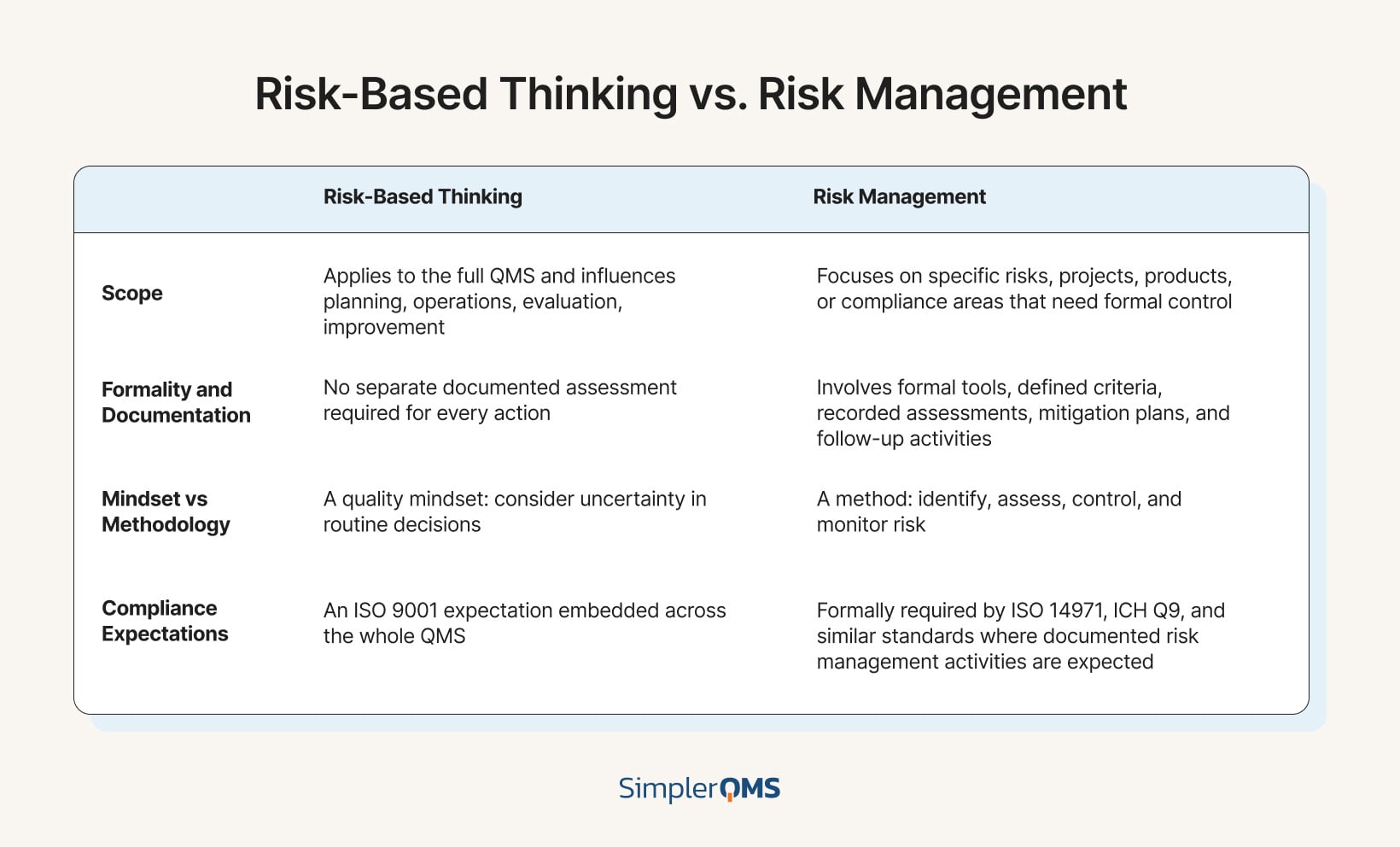
The difference between risk-based thinking and risk management lies in scope and level of formality. Risk-based thinking in QMS is a broad, embedded mindset used across daily processes and decisions. Risk management is a more formal and structured process used to identify, analyze, evaluate, control, and monitor specific risks.
The core distinctions between risk-based thinking and risk management are listed below.
- Scope: Risk-based thinking applies to the full QMS and influences planning, operations, performance evaluation, and improvement. Risk management usually focuses on specific risks, projects, products, processes, or compliance areas that need formal control.
- Formality and Documentation: Risk-based thinking does not always require a separate documented risk assessment for every action. Risk management involves formal tools, defined criteria, recorded assessments, mitigation plans, and follow-up activities.
- Mindset vs. Methodology: Risk-based thinking is a quality mindset that encourages people to consider uncertainty in routine decisions. Risk management is a method with clear steps for identifying, assessing, controlling, and monitoring risk.
- Compliance Expectations: Risk-based thinking is an ISO 9001 expectation embedded into the whole QMS. Risk management is required more formally under certain standards, such as ISO 14971, or guidelines such as ICH Q9, where documented risk management activities are expected.
The key differences between risk-based thinking and risk management, including their scope, formality and documentation, mindset versus methodology, and compliance expectations, are shown in the image below.
What Are ISO 9001 Requirements for Risk-Based Thinking?
ISO 9001 requires organizations to determine the risks and opportunities that could affect the intended results of the quality management system, plan actions to address them, integrate those actions into QMS processes, and evaluate whether those actions work. ISO 9001 does not require risk-based thinking as a separate system, but it embeds risk-based thinking into planning, process control, performance evaluation, management review, and improvement.
Below are the ISO 9001:2015 requirements for risk-based thinking.
- Understanding the Context (Clause 4.1): ISO 9001 requires the organization to understand its context, including the identification of internal and external issues that affect its purpose, strategic direction, and ability to achieve intended QMS results. Understanding an organization’s context creates the basis for identifying risks and opportunities.
- Understanding the Needs (Clause 4.2): ISO 9001 mandates that the organization understand the needs and expectations of interested parties. Understanding the needs links risk-based thinking to customer and regulatory requirements and business goals.
- Integration with QMS Processes (Clause 4.4): ISO 9001 requires the organization to determine QMS processes and address risks and opportunities within those processes. Integration of risk-based thinking into QMS processes places risk awareness inside process design and operation.
- Leadership Commitment (Clause 5.1): ISO 9001 requires leadership to promote risk-based thinking and ensure it is built into the QMS. This requirement makes leadership responsible for embedding risk awareness into the organization.
- Action Planning and Proportionality (Clause 6.1): ISO 9001 requires the organization to determine risks and opportunities, plan actions, and integrate those actions into QMS processes, in proportion to potential impact. Clause 6.1 is the main operational requirement for risk-based thinking.
- Effectiveness Evaluation (Clause 9.1): ISO 9001 requires the organization to monitor, measure, analyze, and evaluate process performance and effectiveness. Evaluation of the effectiveness of actions taken to address risks and opportunities helps the organization improve.
- Management Review (Clause 9.3): ISO 9001 requires management review inputs to include issues related to risks and opportunities. Management review keeps leadership aware and accountable for risks and opportunities that affect the QMS.
- Continuous Updates (Clause 10.2): ISO 9001 requires organizations to react to nonconformities, control and correct them, and continuously update risks and opportunities when needed.
The ISO 9001:2015 clauses that refer to risks and opportunities are listed below.
- Clause 0.1 (General): Clause 0.1 explains that the process approach and risk-based thinking help an organization achieve effective process control, prevent undesired results, and make maximum use of opportunities.
- Clause 0.3.3 (Risk-based thinking): Clause 0.3.3 explains the concept of risk-based thinking directly and states that it is essential for an effective QMS.
- Clause 4.4.1.f (Quality management system and its processes): Clause 4.4.1.f requires the organization to address risks and opportunities when determining and managing QMS processes.
- Clause 5.1.1.d (General): Clause 5.1.1.d requires top management to promote the use of risk-based thinking.
- Clause 5.1.2.b (Customer focus): Clause 5.1.2.b requires top management to determine and address risks and opportunities that affect product and service conformity and customer satisfaction.
- Clause 6.1 (Actions to address risks and opportunities): Clause 6.1 requires the organization to determine risks and opportunities, plan action, integrate action, and evaluate effectiveness.
- Clause 9.1.3.e (Analysis and evaluation): Clause 9.1.3.e requires analysis and evaluation of process performance and effectiveness, including the review of risk-related action.
- Clause 9.3.2.e (Management review inputs): Clause 9.3.2.e requires management review to consider the effectiveness of actions taken to address risks and opportunities.
- Clause 10.2.1 (Nonconformity and corrective action): Clause 10.2.1 requires the organization to update risks and opportunities determined during planning.
- Annex A.4 (Risk-based thinking): Annex A.4 explains that formal risk management is not required by ISO 9001 and that the level of formality depends on the context of the organization and its processes.
ISO 9001 documented information requirements for risk-based thinking are limited. Evidence is usually captured within process documents, quality objectives, quality metrics, performance data, management review records, and corrective action records. ISO 9001:2015 does not require a standalone risk management procedure, a formal risk register, or a specific documented method for every organization. High-risk or regulated organizations frequently keep formal risk registers and procedures, although ISO 9001 itself does not mandate those documents. The level of documentation depends on organizational context, complexity, and risk level.
How to Apply Risk-Based Thinking in a QMS?
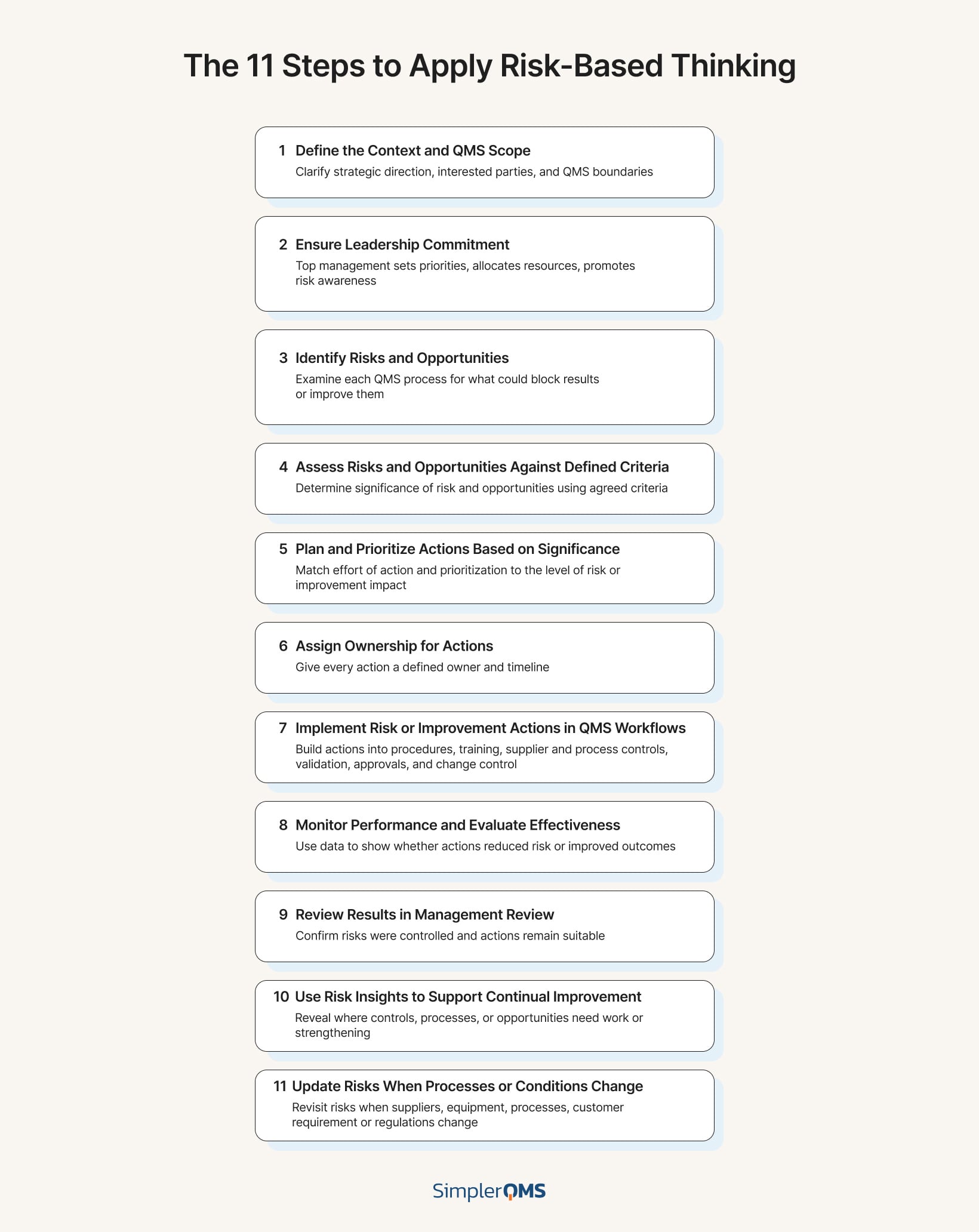
To apply risk-based thinking in a QMS, the following 11 steps must be followed to build risk awareness into planning, operations, review, and improvement.
- Define the Context and QMS Scope: QMS scope definition starts with a clear understanding of the organization’s context, strategic direction, interested parties, and QMS boundaries.
- Ensure Leadership Commitment: Leadership commitment to risk-based thinking requires top management support because leaders set priorities, allocate resources, and promote risk awareness across the QMS.
- Identify Risks and Opportunities in QMS Processes: Risk and opportunity identification in QMS processes requires the organization to examine each process and identify what could prevent planned results or create improvement potential.
- Assess Risks and Opportunities Against Defined Criteria: Evaluation of risks and opportunities against defined criteria supports the consistent determination of their significance.
- Plan and Prioritize Actions Based on Significance: Action planning and prioritization should match the level of risk or improvement impact.
- Assign Ownership for Actions: Action ownership improves risk-based thinking because each action has a defined owner.
- Implement Risk Controls or Improvement Actions in QMS Workflows: Risk control and improvement action implementation should be built into QMS workflows, including procedures, approvals, training, supplier controls, process controls, validation, and change control.
- Monitor Performance and Evaluate Effectiveness: Performance monitoring and effectiveness evaluation use data to show whether actions reduce risk or improve outcomes.
- Review Results in Management Review: Management review should confirm whether major risks were controlled, opportunities were leveraged, and actions remained suitable.
- Use Risk Insights to Support Continual Improvement: Risk insights should support continual improvement by revealing where controls need strengthening, where processes need redesign, and where opportunities can enhance performance.
- Update Risks When Processes or Conditions Change: Risk updates are required when suppliers, products, equipment, systems, processes, personnel, regulations, or customer requirements change.
The 11 key steps to applying risk-based thinking in a Quality Management System (QMS), from defining the context and QMS scope to updating risks when processes or conditions change, are shown in the image below.
Risk-based thinking applies across the full QMS, rather than in one isolated process. Risk-based thinking applies in strategic planning, process design and control, supplier evaluation, production or service delivery, competence and training, change management, corrective action, management review, and improvement planning. Effective use in these areas improves control and decision-making, while weak application increases the risk of process failure, nonconformity, or missed improvement opportunities.
1. Define the Context and QMS Scope
Define the organizational context and QMS scope by identifying the internal and external conditions, interested party requirements, products, services, sites, functions, and process boundaries that shape how the quality management system operates and where quality risks and opportunities exist. Defining the context and QMS scope provides a clear framework for risk-based thinking and helps the organization focus on the right activities, obligations, and quality objectives.
Inputs for QMS scope definition include the organization’s strategic direction, applicable regulatory and customer requirements, product and service range, quality objectives, organizational structure, process map, and outsourced activities that define QMS boundaries and risk relevance.
The organization takes six actions during context and QMS scope definition. These six actions are outlined below.
- Determine the internal issues: Determine the internal issues that affect the QMS, such as company structure, roles, resources, competence, process maturity, and technology.
- Determine the external issues: Identify the external issues that affect the QMS, such as regulatory expectations, market conditions, customer requirements, and supplier dependence.
- Determine the interested parties: Determine the relevant interested parties, such as customers, regulators, notified bodies, suppliers, partners, and employees. Define the relevant requirements for each interested party.
- Define QMS scope: Define the products, services, departments, locations, and activities covered by the QMS.
- Define process linkage: Define the process interaction, outsourced activities, and supporting functions that influence quality performance.
- Confirm quality objectives: Confirm the strategic and quality objectives that the QMS must support.
Outputs from context and QMS scope definition include a clear description of relevant internal and external issues, a defined list of interested parties and requirements, and decisions on which activities fall within the QMS.
Responsibility for this step belongs to top management with support from the quality manager, because scope and context decisions affect the full QMS. Review of this step is performed during the management review and whenever major changes affect the business, such as new regulations, new sites, organizational change, or market change.
2. Ensure Leadership Commitment
Ensure leadership commitment to risk-based thinking in the QMS to guarantee that top management actively supports risk awareness, sets priorities, provides resources, and promotes accountability. Leadership commitment integrates risk-based thinking into business direction and strategic decision-making.
Ensuring leadership commitment requires a defined context and QMS scope, an established quality policy and quality objectives, and resource needs.
The three key actions that ensure leadership commitment and show how top management supports risk-based thinking are described below.
- Confirm leadership accountability for risk-based thinking: Confirm that top management is responsible for promoting risk awareness across the QMS.
- Support resource needs: Ensure adequate resources, including people, systems, training, infrastructure, budget, and time, are available to support effective risk control and improvement actions.
- Ensure leadership involvement in review activities: Ensure top management reviews significant risks, action status, process performance, and improvement needs.
Ensuring leadership commitment results in clear leadership direction, defined priorities, resource allocation decisions, and evidence that risk-based thinking is integrated into QMS governance. Leadership commitment is reflected in quality policies and objectives, and management review records.
Top management is responsible for leadership commitment. Quality managers, department heads, and regulatory leaders support this step by providing data, recommendations, and follow-up on decisions. This step should be reviewed during management review.
3. Identify Risks and Opportunities in QMS Processes
Identify risks and opportunities in QMS processes, such as what could prevent each process from achieving its intended result and what could improve process performance. Identifying risks and opportunities in QMS processes gives the organization a clear basis for action before failures, delays, or missed improvement potential affect the QMS or its effectiveness.
The risk and opportunity identification step requires a defined QMS scope, quality objectives, applicable requirements, customer and regulatory expectations, leadership commitment, and process maps. Identification of risks and opportunities should draw on a range of information sources including prior audit results, nonconformity and CAPA data, complaint data, supplier performance data, training records, change history, validation or verification results, and quality metrics for process evaluation. Process knowledge and objective evidence are needed to judge where uncertainty exists and where better results are possible.
The five main actions that an organization takes to identify risks and opportunities are given below.
- Define each QMS process and intended result: Define each QMS process and what each process must achieve before risks and opportunities are identified.
- Identify process-specific risks: Identify process weaknesses that could negatively affect compliance, quality, timeliness, or control.
- Determine process-specific opportunities: Identify changes that could improve efficiency, consistency, capability, or customer satisfaction.
- Find causes and contributing factors: Define the factors that cause or contribute to each risk or opportunity, such as weak controls, poor training, supplier issues, equipment limits, or changing requirements.
- Select controls: Define checks, approvals, training, procedures, digital tools, or system controls that reduce risk exposure or optimize the process.
Identifying risks and opportunities results in a list of process risks and opportunities, linked causes, current controls, affected requirements, and areas that need action or further assessment. This step may lead to a formal risk assessment.
Identifying risks and opportunities is led by process owners with support from quality assurance. Risks and opportunities are reviewed after major changes, or when process performance changes, non-conformances appear, audits identify gaps, or customer feedback shifts.
4. Assess Risks and Opportunities Against Defined Criteria
Assess risks and opportunities against defined evaluation criteria to determine their significance and support consistent prioritization of actions. This ensures the organization focuses controls and resources on risks and opportunities with the highest impact. Organizations can use different assessment methods and rating criteria depending on process complexity and regulatory requirements. Common evaluation criteria include impact, likelihood of occurrence, and detectability.
Assessing the impact, likelihood, and detectability typically uses a defined list of risks and opportunities, and historical nonconformity data, audit results, process performance and quality metrics, and subject matter input from process owners. This step needs factual evidence to rate risk significance with consistency and to avoid subjective decisions.
The five main actions that an organization must take when assessing the significance of risks and opportunities are listed below.
- Select rating criteria for impact: Set clear rules for judging how strongly a risk or an opportunity could affect product or service quality, compliance, process performance, or customer satisfaction.
- Set rating criteria for likelihood: Set clear rules for judging how probable the risk or opportunity will occur under existing process conditions or controls.
- Define rating criteria for detectability: Set rules for judging how likely the organization is to detect the issue or opportunity before customer or process impact, where applicable.
- Use ratings for risks and opportunities: Apply the agreed criteria and scoring method to each risk or opportunity and determine significance in a structured way.
- Categorize the priority level for action: Categorize risks or improvement actions to determine urgency and scale of response needed.
Assessing risks and opportunities against defined evaluation criteria results in ratings and priority decisions. This step may be recorded in risk assessment forms or risk matrices. Risk and opportunity evaluations are typically led by process owners and quality assurance personnel. This step should be reviewed when new risks or opportunities are identified.
5. Plan and Prioritize Actions Based on Significance
Plan and prioritize actions based on risk or opportunity significance to ensure the organization addresses the most important risks and opportunities first and that responses are appropriate for the potential impact. Action planning and prioritization protects QMS’s intended results, uses resources effectively, and supports improvement. Effective action planning and prioritization require complete risk assessments, resource availability, and leadership commitment.
The six sub-steps included in the planning and prioritization of actions are listed below.
- Define the type of action needed: Determine whether the organization should control or monitor the risk or pursue the opportunity.
- Decide actions in proportion to significance: Ensure actions taken are proportionate to the significance of risks and opportunities.
- Determine deadlines and implementation steps: Decide when actions must be completed and in what order.
- Evaluate required resources and support: Confirm the people, tools, training, budget, and system support needed for effective action.
- Determine escalation needs for major risks: Ensure critical issues are raised to management for review and decision.
- Define acceptance criteria for residual risk: Set the level of remaining risk the organization will tolerate after action is applied.
Action planning and prioritization results in an action plan with specified timelines, resources needed, escalation decisions, and acceptance criteria for residual risk, where relevant. This step may be recorded in risk mitigation plans, CAPA plans, or process improvement plans.
Process owners and quality assurance personnel usually lead the action planning and prioritization, with support from department managers and subject matter experts. Top management is responsible for major priority decisions, resource approval, and acceptance of significant residual risks. Action planning and prioritization are reviewed when action deadlines change, assessment results change based on new data, or business and regulatory conditions change.
6. Assign Ownership for Actions
Assign ownership for risk and opportunity actions so that each planned action has a clearly defined responsible person. Clear ownership ensures the action moves from intention to execution, follow-up, and closure. Assigning ownership creates accountability for implementation, monitoring, escalation, closure, and effectiveness review.
Assigning ownership for actions requires information to match each action to the appropriate role, authority level, and functional responsibility. Ownership may be assigned through action plans, CAPA, or change control records. Action owners and the quality department, with support from department managers, are responsible for this step. Ownership assignment should be reviewed when actions are delayed, responsibilities change, resources shift, or process ownership changes.
7. Implement Risk Controls or Improvement Actions in QMS Workflows
Implement risk controls or improvement actions in QMS workflows to integrate planned actions into daily process execution. Implementing risk controls or improvement actions in QMS workflows moves risk-based thinking from planning into actual procedures, systems, responsibilities, and routine work.
This step needs approved risk assessments with action plans and operational details to ensure the action fits the workflow and works effectively under normal conditions.
The four actions that the organization should take to implement risk controls or improvement actions in QMS workflows are described below.
- Embed controls into procedures and workflows: Apply the required controls to the process steps where the risk or opportunity exists.
- Revise controlled documents and records: Update procedures, forms, templates, specifications, and work instructions to reflect the approved action.
- Configure system-based controls: Apply automated workflow rules and controls or alarms to support consistent execution.
- Train affected personnel: Ensure employees understand the new control, the changed workflow, and their role in execution.
Implementing risk controls or improvement actions in QMS workflows results in updated procedures, completed training, and validation or verification when required. Risk controls and improvement actions may be implemented through the organization’s change management or CAPA processes, where applicable. This step is usually led by process owners with support from quality personnel.
8. Monitor Performance and Evaluate Effectiveness
Monitor performance and evaluate effectiveness for risk or improvement actions in the QMS to determine whether implemented actions reduce risk, support process performance, and protect intended quality results.
Inputs to performance monitoring and effectiveness evaluation include defined success criteria and process performance and quality metrics. Performance monitoring and effectiveness evaluation requires reliable input data to compare expected results with actual process performance and to determine if additional action or adjustment is necessary.
The five main actions taken during performance monitoring and effectiveness evaluation are listed below.
- Establish performance metrics for each action: Define what metrics or data will show whether the control or improvement action achieves its intended result.
- Measure actual process and quality results: Gather objective evidence such as non-conformance rates, cycle times, or inspection readiness score.
- Compare actual results against expected outcomes: Determine whether the action reduced risk or improved performance to the planned level.
- Decide whether further action is needed: Determine whether the organization should maintain, strengthen, revise, or replace the control.
- Record evaluation results and follow-up decisions: Create traceable evidence for review, escalation, and continual improvement.
Performance monitoring and effectiveness evaluation result in performance data, effectiveness conclusions, trend analyses, follow-up decisions, and revised actions when necessary. This step may be recorded in metrics, effectiveness check records, management review inputs, or risk registers. Performance monitoring and evaluation are usually led by process owners and supported by QA.
9. Review Results in Management Review
Review the effectiveness of actions taken to address risks and opportunities during management review to ensure top management evaluates whether implemented actions supported the intended results of the QMS. This results review provides leadership with a structured basis for decisions related to priorities, resources, and improvements. Inputs required for this review include action effectiveness evaluation data, typically measured through metrics, and previous management review outputs.
The five actions that an organization should take when reviewing results during management review are summarized below.
- Examine the effectiveness of actions taken: Determine whether implemented controls and improvements result in a successful outcome.
- Consider changes in context and requirements: Identify whether new business, regulatory, customer, or operational conditions affect the QMS.
- Evaluate resource and support needs: Decide whether sufficient resources remain available, including people, training, systems, or infrastructure, or if adjustment is needed.
- Decide on further actions or changes: Determine if additional controls, priorities, or improvement work are required.
- Document conclusions and assigned follow-up: Create formal evidence of management review decisions and required next steps.
The management review outputs include updated opportunities for improvement, priorities, any need for changes to the QMS, and required resources. This step is owned by top management. Quality managers and other department leaders support this step by preparing inputs, presenting results, and following up on decisions. Management reviews are performed at planned intervals and whenever major risks, critical process failures, regulatory changes, or business changes affect the QMS.
10. Use Risk Insights to Support Continual Improvement
Use risk insights to support continual improvement, strengthen processes, prevent recurrence, improve control, and achieve better QMS results over time. Using risk insights embeds risk-based thinking into daily operational activities and supports proactive improvement.
Using risk insights includes the review of performance data, audit results, nonconformity and CAPA trends, change records, management review outputs, and KPIs. Personnel at all levels must apply risk-based thinking to use risk insights successfully. Personnel must also identify risks and opportunities during routine work, process reviews, and decision-making.
The four key actions that an organization takes when using risk insights to support continuous improvement are the following.
- Review recurring signals and patterns: Identify repeated issues, weak controls, and missed opportunities across QMS processes.
- Identify improvement opportunities in daily operations: Recognize where opportunities to enhance efficiency, consistency, or overall process performance exist, or where risk reduction or better control is needed.
- Promote risk-aware decisions at all levels: Embed risk-based thinking into routine planning, execution, review, and problem-solving.
- Support improvement through training and awareness: Strengthen the ability of personnel to detect risks, identify opportunities, apply controls correctly, and contribute to continual improvement.
Using risk insights to support continuous improvement results in stronger process control, better decisions, and improved performance. This step does not always lead to a written risk assessment and action plan. However, it may generate records such as CAPAs, improvement plans, change control records, and risk assessments when formal documentation is needed.
Using risk insights is a responsibility of all personnel, because continual improvement depends on risk awareness across the full organization. This step is reviewed through management review, KPIs, and metrics review. Using risk insights improves when personnel report issues early, leaders reinforce risk awareness, and the QMS uses lessons learned to drive better decisions.
11. Update Risks When Processes or Conditions Change
Update risks and opportunities when processes or conditions change to ensure the QMS reflects current conditions. Updating risk and opportunities protects intended quality results when changes affect process performance, compliance, product or service quality, or customer satisfaction.
Updating risks and opportunities uses inputs such as change control records, CAPA records, regulatory updates, and customer requirement changes as inputs.
The five main sub-steps included in the risk update are listed below.
- Review the change and its impact: Determine how the new condition affects processes, requirements, controls, and intended results.
- Identify new or changed risks and opportunities: Find what could now go wrong or what could now improve because of the change.
- Reassess existing risk ratings and controls: Check whether previous ratings of impact, likelihood, detectability, and control decisions still remain valid.
- Revise risk priorities where needed: Update risk priorities upon assessing which issues need urgent action, monitoring, or acceptance.
- Adjust controls and mitigation actions: Update procedures, approvals, training, monitoring, or controls as necessary to address revised risk level.
Risk updates may be recorded in change control records, risk registers, CAPA records, management review inputs, validation records, training records, or updated process documents. This step is usually led by process owners and QA. Department managers often support risk updates because they manage the changes that affect process conditions. Risks and opportunities should be reviewed whenever products, processes, suppliers, systems, personnel, regulations, customer requirements, or business conditions change.
How Is Risk-Based Thinking Addressed Across Quality Standards and Regulations?
Risk-based thinking is addressed across quality standards and regulations as a structured and preventive approach to identifying, analyzing, evaluating, and controlling risks that affect product quality, process performance, compliance, and customer satisfaction. Risk-based thinking in quality management means the systematic use of risk and opportunity awareness across QMS processes, so decisions are proportionate to the significance of identified risks and opportunities, rather than based on assumptions or past practice. Risk-based thinking appears either as a QMS requirement, as in ISO 9001:2015, or as a formal risk-management requirement, as in ICH Q9 and ISO 14971. Risk-based thinking across quality standards places strong emphasis on proportionality and lifecycle control.
Major standards and regulations that address risk-based thinking in life sciences are listed below.
- ISO 9001:2015: ISO 9001:2015 places risk-based thinking into the process approach and links it to the prevention of undesirable results and capture of opportunities across the QMS.
- ISO 14971:2019: ISO 14971:2019 defines terminology, principles, and the full process to analyze, evaluate, control risks, and evaluate the effectiveness of such controls during all lifecycle phases of a medical device.
- ISO 13485:2016: ISO 13485:2016 applies risk-based decision-making to medical device quality systems, with a focus on safety, performance, and regulatory compliance across the lifecycle.
- ICH Q9: ICH Q9 establishes the framework for effective quality risk management in the pharmaceutical industry and supports proactive identification and control of potential risks during development, manufacturing, and distribution.
- EU MDR/IVDR: EU MDR/IVDR require risk management activities, including risk analysis, evaluation, control, and post-market surveillance for devices and IVDs.
- EU GMP: EU GMP links quality risk management to Good Manufacturing Practices (GMP) to identify, assess, and mitigate potential risks to the quality of medicinal products.
- FDA Process Validation: General Principles and Practices: FDA process validation general principles use a lifecycle approach and state that process controls should be commensurate with the risk to product quality and process output.
- ISPE GAMP 5: ISPE GAMP 5 applies a risk-based approach to computerized systems and validation activities in GxP environments and promotes critical thinking to define the appropriate level of control.
What Are the Practical Examples of Risk-Based Thinking in QMS Processes?
Risk-based thinking in QMS processes appears in daily decisions where the organization identifies potential failures, evaluates the effect on quality and compliance, and applies controls before failure occurs. Risk-based thinking in practice links each process to specific risks, specific controls, and specific improvement actions.
Below are listed some practical examples of risk-based thinking in nonconformance and CAPA management, supplier management, training management, and change management.
- Nonconformance and CAPA: Risk-based thinking in nonconformance and CAPA focuses on issue containment and addressing the risk of recurring failures. A QMS addresses this through risk-based prioritization of investigations, structured root cause analysis, defined corrective action plans with assigned ownership and timelines, and verified effectiveness checks.
- Supplier Management: Risk-based thinking in supplier management centers on the risk of poor supplier performance, material defects, delivery delays, or counterfeit inputs affecting product quality. Risk-based thinking supports positive outcomes such as improved supplier reliability and stronger incoming quality. A QMS addresses these risks and opportunities through supplier qualification, supplier classification, risk-based re-evaluation, performance monitoring, and incoming materials checks or analysis.
- Training Management: Risk-based thinking in training and competency focuses on the risk of personnel performing tasks without the required knowledge or skill, and the opportunity of upskilling employees to achieve better performance. A QMS addresses risk and opportunity through role-based training requirements, competency assessment, structured training programs, and retraining after changes or prolonged absence.
- Change management: Risk-based thinking in change management means the organization assesses how a proposed change may affect validated systems and processes, qualified materials and equipment, product or service quality, process performance, regulatory compliance, or customer satisfaction. A QMS mitigates this risk through controls such as change impact assessment, cross-functional review, approval before implementation, re-validation where needed, and follow-up activities to verify change effectiveness.
What Common Mistakes to Avoid When Applying Risk-Based Thinking?
The common mistakes organizations make when applying risk-based thinking are given below.
- Treating risk-based thinking as a one-time activity: Risk-based thinking fails when the organization performs one assessment and does not revisit it as processes, requirements, or conditions change. Risk-based thinking needs regular review and update of risks and opportunities.
- Lack of integration into daily operations: Risk-based thinking loses value when it stays in meetings, forms, or isolated assessments and does not shape routine process decisions. Risk-based thinking should influence planning, execution, review, and improvement.
- Focusing only on risks, ignoring opportunities: Risk-based thinking becomes incomplete when the organization only looks at threats and does not consider ways to improve process performance, efficiency, compliance, or customer satisfaction. Risk-based thinking should address both negative and positive outcomes.
- Applying disproportionate effort: Risk-based thinking becomes inefficient when the organization uses the same level of formality for every issue, regardless of significance. Risk-based thinking should apply stronger control to higher-risk issues and simpler control to lower-risk issues.
- Inconsistent or poorly defined risk criteria: Risk-based thinking becomes unreliable when impact, likelihood, or detectability criteria are unclear, inconsistently applied, or subjective, leading to poor prioritization and weak decision-making.
- Leaving risk-based thinking solely to the quality department: Risk-based thinking becomes weak when only quality personnel identify and review risks while process owners and operational teams remain passive. Risk-based thinking should involve all relevant functions.
- Top management disengagement: Risk-based thinking loses direction when top management does not promote it, review significant risks, or provide resources for action. Risk-based thinking needs visible leadership support.
- No evaluation of effectiveness: Risk-based thinking stays incomplete when the organization implements actions but does not check whether those actions reduced risk or improved results. Risk-based thinking needs monitoring, measurement, and review.
- Not considering risk in management review: Risk-based thinking becomes disconnected from QMS governance when management review does not address major risks, opportunities, and action results. Risk-based thinking should be part of leadership review and decision-making.
- Using risk assessment results only for compliance, not for decision-making: Risk-based thinking loses practical value when assessments are created only to satisfy auditors and not to guide priorities, controls, resources, or improvement. Risk-based thinking should support real decisions across the QMS.
Which Tools Help Apply Risk-Based Thinking in a Quality Management System?
The tools that are commonly used to apply risk-based thinking in a quality management system are the following.
- SWOT Analysis (Strengths, Weaknesses, Opportunities, Threats): SWOT analysis helps the organization identify internal strengths and weaknesses and external opportunities and threats that may affect QMS performance, compliance, and quality objectives. SWOT analysis is useful during context review, strategic planning, and scope definition.
- Risk matrix: Risk matrix helps the organization rank risks by combining impact and likelihood, and in some cases, detectability. A risk matrix is useful for setting priorities and deciding which issues need immediate action, planned mitigation, routine monitoring, or acceptance.
- Risk and Opportunities Register: A risk and opportunities register helps the organization record, track, and manage identified risks and opportunities in a structured and consistent way. The register captures the risk description, linked process, cause, current controls, significance rating, assigned owner, planned actions, and review status.
- FMEA (Failure Mode and Effects Analysis): FMEA helps the organization identify possible failure modes within a process or design, their causes, their effects, their significance, and the controls needed to reduce risk. FMEA is useful for process design, product development, validation, change management, and continuous improvement initiatives.
- Process Flowcharts or Process Maps: Process flowcharts and process maps help the organization visualize process steps, inputs, outputs, interfaces, and critical points where risks and opportunities may arise. Process maps are useful for finding weak handoffs, unclear responsibilities, and missing controls.
- Root Cause Analysis Tools: Root cause analysis tools help the organization investigate why a problem happened and what underlying factors allowed it to occur. Root cause analysis tools such as 5 Whys and fishbone diagrams are useful in nonconformance investigation, CAPA decision-making, and continual improvement.
- Quality KPIs and Trend Analysis: Quality KPIs and trend analysis help the organization set measurable targets and monitor whether quality objectives are achieved. Quality KPIs and trend analysis are useful for detecting issues, measuring the effectiveness of existing controls, and supporting management review.
How Does Modern QMS Software Support Risk-Based Thinking?
Modern QMS software supports risk-based thinking by helping organizations identify, assess, monitor, document, and respond to risks and opportunities across QMS processes in a more consistent, visible, and proactive way. Modern QMS software strengthens risk-based thinking because it connects quality workflows, responsibilities, approvals, and records in one system. Modern QMS software, therefore, helps organizations make risk-based decisions across routine quality activities instead of relying on fragmented and isolated systems with manual follow-up.
A modern QMS software supports risk-based thinking in a quality management system through the functions listed below.
- Centralized quality data and traceability: Modern QMS software centralizes documents, changes, CAPAs, non-conformances, supplier records, complaints, and risk management records in one platform. Centralized QMS software improves visibility into where risk exists, what controls are in place, and what actions remain open.
- Structured risk documentation and assessment: Modern QMS software supports formal risk documentation through risk registers and risk assessment files. QMS platform helps organizations document identified risks, assess severity and probability, define controls, and maintain current risk records.
- Integrated action management: Modern QMS software integrates core quality activities with risk decisions, such as linking risk to CAPA, change control, non-conformances, suppliers, and audit findings.
- Monitoring and effectiveness evaluation: Modern QMS software supports reporting, trend analysis, and effectiveness evaluation throughout quality data. Trend identification helps organizations evaluate whether actions reduced risk and captured opportunities effectively and whether new issues require attention.
- Compliance support for regulated environments: Modern QMS software strengthens risk-based thinking when the system itself supports data integrity, secure access, and audit trails. Compliance support helps organizations manage risk in a way that aligns with quality standards and regulatory requirements.
Modern QMS software features most useful for risk-based thinking include risk management, CAPA management, change control, document control, training management, non-conformance management, supplier management, audit management, reporting capabilities, and dashboards. These features are useful because risk-based thinking depends on connected information, clear accountability, controlled execution, and visibility.
SimplerQMS supports risk-based thinking through an integrated, all-in-one eQMS built for life science companies. SimplerQMS quality management software brings core quality processes into one platform, so risk information, actions, and records stay connected across the QMS. SimplerQMS includes modules for document control, change control, training management, CAPA management, supplier management, non-conformance management, audit management, design control, equipment management, and risk management.
SimplerQMS’s risk management module supports structured risk documentation by integrating risk management with document control. SimplerQMS’s connected modules support linking related documents such as SOPs, training records, and risk assessments, improving visibility into how risks are identified, mitigated, and controlled. SimplerQMS supports risk-based thinking by helping life science organizations fulfill their regulatory obligations through audit trails, role-based permissions, compliant electronic signatures, and a system fully validated according to ISPE GAMP5.
