Quality assurance (QA) is a planned, systematic set of activities that ensures products or services consistently meet defined quality requirements and customer expectations. In life sciences, QA focuses on protecting patient safety, product quality, and regulatory compliance.
The main purpose of QA is to prevent defects before they reach the customer or patient, and to create reliable, repeatable operations that support safety, performance, and compliance. The nine core principles of QA include customer focus, fit for purpose, process approach, preventive and risk-based thinking, leadership commitment, employee engagement and accountability, evidence-based decision-making, continuous improvement, and relationship management. Together, QA principles ensure that quality is designed into daily work, supported by management, executed by trained personnel, measured through data, and improved over time.
A QA system is the structured framework within the broader Quality Management System (QMS) that provides confidence that quality requirements will be fulfilled. The main components of a QA system include process control and monitoring, training management, change control, deviation and non-conformance management, complaint handling, CAPA management, audits and inspections, management review, risk management, supplier management, equipment management, document control, records management, and data integrity.
In practice, QA includes overlapping types, such as process QA, product QA, system QA, and regulatory compliance QA. Process QA controls how work is performed. Product QA ensures outputs or batches meet specifications and are fit for use. System QA evaluates the effectiveness of the full QMS. Regulatory compliance QA ensures alignment with regulations, standards, and guidelines such as FDA regulations, Good Manufacturing Practice (GMP), ISO 9001, and ICH Q10.
A typical QA process follows a Plan-Do-Check-Act (PDCA) logic with 8 main steps. The process includes defining quality standards and requirements, aligning activities with the quality policy and objectives, establishing processes and controls, training personnel, monitoring and measuring execution, identifying non-conformances and implementing CAPAs, reviewing and analyzing performance, and implementing improvement actions. QA processes create a repeatable cycle in which requirements are translated into procedures, procedures are executed by qualified people, records are generated as evidence, non-conformances are investigated, and data is used to strengthen the system.
Different techniques support quality assurance, including SOPs and document control, reviews and walkthroughs, audits, statistical process control and control charts, risk assessment, validation and verification, root cause analysis, Corrective and Preventive Action (CAPA). Broader QA methodologies, such as Total Quality Management (TQM), PDCA, Six Sigma, Lean, and continuous improvement, are used.
QA teams include a range of specialized roles depending on the industry and company size. Common roles include QA Officer or Specialist, Compliance Officer or Specialist, Shop-floor QA or QA for QC, Validation or CSV Specialist, Clinical or Pharmacovigilance QA Specialist, Regulatory Affairs and QA Specialist, Quality Auditor, QA Manager or Lead, and Quality Director or Head of Quality. In pharmaceutical companies that manufacture, import, or certify medicinal products or active ingredients for the EU market, the Qualified Person (QP) role is required.
The core difference between QA in life sciences and QA in other industries is that life sciences places patient safety at the center, while other industries usually place stronger emphasis on product performance or customer satisfaction. Life sciences QA protects patient safety through intense regulatory oversight, extensive validation and qualification requirements, strict data integrity and documentation practices, and independent QA review before product release. Life sciences QA maintains lifecycle and post-market obligations and treats the supply chain as part of the quality system.
SimplerQMS supports quality assurance in life science organizations by providing an electronic Quality Management System (eQMS) tailored to their needs. SimplerQMS streamlines core QA processes such as document control, training management, change control, non-conformance management, complaint handling, CAPA management, audit management, supplier management, and risk management in one validated platform. SimplerQMS supports life science organizations to achieve stronger process control, improved inspection readiness, lower manual effort, faster issue resolution, and stronger data integrity.
What Is Quality Assurance?
Quality assurance is a planned and systematic set of activities that ensures products or services meet defined quality and customer requirements. Quality assurance, in simple terms, is building quality into daily operations so problems do not reach the final product or service. Quality assurance, in technical terms, refers to a structured system that defines standards, controls processes, verifies adherence to requirements, and drives continual improvement to maintain consistent quality.
Quality assurance has a common foundation across industries, but industry priorities differ because life sciences emphasize patient safety and compliance, software emphasizes reliability and security, and food production emphasizes food safety and operational consistency.
Quality assurance is defined in 3 main industry contexts below.
- Life Sciences: Quality assurance in life science industries, such as pharmaceuticals, medical devices, and biotechnology, focuses on ensuring patient safety, product quality, and regulatory compliance. Life science QA operates under strict frameworks such as FDA regulations, GMP guidelines, and ISO standards, where controlled documentation, validated processes, and traceability are required to protect patient health.
- IT and Software: Quality assurance in software development centers on preventing defects throughout the software development lifecycle, including planning, development, testing, deployment, and ongoing maintenance. IT QA ensures software’s reliability, security, and user satisfaction.
- Food Industry: Quality assurance in food production focuses on proactive controls that maintain food safety, product consistency, and regulatory compliance. Food QA systems rely on structured processes such as hazard analysis, sanitation controls, and traceability to ensure products remain safe for consumption.
The primary purpose of quality assurance is to prevent defects and ensure products or services consistently meet defined quality requirements and customer expectations. Quality assurance objectives guide organizations toward reliable and consistent operations.
The main QA objectives are listed below.
- Compliance: Quality assurance ensures adherence to regulatory requirements, industry standards, and internal procedures through standardized processes and controlled documentation.
- Defect Prevention: Quality assurance focuses on identifying process weaknesses early so errors do not reach the final product or customer.
- Product Quality Improvement: Quality assurance strengthens processes that influence product characteristics, which improves reliability, safety, and performance.
- Process Standardization: Quality assurance involves defined procedures and documented workflows so tasks are performed consistently across teams and locations.
- Continuous Improvement: Quality assurance promotes ongoing evaluation of processes through audit findings and performance data to drive systematic improvement.
Quality assurance and quality control are both parts of quality management, but quality assurance focuses on preventing defects through processes, while quality control focuses on detecting defects in outputs. Quality assurance is a shared responsibility across the entire organization. Management plays a critical role by defining the quality policy, establishing quality objectives, allocating resources, and ensuring the organization maintains a functioning quality management system that supports consistent quality outcomes. Every employee contributes to quality outcomes by following approved procedures, maintaining accurate records, and reporting issues promptly.
What Is the Difference Between Quality Assurance and Quality Control?
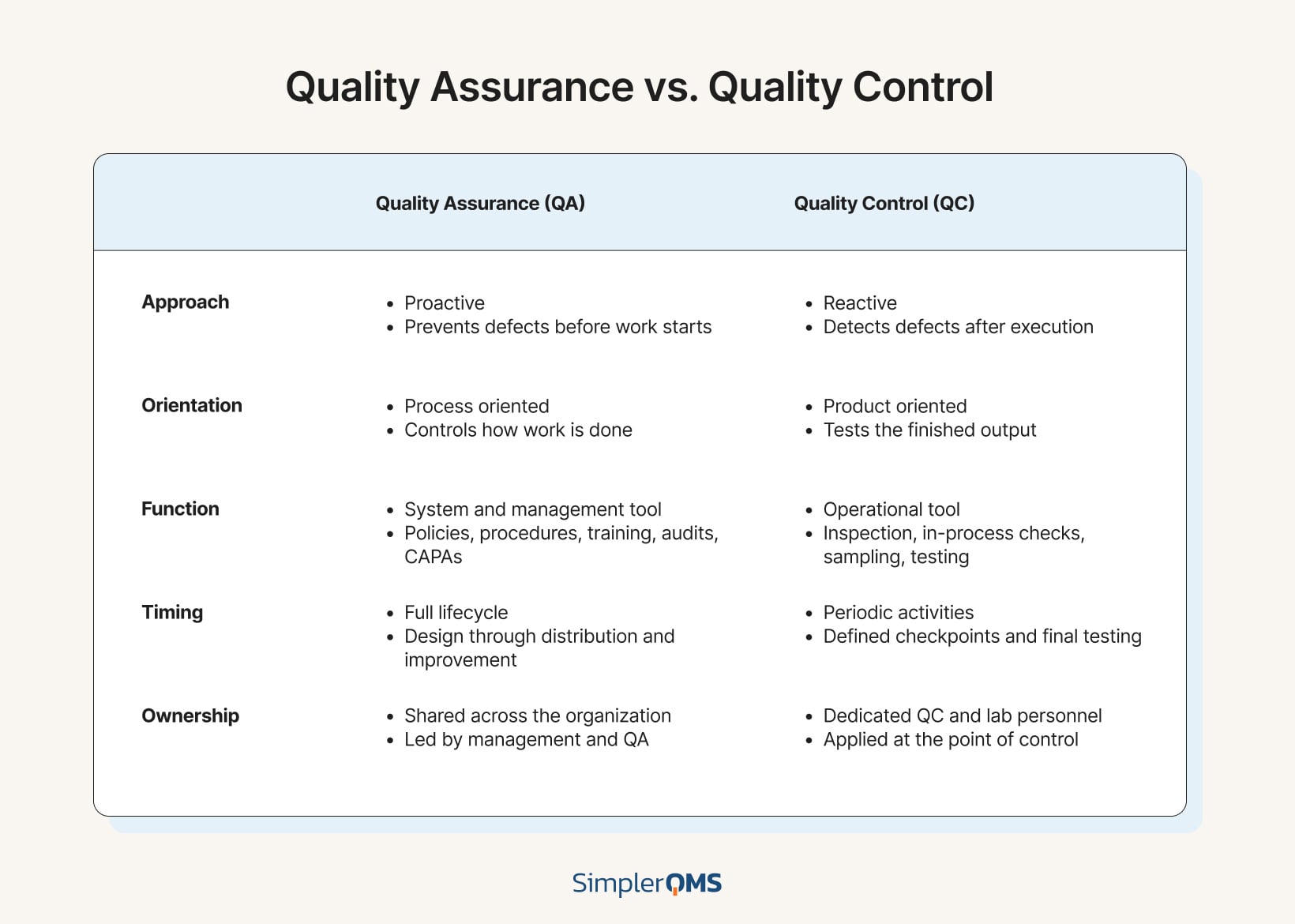
Quality assurance and quality control differ in focus, timing, and function. Quality assurance is a planned and systematic approach that prevents defects by controlling processes, systems, and methods before issues occur. Quality control is an operational tool that identifies defects by inspecting, testing, and verifying products or outputs after work has been performed.
The practical differences between quality assurance and quality control are given below.
- Proactive (QA) vs. Reactive (QC): Quality assurance is proactive because it prevents quality issues by defining standards, procedures, and controls before work starts. Quality control is reactive because it detects defects after production or task execution has taken place.
- Process Oriented (QA) vs. Product Oriented (QC): Quality assurance is process-oriented because it focuses on how work is done, so processes remain controlled and consistent. Quality control is product-oriented because it tests the finished or intermediate product, material, part, or service result to confirm it meets specifications.
- System Tool (QA) vs. Operation Tool (QC): Quality assurance works as a system tool and management function through policies, procedures, training, audits, and CAPAs. Quality control works as an operational tool through inspections, in-process checks, sampling, and testing.
- Activities Across Full Lifecycle (QA) vs. Periodic Activities (QC): Quality assurance applies across the full lifecycle, from planning and design to production, distribution, and improvement. Quality control consists of periodic activities at defined points, such as incoming material checks, in-process controls, or final product testing.
A comparison table illustrating the differences between Quality Assurance (QA) and Quality Control (QC) across five key areas is shown in the image below.
Why Is Quality Assurance Important?
Quality assurance is important because it helps organizations build quality into processes and minimize defects. Quality assurance provides several core values, including consistency, reliability, compliance, and customer trust. QA supports these outcomes by ensuring work follows defined processes. Defined processes help organizations deliver products and services that meet requirements consistently.
Quality assurance delivers measurable benefits across the organization. The key benefits of quality assurance include the following.
- Improved Product or Service Quality: Quality assurance improves quality by controlling the processes that shape the product or service. Better process control leads to more consistent outputs.
- Stronger Compliance: Quality assurance supports compliance through documented procedures, training, audits, and controlled changes. Strong compliance reduces regulatory and business risk.
- Reduced Defects, Rework, and Complaints: Quality assurance prevents errors, which lowers defect rates and reduces rework and customer complaints.
- Reduced Costs: Quality assurance lowers the cost of poor quality by preventing failures, recalls, and repeated corrections.
- Increased Operational Efficiency: Quality assurance improves efficiency by standardizing workflows and reducing variation.
- Enhanced Decision-Making: Quality assurance improves decisions through better documentation, trend analysis, and data collection and review. Better visibility supports faster and more accurate action.
- Higher Customer Satisfaction: Quality assurance increases customer satisfaction because products and services more consistently meet expectations for quality, safety, and performance.
- Stronger Team Morale: Quality assurance supports teams by creating clear processes with defined roles. Stable systems reduce frustration and improve accountability.
- Enhanced Brand Reputation: Quality assurance strengthens brand reputation because consistent quality and compliance build long-term confidence among customers, partners, and regulators.
What Are the Principles of Quality Assurance?
Quality assurance principles are the core rules that guide how organizations plan, control, monitor, and improve quality. Quality assurance principles are based on internationally recognized quality management standards such as ISO 9000, 9001, 13485, and guidelines such as GMP and ICH.
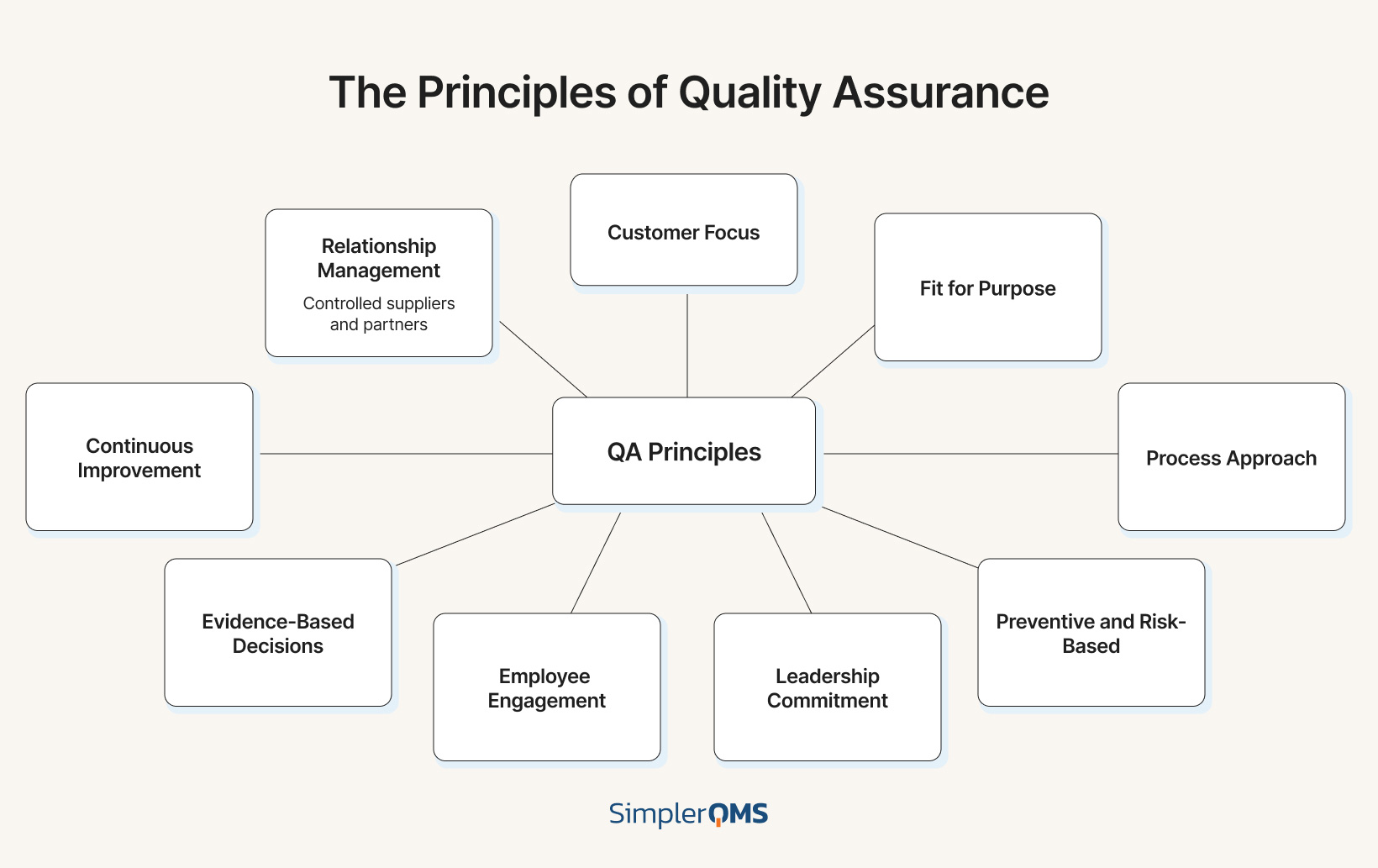
The nine core quality assurance principles and the role of each principle in quality management and improving quality are described below.
- Customer focus: Quality assurance starts with customer needs, intended use, and defined requirements. Customer focus is necessary because quality has value only when the product or service meets user expectations, safety needs, and performance requirements. Customer focus is critical in life sciences, software, manufacturing, and food because poor alignment with user needs leads to complaints, failures, or compliance issues.
- Fit for purpose: Quality assurance requires that a product, service, or process is suitable for its intended use. The fit for purpose principle is essential because conformance alone is not enough if the output does not perform as required in real use. Fit for purpose has a strong importance in pharmaceuticals, medical devices, and biotech, where product suitability affects patient safety.
- Process approach: Quality assurance treats work as a set of connected processes rather than isolated tasks. The process approach leads to more consistent outputs and makes root causes of non-conformances easier to identify. The process approach improves and sustains quality by defining inputs, outputs, responsibilities, controls, and interactions across the full workflow.
- Preventive approach and risk-based thinking: Quality assurance focuses on preventing defects and controlling risk before failures occur. The preventive approach is necessary because prevention reduces deviations, rework, complaints, and compliance failures more effectively than late detection alone. The preventive approach is highly relevant in life sciences, food, and aerospace because risk to safety, compliance, or performance must be assessed and controlled early.
- Leadership commitment: Quality assurance depends on active management support, clear quality policy, quality objectives, and resource allocation. Quality systems fail when leadership does not set direction or enforce standards. Leadership commitment sustains quality by creating a culture where compliance, accountability, and improvement remain part of daily operations.
- Employee Engagement and Accountability: Quality assurance requires that people understand their roles, responsibilities, and authority in the quality system. Employee engagement and accountability is necessary because even strong procedures fail when ownership is unclear, training is weak, and individuals are disengaged. Employee engagement and accountability improves quality through competence, traceability, and consistent execution, especially in regulated industries where each action must be controlled and documented.
- Evidence-based decision-making: Quality assurance relies on data, records, performance indicators, and trend analysis to guide decisions. Decisions based on assumptions weaken control and hide root causes. Evidence-based decision-making helps organizations improve quality in a structured and actionable way.
- Continuous improvement: Quality assurance requires regular review and improvement of processes, controls, and system performance. Continuous improvement is important because requirements, risks, technologies, and customer expectations change over time. Continuous improvement sustains quality by turning audit findings, CAPAs, performance trends, and feedback into measurable improvements.
- Relationship management: Quality assurance depends on controlled relationships with suppliers, service providers, partners, and customers. Quality risks often come from poor communication, weak supplier control, or misaligned expectations across the supply chain. Relationship management is especially relevant in manufacturing, life sciences, and food, where supplier quality and external services directly affect final product quality.
The 9 principles of quality assurance, including customer focus, risk prevention, leadership commitment, and continuous improvement is illustrated on the image below.
What Is a Quality Assurance System?
A quality assurance system is a structured framework, supported by policies, processes, procedures, and resources, that provides confidence that quality requirements will be fulfilled. The quality assurance system is part of the broader Quality Management System (QMS). According to ISO 9000:2015, the quality management comprises four interrelated components, quality assurance, quality planning, quality control, and quality improvement, which operate within a QMS to achieve quality objectives. The quality assurance system functions by standardizing processes, setting requirements, assigning responsibilities, monitoring execution, recording evidence, investigating issues, and driving corrective and preventive action when performance does not meet expectations.
The key components of a quality assurance system include the following.
- Process Control and Monitoring: A quality assurance system controls critical processes through standard operating procedures (SOPs), work instructions, acceptance criteria, and performance checks. Process monitoring helps detect variation early and supports consistent results.
- Training Management: A quality assurance system ensures personnel are trained, qualified, and kept current on applicable procedures and job requirements. Training management supports compliance, consistency, and accountability.
- Change Control: A quality assurance system manages changes to processes, documents, equipment, systems, materials, or products in a controlled manner. Change control protects the validated or approved state and reduces unintended quality risks.
- Deviation, Non-conformance, Complaint, and CAPA Management: A quality assurance system records and investigates quality issues, customer complaints, and process failures in a structured way. CAPA management eliminates root causes and prevent recurrence.
- Audits, Inspections, and Management Review: A quality assurance system uses audits, inspections, and management review to verify compliance and system performance. These activities provide oversight and support improvement decisions.
- Risk Management: A quality assurance system identifies, assesses, and controls risks that could affect product quality, compliance, or process performance. Risk management strengthens prevention and supports better control decisions.
- Supplier Management: A quality assurance system ensures suppliers consistently meet defined quality requirements. Supplier management helps control incoming materials, outsourced activities, and service quality.
- Equipment Management: A quality assurance system controls equipment through qualification, calibration, maintenance, and status tracking. Equipment control helps ensure reliable operation and accurate results.
- Records, Data Integrity, and Document Control: A quality assurance system maintains controlled documents, complete records, and reliable data throughout the lifecycle. Document control and data integrity support consistent process execution, traceability, and audit readiness.
What Are the Different Types of Quality Assurance?
The different types of quality assurance are the main sub-categories organizations use to protect quality, consistency, and compliance. Quality assurance types are not universally standardized, so different industries and companies may group them differently.
The main types of QA in life sciences are given below.
- Process QA: Process quality assurance focuses on designing, documenting, implementing, monitoring, and controlling operational processes so they remain stable, capable, and consistently followed. Process QA improves quality by reducing variation, strengthening preventive controls, and supporting continuous improvement.
- Product QA: Product quality assurance focuses on ensuring products, batches, or service outputs meet defined specifications and are fit for intended use. Product QA supports quality through validation, verification, acceptance criteria, and formal release or approval controls.
- System QA: System quality assurance focuses on the effectiveness of the full QMS, including policies, procedures, records, metrics, and audits. System QA sustains quality by ensuring the QMS remains effective over time.
- Regulatory Compliance QA: Regulatory compliance quality assurance focuses on meeting external standards, regulations, and guidelines such as Good Manufacturing Practice (GMP), Good Laboratory Practice (GLP), Good Clinical Practice (GCP), and ISO standards. Regulatory compliance QA sustains quality by aligning internal processes, documentation, and controls with regulatory expectations, which reduces the risk of inspection findings, penalties, product quality failures, and loss of market access.
Quality assurance types often overlap in practice. Process QA supports product quality, system QA supports process control, and regulatory compliance QA strengthens all three through documented regulatory requirements and compliance evidence.
Process QA
Process quality assurance defines, standardizes, monitors, and improves operational processes so that those processes consistently deliver quality outputs without defects. Process quality assurance focuses on how work is performed rather than only on the result. Process-focused QA builds repeatable workflows and controls that reduce variation and improve quality consistency.
The key objective of process quality assurance is defect prevention through upfront process optimization rather than post-completion issue detection. Process quality assurance is important because stable and controlled processes reduce errors. These controlled processes improve right-first-time performance, support compliance, and make outcomes more predictable. This type of quality assurance is used in manufacturing, including pharmaceuticals, biotechnology, medical devices, food processing, automotive, and service environments with repeatable workflows.
Process quality assurance defines quality through process capability, right-first-time performance, adherence to SOPs, on-time performance, and defect rates within defined limits. Process quality assurance depends on clear procedures, trained personnel, control points, and review of process data so performance trends can be detected early.
Process quality assurance uses statistical process control, control charts, SOPs, work instructions, and process audits.
Product QA
Product quality assurance is focused on verifying and ensuring that specific products, batches, or outputs meet predefined specifications, standards, and fitness-for-use criteria before release. Product quality assurance centers on the acceptability of the product itself, though it remains linked to the processes that created it. Product QA is interconnected with quality control because it depends on inspection, testing, and review results to support release and approval decisions.
The primary objective of product quality assurance is to confirm that individual products are compliant, safe, and suitable for their intended purpose through direct evaluation and approval. Product quality assurance applies to pharmaceuticals, medical devices, consumer goods, automotive, electronics, food and beverage, and other sectors that produce tangible and inspectable outputs.
Product QA defines quality through conformance to specifications at release and through shelf life, fitness for intended use, and absence of defects, contamination, or other unacceptable conditions. Product quality assurance supports consistent release decisions by combining documented requirements, product testing or inspection, and objective evidence. Product-focused QA is important in life sciences because each batch or product unit must meet approved requirements before being released to the market.
Product quality assurance uses tools and methods such as batch testing, inspection, in-process controls, sampling plans, acceptance criteria, stability testing, methods of analysis, installation qualification (IQ), operational qualification (OQ), performance qualification (PQ), and non-conformance reporting, batch record review, Certificates of Analysis (CoA), and product release.
System QA
System quality assurance is centered on verifying the effectiveness, compliance, and continuous improvement of the overall QMS. System quality assurance examines whether the full quality framework works as intended across the organization, with an emphasis on policies, procedures, governance, and oversight.
The primary purpose of system quality assurance is QMS effectiveness and the delivery of consistent quality across the organization. System quality assurance sub-category is important because weak system control leads to recurring issues, poor audit outcomes, inconsistent execution, and compliance gaps. System-centered quality assurance is used in regulated sectors such as pharmaceuticals, biotechnology, GMP manufacturing, medical devices, and aerospace, as well as in multi-site organizations, ISO 9001-certified companies, and businesses where strong oversight and audit readiness is essential.
The criteria that define quality in system QA are the compliance status, audit outcomes, inspection readiness, CAPA effectiveness, improvement actions, and risk management actions across the system. System quality assurance helps sustain quality by identifying gaps in procedures, training, metrics, and oversight before those gaps lead to broader failures.
System quality assurance uses methods such as internal audits, quality KPIs, management reviews, QMS certification audits and inspections, and compliance gap assessments.
Regulatory Compliance QA
Regulatory compliance quality assurance is focused on adhering to external laws, guidelines, and standards set by governing bodies and regulatory agencies.
The primary objective of regulatory compliance quality assurance is to ensure that the organization meets applicable requirements. The importance of regulatory compliance QA lies in protection from regulatory and business consequences, including legal penalties, warning letters, product recalls, import restrictions, and loss of licenses or authorizations. This QA sub-category is most critical in life sciences and other heavily regulated sectors, where compliance status directly affects product approval, market access, and patient safety.
Regulatory compliance quality assurance defines quality through indicators such as zero critical audit findings, successful regulatory inspections, timely reporting to regulatory authorities, and successful dossier or product file submissions that lead to granted authorizations or maintained approvals.
Regulatory compliance quality assurance uses methods and tools such as mock audits, regulatory inspections, legislation monitoring, compliance gap assessments, dossier or medical device file lifecycle management, and structured regulatory training programs.
What Are the Different Steps in a Quality Assurance Process?
Quality assurance process is the structured, interrelated activities within an organization’s quality management system, specifically focused on providing confidence that quality requirements will be fulfilled. A quality assurance process works as a repeatable framework that helps organizations maintain consistency, compliance, and reliable outcomes.
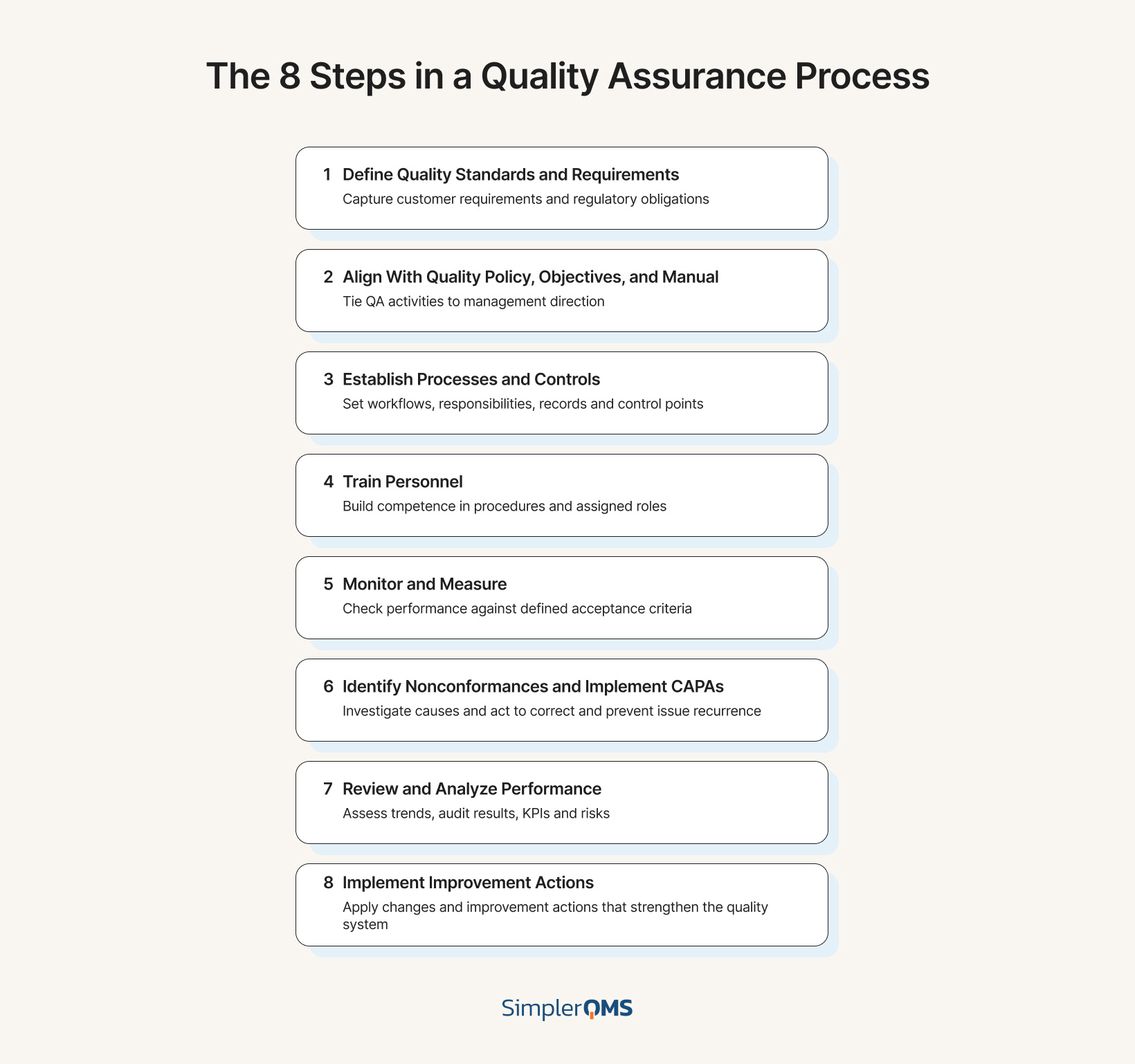
Quality assurance processes usually follow a Plan-Do-Check-Act cycle, consisting of the following eight steps.
- Define Quality Standards and Requirements: Define customer requirements and regulatory obligations. The definition of requirements sets the basis for process design, control, and evaluation.
- Align with Quality Policy, Objectives, and Manual: Align the quality assurance process with the organization’s quality policy, quality objectives, and quality manual. This alignment ensures that each quality process supports management direction regarding quality and system-wide consistency.
- Establish Process and Controls: Establish workflows, responsibilities, records, and control points needed for consistent execution. The standardization of processes and controls reduces variation and builds prevention into operations.
- Train Personnel: Train personnel on procedures, assigned roles, and expectations. Training supports consistent execution, accountability, and compliance.
- Monitor and Measure: Monitor process performance against defined acceptance criteria. The monitoring and measurement step shows whether the process works as intended and where gaps exist.
- Identify Non-Conformances and Implement CAPAs: Identify non-conformances, investigate their causes, and implement corrective and preventive actions. Identifying non-conformances and implementing CAPAs supports continuous improvement.
- Review and Analyze Performance: Review trends, audit results, KPIs, risks, and overall performance. The review step helps management understand whether the quality process and subsequently the quality system remain effective.
- Implement Improvement Actions: Implement process changes and improvement actions based on review and audit findings. Improvement actions drive continuous improvement of the quality system and help sustain quality over time.
The 8 stages of the quality assurance process, from defining quality standards to implementing improvements is shown in the image below.
1. Define Quality Standards and Requirements
Defining quality standards and requirements is the first step in the quality assurance process. Requirements definition creates the baseline for later process controls, reviews, approvals, and improvement actions. The definition of quality standards and requirements includes the identification of the internal, customer, technical, and regulatory requirements that products, services, and processes must meet.
Defining quality standards and requirements makes quality expectations clear before work begins. It is critical to quality assurance and improvement because defined requirements guide specifications and acceptance criteria. Defining quality standards and requirements mitigates risks such as compliance gaps, release failures, and customer complaints. Quality standards and requirements have a direct compliance impact. Regulated industries must translate laws, guidelines, standards, product requirements, and customer obligations into controlled procedures.
The three key activities in defining quality standards and requirements include the following.
- Identify applicable requirements: Applicable requirements include customer expectations, product requirements, and applicable regulations, guidelines, or standards.
- Classify critical quality attributes and process needs: Critical quality attributes and process needs include product characteristics, process parameters, and records that are critical for quality, safety, and compliance.
- Translate requirements into quality criteria: Quality criteria convert broad expectations into measurable acceptance requirements.
Quality assurance typically leads the definition of quality standards and requirements. Regulatory affairs, production, engineering, R&D, quality control, and process owners also contribute, depending on the industry and organizational structure. Defining quality standards and requirements uses tools and documents such as customer requirements, regulatory or standard requirements, risk assessments, product specifications, and design or process requirements. Requirements definition delivers quality acceptance criteria. Defining quality standards and requirements is successful when the requirements are complete, current, approved, measurable, communicated, and traceable to applicable regulations, product specifications, and operational controls.
2. Align with Quality Policy, Objectives, and Manual
Aligning quality processes with the quality policy, quality objectives, and quality manual is the second step in a quality assurance process. Aligning quality processes with policy, objectives, and manual ensures that day-to-day quality activities are directly connected to the organization’s formal quality direction. This alignment ensures that procedures, controls, and responsibilities, including SOP ownership, approval flows, and role assignments, follow the Quality Management System (QMS) framework.
Alignment with the quality policy, objectives, and manual supports consistent execution of quality activities across the organization. It is critical because disconnected practices create inconsistent execution, weak oversight, and gaps between stated quality commitments and actual operations, such as unaligned SOPs or unassigned quality objectives.
The alignment of QA processes with higher-level QMS documentation mitigates risks such as conflicting procedures, unclear priorities, poor resource use, and weak accountability. Aligning QA processes with quality policy, objectives, and manual has a compliance impact because it links daily operations to the overall organization’s commitment to quality.
The four sub-activities of alignment with the quality policy, objectives, and manual are the following.
- Review the quality policy: Quality policy review confirms that operational activities support the quality policy and its stated commitments.
- Link processes to quality objectives: Process-to-objective linkage connects departmental activities and controls to measurable quality objectives.
- Check consistency with the quality manual: Quality manual consistency review verifies that procedures and roles match the structure and rules defined in the quality manual.
- Review alignment during updates: Alignment review during updates checks that changes to processes or documents remain consistent with the approved QMS framework.
Aligning with quality policy, objectives, and manual is usually led by management and quality assurance, with support from process owners and department heads. Ensuring alignment between the QA process and quality policy, objectives, and manual involves gap assessments and checklists. This step produces aligned procedures with documented links between operations and quality goals. The alignment of QA processes is successful when processes match the approved QMS framework, objectives are measurable and assigned, and teams show clear traceability between daily work and quality goals.
3. Establish Process and Controls
Establishing processes and controls is the third step in the quality assurance process and defines how work is performed and how quality is checked during execution. Establishing processes and controls means creating documented workflows with clear responsibilities, acceptance criteria, monitoring points, and preventive controls. It includes the development of SOPs, acceptance limits, and in-process checks, so processes consistently deliver compliant and reliable outputs.
Standardized processes and controls build quality into operations before defects occur. This step is critical because uncontrolled or poorly designed workflows lead to variation, errors, rework, delays, compliance gaps, and nonconforming outputs, such as missed approvals, undocumented deviations, and rejected batches. Establishing processes and controls mitigates risks such as inconsistent execution, missed approvals, weak traceability, data integrity issues, and product or service non-conformance. Establishing processes and controls has a regulatory impact in life sciences because defined procedures, documented responsibilities, and evidence retention are required for compliance.
The six sub-steps involved in establishing processes and controls are given below.
- Define process steps and sequence: Process step and sequence definition maps the workflow from input to output and shows how each step connects to the next.
- Assign roles and responsibilities: Role and responsibility assignment identifies who performs, reviews, approves, and oversees each activity.
- Set acceptance criteria and control points: Acceptance criteria and control points define measurable checkpoints and limits that determine whether the process remains in control.
- Document procedures and instructions: Procedures and instructions document the approved way of working in SOPs and work instructions.
- Link processes to records and monitoring: Records and monitoring requirements define which records must be created and which data must be captured.
- Verify process suitability: Process suitability verification confirms that the process design and controls are practical, sufficient, and aligned with requirements before routine use.
Establishing processes and controls is usually led by quality assurance and process owners, with support from operations, engineering, production, quality control, validation, and regulatory affairs, where applicable. Establishing processes and controls uses tools and documents such as process maps, SOPs, work instructions, records and forms, validation protocols, and reports.
This step produces approved QA processes with documented controls, defined responsibilities, and controlled records that guide consistent execution. Establishing processes and controls is successful when procedures are approved, and in use, roles are clear, control points are defined, and records are traceable.
4. Train Personnel
Personnel training is the step where the organization ensures employees have the knowledge and skills required to perform their work correctly and consistently. Personnel training includes assigning, delivering, and documenting training, and verifying its effectiveness. Training helps personnel follow approved procedures, meet quality requirements, and maintain compliance.
The purpose of personnel training is to ensure that controlled processes are executed by competent personnel. Employee training is critical because personnel may not understand their tasks, responsibilities, or quality requirements even when procedures are well designed. Training reduces risks such as human error, inconsistent execution, and data integrity issues. Training supports compliance because many standards and regulations require documented evidence that personnel are qualified, trained, and competent for the work they perform.
The six key activities in personnel training are listed below.
- Identify training needs: Training starts by determining which roles require which skills and knowledge.
- Assign required training: Personnel training links training requirements to roles, tasks, or processes.
- Deliver training: Organizations deliver training through classroom sessions, on-the-job training, or document-based training.
- Assess understanding or competence: Personnel training includes quizzes or practical evaluations to confirm that the training material was understood and applied correctly.
- Document training completion: Training documentation includes attendance, completion status, results, and approvals in controlled training records.
- Maintain and update training status: Retraining must be performed as required after document revisions, significant changes, deviations, prolonged absence, or at defined intervals.
Personnel training is typically managed by quality assurance and human resources, with direct involvement from department managers and process owners. Training in regulated industries involves QA oversight because training records, role qualification, and training effectiveness affect compliance with applicable requirements.
Tools and methods used during personnel training include training matrices, SOPs, work instructions, learning management systems, training records, competence assessments, and checklists.
The output of effective training is qualified personnel and complete and current training records as documented evidence of competence. Training is successful when completed on time, competence is verified, and performance data shows reduced errors, deviations, and repeated mistakes.
5. Monitor and Measure
Monitoring and measurement involve checking whether the defined processes and controls work as intended during execution. Monitoring and measurement focus on real-time and routine operational oversight, including in-process checks and documented evidence that activities were performed according to approved requirements.
The purpose of process monitoring is to confirm that personnel perform work according to defined procedures and that process controls remain effective. Monitoring and measurement are critical because process design cannot ensure quality unless execution is checked against requirements. Process monitoring lowers risks such as undetected deviations, undocumented activities, data integrity issues, and the release of nonconforming products. Regulated organizations monitor and control their processes to ensure only compliant products reach the market.
The five main sub-steps involved in monitoring and measurement include the following.
- Confirm personnel and equipment status: Before process initiation, the responsible personnel confirm that only trained personnel will perform the task and that equipment, systems, or materials are in the required status for use.
- Perform the process as defined: Process monitoring requires execution according to SOPs and work instructions.
- Check critical control points during execution: Measurement verifies key parameters, approvals, and in-process criteria while work is performed.
- Record process data and evidence: During monitoring and measurement, personnel capture the required entries, results, signatures, timestamps, and supporting records.
- Verify completion of required process checks: Upon process completion, responsible personnel confirm that all required inspections, reconciliations, line clearances, or in-process verifications were completed.
Monitoring and measurement are usually carried out by process operators, production staff, laboratory personnel, supervisors, and quality control or quality assurance personnel, depending on the activity. Processes are overseen primarily by process owners and then by QA.
During process monitoring and measurement, personnel use documents such as SOPs, work instructions, checklists, batch records, logbooks, in-process inspection forms, and equipment status labels. Monitoring and measurement also include activities such as statistical process control, test result review, reconciliation, and audit trail review when these controls are relevant to the process.
The deliverables of the monitoring and measurement step are the completed process records, in-process and finished product results, and documented evidence. Successful monitoring and measurement ensure that checks are performed on time and records remain complete and contemporaneous. They also ensure that deviations are detected without delay, critical parameters remain within limits, and the process advances only when defined controls are met.
6. Identify Non-Conformances and Implement CAPAs
Identifying non-conformances and implementing CAPAs is the step where the organization records process or product failures, investigates their causes, and takes corrective and preventive action to resolve the problem and prevent recurrence.
Non-conformances identification and CAPA implementation restore control and prevent recurrence. Timely identification and resolution of quality issues are critical because unresolved issues can compromise process reliability, product quality, compliance, and customer trust. Effective non-conformance and CAPA management mitigates risks such as repeat deviations, release of nonconforming products, recurring complaints, and audit findings. Documenting non-conformances, investigating root causes, implementing corrective actions, and verifying effectiveness are mandatory in the life sciences industry.
The seven main activities in identifying non-conformances and implementing CAPAs are given below.
- Detect and document the issue: The first step in identifying non-conformances and implementing CAPAs is recording the non-conformance, deviation, complaint, or other quality event in a controlled record according to a formal procedure.
- Contain the immediate impact: Non-conformance management includes immediate actions such as segregating or isolating affected materials, products, records, or processes.
- Assess criticality and risk: Non-conformance assessment includes the evaluation of potential impact on quality, safety, compliance, and customers, as well as the likelihood of occurrence and detectability, to classify the event.
- Investigate root cause: Non-conformance handling examines why the issue occurred and why existing controls did not prevent it to determine an effective CAPA.
- Define corrective and preventive actions: CAPA(s) are established to correct the current problem and prevent the recurrence of similar failures.
- Implement and track actions: Implementing a CAPA includes assigning responsibilities, setting deadlines, and defining an effectiveness review.
- Verify effectiveness and close the record: CAPA effectiveness verification confirms that actions worked and that the issue no longer recurs before formally closing the record.
Non-conformance identification and CAPA implementation are led by quality assurance, with support from process owners, department managers, and relevant technical functions. The resolution of a significant quality issue may require management oversight.
Documents used for non-conformance identification and CAPA implementation include non-conformance reports, CAPA records, and complaint files. Techniques used include root cause analysis, risk assessments, 5 Whys, Fishbone diagrams, and CAPA effectiveness checks.
The outputs of non-conformance and CAPA management are documented quality events, quality investigation records, approved action plans, implemented corrections, and evidence of effectiveness verification. Identification of non-conformances and CAPA implementation are successful when issues are documented on time, risk is contained, and the root cause is supported by evidence. Success also requires actions to be completed by the due date and recurrence to be reduced or eliminated.
7. Review and Analyze Performance
Performance review and analysis evaluate how well the quality system, processes, and controls perform over time by using collected quality and process data.
Performance review and analysis assesses whether quality activities achieve the intended results and whether controls remain effective, adequate, and aligned with requirements. Performance review is critical to reveal process or system weaknesses, such as ineffective controls, recurring deviations, declining product performance, or missed improvement opportunities. Systematic review lowers the risk of repeated failures, undetected process trends, poor management visibility, inefficient resource allocation, and uninformed decision-making. Standards, guidelines, and regulations, including ISO 9001 and ICH Q10, require performance evaluation and continuous improvement of process performance, product quality, and quality system.
The four key activities included in the performance review and analysis are the following.
- Collect relevant quality and process data: Data collection requires gathering quality records such as non-conformances, CAPAs, audit findings, process trends, and other quality system outputs over a defined period.
- Compare results against targets and requirements: The comparison step checks performance outputs against defined targets and quality objectives.
- Identify patterns, trends, and recurring issues: Trend identification examines the data from repeated failures, complaint trends, errors, weak controls, or performance shifts.
- Document conclusions and escalations: The documentation step is complete after conclusions are written and improvement actions are defined.
Performance review is usually led by quality assurance and process owners, with input from department managers and senior management, depending on the scope of review. Performance review and analysis uses tools such as quality KPIs and metrics, trend reports, management review records, and dashboards.
Performance review delivers documented performance conclusions, identified trends, confirmed system strengths and weaknesses, and prioritized quality issues that require decision or improvement action. Performance review is successful when trends are clearly identified, conclusions are evidence-based, recurring issues are visible, and decision-makers receive clear input for the next improvement step.
8. Implement Improvement Actions
Implementing improvement actions is the step in the quality assurance process where the organization selects and authorizes changes needed to improve quality, strengthen controls, and address gaps found during performance review. Improvement actions convert review findings into planned and prioritized actions so the QMS and QA processes remain effective, compliant, and reliable.
The main purpose of the improvement actions is to translate quality insights into an actionable plan. Implementing improvement actions is critical because review findings do not improve quality unless the organization chooses clear actions, assigns ownership, and commits resources. Implementing improvement actions addresses risks such as system weaknesses, ineffective controls, resource misalignment, and delayed response to compliance or quality issues. Improvement actions affect compliance since regulated organizations are expected to act on review outputs, maintain continual improvement, and keep the quality system effective.
The six key sub-steps to implementing improvement actions are the following.
- Define the improvement action: Improvement action definition specifies what must change, why the change is needed, and what result is expected.
- Prioritize improvement needs: Improvement needs are prioritized based on risk, compliance importance, and business effect.
- Assign ownership and resources: Ownership and resource assignment identify the responsible person or function and confirm resource requirements such as time, budget, tools, or support.
- Set timelines and success criteria: Improvement actions require due dates and measurable targets that define successful completion.
- Select the implementation path: Improvement actions are handled inside QMS. The implementation path determines whether the action is managed through CAPA, change control, or another quality procedure.
- Link actions to follow-up: Action follow-up ensures approved improvements are tracked through implementation and verified for effectiveness.
Improvement actions implementation is typically led by management and quality assurance, with input from department heads, process owners, and other affected functions. Implementing improvement actions requires management involvement because improvement priorities, resource allocation, and system changes depend on leadership direction.
Improvement actions use methodologies, tools, and documents such as management review records, CAPA records, change control, dashboards, and project tracking tools. Implementing improvement actions may use frameworks such as ISO 9001, ICH Q10, and continual improvement methods.
The outputs of this step are approved improvement plans, assigned responsibilities, defined timelines, and measurable success criteria. Successful improvement actions are resourced, clearly assigned, handled through controlled workflows, and linked to specific targets such as reduced non-conformances or improved cycle time.
What Are the Different Quality Assurance Techniques and Methodologies?
Quality assurance techniques are the specific tools or practices applied to execute quality activities, while quality assurance methodologies are the broader frameworks that guide how quality is managed. Quality assurance techniques and methodologies exist to improve process control, support compliance, reduce errors, and strengthen consistent delivery of products or services.
Key quality assurance techniques and methodologies are described below.
- SOPs and Document Control: Standard operating procedures and document control are techniques for defining how work must be performed and ensuring only current, approved documents are used.
- Reviews and Walkthroughs: Reviews and walkthroughs are techniques for examining documents, designs, processes, or outputs before release or implementation.
- Audits: Audits are included in QA techniques and assess whether processes, records, and activities follow defined requirements and procedures.
- Statistical Process Control and Control Charts: Statistical process control and control charts are techniques to monitor process behavior through data and variation patterns.
- Risk Assessment Techniques: Risk assessment techniques identify hazards, possible failures, and control priorities before problems occur.
- Validation and Verification: Validation and verification are quality assurance techniques. Validation confirms that a process, system, or method is fit for intended use, while verification confirms that defined requirements were met.
- Root Cause Analysis (RCA): Root cause analysis is a QA technique used to investigate why a problem occurred and why controls did not prevent it.
- Corrective and Preventive Action: CAPA is a QA technique for the management of correction and prevention of non-conformances and quality issues.
- Total Quality Management (TQM): TQM is a broad management methodology that focuses on customer satisfaction and embeds quality into culture, leadership, and processes.
- Plan-Do-Check-Act (PDCA) Cycle: Plan-Do-Check-Act is a cyclical methodology for planning, implementing, evaluating, and improving processes in a structured way.
- Six Sigma: Six Sigma is a data-driven methodology focused on reducing process variation and defects through structured analysis and improvement.
- Lean: Lean is a methodology focused on removing waste, improving flow, and increasing value in processes.
- Continuous Improvement: Continuous improvement is the ongoing methodology of making processes, controls, and systems better over time through regular review and action.
SOPs and Document Control
SOPs and document control are quality assurance techniques that ensure that the key business or QMS processes are performed consistently. SOPs describe the approved steps and specify responsibilities for performing tasks, while document control ensures that only the current approved version is available for use. SOPs and document control exist to reduce variation, prevent errors, support training, and maintain compliance. SOPs and document control are important in life sciences, manufacturing, medical devices, food, laboratories, and other regulated or process-driven industries. Core components include procedure creation, review, approval, version control, access control, periodic review, and maintenance of document history.
Quality assurance oversees the SOPs management and document control, while process owners and subject matter experts draft and maintain the content. SOPs and document control rely on SOP templates, approval workflows, revision history, records, and document management systems or eQMS platforms. Outputs include approved SOPs, controlled forms, obsolete document archives, and traceable evidence of review and approval.
Reviews and Walkthroughs
Reviews and walkthroughs are quality assurance techniques used to examine documents, processes, or outputs before approval, release, or implementation. Reviews are more formal and structured, while walkthroughs are more guided and explanatory and are led by the process owner. In some organizations, a manager or subject matter expert leads the walkthrough when the topic requires specific technical or compliance input. Reviews and walkthroughs exist to detect errors, gaps, and inconsistencies early, before they lead to defects, rework, or compliance issues. Reviews and walkthroughs are widely used in software, life sciences, manufacturing, and engineering.
Reviews and walkthroughs involve the planned examination of content or output against defined requirements. Quality assurance, managers, supervisors, or cross-functional teams take part depending on the topic and risk. Reviews and walkthroughs rely on specifications, process requirements, controls, checklists, and completed records, and they generate comments, non-conformances, or approvals.
Audits
Audits are structured and independent examinations of processes, records, systems, or activities to verify whether they comply with defined requirements, procedures, standards, or regulations. Audits exist to confirm that the quality system works as intended, identify gaps, and provide evidence of compliance and control. Audits are common in pharmaceuticals, medical devices, manufacturing, food, aerospace, software, and any industry that depends on formal quality oversight or certification.
In practice, audits work through audit planning, review of documents and records, interviews with responsible personnel, observation of activities, and documentation of findings against audit criteria. Internal auditors, quality assurance, external auditors, certification bodies, customers, or regulators perform audits depending on scope and purpose. Quality audits rely on audit plans, checklists, SOPs, records, requirements, prior findings, and objective evidence, and they generate audit reports, observations, non-conformities, CAPAs, and follow-up actions. Common types include internal audits, external audits, certification audits, regulatory inspections, process audits, product audits, and system audits.
Statistical Process Control and Control Charts
Statistical process control and control charts are quality assurance techniques used to monitor process performance over time using collected quality data. Statistical process control focuses on process variation and stability, while control charts show whether a process remains within defined control limits or begins to drift out of control. Together, they help detect abnormal variation and prevent defects before they affect the final output. Statistical process control and control charts are common in manufacturing, pharmaceuticals, medical devices, food production, automotive, laboratories, and other environments with repeatable processes and measurable outputs.
Statistical process control and control charts work by collecting process data at defined intervals. The data is plotted against upper and lower control limits. The plotted data is then reviewed for signs of instability or special-cause variation. Production teams, validation, quality assurance, or quality control maintain and review them. Statistical process control and control charts rely on measured process data, sampling plans, specifications, and control limits. Statistical process control and control charts provide trend visibility, out-of-control signals, and information on process capability and performance. Methods used are X-bar and R charts, X-bar and S charts, p charts and np charts, c charts and u charts.
Risk Assessment Techniques
Risk assessment techniques are used to identify, analyze, evaluate, and control risks that could affect product quality, patient safety, process performance, or compliance. Risk assessment techniques help focus attention, resources, and controls on areas with the highest potential impact. Risk assessment techniques are common in life sciences, food, aerospace, automotive, and manufacturing, where failures can affect safety, compliance, or product reliability. Core elements include risk identification, risk analysis, risk evaluation, control measures, and review of risk mitigation effectiveness.
Risk assessment techniques include the structured review of process steps, product characteristics, historical issues, and possible failure points. Quality assurance, engineering, manufacturing, regulatory, validation, and cross-functional teams take part, depending on the scope. Risk assessment techniques use process maps, specifications, non-conformance data, complaint records, audit findings, and validation data. These inputs support documented risk ratings, priorities, and mitigation plans. Common methods include Failure Mode and Effects Analysis (FMEA), Hazard Analysis and Critical Control Points (HACCP), Hazard Analysis, Risk Matrix, Fault Tree Analysis (FTA), and Preliminary Hazard Analysis (PHA).
Validation and Verification
Validation and verification are quality assurance activities used to confirm that systems, processes, methods, or products meet requirements and are suitable for intended use. Verification checks whether defined requirements were met, while validation confirms that the final output performs as intended in real use. Validation and verification prevent the approval or release of processes, methods, systems, or products that are unreliable or non-compliant. Validation and verification are common in life sciences, software, manufacturing, and laboratories. Core elements include predefined requirements, documented protocols, objective testing, acceptance criteria, traceable evidence, and formal approval.
Validation and verification are carried out through planned testing and documented review against approved requirements and intended use. Quality assurance, validation teams, engineering, quality control, IT, and manufacturing share responsibility depending on the scope. Validation and verification rely on specifications, user requirements, risk assessments, protocols, test scripts, test results, deviations, and approval records. Validation and verification generate documented evidence that the system or output is acceptable for use. Validation and verification activities include process validation/verification, method validation/verification, cleaning validation, computer system validation, design validation, IQ, OQ, and PQ.
Root Cause Analysis
Root cause analysis is a quality assurance technique used to identify the underlying reason a quality defect or failure occurred. Root cause analysis goes beyond the visible symptom and examines the conditions, process weaknesses, or control failures that allowed the issue to happen. Root cause analysis is widely used in life sciences, manufacturing, food, aerospace, engineering, and software.
Root cause analysis works through a structured investigation of the event. The investigation includes a review of records and evidence and an evaluation of possible contributing factors. This evaluation continues until the most probable cause is identified. Quality assurance leads or oversees the process, with support from process owners and subject matter experts. Root cause analysis relies on inputs such as non-conformances and CAPA records, audit findings, complaint data, process records, interviews with involved personnel, and trend analysis. These inputs support documented investigation conclusions and corrective and preventive actions. Common methods include 5 whys, fishbone diagram, and change analysis.
Corrective and Preventive Action
CAPA is a quality assurance technique used to address non-conformances, deviations, complaints, audit findings, and other quality issues in a structured way. Corrective action focuses on eliminating the cause of an existing problem, while preventive action addresses conditions that could lead to a future problem. CAPAs restore control, reduce recurrence, and strengthen the quality system. CAPAs are common in medical devices, biotechnology, pharmaceuticals, laboratories, manufacturing, and other regulated or process-driven industries.
Quality assurance oversees the process, while execution is owned by process owners, department managers, or responsible functional teams. Corrective and preventive actions are derived from quality investigations, audit findings, and risk assessments. CAPA records include assigned action description, action owner, target date, implementation evidence, and effectiveness check.
Total Quality Management
Total quality management is a methodology that embeds quality as a shared responsibility across the full organization. Total quality management focuses on customer needs, process consistency, employee involvement, fact-based decisions, and continuous improvement, so quality is built into daily operations. TQM became a foundational quality approach in manufacturing. Its principles formed the foundation for management systems and methodologies such as the ISO 9000 series, Six Sigma, and lean manufacturing.
Total quality management works through employee commitment, cross-functional participation, standardized processes, and ongoing improvement of systems and workflows. All functions contribute through integrated systems while customer needs set direction. Total quality management relies on the 4 Ps and 3Cs, including planning, process, people, performance, culture, communication, and commitment. The 4 Ps are the hard management necessities. The 3 Cs complement the hard management necessities by shaping the soft organizational outcomes.
Plan-Do-Check-Act Cycle
Plan-Do-Check-Act cycle is a quality improvement methodology that uses a repeating four-step loop to plan a change, implement it, evaluate the result, and take action based on what was learned. The Plan-Do-Check-Act cycle improves processes in a controlled, evidence-based way rather than implementing untested changes. The Plan-Do-Check-Act cycle is common in manufacturing, healthcare, life sciences, services, engineering, and other environments that rely on structured improvement.
The Plan-Do-Check-Act cycle has 4 connected stages. The Plan stage defines the problem, target, method, and success criteria. The Do stage applies the planned change on a defined scale. The Check stage compares actual results against expected results using data and observations. The Act stage standardizes the improvement, adjusts it, or starts another cycle if the outcome is not yet acceptable. Management, quality teams, and process owners use it depending on the scope. The Plan-Do-Check-Act cycle relies on process data, KPIs, audit findings, root cause analysis, action plans, and performance records. It generates verified improvements, updated procedures, corrective actions, and stronger process control.
Six Sigma
Six sigma is a data-driven quality improvement methodology focused on reducing process variation and lowering defect rates. Six sigma aims to make processes more consistent and predictable by identifying the causes of errors and removing them through structured analysis. Six sigma is widely used in manufacturing, pharmaceuticals, medical devices, healthcare, logistics, finance, and other operations where measurable performance and low defect rates matter.
Six sigma works through defined improvement frameworks, most often DMAIC (Define, Measure, Analyze, Improve, and Control) for existing processes and DMADV (Define, Measure, Analyze, Design, Verify) for new process or product design. Specialized roles such as Champions, Master Black Belts, and Black Belts lead projects. Six Sigma relies on process data, defect data, statistical analysis, root cause analysis, process maps, and performance metrics, and it reduces variation and strengthens process capability. Common tools used include control charts, Pareto charts, fishbone diagrams, and FMEA.
Lean
Lean is a quality and process improvement methodology focused on removing waste, improving flow, and increasing value in operations. Lean targets activities that consume time, effort, or resources without improving the outcome for the customer or patient. Lean is common in manufacturing, life sciences, logistics, food production, and service operations with repeatable workflows. Core principles include defining value, mapping the value stream, creating flow, establishing pull, and continuously improving.
Lean works in practice through process observation, workflow mapping, problem identification, and targeted process changes. These changes remove unnecessary transportation and motion, waiting, overprocessing, overproduction, defects, and other non-value-adding steps. Operations teams, process owners, quality teams, engineers, and management share responsibility, depending on the scope of improvement activity. Lean relies on process maps, cycle time data, defect data, visual controls, and performance metrics, and it generates faster flow, reduced waste, shorter lead times, and more efficient processes. Common techniques include value stream mapping, 5S (Sort, Set in order, Shine, Standardize, Sustain), Just-In-Time, and Overall Equipment Effectiveness (OEE).
Continuous Improvement
Continuous improvement is a quality management approach focused on making processes, systems, and controls better over time through ongoing, small, targeted changes. Continuous improvement aims to improve quality, efficiency, compliance, and consistency by learning from performance data, deviations, audits, non-conformances, and daily operations. Continuous improvement is common in manufacturing, life sciences, medical devices, healthcare, software, food, and service organizations. Core elements include regular review of process performance, problem identification, evidence-based action, employee involvement, and sustained follow-up.
Continuous improvement works in practice through routine evaluation of process performance and selection of actions that remove weaknesses or improve results. Management, quality assurance, and process owners share responsibility for improvement actions, covering both oversight and execution. Continuous improvement relies on KPIs, audit findings, CAPA records, non-conformance trends, and risk assessments. Continuous improvement generates updated procedures, reduced waste, fewer defects, and better process performance.
What Are the Different Roles in a QA Team?
The different roles in a QA team include QA Officer or Specialist, Compliance Officer or Specialist, Shop-floor QA, Validation or CSV Specialist, Clinical or PV QA Specialist, Regulatory Affairs and QA Specialist, Quality Auditor, QA Manager or Lead, Quality Director or Head of Quality, and Qualified Person (QP). The different roles in a QA team collectively support building, maintaining, monitoring, and improving the quality system, so products meet defined quality and compliance requirements.
A QA team is a group of quality professionals who oversee process control, documentation, procedure adherence, compliance, risk, inspection readiness, and continuous improvement across the organization. QA team structure differs by industry and company size, with life sciences usually requiring more specialized roles due to extended regulatory obligations.
The main QA team roles and the responsibilities of each role are described below.
- QA Officer / Specialist: QA Officer or Specialist supports daily quality system activities such as document review, non-conformance management, training oversight, change control, and CAPA follow-up. QA Officer/Specialist role needs strong attention to detail, knowledge of procedures, and the ability to collaborate across departments.
- Compliance Officer / Specialist: Compliance Officer or Specialist focuses on ensuring that processes, records, and systems remain aligned with regulations, standards, guidelines, and internal procedures. A Compliance Officer/Specialist often supports inspections, gap assessments, monitoring regulatory updates, and policy enforcement.
- Shop-floor QA / QA for QC: Shop-floor QA and QA for QC support production and laboratory operations through batch review, line clearance, in-process oversight, status checks, and release support. Shop-floor QA and QA for QC roles need strong operational awareness because they work close to manufacturing or testing activities, where they must make immediate quality decisions.
- Validation / CSV Specialist: Validation and CSV Specialists ensure that equipment, systems, processes, and software are qualified, validated, and maintained in a compliant state. Validation and CSV Specialists manage IQ, OQ, PQ, validation protocols, test evidence, and change impact assessment for validated systems.
- Clinical / PV QA Specialist: Clinical and PV QA Specialists support quality oversight in clinical trials and pharmacovigilance activities. Clinical and PV QA Specialists focus on GCP and GVP, vendor oversight, audits, document control, training management and quality review of clinical or safety processes and records.
- Regulatory Affairs QA Specialist: Regulatory Affairs QA Specialist works across quality and regulatory requirements to support product compliance, submissions, change assessment, and inspection readiness.
- Quality Auditor: Quality Auditor plans and performs internal or external audits to verify compliance and identify gaps. The Quality Auditor role needs strong interviewing, observation, documentation, and reporting skills because audit conclusions drive CAPAs and system improvement actions.
- QA Manager / Lead: QA Manager or Lead directs the daily work of the QA function and ensures the quality system operates effectively. The QA Manager/ Lead role oversees team priorities, escalations, metrics, investigations, audit readiness, and cross-functional quality decisions.
- Quality Director / Head of Quality: Quality Director or Head of Quality leads the full quality strategy, governance, and quality culture of the organization. Head of Quality sets direction, allocates resources, works with senior management, and ensures the quality system supports compliance, business goals, and long-term improvement.
- Qualified Person (QP): The Qualified Person is a role in EU pharmaceutical companies, with legal responsibility for certifying that each medicinal product batch meets GMP and marketing authorization requirements before release. QP requires formal qualifications, and the QP application must be assessed and accepted by regulatory authorities.
How Does QA in Life Sciences Differ from Other Industries?
Quality assurance in life sciences differs from other industries because it operates under stricter regulatory control, extensive documentation and data integrity requirements, and a stronger focus on patient safety, product efficacy, and quality. Quality assurance in life sciences protects public health, supports market authorization, and the legal right to manufacture, release, and distribute regulated products.
Quality assurance in life sciences differs from other industries in several core ways listed below.
- Patient Safety as the Primary Objective: Quality assurance in life sciences places patient safety at the center of quality decisions. Other industries often focus first on customer satisfaction or performance, while life sciences must ensure that product quality failures do not result in harm.
- Intense Regulatory Oversight and Compliance Mandates: Quality assurance in life sciences operates under detailed regulatory frameworks such as EU GMP, EU MDR/IVDR, FDA Part 210/211 and 820, and ISO-based requirements. Other industries may follow quality standards, though life sciences face more direct inspection pressure, formal approval requirements, and stricter legal consequences for noncompliance.
- Heavier Focus on Validation and Qualification: Quality assurance in life sciences requires documented validation of processes, systems, methods, and qualification of equipment, facilities, and utilities where relevant. While other industries may test and approve systems and processes, life sciences require formal and traceable evidence that the process or system works as intended.
- Extensive Documentation and Data Integrity Requirements: Quality assurance in life sciences depends on controlled documents, complete records, and data integrity, because every critical activity must be traceable and defensible. Although documentation is used in all industries, life sciences require very strict document control.
- Lifecycle Management and Post-Market Surveillance: Quality assurance in life sciences continues well beyond development and production into distribution, complaint handling, post-market surveillance, stability monitoring, and change management. While other industries monitor field performance, life sciences have formal obligations to track safety, effectiveness, and product quality across the full lifecycle.
- Supply Chain as an Extension of the QA System: Quality assurance in life sciences treats suppliers, contract manufacturers, laboratories, distributors, and service providers as part of the controlled quality system. Other industries manage suppliers for quality and cost, while life sciences require pre-approval qualification, ongoing monitoring, quality agreements, and supply chain traceability because supplier failures may affect compliance and patient safety.
- Product Release Under Independent QA Review: Quality assurance in life sciences includes independent review of production and control records, non-conformances, and release documentation before product disposition. Other industries may release products through production or operational approval, while life sciences require a more formal and independent quality decision before release to market. In particular, in the pharmaceutical industry, batch release decisions are supported by QA reviewers, and, where required by QP.
How Does eQMS Support Quality Assurance in Life Science Organizations?
An electronic Quality Management System (eQMS) supports quality assurance in life science organizations by centralizing quality processes, standardizing workflows, enforcing document control, and maintaining auditable compliance records. An electronic quality management system in life sciences is a digital platform designed to centralize, automate, and manage the company’s quality processes.
The core QA functions supported by eQMS include the following.
- Document Control: eQMS manages controlled documentation, including SOPs, specifications, forms, and records with version control, e-signatures, and full traceability of actions.
- Training Management: QMS software streamlines training management by automating training assignments, tracking completion, and linking training to documentation and role requirements.
- Change Control: eQMS routes change requests through impact assessment, review, approval, and implementation actions.
- Non-Conformance Management: eQMS supports recording of quality events, investigation, and root cause analysis, while preserving traceable evidence of issue handling.
- CAPA Management: QMS software helps life science organizations track corrective and preventive actions from initiation to closure and effectiveness verification.
- Audit Management: eQMS supports audit planning, findings recording, follow-up, and evidence retention.
- Supplier Management: eQMS supports supplier qualification, approval, and monitoring.
- Risk Management: eQMS centralizes risk records and links risks to other quality processes, including non-conformances, changes, and CAPAs.
- Records and Data Integrity: eQMS maintains audit trails, access controls, electronic signatures, and secure records.
Electronic QMS supports compliance in life science organizations by embedding regulatory requirements into quality workflows. QMS software helps organizations manage requirements from FDA 21 CFR Parts 210, 211, and 820, EU GMP, EU MDR and IVDR, ICH Q10, ISO 13485, and ISO 9001. It also supports computerized system controls required by FDA 21 CFR Part 11 and EU Annex 11.
An electronic quality management system provides the following QA benefits in life science organizations.
- Stronger Process Control: eQMS standardizes workflows and execution, reducing variation across sites, teams, and processes.
- Better Inspection Readiness: Inspection readiness is improved when an eQMS keeps records organized, current, and audit-ready.
- Higher Traceability: eQMS links documents, training, deviations, CAPAs, audits, and changes in one system.
- Lower Manual Effort: eQMS reduces paper handling, duplicate entry, and disconnected spreadsheets.
- Faster Issue Resolution: eQMS embeds structured workflows and automated notifications for investigations, CAPAs, and effectiveness checks.
- Improved Visibility: eQMS gives QA teams a clearer view of status, ownership, and pending actions across the quality system.
- Better Data Integrity: eQMS protects records through audit trails, controlled access, and secure storage.
SimplerQMS supports quality assurance activities in life sciences through QMS software tailored for life science organizations. SimplerQMS offers modules for all core life science QA processes, including document control, training management, change control, CAPA management, non-conformance management, complaint management, audit management, supplier management, risk management, and more. SimplerQMS is delivered fully validated according to ISPE GAMP 5 and complies with Part 11 and Annex 11 requirements, further strengthening compliance. SimplerQMS aligns with major life science requirements, including FDA Part 210/211 and 820, EU GMP, EU MDR/IVDR, ISO 13485, and more, offering direct support to life science organizations.
