The pharmaceutical industry is the life sciences sector that researches, develops, manufactures, markets, and distributes medicines. The global pharmaceuticals market size was valued at USD 1,999.24 billion in 2025, according to Pharmaceuticals Market Size, Share and Industry Analysis by Fortune Business Insights. The same analysis projects that the market will grow from USD 2,150.17 billion in 2026 to USD 4,035.35 billion by 2034, exhibiting a CAGR of 8.19% during the forecast period.
Pharmaceutical companies include large innovator companies, biotechnology or biopharma companies, generic drug manufacturers, biosimilar companies, specialty pharma companies, orphan drug companies, contract research organizations (CROs), contract development and manufacturing organizations (CDMOs), research-based innovators, active pharmaceutical ingredient (API) manufacturers, and over-the-counter (OTC) or consumer health companies.
Pharmaceutical organizations operate across a 9-stage value chain, including drug discovery, preclinical research, formulation development, clinical trials, technology transfer and manufacturing scale-up, regulatory submission and approval, marketing and market access, commercial manufacturing and supply, and post-market surveillance and lifecycle management. Large pharmaceutical companies typically operate across the full value chain. Smaller firms often specialize in selected activities, although some smaller firms expand through partnerships, licensing, or outsourcing models.
The pharmaceutical industry is governed by several main regulation categories. These categories include marketing authorization regulations, GCP, GMP, GDP, GVP, pricing and reimbursement rules, drug advertising rules, intellectual property rules, and environmental and occupational safety rules. Major regulatory agencies include the U.S. Food and Drug Administration (FDA), European Medicines Agency (EMA), national health authorities such as the Central Drugs Standard Control Organization (CDSCO) and National Medical Products Administration (NMPA), and international bodies such as the International Council for Harmonisation (ICH) and the World Health Organization (WHO).
A pharmaceutical quality management system (QMS) is a structured set of processes, documentation, responsibilities, and resources that ensure medicines consistently meet quality, safety, and efficacy requirements. A QMS supports quality and compliance by providing the framework to manage processes and documentation in line with GxP and ICH Q10 expectations. Pharmaceutical companies use QMS software when they need stronger traceability, audit readiness, task tracking, data integrity, and workflow efficiency than paper-based systems can provide.
SimplerQMS helps pharmaceutical companies ensure quality and compliance by centralizing core quality processes in a validated digital platform. These quality processes include document control, training management, CAPA management, deviation management, change management, audit management, complaints management, supplier management, and related quality records. SimplerQMS reduces manual errors and strengthens accountability by embedding structured workflows, audit trails, automated reminders, and electronic signatures.
What Is the Pharmaceutical Industry?
The pharmaceutical industry is the sector that researches, develops, manufactures, markets, distributes, and regulates medicines. The pharmaceutical industry translates scientific knowledge into drug products that prevent, diagnose, treat, and manage disease, or alleviate symptoms of illness or injury.
The pharma industry consists of large multinational companies, mid-sized firms, and smaller companies. Pharmaceutical companies discover new medicines, manufacture generic versions after exclusivity periods end, or provide contract services. Examples of pharmaceutical companies include Pfizer, Novartis, Roche, Merck & Co., Sanofi, AstraZeneca, GSK, Eli Lilly, Bristol Myers Squibb, and Takeda.
The pharmaceutical sector developed from local apothecaries into a global research and manufacturing industry. Early apothecaries distributed botanical drugs such as morphine and quinine in the mid-1800s. By the late 1880s, German dye manufacturers improved the purification of organic compounds from tar and other mineral sources and established early methods of organic chemical synthesis. The industry advanced again in the early 1920s with insulin isolation and in 1928 with the discovery of penicillin.
The pharmaceutical industry adopted stricter regulations after major safety failures, including the 1937 sulfanilamide disaster and the 1960s thalidomide crisis. The sulfanilamide disaster and thalidomide crisis helped shape modern pharmaceutical regulation and later Good Manufacturing Practices (GMP). Rapid vaccine development during the COVID-19 pandemic increased public attention and investment in the pharmaceutical sector. The pharmaceutical industry now focuses on artificial intelligence (AI) in drug discovery, personalized medicine, and high-value research areas such as biologics, oncology, and advanced therapies.
The pharmaceutical industry develops and sells different product types, such as prescription medicines, over-the-counter medicines, vaccines, biologics, biosimilars, cell and gene therapies, orphan drugs, and combination products.
The pharmaceutical industry is important to healthcare systems and public health because it offers safe, effective, and reliable medicines of consistent quality to patients through regulated development, manufacturing, and supply chains.
The main participants in the pharmaceutical industry include drug manufacturers, active pharmaceutical ingredient manufacturers, excipient manufacturers, suppliers, wholesalers, distributors, regulators, contract manufacturing organizations, contract laboratories, contract research organizations, pharmacies, doctors, hospitals, patients, research institutions, and reimbursement bodies.
The pharmaceutical industry is a major segment of the life sciences sector transforming scientific discoveries into commercialized drugs that improve health outcomes and support public health protection.
What Is the Difference Between the Pharmaceutical and the Biotech Industry?
The difference between the pharmaceutical industry and the biotech industry is that the pharmaceutical industry mainly develops small-molecule drugs through chemical synthesis. The biotech industry develops products derived from living organisms, cells, or biological processes.
The main differences between the pharmaceutical and the biotech industry are listed below.
- Product Type and Origin: Product type and origin differ because the pharmaceutical sector mainly produces small-molecule drugs made through chemical synthesis. The biotech sector produces biologics, such as monoclonal antibodies, recombinant proteins, cell therapies, gene therapies, and some vaccines, using living systems or biological materials.
- Primary Industry Focus: Primary focus differs because the pharmaceutical sector often focuses on medicines for broad patient populations and large-scale disease treatment. The biotech sector often focuses on biologically targeted therapies, advanced therapies, and precision medicine based on molecular and cellular mechanisms.
- Manufacturing Process and Quality Control: Manufacturing process and quality control differ because the pharmaceutical sector relies on controlled chemical synthesis, standardized raw materials, and reproducible batch processes. The biotech sector relies on cell culture, fermentation, recombinant DNA methods, or other biological systems, which create higher process complexity and variability.
- Stability and Storage: Stability and storage differ because pharmaceutical products, especially small-molecule tablets and capsules, often have higher physical and chemical stability and can be stored at room temperature. Exceptions include products that require refrigeration, light protection, or controlled humidity. Biotech products often have lower stability, higher sensitivity to temperature, and cold-chain storage needs.
- Development Timeline and Cost: Development timeline and costs differ between pharmaceutical and biotechnology products. Pharmaceutical development often involves long research, clinical testing, and regulatory review, but manufacturing scale-up is often more predictable once the process is established. Biotech development may involve high scientific uncertainty, complex characterization, difficult scale-up, and high production costs, which often increase development time and expense.
- Regulatory Path (US): The regulatory path in the U.S. differs because pharmaceutical products follow FDA pathways, such as New Drug Application (NDA) approval for new drugs and Abbreviated New Drug Application (ANDA) approval for generic drugs under the Federal Food, Drug, and Cosmetic Act. NDAs and ANDAs are reviewed by CDER. Biotech products usually follow Biologics License Application (BLA) approval for biologics under the Public Health Service Act, with biosimilars following a separate abbreviated pathway. BLAs are generally reviewed by the Center for Biologics Evaluation and Research (CBER). Some BLAs, including antibodies, are reviewed by the Center for Drug Evaluation and Research (CDER).
What Are the Types of Pharmaceutical Companies?
Pharmaceutical companies can be grouped by product category, business model, therapeutic area, and size. The categories given in the following list show how drug companies differ in what they develop, how they operate, and where they create value in the medicine supply chain.
- Large Innovator Companies: Large innovator companies develop and commercialize new medicines on a global scale. Large innovator companies invest heavily in drug discovery, clinical trials, manufacturing, and commercialization across multiple therapeutic areas.
- Biopharma Companies: Biopharma companies develop medicines derived from living cells, biological systems, or genetic technologies. Biopharma companies focus on biologics, cell and gene therapies, monoclonal antibodies, and other targeted therapies.
- Generic Drug Manufacturers: Generic drug manufacturers produce equivalent versions of branded medicines after the patent period ends. Generic drug companies focus on cost-efficient manufacturing, bioequivalence, and broad market access.
- Biosimilar Companies: Biosimilar companies develop highly similar versions of approved biologic medicines after reference product exclusivity ends. Biosimilar companies focus on analytical comparison, clinical evidence, and regulatory pathways for biosimilar approval.
- Specialty Pharma Companies: Specialty pharma companies focus on complex, high-value, or niche medicines that often require special handling, monitoring, or delivery systems. Specialty pharma companies often work in areas such as oncology, immunology, neurology, and rare disease treatment.
- Orphan Drug Companies: Orphan drug companies focus on medicines for rare diseases and small patient populations. Orphan drug companies often rely on orphan drug incentives, focused clinical development, and specialized scientific expertise.
- Contract Research Organizations (CROs): Contract research organizations provide outsourced clinical research services to drug sponsors. Services provided by CROs include preclinical studies, clinical trial management, data management, regulatory and quality support, and biostatistics.
- Contract Development and Manufacturing Organizations (CDMOs/CMOs): Contract development and manufacturing organizations provide outsourced formulation, process development, scale-up, manufacturing, analysis, and packaging services. CDMOs and CMOs support pharmaceutical firms that outsource development or production activities.
- Research-Based Innovators: Research-based innovators focus on discovering and developing new molecular entities or new biologic products. Research-based companies build value through scientific research, intellectual property, and long-term product pipelines.
- Active Pharmaceutical Ingredient (API) Manufacturers: API manufacturers produce active substances that give medicines their therapeutic effect. API companies supply pharmaceutical manufacturers that formulate finished dosage forms.
- Over-The-Counter (OTC) and Consumer Health Companies: OTC and consumer health companies develop and sell non-prescription medicines and health products for self-care. OTC and consumer health companies focus on products such as pain relief, cough and cold treatments, digestive remedies, vitamins, and wellness products.
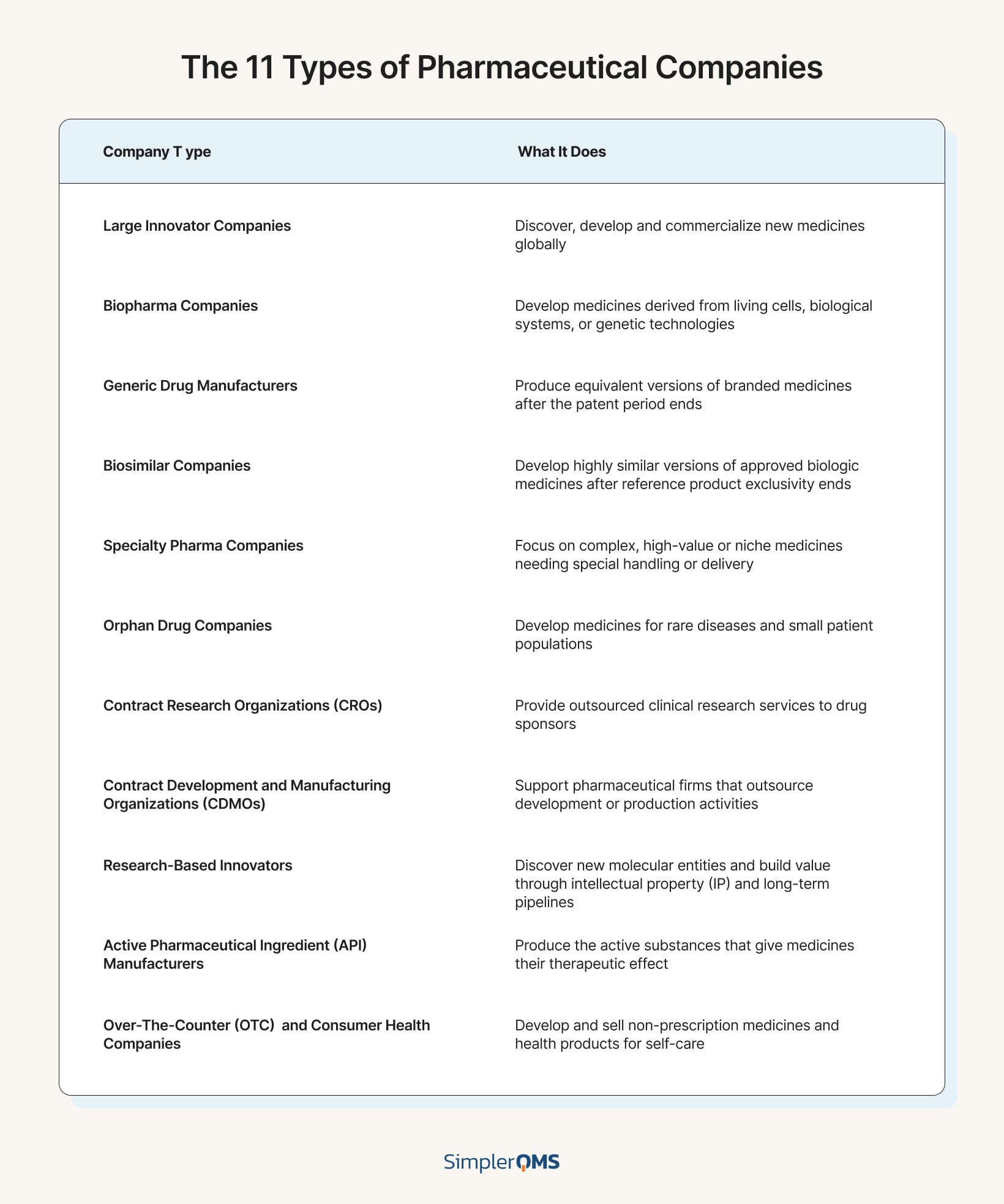
Pharmaceutical companies can be categorized into 11 types based on their business models, products, and areas of specialization, including innovative drug development, generics, biologics, contract research, and manufacturing, as shown in the image below.
How Do Pharmaceutical Organizations Operate Across The Value Chain?
Pharmaceutical organizations operate across the value chain by moving medicines from drug discovery through to post-market monitoring. The pharmaceutical value chain is a set of interconnected activities with nine stages.
The nine stages of the pharmaceutical value chain are presented below.
- Drug Discovery: Drug discovery involves identifying disease targets, studying biological mechanisms, and screening compounds for therapeutic potential.
- Preclinical Research: Preclinical research tests drug candidates in laboratory and animal studies to evaluate pharmacokinetics, toxicity, and early safety before human trials.
- Formulation Development: Formulation development defines the dosage form, product composition, active pharmaceutical ingredient (API), excipients, and container closure system. Pharmaceutical organizations also perform primary stability studies during this stage. The formulation development phase runs in parallel with the preclinical research phase.
- Clinical Trials: Clinical trials study the product in humans through phased clinical trials to evaluate safety, dosing, efficacy, and side effects.
- Technology Transfer and Manufacturing Scale-Up: Technology transfer and manufacturing scale-up move knowledge from development teams to manufacturing teams and expand production from pilot scale to commercial scale.
- Regulatory Submission and Approval: Regulatory submission and approval involve compiling quality, nonclinical, and clinical data into regulatory submission dossiers for health authorities.
- Marketing, Market Access, and Sales: Marketing, market access, and sales define product positioning, pricing, reimbursement planning, stakeholder engagement, and commercial strategy.
- Commercial Manufacturing and Supply: Commercial manufacturing and supply include manufacturing, packaging, releasing, and distributing approved products to the market.
- Post-Market Surveillance and Lifecycle Management: Post-market surveillance and lifecycle management activities include monitoring product safety, quality, and performance after launch through pharmacovigilance, complaint investigation, change control, and regulatory lifecycle management.
Pharmaceutical organizations participate differently across the value chain based on their business model and product focus. Research-based innovators and CROs typically operate in discovery, preclinical work, and clinical development. Generic manufacturers and CDMOs usually focus more on formulation, manufacturing, and lifecycle management. API manufacturers support production by supplying active ingredients. Large pharmaceutical companies often work across the full value chain, while smaller or specialized companies usually focus on selected stages and outsource the rest.
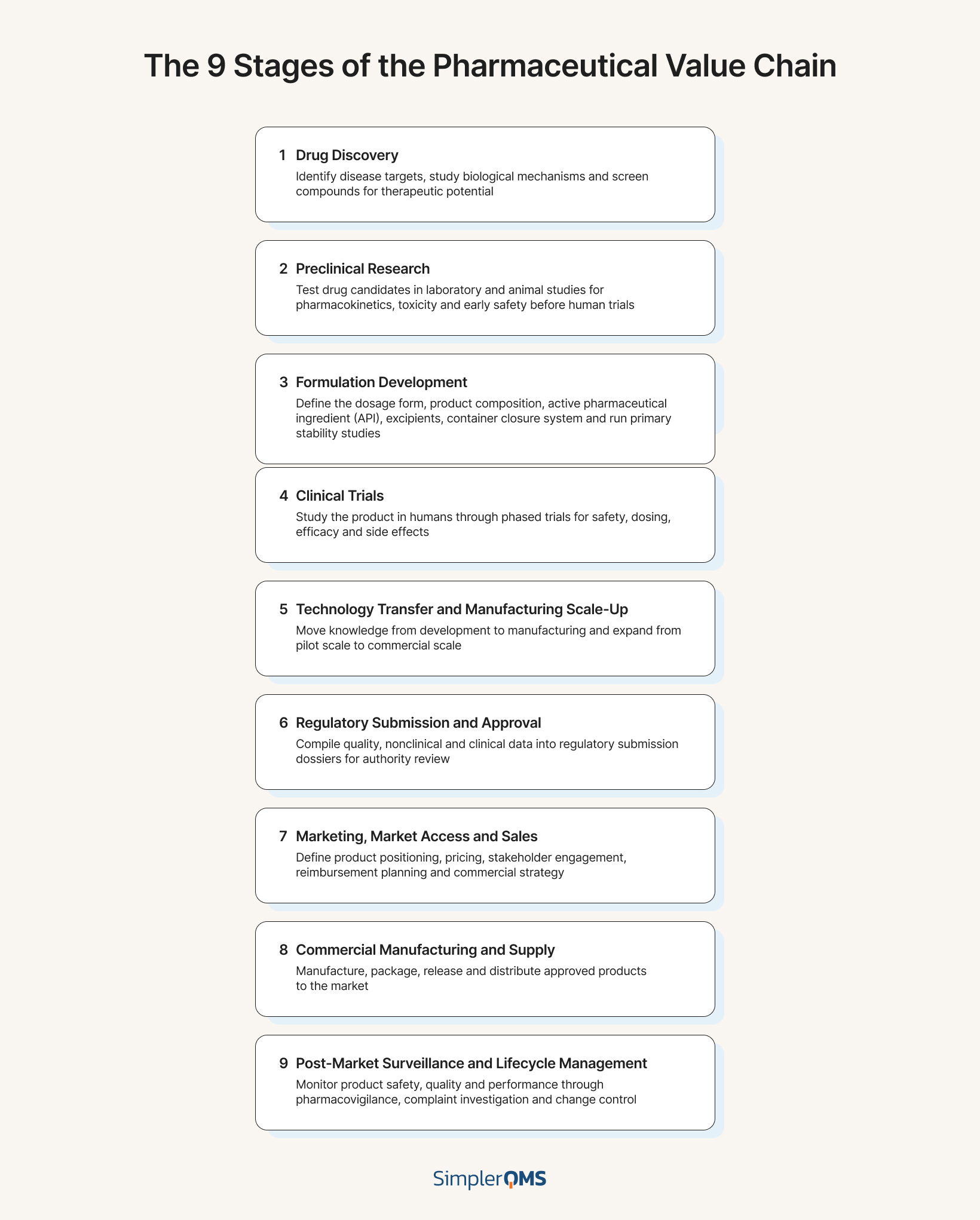
The pharmaceutical value chain consists of nine key stages, from drug discovery and preclinical research to clinical trials, regulatory approval, commercial manufacturing, and post-market surveillance, as shown in the image below.
1. Drug Discovery
Drug discovery is the first stage of the pharmaceutical value chain. In drug discovery, a company identifies and designs a potential medicine candidate. The medicine discovery process aims to find new candidate medications for disease treatment.
The main activities in drug discovery and how each activity supports candidate selection are described below.
- Target Identification and Validation: Target identification and validation allow drug discovery teams to identify a biological target linked to disease and confirm that modulating the target has therapeutic relevance.
- Hit Identification: Hit identification includes screening of compounds, biologic materials, or molecular libraries, and finding hits that interact with the selected target.
- Lead Generation and Optimization: During lead generation and optimization, drug discovery teams refine leads with stronger potency, selectivity, and better ADME (Absorption, Distribution, Metabolism, and Excretion) properties.
- Pre-formulation Development: Drug discovery researchers start pre-formulation studies on the physical and chemical properties of the API, such as solubility, stability, and bioavailability. An initial, usually simple form (e.g., solution) of drug formulation is developed to enable further testing.
- Preclinical Candidate Selection: Drug discovery teams select the best preclinical candidate based on the balance of efficacy, safety, and developability.
Drug discovery studies, conducted to identify a preclinical candidate in the early stage of research, are generally considered non-regulated. Some discovery activities may follow controlled procedures when organizations apply internal quality standards.
Drug discovery involves cross-functional internal teams and external partners. Internal participants usually include biology, chemistry, pharmacology, toxicology, bioinformatics, translational science, intellectual property, regulatory strategy, and portfolio leadership teams. External participants may include universities, research institutes, specialized contract labs, research organizations, and platform technology providers.
The main inputs in drug discovery include unmet medical need, disease biology data, scientific literature, and prior research findings. The main outputs include validated targets, hit compounds, optimized leads, patentable candidates, and a selected development candidate ready for preclinical research.
Drug discovery builds the future product pipeline of an innovator company. Drug discovery is relevant only to innovator companies because generic manufacturers do not discover new drug candidates. Drug discovery determines which scientific ideas become development programs and which formulations can create long-term commercial and clinical value.
Scientific uncertainty remains the main risk in drug discovery because many targets do not translate into useful human treatments. Weak target validation, poor lead quality, limited predictive models, patent barriers, and weak developability often delay or stop progress.
Drug discovery performance is often evaluated through pipeline and research metrics. Common metrics include lead optimization success rate, candidate nomination rate, cycle time, cost per candidate, patent output, and early safety or developability success rates.
2. Preclinical Research
Preclinical research is the second stage of the pharmaceutical value chain. During preclinical research, researchers study a drug candidate in vitro and in vivo to determine drug safety before human testing. Preclinical research assesses whether a compound can cause serious harm before human administration.
Preclinical research usually runs in parallel with formulation development. Preclinical research starts with a simple pre-formulation form and progresses toward the final dosage form.
The main preclinical research activities and how each activity supports dosing and formulation decisions are listed below.
- Pharmacodynamics Studies: Pharmacodynamics studies examine what the drug does to the body by measuring biological activity, mechanism of action, and dose response.
- Pharmacokinetics Studies: Pharmacokinetics studies examine what the body does to the drug by studying absorption, distribution, metabolism, and excretion.
- Toxicology Studies: Toxicology studies evaluate potential toxicity, target organ effects, dose limits, and safety margins.
- Dose Range Finding and Starting Dose Selection: Preclinical research helps determine dose levels for initial human studies and supports first-in-human trial planning.
- Bioavailability and Administration Studies: Bioavailability and administration studies evaluate how the drug reaches systemic circulation and which route of administration is suitable.
- Formulation Support Studies: Preclinical research informs formulation development through stability, solubility, and developability findings.
Internal participants in preclinical research usually include pharmacology, toxicology, drug metabolism and pharmacokinetics (DMPK) specialists, formulation scientists, analytical scientists, regulatory teams, and project leadership. External participants often include contract research organizations, specialized toxicology labs, formulation partners, and academic collaborators.
Preclinical research uses inputs such as the selected development candidate, analytical and bioanalytical methods, and early formulation information. Preclinical research produces outputs such as pharmacology data, pharmacokinetic data, toxicology results, dosing, and formulation insights. Preclinical studies support the investigational product dossier and are included in the common technical dossier (CTD). Preclinical research results help determine stability, bioavailability, and administration method.
Preclinical research helps pharmaceutical organizations reject unsafe or nonviable candidates early, select better formulations, and generate the evidence needed for regulatory submission.
Preclinical research also involves scientific, operational, and compliance risks. Preclinical research may fail because of toxicity, poor pharmacokinetics, weak bioavailability, or formulation limitations. Preclinical studies must be conducted according to Good Laboratory Practice (GLP) principles. Additional regulatory risks arise if the formulation changes significantly after completion of the studies included in the investigational dossier. In this case, regulators may require additional studies.
Preclinical research performance is commonly evaluated through compliance and performance metrics, such as study completion on time, GLP compliance status, or study cost variance.
3. Formulation Development
Formulation development is the stage of pharmaceutical development that defines the qualitative and quantitative composition of the investigational medicinal product, the dosage form, and the function of each excipient. Formulation development aims to create a drug product that is safe, stable, manufacturable, and suitable for clinical trials.
Formulation development differs between innovator companies and generic companies, although both company types perform formulation development. Innovator companies focus on novel formulation development to optimize safety, efficacy, patient use, and product differentiation. Generic companies use reverse engineering to develop a bioequivalent formulation with the same active ingredient, strength, and route of administration.
The main activities involved in formulation development are given below.
- Excipient Selection: Formulation teams select excipients based on function, compatibility, safety, and performance in the intended dosage form.
- Dosage Form Design: Formulation teams define whether the product will be developed as a tablet, capsule, injection, suspension, cream, or another dosage form.
- Finished Product Specification Development: Formulation teams work with analytical scientists to develop specifications for identity, assay, potency, degradation products, and other critical quality attributes. Analytical scientists develop analytical procedures to test the finished product against these specifications.
- Process Development for Clinical Batches: Formulation teams develop the manufacturing process for clinical batches, including the successive steps, process parameters, the components used for each step, and any relevant in-process control.
- Production of Pilot-scale Batches: Formulation and manufacturing teams produce pilot-scale batches. A small-scale production run is typically 10% of the final commercial batch size to ensure representativeness.
- Container Closure System Selection: Formulation teams choose the container closure system that protects the product during storage, transport, and clinical use.
- Stability Studies: Stability studies test how the product performs over time under different storage conditions or in different container closure systems to determine shelf life, packaging, and storage requirements.
Formulation development involves formulation scientists, analytical development teams, process development teams, manufacturing, quality assurance, quality control, regulatory affairs, supply chain, and project management. External participants may include excipient and packaging suppliers, API manufacturers, contract development and manufacturing organizations, and analytical laboratories.
The main inputs in formulation development include the active pharmaceutical ingredient, preclinical findings, route of administration, early manufacturability data, and regulatory expectations. The main outputs include the defined composition of the investigational medicinal product, the selected dosage form, excipient functions, manufacturing instructions, stability data, analytical data, and the clinical trial drug product.
Formulation development converts an active substance into a usable drug product for human studies. Formulation development reduces technical risk, supports clinical success, improves product quality, and prepares the path to commercial scale-up and product registration.
Formulation development may be delayed by poor solubility, weak stability, excipient incompatibility, low bioavailability, scale-up failure, or unsuitable analytical methods. Formulation development must align with preclinical research because major formulation changes after key studies may create representativeness issues and trigger additional studies.
Formulation development performance is measured through metrics like batch success rate, cycle time, and acceptance of the investigational product dossier.
4. Clinical Trials
Clinical trials are a stage of pharmaceutical development in which an investigational medicinal product is studied in humans to evaluate safety and efficacy, and to inform dosing and labelling. Clinical trials aim to generate the human evidence needed to support regulatory approval and safe medical use.
Generic drug applications generally do not require full clinical efficacy and safety trials as they are supported by bioequivalence studies. Bioequivalence studies demonstrate that the generic drug behaves similarly in the body to the reference medicinal product.
Clinical trials begin only after the sponsor receives the required authorization from the relevant authority. Clinical trials rely on an investigational medicinal product dossier, which presents the quality, nonclinical, and clinical information to justify human testing.
The main activities involved in clinical trials are the following.
- Clinical Trial Application and Authorization: Clinical trial application and authorization include preparing the clinical trial application and submitting the investigational medicinal product dossier and related documents to regulators and ethics committees before the study starts.
- Site Selection and Study Start-up: Site selection and study start-up include identifying sites, qualifying investigators, completing contracts, and preparing materials and logistics.
- Patient Recruitment and Enrollment: Patient recruitment and enrollment include recruiting eligible participants and obtaining informed consent according to the trial protocol.
- Study Conduct and Monitoring: Study conduct and monitoring include data collection, safety reporting, monitoring visits, and verifying protocol compliance throughout the study.
- Data Analysis and Clinical Reporting: Clinical trial teams analyze results and prepare clinical study reports that support regulatory dossier submission.
Clinical trials consist of four phases as listed below.
- Phase I Trials: Phase I trials evaluate safety and dose in a small group of participants, usually fewer than 100. In phase I trials, typically healthy volunteers participate. Selected patients may participate when other treatments are not available or not ideal.
- Phase II Trials: Phase II trials assess preliminary efficacy and dose range in patients with the target disease. Phase II has a larger group of participants, and the study treatment is administered at the safe doses identified in Phase I.
- Phase III Trials: Phase III trials confirm efficacy and safety in larger patient populations and generate the main evidence for marketing authorization. Phase III trials compare the new treatment against the current standard treatment or a placebo.
- Phase IV Trials: Phase IV trials take place after approval and examine long-term safety, real-world use, and additional indications or populations.
Clinical trials involve internal teams and external partners. Internal stakeholders usually include clinical operations, medical affairs, biostatistics, data management, pharmacovigilance, regulatory affairs, quality assurance, clinical supply, and project management teams. External participants often include investigators, trial sites, patients, contract research organizations, and logistics providers.
The main inputs in clinical trials include the investigational medicinal product, the investigational medicinal product dossier, preclinical data, the study protocol, regulatory authorizations, and clinical supply. The main outputs include human safety and efficacy data, dose selection evidence, and clinical study reports used for marketing authorization.
Clinical trials produce the core evidence that determines whether development moves forward, changes direction, or stops, such as advancing to the next phase or manufacturing scale-up, changing dose or dosage form, or terminating a program for safety or efficacy reasons. Clinical trials determine whether a candidate has a realistic path to approval, reimbursement, and market use. Clinical trials therefore, shape both portfolio value and investment decisions.
Clinical trials fail because of weak drug efficacy, safety signals, poor patient recruitment, protocol deviations, data integrity issues, or site performance problems. Clinical trials must comply with GCP, protocol requirements, safety reporting obligations, and clinical trial authorization conditions. The batches used in clinical trials must be manufactured under GMP.
Pilot-scale batches are typically used in clinical trials, especially in Phase I and Phase II. Clinical trials require additional justification or bridging studies when significant parameters such as formulation, dosage form, or manufacturing process change compared with the investigational medicinal product used in earlier phases. Sponsors must assess quality changes with potential clinical relevance, such as changes in in vitro dissolution rate.
Common metrics in clinical trials include enrollment rate, protocol deviation rate, study completion time, and safety event rate.
5. Technology Transfer and Manufacturing Scale-Up
Technology transfer and manufacturing scale-up are stages in pharmaceutical development in which product and process knowledge are transferred from development into routine manufacturing. Technology transfer and manufacturing scale-up aim to ensure that the product can be manufactured consistently and in compliance with regulatory requirements at the intended commercial scale.
Technology transfer and manufacturing scale-up are typically conducted before dossier submission because authorities expect process validation data in the dossier. However, technology transfer and manufacturing scale-up can occur after dossier submission in specific cases when the authority accepts the process validation protocol as sufficient at the time of filing.
The main activities involved in technology transfer and manufacturing scale-up are given below.
- Equipment and Facility Assessment: Equipment and facility assessment determines whether the target equipment, utilities, and production rooms support the intended process and product requirements.
- Scale-up Studies: Process development teams perform scale-up studies to confirm that process performance and product quality remain acceptable at a larger scale.
- Process Validation Planning and Execution: Validation teams define the process validation approach and execute validation activities to show that the manufacturing process performs consistently. Process validation results in updated manufacturing instructions with optimized process parameters and in-process controls.
- Analytical Method Transfer: In parallel with process validation activities, analytical teams transfer analytical methods to the receiving quality control laboratory and confirm that methods perform as intended.
Internal participants in technology transfer activities are usually process development, technical operations, manufacturing, quality assurance, quality control, validation, engineering, supply chain, R&D, and project management teams. External participants may include contract development and/or manufacturing organizations, equipment suppliers, raw materials and packaging material suppliers, analytical laboratories, and specialized engineering or validation service providers.
The main inputs in technology transfer and manufacturing scale-up include the pilot scale manufacturing process, formulation data, analytical methods, equipment information, and regulatory expectations. The main outputs include a transferred and scalable manufacturing process, transferred analytical methods, validation reports, and commercial manufacturing instructions.
Technology transfer and manufacturing scale-up convert development knowledge into a reliable commercial operation. Technology transfer and manufacturing scale-up reduce manufacturing risk, support regulatory approval, improve supply readiness, and protect product quality as volumes increase.
Technology transfer and manufacturing scale-up risks are related to process variability, poor knowledge transfer, and feasibility gaps. Technology transfer and manufacturing scale-up must meet GMP requirements.
Technology transfer and manufacturing scale-up performance is commonly evaluated through batch success rate, yield, deviation rate, right-first-time, process capability, cycle time, and readiness for submission or launch.
6. Regulatory Submission and Approval
Regulatory submission and approval form the stage in which a pharmaceutical organization compiles and submits the technical dossier of a drug product to health authorities. Regulatory submission seeks authorization to market the product. Regulatory submission and approval demonstrate that the product meets the required standards for quality, safety, and efficacy.
Regulatory submissions follow the Common Technical Document (CTD) structure, which organizes the dossier into five modules. Module 1 includes regional administrative information. Module 2 consists of summarized overviews of quality, non-clinical, and clinical data. Module 3, Chemistry, Manufacturing, and Controls (CMC), concerns drug substance and drug product quality. Module 4 includes non-clinical study reports. Module 5 presents the clinical study reports.
The main activities involved in regulatory submission and approval are listed below.
- Regulatory Strategy and Submission Planning: Regulatory strategy and submission planning define the filing pathway, target markets, and authority expectations for the product.
- Dossier Compilation: Dossier compilation includes collecting, structuring, reviewing, and formatting CTD content across the five modules.
- Authority Interaction and Deficiency Response: Authority interaction and deficiency response include answering authority questions through deficiency letters and coordinating dossier updates during review.
- Labeling and Approval Finalization: Labeling and approval finalization align final product information and approval conditions with the authority and internal stakeholders before launching.
Regulatory submission and approval involve regulatory affairs, quality assurance, pharmacovigilance, clinical operations, medical writing, and project management teams. External participants may include regulatory consultants, local agents, and health authorities, such as the FDA, EMA, and national competent authorities.
The main inputs in regulatory submission and approval include product formulation data, manufacturing process and controls, release and shelf-life specifications, API, excipients and packaging materials specifications, process and analytical method validation reports or protocols, stability data, non-clinical reports, clinical study reports, product labeling, manufacturing site information, and prior authority interactions. The main outputs include the CTD dossier, authority questions and responses, approval decisions, and the final market authorization or rejection.
Regulatory submission and approval determine whether a product enters the market, generates revenue, and competes for reimbursement. Regulatory submission and approval, therefore, have a direct impact on asset value and launch timing.
Regulatory submission and approval face technical, procedural, and compliance risks. Regulatory submission and approval may be delayed by incomplete data, inconsistent dossier sections and gaps, weak clinical benefit-risk evidence, or inadequate responses to authorities. Regulatory submission and approval must meet regional legal requirements, CTD formatting rules, and data integrity expectations for product and site documentation.
Regulatory submission and approval performance are commonly evaluated through filing and approval metrics. Common metrics include first-cycle approval rate, deficiency closure time, approval timeline, and approval success by market.
7. Marketing, Market Access, and Sales
Marketing, market access, and sales refer to the stage in which a pharmaceutical organization prepares the product for launch and secures market entry and reimbursement. Marketing, market access, and sales commercialize approved medicine, support patient reach, and secure payer coverage.
Marketing, market access, and sales are closely linked with commercial manufacturing because the launch plan, demand creation, supply readiness, and customer commitments must be coordinated. Marketing, market access, and sales close the commercial deal. This stage also prepares the product launch. Each country has its own pharmaceutical reimbursement regulations, so the access strategy differs by market.
The main marketing, market access, and sales activities and their roles in launch readiness, reimbursement, pricing, and commercialization are described below.
- Market Analysis: Market analysis helps commercial teams assess competitor products, pricing conditions, and target customer segments.
- Value Proposition and Product Positioning: Value proposition and product positioning define how marketing teams present the medicine to prescribers, payers, healthcare providers, and patients based on clinical benefit, unmet need, and product differentiation.
- Pricing Strategy: Pricing strategy sets product pricing objectives based on product therapeutic value, market conditions, and reimbursement frameworks.
- Health Economics and Outcomes Evidence: Health economics and outcomes evidence support payer and reimbursement discussions through cost-effectiveness and real-world value data.
- Reimbursement and Payer Engagement: Market access and regulatory teams prepare submissions, negotiate with payers, and work through national or regional reimbursement pathways, which differ from country to country.
- Launch Planning: Commercial teams coordinate launch timelines, demand forecasts, and stakeholder engagement.
- Promotional and Medical Communication: Marketing, sales, and medical teams prepare compliant promotional materials for healthcare professionals and other stakeholders.
- Sales Force Readiness: Sales teams receive training, build account plans, engage customers, and support early product uptake after launch.
Marketing, market access, and sales involve several internal teams, including commercial teams for launch execution, medical affairs for scientific communication, regulatory affairs for label alignment, finance for pricing, supply chain for product availability, and business development for partner agreements. External participants include reimbursement bodies, payers, health technology assessment agencies, local commercial partners, and healthcare professionals when these stakeholders are part of the launch pathway.
The main inputs in marketing, market access, and sales include regulatory approval status, clinical evidence, health economic data, manufacturing and supply forecasts, competitor products, and country-specific reimbursement requirements. The main outputs include launch strategy, pricing, Health Technology Assessments (HTA) and Health Economics and Outcomes Research (HEOR), promotional materials, marketing and licensing agreements, demand forecasts, and launch execution plans tied to commercial supply.
Marketing, market access, and sales determine how fast a product reaches patients, how broadly it is reimbursed, and how strongly it performs against competitors. Marketing, market access, and sales shape return on investment.
Marketing, market access, and sales experience delays when price pressure, reimbursement barriers, or launch execution issues affect market entry. Marketing, market access, and sales must comply with country-specific promotion requirements. Marketing claims must remain aligned with the approved label and supported by evidence.
Marketing, market access, and sales performance are commonly evaluated through launch and commercial metrics, such as price approval success, launch readiness, and market share.
8. Commercial Manufacturing and Supply
Commercial manufacturing and supply is the stage in which a pharmaceutical organization produces, tests, releases, and distributes approved medicines on a commercial scale. Commercial manufacturing and supply ensure the continuous availability of safe, effective, and high-quality medicines for the market.
The main activities involved in commercial manufacturing and supply include the following.
- Production Planning: Supply teams plan batch production based on demand forecasts, inventory targets, and lead times.
- Raw Material Management: Raw material management covers sourcing, qualification, receipt, and control of active ingredients, excipients, and packaging materials.
- Commercial Batch Manufacturing: Manufacturing teams produce the drug product at the approved commercial batch size using validated processes, qualified equipment, and standardized procedures.
- Packaging and Labeling: Packaging teams place the finished product in the approved presentation for each target market.
- In-process Controls and Quality Control Testing: Quality teams monitor critical process parameters and test raw materials, intermediates, and finished products against approved specifications using validated methods.
- Batch Review and Batch Release: Batch review and batch release involve quality assurance and the Qualified Person (QP) for the EU market reviewing manufacturing and testing records before batch approval for market distribution.
- Warehousing and Inventory Control: Supply chain teams manage storage conditions and stock levels to maintain product quality and availability.
- Distribution and Logistics: Distribution and logistics teams coordinate shipments through wholesalers, distributors, and other controlled channels while maintaining required transport conditions.
- Deviation, Change, and Complaint Handling: Quality teams manage deviations, changes, out-of-specification results, and product complaints to preserve product quality across commercial operations.
Commercial manufacturing and supply involve manufacturing, production planning, supply chain, procurement, warehouse operations, quality assurance, quality control, engineering, maintenance, regulatory affairs, and validation teams. External participants include API suppliers, excipient suppliers, packaging suppliers, contract manufacturing organizations, contract laboratories, logistics providers, wholesalers, and distributors.
The main inputs in commercial manufacturing and supply include the approved product dossier, validated processes, qualified suppliers, approved raw materials and packaging components, demand forecasts, and approved specifications. The main output is the released commercial batches. Additional outputs include batch manufacturing and quality control records, release documentation, inventory records, and distribution documentation.
Commercial manufacturing and supply protect product quality and availability and strengthen trust with regulators, healthcare providers, and patients.
Commercial manufacturing and supply face technical, operational, and compliance risks. Commercial manufacturing and supply may be disrupted by equipment failure, deviations, supplier failures, forecasting errors, and transport delays. Commercial manufacturing and supply must comply with Good Manufacturing Practice, approved specifications, validated process requirements, data integrity expectations, and market-specific distribution requirements.
Commercial manufacturing and supply performance is commonly evaluated through operations and quality metrics. Commercial manufacturing and supply metrics include batch release rate, right-first-time rate, yield, cycle time, and cost of goods.
9. Post-Market Surveillance and Lifecycle Management
Post-market surveillance and lifecycle management refer to the stage in which a pharmaceutical organization monitors the safety, quality, and performance of an approved medicine after release and manages changes across its commercial life. Post-market surveillance and lifecycle management protect patients, maintain compliance, support continuous product improvement, and sustain the product’s value over time.
The main activities involved in post-market surveillance and lifecycle management, and their role in product quality, safety, and efficacy monitoring include the following.
- Adverse event monitoring: Pharmacovigilance teams collect, assess, investigate, and report adverse events and other safety signals from real-world product use.
- Signal Detection and Risk Management: Signal detection and risk management uses pharmacovigilance (PV) trend review to evaluate whether additional warnings, studies, or updated risk management plans are needed.
- Periodic Safety Reporting: Periodic safety reporting requires PV teams to prepare required post-approval periodic safety reports for authorities.
- Labeling Updates: Regulatory teams update product information, warnings, contraindications, and educational measures when new evidence affects the benefit-risk balance.
- Complaint Handling: Quality teams investigate product complaints to identify root causes and corrective actions.
- Product Quality Review (PQR) and Continuous Process Verification (CPV): PQR verifies process consistency and specification suitability for starting materials and finished products. CPV monitors whether the validated process remains in control during commercial production.
- Change Control and Variation Management: Quality teams assess and oversee implementation of changes to process, specifications, suppliers, labeling, packaging, or sites through the change management procedure. Regulatory teams submit the relevant variation when the change requires health authority approval or notification.
- Stability Monitoring: Quality teams continue to monitor product stability in the approved storage conditions by performing analysis at predefined intervals during the product’s shelf-life.
- Recalls and Field Actions: Quality and supply teams coordinate recalls or other field actions when safety or quality issues require market intervention.
- Line Extensions and Lifecycle Optimization: Line extensions and lifecycle optimization support new strengths, dosage forms, market expansions, or reformulations to extend product value.
Post-market surveillance and lifecycle management involve internal participants from pharmacovigilance, regulatory affairs, quality assurance, quality control, medical affairs, supply chain, commercial teams, and portfolio leadership. External participants include health authorities, healthcare professionals, patients, distributors, wholesalers, contract manufacturers, contract labs, and PV service providers.
The main inputs in post-market surveillance and lifecycle management include adverse event reports, complaint data, stability data, inspection findings, literature, real-world evidence, and commercial performance data. The main outputs include safety assessments, variation submissions, updated dossiers, CAPAs, recall decisions, and product improvements.
Post-market surveillance and lifecycle management help pharmaceutical organizations maintain market authorization, reduce risk, and improve product quality.
Post-market surveillance and lifecycle management may be affected by delayed adverse event reporting, weak signal detection, poor complaint investigations, data integrity issues, or uncontrolled changes. Post-market surveillance and lifecycle management must comply with pharmacovigilance obligations, GMP requirements, post-approval commitments, and reporting timelines.
Post-market surveillance and lifecycle management performance is evaluated through safety, quality, and compliance metrics, such as adverse event reporting timeliness, complaint rate, recall rate, inspection readiness, on-time submission rate, and product supply continuity.
What Challenges Do Pharma Companies Face?
Pharmaceutical organizations face operational, scientific, commercial, and regulatory challenges across the full product lifecycle. The main challenges that pharma companies face are listed below.
- Regulatory Compliance Hurdles: Pharmaceutical organizations face regulatory compliance hurdles because they operate under strict regulatory requirements for product quality, safety, efficacy, covering the product lifecycle. Regulatory changes across markets increase complexity and raise the risk of delays, warning letters, or even recalls and market authorization revocations.
- Supply Chain Disruptions: Supply chain disruptions affect pharmaceutical companies because they depend on complex global supply networks for active ingredients, excipients, packaging components, contract services, and distribution. Supplier failures, geopolitical events, transport delays, shortages, and quality issues interrupt production and reduce product availability.
- R&D Costs: High R&D costs challenge pharmaceutical organizations because drug development requires a large investment of time and capital in discovery, preclinical research, clinical trials, manufacturing development, and regulatory submission. High attrition rates increase development costs because unsuccessful candidates consume resources before a successful product reaches approval.
- Pricing, Reimbursement, and Market Access Pressure: Pricing, reimbursement, and market access pressure affects pharmaceutical organizations because payers require evidence of clinical and economic value while governments apply price controls and reimbursement barriers. Market access requirements vary by country because each healthcare system applies its own pricing and reimbursement rules.
- Talent Acquisition and Retention: Talent acquisition and retention challenges affect pharmaceutical organizations because quality, manufacturing, regulatory affairs, clinical development, pharmacovigilance, data science, and supply chain operations require skilled professionals. Talent shortages and strong competition for experienced staff make hiring and retention difficult.
- Digital Transformation and Data Management: Pharmaceutical organizations proceed with digital transformation and improve data management by modernizing legacy systems and connecting fragmented data across quality, development, manufacturing, and commercial functions. Poor data quality, weak integration, cybersecurity risk, high cost, and complex validation requirements can slow digital transformation.
What Regulations Govern the Pharmaceutical Industry?
The pharmaceutical industry is governed by a combination of drug approval regulations, manufacturing and quality standards, clinical research rules, marketing controls, and pharmacovigilance requirements.
The main categories of regulations that govern the pharmaceutical industry are listed below.
- Marketing Authorization Regulations: Marketing authorization regulations govern how a company obtains approval to place a medicine on the market. Marketing authorization requirements define the evidence needed for quality, safety, and efficacy before a product can be sold.
- Clinical Research Requirements and Good Clinical Practice (GCP): Clinical research requirements define how sponsors, investigators, and sites conduct human studies. GCP protects trial participants and ensures trial data is credible, traceable, and ethically generated.
- Good Manufacturing Practice (GMP) and Quality Standards: GMP and quality standards set the requirements for how pharmaceutical companies manufacture medicines and control product quality. GMP covers all aspects that affect product quality, including facilities, equipment, personnel, validation, documentation, testing, deviation handling, and batch release.
- Good Distribution Practice (GDP) and Supply Chain Requirements: GDP and supply chain requirements govern how medicines are stored, transported, imported, exported, and distributed. GDP protects product integrity, prevents falsification, and maintains traceability across the supply chain, including requirements such as the Falsified Medicines Directive in the EU.
- Good Pharmacovigilance Practice (GVP) and Post-Market Obligations: Pharmacovigilance regulations mandate companies to monitor, assess, and report safety issues after approval. Post-approval obligations include adverse event reporting, signal detection, risk management, periodic safety reporting, and product safety updates.
- Pricing, Reimbursement, and Market Access Regulations: Pricing, reimbursement, and market access rules shape how medicines are priced and funded within each healthcare system. Pricing and reimbursement requirements differ by country and affect market access, payer coverage, and commercial uptake.
- Drug Advertising Regulations: Drug advertising regulations govern how companies promote medicines to healthcare professionals and, where permitted, to the public. Drug advertising rules limit misleading claims and require promotional materials to remain consistent with the approved product label.
- Intellectual Property and Patent Regulations: Intellectual property and patent rules protect pharmaceutical inventions and commercial exclusivity for a defined period. Patent regulations shape competition, licensing, and the commercialization of pharmaceutical products.
- Environmental and Occupational Safety Regulations: Environmental and occupational safety regulations apply to pharmaceutical manufacturing, laboratories, and waste management activities. Environmental and occupational safety requirements address hazardous substances, emissions, wastewater, chemical handling, occupational health controls, and facility safety obligations.
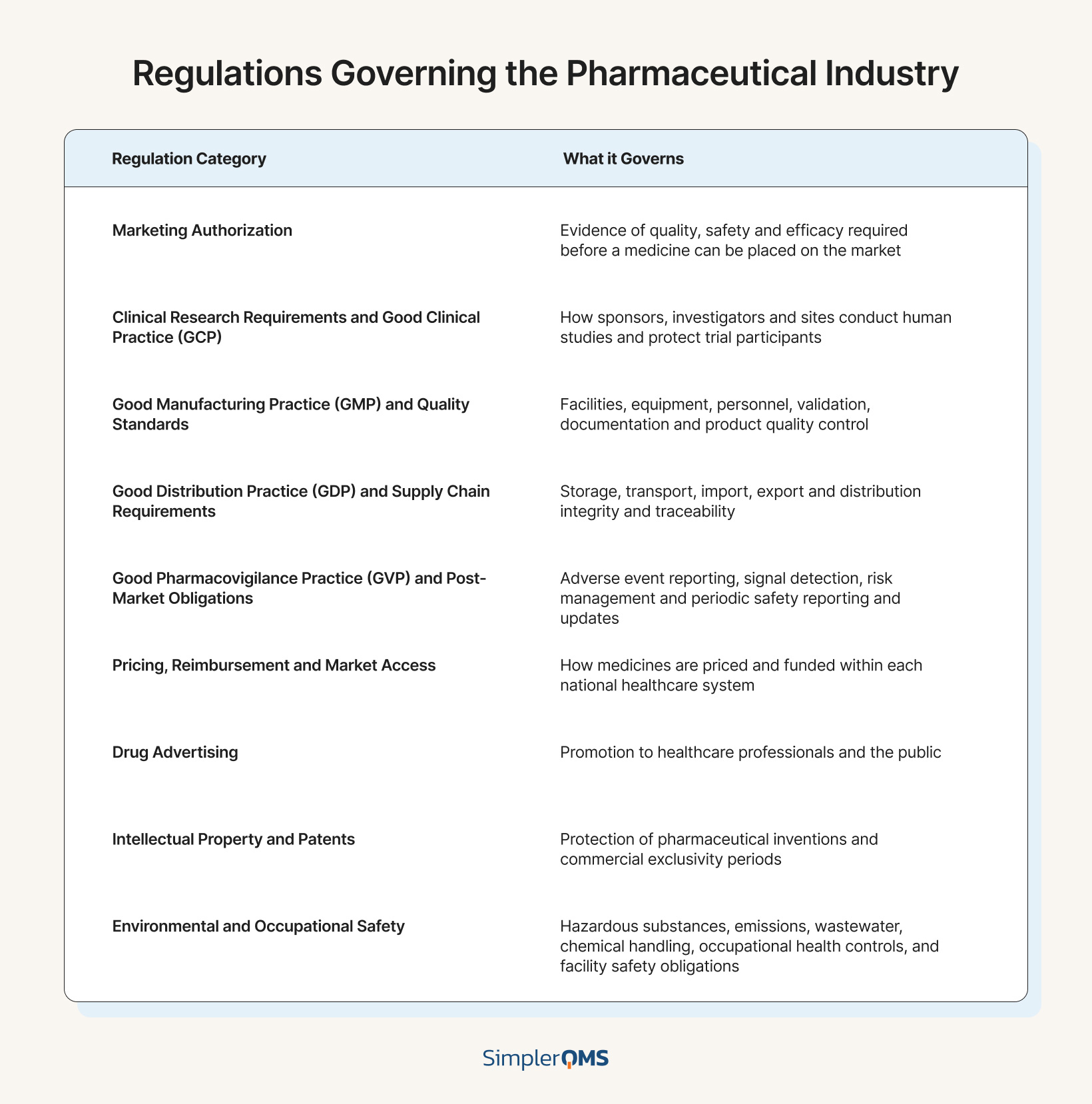
The pharmaceutical industry is governed by regulatory requirements covering drug approval, clinical research, manufacturing, distribution, pharmacovigilance, and other key activities to ensure product quality, safety, and efficacy, as shown in the image below.
Marketing Authorization Regulations
Marketing authorization regulations define how a pharmaceutical company proves that a medicine has acceptable quality, safety, and efficacy before the medicine is placed on the market. Marketing authorization matters because no medicinal product can be legally commercialized without the required approval from the health authority. The approved marketing authorization determines the conditions of use, labeling, and manufacturing and quality requirements.
Marketing authorization requirements regulate the submission pathway, dossier format, supporting evidence included in the dossier, and regulatory review process. Different marketing authorization rules apply by product and region. In the United States, regulatory pathways include the NDA for new drugs and the ANDA for generics. In the European Union, similarly, medicinal products can be submitted through different application types such as a full (including mixed), generic, hybrid, and biosimilar applications. EU medicines follow centralized, national, decentralized, and mutual recognition procedures depending on the product and scope of authorization.
Health authorities enforce marketing authorization regulations. In the United States, the FDA reviews and decides on relevant applications. In the European Union, EMA plays a central role for medicines that use the centralized route, while national competent authorities oversee national, decentralized, and mutual recognition procedures. Pharmaceutical companies, regulatory affairs teams, quality units, clinical teams, healthcare providers, and patients all rely on these rules.
The main requirements of marketing authorization regulations include the following.
- Submission Pathway: Marketing authorization rules require the applicant to use the correct regulatory submission pathway for the product type.
- Technical Dossier: Marketing authorization rules require a structured technical dossier that presents administrative, quality, nonclinical, and clinical information in the required format. In ICH regions, that format is the common technical document.
- Regulatory Review, Questions, and Lifecycle Maintenance: Marketing authorization rules require companies to respond to authority questions during review and to maintain the license through variations and renewals after authorization is granted.
Marketing authorization regulations affect pharmaceutical operations across the full value chain. Drug discovery and preclinical studies must generate evidence suitable for later submission. Clinical research must follow approved protocols and dossiers and produce reliable data. Formulation, scale-up, and commercial manufacturing must align with the processes described in the dossier. Regulatory, quality, and pharmacovigilance teams must then maintain the approved product dossier after launch.
The documents commonly required under marketing authorization regulations include the CTD dossier, region-specific application forms, quality documentation for drug substance and drug product, nonclinical reports, clinical study reports, approved labeling text, validation data, and stability data.
Noncompliance with marketing authorization regulations creates serious regulatory and business risk. A deficient or inconsistent application may lead to delays or refusal. Post-approval noncompliance may lead to inspection findings, product recall, or marketing authorization revocation, if the marketed product no longer matches the approved dossier.
Clinical Research Requirements and Good Clinical Practice (GCP)
Clinical research requirements and Good Clinical Practice (GCP) establish the ethical, scientific, and quality standards for designing, conducting, and reporting clinical trials with human participants. GCP is important because it protects the rights, safety, and well-being of trial participants and supports credible clinical data for regulatory decisions.
Clinical research requirements and GCP regulate key aspects of clinical trial conduct, including human subject protection, informed consent, clinical trial protocol design and compliance, sponsor and investigator responsibilities, trial monitoring, investigational product management, safety reporting, documentation, and data integrity.
In the US, GCP requirements are implemented through regulations administered by the FDA, including 21 CFR Part 50 for protection of human subjects, 21 CFR Part 56 for institutional review boards, and 21 CFR Part 312 for investigational new drug applications. In the EU, clinical trials are governed primarily by Regulation 536/2014 (Clinical Trials Regulation), supported by applicable GCP legislation. Internationally, GCP expectations are harmonized through the ICH Guideline for GCP E6(R3). Regulators, sponsors, investigators, contract research organizations, ethics committees, trial sites, and patients rely on GCP.
The main principles of GCP are given below.
- Ethical Trial Conduct: GCP requires that clinical trials follow ethical principles that protect participants and support a favorable benefit-risk approach
- Informed Consent: GCP requires that participants give informed consent before trial participation under conditions that support understanding and voluntariness.
- Scientifically Sound Protocol and Reliable Data: GCP requires a scientifically justified protocol with an appropriate trial design, qualified personnel, and trial performance that support credible results. Trial design must be based on adequate and current scientific knowledge, including sufficient nonclinical and clinical information to support the proposed trial.
- Defined Sponsor and Investigator Responsibilities: Defined sponsor and investigator responsibilities ensures duties are clearly assigned to sponsors, investigators, and service providers for oversight, participant protection, documentation, reporting, and trial execution.
- Risk-based Approach: ICH GCP E6(R3) encourages a risk-based and proportionate approach to the conduct of a clinical trial.
- Data Integrity and Recordkeeping: Data integrity and recordkeeping requirements under GCP mandate complete, accurate, and traceable records that support the study.
- Investigational Product Control: GCP requires investigational products in clinical trials to be managed under controlled conditions, and ICH E6(R3) states they should be manufactured in line with applicable GMP standards.
Clinical research requirements affect pharmaceutical operations across the value chain, including clinical development, regulatory affairs, pharmacovigilance, quality assurance, and product approval, because regulatory submission and approval depend on reliable clinical trial data.
The main documents and controls commonly required under GCP include the clinical trial protocol, informed consent forms, ethics committee and authority approvals, safety reporting records, monitoring plans, trial master file, case report forms, data management, investigational product records, and sponsor oversight controls for vendors and CROs.
Noncompliance with GCP creates patient risk, unreliable clinical data, trial suspension, or barriers to product approval. Noncompliance can damage both the drug development program and the company’s reputation because authorities expect trial evidence to be ethically obtained and scientifically reliable.
Good Manufacturing Practice (GMP) and Quality Standards
Good Manufacturing Practice (GMP) and quality standards describe the minimum requirements that a manufacturer must meet to ensure medicines are consistently produced and controlled. GMP is important because it builds quality into facilities, equipment, materials, processes, documentation, and oversight across manufacturing operations.
GMP and quality standards regulate pharmaceutical manufacturing and quality systems. GMP covers all aspects of pharmaceutical manufacturing that affect the quality of the finished product, including facilities, equipment, personnel, sanitation, documentation, materials control, production controls, laboratory controls, packaging, labeling, storage, investigations, and batch release.
In the United States, finished pharmaceuticals are regulated under 21 CFR Parts 210 and 211. In the EU, manufacturers supplying medicines to the EU market must comply with EU GMP. ICH Q10 provides a lifecycle-based pharmaceutical quality system framework that applies from product development through commercial manufacturing and discontinuation.
GMP and quality standards are enforced and applied by health authorities and inspectorates. The FDA inspects drug manufacturers and applies current GMP requirements in the US. In the EU, national authorities perform GMP inspections, while EMA coordinates GMP activities and supports harmonization at the EU level. Manufacturers, quality units, laboratories, supply chain partners, and regulatory authorities rely on Good Manufacturing Practice as it defines the baseline for compliant and reliable pharmaceutical production.
The main principles of GMP and quality standards are listed below.
- Effective Pharmaceutical Quality System: An effective pharmaceutical quality system requires process performance monitoring, corrective and preventive action (CAPA), change management, and management review. ICH Q10 identifies these as core quality system elements.
- Qualified Personnel and Clear Responsibilities: GMP mandates qualified personnel with defined responsibilities, and appropriate training for manufacturing, quality control, and quality assurance activities.
- Suitable Premises, Utilities, and Equipment: Suitable premises, utilities, and equipment prevent cross-contamination and support cleaning, maintenance, and reliable manufacture.
- Controlled Materials and Suppliers: GMP requires controls for APIs, excipients, and packaging materials, and suppliers, so only suitable and approved raw materials from qualified suppliers enter production.
- Validated and Documented Processes: GMP requirements include written procedures, process controls, and validation where needed to show that the process performs consistently.
- Laboratory Controls and Batch Record Review: GMP requirements include laboratory controls, such as testing of raw materials and finished products, specification compliance, and batch record review before batch release.
- Traceable Documentation and Data Integrity: Traceable documentation and data integrity requirements ensure records follow ALCOA+ principles so manufacturing activities and decisions can be reconstructed and verified during review or inspection.
- Continuous Improvement and Deviation Handling: Continuous improvement refers to improvement actions for systems and processes. Deviation handling includes investigation of deviations followed by corrective action where needed to protect product quality and patient safety.
GMP and quality standards affect pharmaceutical operations across the full value chain. Development teams must design processes and controls that support scale-up and validation. Technology transfer must preserve process knowledge. Commercial manufacturing must operate within approved and validated processes. Distribution and product supply depend on batch release and documented quality decisions. Post-market activities such as complaints, recalls, and product lifecycle management must be handled through the quality system.
The main documents, systems, and controls required under GMP include quality manuals, standard operating procedures, master batch records, executed batch records, specifications, validation protocols and reports, calibration and maintenance records, cleaning records, deviation and CAPA records, change controls, training records, supplier qualification records, environmental monitoring records, laboratory data, stability data, and batch release records. Companies can support GMP compliance through document control systems, training systems, electronic quality management systems, and laboratory and manufacturing systems.
Noncompliance with GMP creates major regulatory, operational, and patient risk. Consequences may include inspection findings, warning letters, import restrictions, rejected batches, manufacturing stoppages, recalls, supply shortages, and revocation of GMP or manufacturing authorization.
Good Distribution Practice (GDP) and Supply Chain Requirements
Good Distribution Practice (GDP) and supply chain requirements ensure that medicines are stored, transported, and distributed under conditions that preserve quality, integrity, and authenticity until they reach the patient. GDP matters because product quality must remain protected after batch release, and the supply chain must prevent mix-ups, damage, theft, temperature excursions, and introduction of falsified medicines.
GDP and supply chain requirements regulate wholesale distribution, storage, transportation, traceability, trading partner qualification, returns, recalls, handling of suspected falsified products, and market-specific import or export controls. GDP applies to both APIs and finished products in the EU and works alongside the Falsified Medicines Directive. In the US, supply chain security for prescription drugs is enforced through the Drug Supply Chain Security Act (DSCSA). DSCSA requires interoperable electronic identification and tracing at the package level. FDA 21 CFR Part 205 describes the requirements for licensing of wholesale prescription drug distributors.
GDP and supply chain requirements are enforced by health authorities and applied by manufacturers, importers, exporters, wholesale distributors, third-party logistics providers, pharmacies, and hospitals. Pharmaceutical companies across manufacturing, warehousing, distribution, and quality functions rely on GDP for compliant supply operations and patient protection.
The main principles of GDP include the following.
- Documented Quality System: GDP requires a documented quality system that defines responsibilities, processes, and oversight for distribution activities, and embeds risk management principles.
- Qualified Suppliers and Customers: GDP requires companies to qualify and verify trading partners, including suppliers, customers, and service providers, and ensure medicines move only through authorized channels.
- Controlled Storage and Transport Conditions: GDP requires medicines to be stored and transported under suitable environmental conditions, including temperature control for temperature-sensitive products.
- Traceability and Secure Product Movement: Supply chain security rules require systems that identify and trace products through the supply chain.
- Qualified Personnel: All personnel must be qualified and receive training relevant to their roles, including aspects like product handling and the prevention of falsified medicines entering the supply chain.
- Returns, Recalls, and Suspected Falsification Management: Controlled procedures must be in place to manage returned goods, recalls, and investigations of suspected falsified medicines.
- Import and Export Controls: Import and export controls require alignment with local authorization, licensing, customs, and product-specific market rules in the destination and originating countries.
GDP and supply chain requirements affect pharmaceutical operations throughout warehousing, transport, and post-market distribution because storage and distribution conditions directly impact product quality and legal marketability.
The main documents and controls required under GDP and supply chain requirements include wholesale distribution authorizations, quality agreements, approved supplier and customer lists, transportation and temperature monitoring data, equipment qualification records, deviation and CAPA records, personnel training records, recall procedures, falsified medicine investigation procedures, and traceability records across distribution partners.
Noncompliance with GDP and supply chain requirements creates product quality risk, patient safety risk, and serious regulatory exposure. Consequences may include product quarantine, recalls, authorization restrictions, inspection findings, rejected shipments, and import or export delays. Noncompliance means the company cannot prove that the medicine remained authentic, traceable, and within required storage and transport conditions throughout the supply chain.
Good Pharmacovigilance Practice (GVP) and Post-Market Obligations
Good Pharmacovigilance Practice (GVP) and post-market obligations are the rules that ensure a pharmaceutical company continuously monitors, evaluates, and manages the safety and quality of a medicine after release. GVP’s importance lies in the continuous review of the product’s benefit-risk balance and timely reporting of safety issues after launch.
GVP regulates pharmacovigilance activities, including adverse event collection, signal detection, risk management, and periodic reporting. Post-market obligations extend beyond safety alone and include investigating product quality complaints, managing recalls, and submitting variations when changes affect the approved dossier. Complaints and recalls are governed by GMP requirements. Post-approval changes or variations must comply with the respective marketing authorization requirements published by competent authorities, including the EMA or the FDA.
GVP and post-market obligations are enforced by regulatory authorities, such as the FDA, EMA and EU Member State authorities. Marketing authorization holders carry out post-market obligations through pharmacovigilance, regulatory affairs, quality assurance, and medical affairs teams. In practice, the marketing authorization holder remains responsible for maintaining an effective pharmacovigilance system and for managing post-approval changes and quality defects across the product lifecycle. CMOs support post-market activities when outsourced manufacturing or quality tasks affect the marketed product. Healthcare professionals and patients provide post-market safety and quality input through adverse event reports, product complaints, and clinical feedback.
The main requirements of GVP and post-market obligations are described in the following list.
- Effective Pharmacovigilance System: An effective pharmacovigilance system monitors the safety of authorized medicines and detects changes in their benefit-risk balance.
- Adverse Event Collection and Reporting: Marketing authorization holders collect, assess, and submit postmarketing adverse event reports and other safety information within defined timelines.
- Signal Detection and Evaluation: PV teams review safety data to identify new risks, evaluate emerging signals, and determine whether additional warnings, studies, or risk minimization measures are needed.
- Periodic Safety Reporting: GVP requires companies to prepare periodic safety reports that keep authorities informed about the product’s safety profile and benefit-risk balance.
- Quality Defect and Recall Reporting: Post-market obligations require the company to report quality defects that lead to recall or abnormal supply restriction and to support related field actions.
- Variation Submission: Marketing authorization holders must submit variations when changes affect the terms of an approved marketing authorization.
GVP and post-market obligations affect different aspects of pharmaceutical operations. A signal from adverse events may trigger labeling updates. A complaint may trigger CAPA and recall when the complaint identifies a confirmed critical quality defect or a patient safety risk. A manufacturing or supplier change requires a variation when the change affects the approved dossier. Post-market obligations, therefore, require the coordination of pharmacovigilance, quality, and regulatory affairs.
The documents required under GVP and post-market obligations include the Pharmacovigilance System Master File (PSMF), safety databases, case processing procedures, signal management procedures, periodic safety reports, risk management documentation, complaint handling procedures, recall procedures, change management procedures, and variation submission files.
Noncompliance with GVP and post-market obligations creates patient, regulatory, and business risks. Delayed safety reporting, weak signal detection, poor complaint escalation, or unapproved post-authorization changes increase the risk of inspection findings, warning letters or other enforcement action, supply disruption, and loss of authorization. Effective reporting, signal review, complaint escalation, and change control reduce these post-market compliance risks.
Pricing, Reimbursement & Market Access Regulations
Pricing, reimbursement, and market access regulations are national and regional rules for medicine pricing and payer funding. These regulations define the conditions under which patients can access a medicine after regulatory approval. Market access is important because it determines the practical route to market in each target country.
Pricing, reimbursement, and market access rules are applied by national governments, health technology assessment (HTA) bodies, and reimbursement bodies. In the EU, Member States decide medicine prices and reimbursement status, while EU law sets a transparency framework for pricing and reimbursement procedures. EU-level transparency rules support procedural clarity but do not replace the national pricing authority. In the US, the FDA approves drugs but does not regulate their prices.
The main principles of pricing, reimbursement, and market access requirements are listed below.
- National Pricing and Reimbursement Decision Processes: Pricing and reimbursement decision processes differ by country and require companies to follow the local pathway for price application, reimbursement request, negotiation, or listing.
- Comparative Clinical Value Evidence: Comparative clinical value evidence demonstrates whether a medicine improves outcomes compared with current standard care or provides a justified therapeutic benefit for the target population.
- Health Economic and Cost-Effectiveness Assessment: Health economic and cost-effectiveness assessment uses evidence such as cost-effectiveness and budget impact analysis to support reimbursement decisions.
- Transparent Procedures and Timelines: Reimbursement systems require structured submissions through transparent procedures and decision timelines.
Pricing, reimbursement, and market access regulations affect pharmaceutical operations across the full product lifecycle. Clinical development must produce evidence relevant for regulatory approval and payer review. Regulatory, medical, health economics, and business teams must align the product label, comparative data, and value proposition for payer submissions. Manufacturing and supply planning must support launch timing. Commercial strategy and revenue forecasts depend on reimbursement outcomes in each market.
The key document required under pricing, reimbursement, and market access regulations is the health technology assessment dossier. Companies need coordinated evidence review, pricing governance, and cross-functional approval systems because access decisions rely on both regulatory and economic documentation.
Noncompliance with pricing, reimbursement, and market access regulations can delay launch, restrict reimbursement, or trigger pricing disputes that reduce patient access and revenue.
Drug Advertising Regulations
Drug advertising regulations are the rules that control how pharmaceutical companies promote medicines to healthcare professionals and, where allowed, to the public. Drug advertising regulations are important because medicine promotion influences prescribing and patient decisions. Promotional claims must be accurate and consistent with the approved product information. Drug advertising regulations cover promotional claims, audience restrictions, promotional materials, sales representative activity, and samples.
In the United States, FDA in 21 CFR Part 202 states that prescription drug ads must not be false or misleading and must present fair balance between benefits and risks. The FDA has authority over advertising for prescription drugs only, while advertising for OTC drugs is overseen by the Federal Trade Commission (FTC). In the EU, pharmaceutical advertising is regulated under the EU medicines legal framework, including Title VIII of Directive 2001/83/EC. Advertising prescription-only medicines is prohibited to the general public in the EU.
Marketing authorization holders, medical affairs, sales teams, healthcare professionals, and patients rely on drug advertising requirements. Marketing authorization holders are primarily responsible for ensuring that they and parties working for them comply with relevant advertising legislation and guidelines both in the EU and the US.
The main requirements of drug advertising regulations include the following.
- Truthful and Non-Misleading Promotion: Drug advertising rules require promotional materials to avoid false or misleading claims and misleading overall impressions regarding a medicine’s safety or efficacy.
- Fair Balance Between Benefit and Risk: Drug advertising rules in the US require a balanced presentation of a product’s benefits and risks.
- Alignment with Approved Product Information: Drug advertising rules require promotional claims to stay aligned with the approved product information.
The documents and systems used under drug advertising regulations include approved labeling, promotional review procedures, training records for sales and marketing teams, and systems for handling complaints or regulatory inquiries about promotion.
Noncompliance with drug advertising regulations creates legal and commercial risks, including required correction of materials, enforcement letters, restricted promotional activity, or court actions.
Intellectual Property & Patent Regulations
Intellectual property and patent regulations are the legal framework that protect pharmaceutical inventions and market exclusivity. Intellectual property and patent regulations help companies protect the value of drug research, support investment in development, and define when competitors may enter the market. Patent rights give the owner an exclusive right over an invention for a limited period, while regulatory exclusivity is a separate legal protection linked to drug approval. In pharmaceuticals, patent and exclusivity rules shape both innovation strategy and the timing of generic or biosimilar entry.
Intellectual property and patent regulations are granted and enforced by patent offices, courts, or regulatory authorities. The FDA explains that patents and exclusivity are distinct and governed by different statutes, and the Orange Book records patents and exclusivity for approved drugs. In the European Union, supplementary protection certificates (SPCs) may extend protection for certain authorized medicinal products. Pharmaceutical innovators, generic manufacturers, and biosimilar companies rely on patent and exclusivity rules because they affect product development, launch timing, and market competition.
Within the pharmaceutical value chain, discovery teams use patent rules to protect compounds, formulations, and therapeutic uses. After discovery protection is defined, development teams consider exclusivity timelines when planning clinical programs and regulatory submissions. Regulatory and marketing teams then track listed patents and exclusivities for launch strategy. Business development teams use the same patent and exclusivity information in licensing and partnership deals. Generic and biosimilar companies use this protection information to plan freedom to operate and market entry timing after protection ends.
Noncompliance with patent rules creates legal and business risk. An innovator company can lose patent rights through poor filing when filing errors, missed deadlines, or inadequate claim support affect patent validity or enforceability. A generic or biosimilar company faces launch delays and licensing problems when patent barriers, exclusivity periods, or unresolved freedom-to-operate issues prevent market entry.
Environmental & Occupational Safety Regulations
Environmental and occupational safety regulations protect workers, the environment, and public health from hazards linked to chemical exposure during manufacturing, laboratory work, and drug storage, transport and disposal. Environmental and occupational safety regulations are important because pharmaceutical operations frequently use hazardous chemicals.
Environmental and occupational safety requirements regulate areas including workplace exposure, hazardous substance classification, labeling, safety data, ventilation and containment, personal protective equipment, handling, spill response, and waste management. These rules apply throughout pharmaceutical operations, including manufacturing facilities, laboratories, storage, and waste management activities where workers handle raw materials, intermediates, solvents, and reagents.
Environmental and occupational safety requirements are primarily under the jurisdiction of authorities such as the Occupational Safety and Health Administration (OSHA) in the US and the European Chemicals Agency (ECHA) in the EU.
The main requirements of environmental and occupational safety regulations are listed below.
- Safety Data Sheets (SDSs): Safety Data Sheets communicate the hazards of substances and mixtures and provide instructions for safe handling, storage, and disposal. SDSs have a standardized 16-section format.
- Exposure Control and Worker Protection: Exposure control limits worker exposure through containment, engineering controls, ventilation, safe work practices, training, and personal protective equipment.
- Waste and Disposal Controls: Waste and disposal controls require safe disposal of chemicals, hazardous waste, and contaminated materials to reduce worker and environmental risk.
Environmental and occupational safety regulations require documents and controls such as SDSs, training records, personal protective equipment (PPE) procedures, handling procedures, and waste disposal procedures. Appropriate package leaflets are also required in the EU when disposal or handling instructions are needed for end users.
Noncompliance with environmental and occupational safety regulations creates worker injury risk, contamination risk, and environmental risk, including chemical burns, inhalation exposure, waste release, and environmental contamination.
Which Are the Main Pharmaceutical Regulatory Agencies?
The main pharmaceutical regulatory agencies are listed below and include legally binding regulators and international bodies that help align requirements across countries.
- U.S. Food and Drug Administration (FDA): FDA is the national regulator for the United States. FDA requirements are legally binding in the US because the agency enforces regulations for drug approval, manufacturing, labeling, safety monitoring, and promotion.
- European Medicines Agency (EMA): EMA is the European Union agency responsible for the scientific evaluation, supervision, and safety monitoring of medicines. EMA plays a central role in the EU regulatory system, especially in the centralized regulatory procedure, which leads to a single authorization valid across the EU. EMA itself is part of a legally binding EU framework, though national authorities in EU Member States still apply and enforce country-level regulatory requirements.
- National health authorities: National health authorities apply legally binding pharmaceutical rules within their own countries. Examples include the Central Drugs Standard Control Organization (CDSCO) in India and the National Medical Products Administration (NMPA) in China. National authorities issue binding requirements in their own markets.
- International Council for Harmonisation (ICH): ICH is not a regulator and does not issue laws by itself. ICH develops harmonized technical guidelines through scientific consensus, and those guidelines become binding only when a regulator adopts them into its own framework. ICH therefore helps align regulatory requirements across major markets rather than enforce them directly.
- World Health Organization (WHO): WHO is the United Nations agency responsible for international public health. WHO does not generally issue directly binding pharmaceutical laws but plays a vital role in safeguarding public health, especially in regions with weak regulatory oversight.
How Does a QMS Support Quality and Compliance in Pharma Companies?
A pharmaceutical QMS is a structured set of processes, documentation, responsibilities, and resources that ensure a medicinal product consistently meets quality, safety, and efficacy requirements. In the pharmaceutical context, the QMS aligns day-to-day operations with GxP expectations and the broader pharmaceutical quality system model described in ICH Q10.
A QMS supports the following in pharmaceutical operations.
- Product Quality: Consistent product quality is achieved when a pharmaceutical QMS defines the framework that ensures every operation and batch follow predefined processes and meet approved specifications.
- Patient Safety: A pharmaceutical QMS protects patient safety by preventing the release of defective products, reducing contamination risk, and supporting rapid investigation or recall when quality issues arise.
- Regulatory Compliance: A pharmaceutical QMS provides documented evidence that regulatory requirements are being met and maintained.
- Process Standardization: A pharmaceutical QMS supports process standardization with approved SOPs, work instructions, and controlled documentation, so employees perform critical tasks in a consistent way.
- Data Management and Data Integrity: A pharmaceutical QMS controls how data are created, reviewed, retained, and traced so they remain attributable, legible, contemporaneous, original, accurate, complete, consistent, enduring, and available.
- Risk Management: A pharmaceutical QMS applies ICH Q9 risk management principles to identify, assess, control, communicate, and review risks to product quality across the lifecycle.
- Change Control: QMS ensures any changes to processes, methods, materials, or systems are evaluated and approved before implementation to prevent unintended consequences and ensure regulatory compliance.
- Deviation and CAPA Management: A pharmaceutical QMS provides a formal method to document deviations, investigate root causes, and implement CAPAs to reduce recurrence.
- Continuous Improvement: A pharmaceutical QMS drives continuous improvement through metric monitoring, management review, change, and CAPA management.
- Supplier and Equipment Management: A pharmaceutical QMS supports qualification and ongoing control of suppliers, contractors, facilities, and equipment so materials and processes remain suitable for intended operations.
- Personnel Qualification: A pharmaceutical QMS manages training and competency assessment so that the personnel are qualified for their assigned tasks.
- Product Lifecycle Management: A pharmaceutical QMS supports quality oversight from development through technology transfer, commercial manufacturing, and discontinuation.
- Supply Chain Resilience: A pharmaceutical QMS maintains visibility over suppliers, customers, materials, changes, and provides supply chain traceability so the company can respond effectively to disruptions, defects, and recalls.
A pharmaceutical QMS supports regulatory compliance by translating regulatory requirements into internal processes. A pharmaceutical QMS gives regulators objective evidence that the company maintains an effective system for managing product quality and preserving a state of control.
A weak or ineffective pharmaceutical QMS leads to inconsistent execution, weak documentation, poor investigations, uncontrolled changes, repeated deviations, training gaps, and weak risk control. A weak pharmaceutical QMS increases the likelihood of batch failures, complaints, recalls, inspection findings, warning letters, supply disruption, and patient risk because the company cannot reliably show that quality is built into its operations.
Why Do Many Pharmaceutical Companies Use QMS Software Instead of Paper-Based QMS Systems?
Many pharmaceutical companies use QMS software instead of paper-based QMS systems because regulators expect trustworthy records, controlled processes, and strong data integrity across GxP activities.
In the pharmaceutical context, QMS software is a digital system used to manage quality processes such as document control, CAPA, deviations, training, change control, audits, complaints, and supplier quality.
The main reasons many pharmaceutical companies move away from paper-based QMS systems are listed below.
- Data Integrity Gaps: Paper systems may create data integrity gaps through missing pages, illegible entries, and manual filing errors. QMS software supports stronger control over record creation, change tracking, backup, and retrieval, which aligns better with current data integrity expectations.
- Difficult Version Control: Paper systems make it harder to ensure that only the current approved SOP or form is in use. Digital document control helps prevent the use of obsolete procedures by controlling issuance and access.
- Limited Traceability: Paper-based quality records often remain disconnected across departments or sites. Digital QMS software improves traceability by linking related records and maintaining searchable documents.
- Time-intensive Audit Preparation: Paper systems usually require manual collection, reconciliation, and review of documents before inspections or audits. Digital systems reduce that effort by keeping approved records and supporting evidence in one controlled environment.
The main advantages QMS software provides in pharmaceutical operations include the following.
- Enhanced Regulatory Compliance: QMS software helps companies maintain controlled processes, documented approvals, and evidence that support regulatory compliance.
- Improved Data Integrity: QMS software supports data integrity through controlled access, audit trails, and standardized review and approval workflows.
- Secure Data Storage: QMS software supports secure data storage through backup and durable record retention. These controls require more manual oversight in paper systems because paper records depend on physical filing and manual retrieval.
- Streamlined Quality Workflows: Quality workflows become more efficient when QMS software automates routing, review, approval, and task assignment across deviations, CAPAs, change controls, and training. Automation reduces manual coordination and shortens cycle time for quality actions.
- Stronger Documentation Management: QMS software improves documentation management by centralizing documents, revision history, approval status, and making retrieval easier.
- Improved Accountability and Governance: QMS software supports improved accountability and governance by recording who performed each action, when it happened, and what changed.
- Enhanced Audit Readiness: QMS software makes records easier to retrieve, review, and present during audits, enhancing audit readiness.
- Reduced Missed Tasks: QMS software supports reminders, due dates, and status tracking, which lowers the risk that training, review, investigation, or approval tasks are overlooked.
The main points to look for in a pharmaceutical QMS software solution include compliance with regulatory expectations for computerized systems and data integrity, pharmaceutical industry expertise, validation support, audit support, usability, scalability, integration capabilities, and implementation timeline. A strong pharmaceutical QMS software solution fits pharmaceutical workflows, supports inspection readiness, and remains practical for daily use.
How Has Digital Transformation Changed the Pharmaceutical Industry?
Digital transformation has changed the pharmaceutical industry by replacing manual, paper-heavy, and disconnected work with data-driven, connected, and more automated processes across research, development, manufacturing, quality, safety, and commercial operations.
The main areas changed by digital transformation are given below.
- Drug Discovery and Preclinical Research: Digital transformation has shifted drug discovery and preclinical research by improving data handling, modeling, screening, and cross-team data use.
- Clinical Trial Design and Execution: Digital transformation has changed clinical trials by shifting from paper-based, in-person processes to electronic data management systems and decentralized processes.
- Regulatory Dossier Compilation and Submission: Digital transformation has changed regulatory submission by replacing paper dossiers with electronic submissions. Current eCTD requirements show that dossier compilation, lifecycle updates, and regulatory exchanges now rely on electronic formats and validation rules.
- Manufacturing and Process Control: Digital transformation has improved manufacturing and process control by introducing advanced monitoring, automation, and process analytics for production control.
- Quality Control: Digital transformation has changed quality control by moving laboratory and quality records into electronic systems with stronger traceability and control.
- Quality Management and Compliance: Digital transformation has streamlined quality management and compliance by digitalizing core quality processes in one connected platform.
- Supply Chain and Distribution: Digital transformation has reshaped supply chain operations by improving traceability and allowing even package-level tracking of finished products across distribution.
- Pharmacovigilance and Patient Safety: Digital transformation has changed pharmacovigilance by moving adverse event reporting and safety surveillance into electronic databases and submission channels.
- Customer Engagement: Digital transformation has changed customer engagement by expanding digital communication with customers, healthcare professionals, and patients.
How Is AI Used in Pharma Industry?
AI is used across all phases of the drug product lifecycle. The main uses of AI across the pharmaceutical industry are listed below.
- Drug Discovery and Development: AI is used in drug discovery and development to identify targets, screen compounds, and support repurposing of existing drugs.
- Non-Clinical and Clinical Research: AI assists non-clinical research in pharmacokinetic and pharmacodynamic modeling, and clinical research supporting trial design and recruitment, and collecting continuous physiological data.
- Advanced Pharmaceutical Manufacturing: AI in manufacturing enables enhanced process monitoring and improved control of critical operations.
- Quality Management: AI is used in quality management for activities such as report summarization, trend review, and gap assessment.
- Postmarketing Safety Surveillance: AI supports safety surveillance and case processing.
AI use in pharma is receiving direct regulatory attention from the health authorities. The FDA established the CDER AI Council to coordinate internal policies and ensure a consistent approach to evaluating drug safety and effectiveness. In the EU, regulators are revising GMP Chapter 4 and Annex 11 and are introducing a new GMP Annex 22 on Artificial Intelligence to support innovation and harmonization in medicines manufacturing. The FDA and EMA published Guiding Principles of Good AI Practice in Drug Development in January 2026 to describe the principles of compliant AI use during drug development.
What Types of Software Do Pharma Organizations Use?
Pharmaceutical organizations use many software categories in quality management, laboratory operations, manufacturing, supply chain, clinical development, regulatory, safety, and commercial operations.
The main types of software that pharmaceutical companies use are given below.
- QMS Software: QMS software manages core quality processes such as document control, training, deviations, CAPA, change control, audits, complaints, and supplier quality.
- Laboratory Information Management System (LIMS): LIMS manages laboratory samples, analytical workflows, specifications, and results.
- Electronic Lab Notebook (ELN): ELN records experimental data and notes in digital form.
- Chromatography Data System (CDS): CDS acquires, processes, and stores chromatography data from instruments such as high-performance liquid chromatography (HPLC) and gas chromatography (GC) systems.
- Manufacturing Execution System (MES): MES controls and monitors manufacturing execution on the shop floor, including process steps, material movement, equipment use, and operator actions.
- Enterprise Resource Planning (ERP) System: ERP system manages business operations such as procurement, inventory, production planning, finance, and supplier transactions.
- Warehouse Management System (WMS): WMS manages warehouse operations, including receipt, storage, picking, stock control, and shipment preparation.
- Building Management System (BMS): BMS monitors and controls building infrastructure such as heating, ventilation, and air conditioning (HVAC) in GMP facilities.
- Weigh and Dispense System: Weigh and dispense systems control material weighing, dispensing accuracy, label printing, and material traceability.
- Electronic Logbooks: Electronic logbooks record equipment use, cleaning, maintenance, calibration, and room activities in a traceable digital format.
- Electronic Batch Records: Electronic batch records document batch manufacturing steps, in-process checks, operator entries, and batch review in digital form.
- Serialization and Aggregation Software: Serialization and aggregation software assign and verify unique product identifiers and packaging hierarchies for traceability and anti-counterfeiting compliance.
- Clinical Trial Management System (CTMS): CTMS manages clinical trial planning, site activities, enrollment tracking, study milestones, budgets, and operational oversight.
- Pharmacovigilance (PV) / Safety Database: PV or safety databases collect, assess, track, and report adverse events and other post-market safety information.
- Regulatory Information Management System (RIMS): RIMS manages regulatory data, submission planning, product registrations, commitments, variations, and health authority interactions.
- Electronic Common Technical Document (eCTD) Publishing and Validation Software: ECTD software compiles, publishes, validates, and submits regulatory dossiers in the required electronic format.
- Customer Relationship Management (CRM): CRM system is used to manage customer interactions, account information, and commercial engagement with healthcare stakeholders.
- Medical Information System: Medical information system is used to receive, document, assess, and respond to medical inquiries about their products in a controlled way.
What Types of Consulting Services Do Pharma Businesses Use?
Pharmaceutical businesses use consulting services to address scientific, regulatory, operational, commercial, and strategic needs across operations.
The key types of consulting services that pharmaceutical companies receive are the following.
- Regulatory Affairs Consulting: Regulatory affairs consulting supports submission strategy, dossier preparation, health authority interactions, labeling, post-approval changes, and market-specific regulatory planning.
- Clinical Research Consulting: Clinical research consulting guides trial design, protocol development, study feasibility, patient recruitment planning, data management, and clinical operations improvement.
- Quality and Compliance Consulting: Quality and compliance consulting manages areas like GMP, GCP, and GDP compliance, QMS design, inspection readiness, CAPA, deviation management, data integrity, validation, and remediation programs.
- Manufacturing and Supply Chain Consulting: Manufacturing and supply chain consulting guides technology transfer, process scale-up, feasibility assessments, inventory planning, and operational efficiency.
- Market Access and Pricing Consulting: Market access and pricing consulting supports reimbursement strategy, health economics, payer evidence, pricing models, market entry planning, and country-specific access pathways.
- R&D and Portfolio Strategy Consulting: R&D and portfolio strategy consulting guides drug discovery, development planning, CMC and clinical strategy, pipeline prioritization, asset evaluation, and investment decision-making.
- Commercialization and Launch Consulting: Commercialization and launch consulting strengthens product positioning, launch planning, sales readiness, stakeholder mapping, channel strategy, and market uptake planning.
- Intellectual Property and Patent Consulting: Intellectual property and patent consulting guides patent strategy, freedom-to-operate analysis, exclusivity planning, portfolio protection, licensing strategy, and dispute preparation.
- Medical Affairs Consulting: Medical affairs consulting supports scientific communication, medical strategy, evidence dissemination, field medical planning, medical information processes, and stakeholder engagement.
- Pharmacovigilance Consulting: Pharmacovigilance consulting guides safety system setup, adverse event case processing, signal management, risk management, periodic reporting, audit readiness, and post-market safety compliance.
- Management and Corporate Strategy Consulting: Management and corporate strategy consulting guides organizational design, operating model improvement, digital transformation, mergers and acquisitions, cost optimization, and long-term growth planning.
