Life sciences is the regulated industry focused on researching, developing, manufacturing, and commercializing products that improve human, animal, and plant life. According to Precedence Research, the global life science market reached about USD 100.88 billion in 2025 and is forecast to reach about USD 278.40 billion by 2034, growing at an 11.94% CAGR.
Life science companies include pharmaceutical companies, biotechnology firms, medical device manufacturers, diagnostics companies, veterinary medicine companies, life science software providers, contract research organizations (CROs), contract development and manufacturing organizations (CDMOs), contract manufacturing organizations (CMOs), and support service providers such as active pharmaceutical ingredient (API) manufacturers, distributors, and specialized service providers.
Life science organizations operate across a 10-stage value chain involving research and discovery, preclinical studies, product development and definition, clinical development, process validation and scale-up, regulatory submission and approval, market access and commercialization, commercial manufacturing and quality assurance, distribution and supply chain management, and post-market surveillance and lifecycle management.
Life science regulatory requirements include U.S. Food and Drug Administration (FDA) regulations, European Union (EU) regulations, ISO standards, and international harmonization guidelines. FDA requirements include 21 CFR Parts 11, 58, 210, 211, 600–680, 820, and 1271. EU requirements include European Union Good Manufacturing Practice (EU GMP), the Medical Device Regulation (MDR) 2017/745, the In Vitro Diagnostic Regulation (IVDR) 2017/746, and Directive 2001/83/EC. International standards and guidelines include ISO 13485, ISO 14971, ISO/IEC 27001, International Council for Harmonisation (ICH) guidelines, and Veterinary International Conference on Harmonization (VICH) guidelines.
A life sciences quality management system (QMS) standardizes processes, documentation, roles, controls, and oversight across development, manufacturing, testing, distribution, and post-market activities. A quality management system (QMS) supports compliance and quality through controlled and standardized quality processes. These QMS processes include document control, deviation and nonconformance management, corrective and preventive action (CAPA), change control, training, supplier management, risk management, audits, equipment qualification, performance review, complaint handling, and post-market surveillance.
SimplerQMS helps life science companies ensure quality and compliance by providing fully validated QMS software built for regulated life science operations. SimplerQMS centralizes quality processes, standardizes workflows, and controls documentation. SimplerQMS strengthens traceability and supports inspection readiness for pharmaceutical, biotechnology, medical device, diagnostics, CRO, CDMO, and veterinary medicine organizations.
What Is the Life Sciences Industry?
The life sciences industry is the sector focused on the research, development, manufacturing, and commercialization of products and services that improve human, animal, and plant life. Life sciences companies include pharmaceutical companies, biotechnology firms, medical device organizations, diagnostics companies, veterinary medicine companies, contract service companies such as contract research organizations (CROs) and contract development and manufacturing organizations (CDMOs), and suppliers such as API manufacturers, excipient suppliers, and life science software providers.
The life sciences industry evolved from ancient herbal remedies and early fermentation practices into a high-technology, multi-billion-euro sector. The pharmaceutical industry gained its industrial foundation in the late 19th century, when German and Swiss firms moved medicine production away from apothecary remedies and toward industrial production of synthetic drugs. Around the same period, Rontgen’s 1895 discovery of X-rays opened a path toward modern diagnostic medical devices.
The first major U.S. regulatory milestone was in 1906, when the United States Food and Drugs Act created federal controls against adulterated and misbranded foods and drugs. The life sciences industry entered the antibiotic era after Alexander Fleming discovered penicillin in 1928. The industry expanded antibiotic use after penicillin was mass-produced during World War II.
The industry moved deeper into molecular biology in 1953, when James Watson and Francis Crick published the double-helix structure of DNA, setting the foundation for modern biotechnology. Genentech produced recombinant human insulin in Escherichia coli in 1978, and the FDA approved it in 1982 when Eli Lilly brought it to market as Humulin. The Medical Device Amendments of 1976 formalized device regulation.
The life sciences industry expanded again in the 1990s through the Human Genome Project and early human gene therapy research. Another major breakthrough emerged with Clustered regularly interspaced short palindromic repeats-associated protein (CRISPR-Cas) gene-editing technology, which allows researchers to add, delete, or replace specific genes or individual nucleotides in living cells. CRISPR-Cas gene-editing technology was developed as a programmable genome-editing method in 2012 and in 2013 it was successfully used for targeted genome editing in animal and human cells. The life sciences industry reached another milestone in 2020 when the first mRNA COVID-19 vaccines developed by Pfizer-BioNTech and Moderna, received authorization. Today, digital health and AI are now increasingly integrated into discovery, diagnostics, and quality systems across all branches of the life sciences industry.
The life sciences industry conducts applied research on biology, disease mechanisms, diagnostics, therapies, and new technologies. The industry turns scientific knowledge into regulated products. The life sciences industry develops and sells products including chemically synthesized medicines, biologics, vaccines, veterinary medicines, surgical instruments, implants, imaging equipment, diagnostic tests, reagents, and analyzers.
The life sciences industry usually focuses on health sciences in business and regulatory discussions. The broader life sciences field includes agrifood technologies, agricultural biotechnology, environmental biotechnology, and plant science.
The life sciences industry excludes healthcare delivery. Hospitals, clinics, and direct care providers belong to healthcare delivery, even though some broad economic studies may include them under a wider human health category. The life sciences industry excludes other industrial sectors, such as general chemical manufacturing, and non-life-science-focused software, such as general IT systems.
The life sciences industry is important to healthcare systems because it supplies the medicines, vaccines, diagnostics, devices, and technologies used to prevent, detect, treat, and monitor disease. The life sciences industry supports public health through infection control, chronic disease treatment, screening programs, emergency response, and safer product supply chains.
The main goals of the life sciences industry are to understand living systems, improve health outcomes, develop safe and effective products, meet regulatory requirements, protect patients and users, improve product quality, reduce disease burden, and create economic value through research and production.
The global life science market reached USD 100.88 billion in 2025 and is forecast to reach approximately USD 278.40 billion by 2034, according to Precedence Research. The global life science market is forecast to grow at an 11.94% compound annual growth rate from 2025 to 2034. Precedence Research states that North America was the largest life science market in 2024, and the Asia Pacific is expected to be the fastest-growing life science market from 2025 to 2034.
The U.S. life science market is expected to grow from about USD 31.55 billion in 2025 to about USD 87.75 billion by 2034 and is projected to grow at a 12.03% compound annual growth rate over the same period. Precedence Research market segmentation by type included biotechnology, pharmaceuticals, medical devices, life science tools, and digital health solutions.
The European life science market size is expected to grow from USD 29.40 billion in 2025 to around USD 78.90 billion by 2034, according to Towards Healthcare. The market is projected to expand at a CAGR of 11.61% between 2025 and 2034.
The economic footprint of the life science industry extends beyond product revenues. According to the European Commission (EC) report on life science sectors in the European Union (EU), EU life sciences sectors generated 1.5 trillion € in value added in 2022, equal to 9.4% of EU GDP, and employed 29 million people. This figure measures overall economic value and uses a broad definition of life sciences encompassing primary production, food and bio-based manufacturing, human healthcare technologies and services, and horizontal and knowledge-based activities, such as scientific R&D in biotechnology. The same EC report states that EU life sciences sectors generated 46.6 billion € in business R&D expenditure, equal to 19.4% of total EU business R&D expenditure. The EU life sciences sectors grew faster than the EU economy between 2012 and 2022, with value added rising at a 4.3% compound annual growth rate compared with 3.5% for EU GDP.
What Is the Difference Between Life Sciences and the Healthcare Industry?
Life sciences focus on the research, development, manufacturing, and commercialization of medicines, medical devices, diagnostics, and other health-related technologies, while healthcare focuses on using these products in clinical practice to diagnose, treat, and monitor patients.
The differences between life sciences and the healthcare industry are explained across the following comparison points.
- Core Activity: The core activity of life sciences companies is discovering, developing, testing, manufacturing, and commercializing regulated products. The core activity of healthcare organizations is delivering care through consultations, diagnosis, treatment, surgery, rehabilitation, and patient monitoring.
- Primary Focus: The primary focus of life sciences is product innovation, scientific research, quality, safety, efficacy, regulatory approval, and post-market surveillance. The primary focus of healthcare is patient outcomes, care delivery, and clinical workflows.
- Key Participants: The key participants in life sciences include pharmaceutical companies, biotechnology firms, medical device manufacturers, diagnostics companies, contract service providers such as contract research organizations and contract development and manufacturing organizations, and suppliers such as active pharmaceutical ingredient manufacturers. The key participants in healthcare include hospitals, clinics, physicians, nurses, pharmacists, therapists, and medical laboratories.
- End Customer: The primary customers of life sciences companies include hospitals, pharmacies, other life science companies, and distributors. Life science companies also reach patients indirectly through prescribed medicines, diagnostic tests, and medical technologies used in clinical care. The primary customers of healthcare providers are patients who receive clinical services directly.
What Are the Types of Life Science Companies?
Life science companies are grouped by function, product type, and position in the value chain. The main types of life science companies include finished-product companies, research and manufacturing service providers, and support service companies. Finished-product companies develop and commercialize medicines, medical devices, and diagnostics. Support service companies provide raw materials, infrastructure, software, storage, and distribution support.
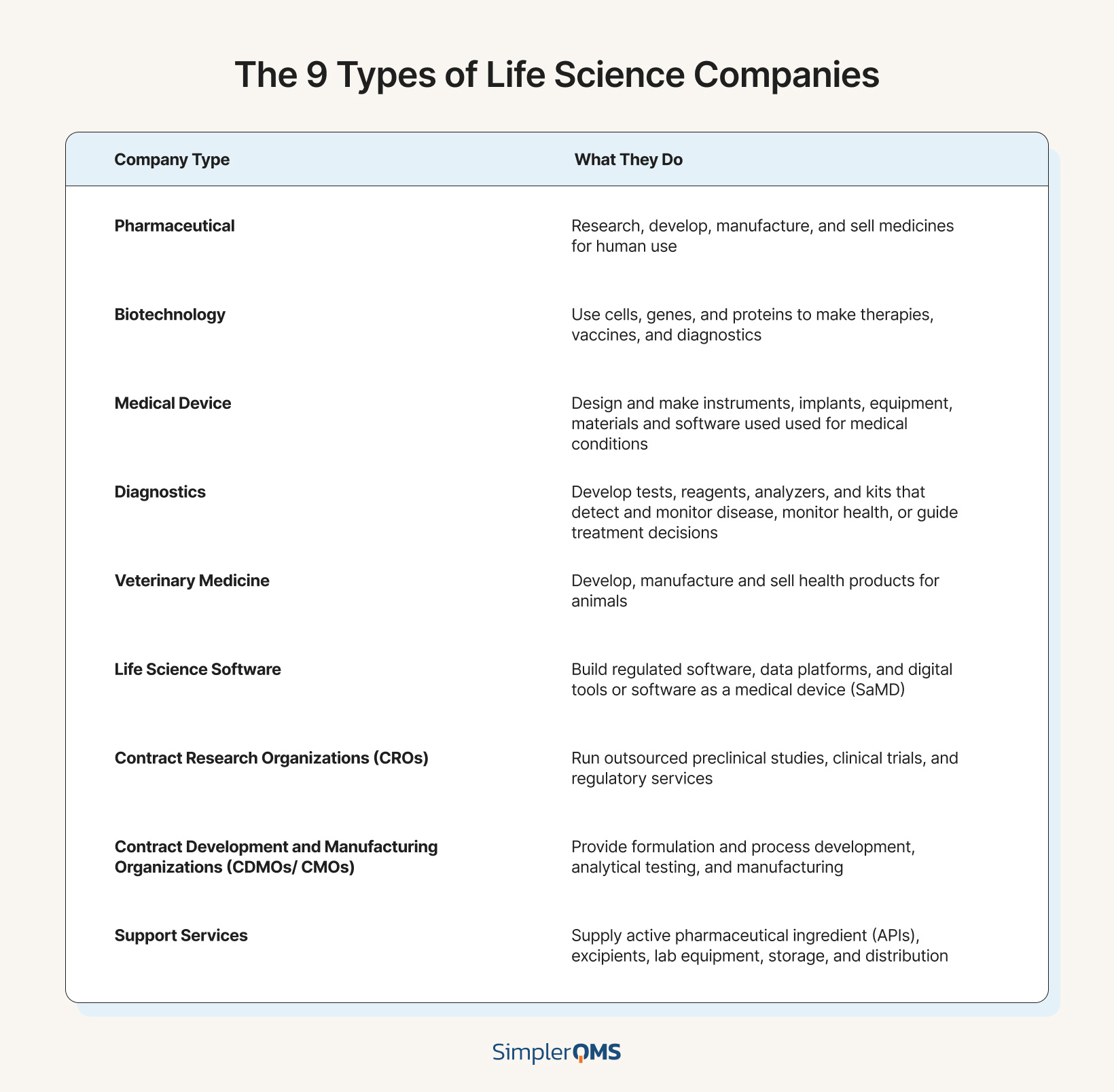
The 9 main types of life science companies are listed below.
- Pharmaceutical Companies: Pharmaceutical companies research, develop, manufacture, and commercialize medicines for human use. Medicinal products are available in dosage forms such as tablets, capsules, creams, injectables, oral solutions, and are commercialized as prescription medicines or over-the-counter medicines.
- Biotechnology Companies: Biotechnology companies use living cells, proteins, genes, and other biological materials to develop therapies, vaccines, and diagnostics. Biotech companies focus on products such as cell therapies, gene therapies, monoclonal antibodies, and recombinant proteins.
- Medical Device Companies: Medical device companies design, manufacture, and sell instruments, implants, equipment, software, and materials used for diagnosis, treatment, monitoring, prevention, or support of medical conditions. Medical devices include surgical tools, pacemakers, imaging systems, prosthetics, and wound care products.
- Diagnostics Companies: Diagnostics companies develop and sell tests, reagents, analyzers, and kits used to detect diseases, monitor health, or guide treatment decisions. Common diagnostic products include pregnancy tests, COVID-19 or flu tests, and clinical chemistry analyzers.
- Veterinary Medicine Companies: Veterinary medicine companies develop, manufacture, and sell health products for animals. Veterinary medicine companies support disease prevention, treatment, and health maintenance in livestock, companion animals, and other animal populations.
- Life Science Software Companies: Life science software companies develop regulated software, data platforms, and digital tools for product development, quality management, clinical research, manufacturing, or software as a medical device (SaMD). Life science software companies differ from healthcare delivery platforms because they support life science operations or function as regulated medical devices.
- Contract Research Organizations (CROs): Contract research organizations provide outsourced research services to life science companies. CROs support preclinical studies, clinical trials, regulatory submissions, data management, biostatistics, pharmacovigilance, and study monitoring.
- Contract Development and Manufacturing Organizations (CDMOs/ CMOs): Contract development and manufacturing organizations help life science companies develop, scale, and manufacture products. CDMOs/CMOs support activities such as formulation, process development, analytical testing, clinical batch production, commercial manufacturing, packaging, and serialization.
- Support Service Companies: Support service companies provide raw materials, infrastructure, and specialized services that help life science companies operate. Support service companies include active pharmaceutical ingredient manufacturers, excipient manufacturers, laboratory equipment and consumable suppliers, warehouses, distributors, and specialized service providers, such as validation experts.
Agricultural biotechnology and crop science companies are also part of the life science sector. Agricultural biotechnology and crop science companies develop genetically modified crops, biopesticides, and related technologies aimed at improving crop yield, disease resistance, and food security.
Life science companies can be categorized into nine types based on their core activities, including pharmaceuticals, biotechnology, medical devices, diagnostics, contract research, and manufacturing services, as shown in the image below.
Pharmaceutical Companies
Pharmaceutical companies are life science companies that research, develop, manufacture, and commercialize medicines for human use. Pharmaceutical companies meet the need for safe, effective, and high-quality medicines that prevent, treat, diagnose, or manage disease.
Pharmaceutical companies offer drug products in different dosage forms, including solid, liquid, semisolid, and gaseous dosage forms. Medicinal products are classified as innovative medicines or generic medicines. Drug products are sold as prescription drugs or over-the-counter medicines based on regulatory status.
Some pharmaceutical companies cover the full drug development and post-market surveillance value chain. Other pharmaceutical companies provide specialized services for selected activities, such as formulation development, clinical trials, regulatory submissions, pharmacovigilance, or manufacturing support.
Pharmaceutical companies serve patients through healthcare professionals, hospitals, and pharmacies. Other important stakeholders include wholesalers, distributors, reimbursement bodies, regulatory authorities, payers, and research partners. Pharmaceutical companies treat patients as the final beneficiaries, whereas healthcare providers and payers typically influence product access and use through prescribing, coverage, and reimbursement decisions.
Pharmaceutical companies operate across research and development, clinical operations, regulatory affairs, quality assurance, quality control, manufacturing, supply chain, medical affairs, pharmacovigilance, business development, market access, and sales operations. The pharmaceutical industry connects these functions through the medicinal product lifecycle. The medicinal product lifecycle extends from target discovery and clinical evidence generation to market authorization, commercial manufacturing, distribution, safety monitoring, and lifecycle management.
Pharmaceutical companies face common risks and challenges across research, production, regulatory compliance, and market access. These include high development costs, clinical trial failure risks, safety issues, deviations, complaints, supply shortages, pricing pressure, reimbursement barriers, counterfeit medicines, data integrity failures, and product recalls.
Biotechnology Companies
Biotechnology companies are life science companies that use living cells, genes, proteins, microorganisms, and biological systems to develop products for human health, animal health, agriculture, and research. Biotechnology companies apply biotechnology principles to create advanced therapies, diagnostics, vaccines, agricultural products, animal health products, and research tools. The Organization for Economic Co-operation and Development (OECD) defines biotechnology as the application of science and technology to living organisms, as well as parts, products, and models of them, to alter living or non-living materials to produce knowledge, goods, and services.
Biotechnology companies address health problems driven by biological mechanisms, including complex, chronic, genetic, and rare diseases and immune disorders. Biotechnology products include cytokines, growth factors, hormones, interferons, peptides, proteins, monoclonal antibodies, cell therapies, gene therapies, vaccines, and products from novel cell lines.
The key stakeholders involved in biotechnology operations include manufacturers, hospitals, healthcare professionals, specialty pharmacies, distributors, regulators, payers, reimbursement bodies, clinical research sites, research partners, and patients. Biotechnology products in healthcare reach patients through prescribing and hospital administration because biologics are not sold as OTC products.
Biotechnology companies function through R&D, clinical operations, regulatory affairs, quality assurance, quality control, manufacturing, process development, technology transfer, supply chain, commercial operations, business development, pharmacovigilance, market access, and medical affairs departments.
Biotechnology companies face technical, financial, regulatory, and operational risks. The biotechnology industry faces manufacturing and analytical complexity, cold-chain failures, batch variability, scale-up failures, clinical trial failures, funding gaps, and reimbursement barriers. Biotechnology challenges commonly arise during technology transfer because biotech products have inherent instability and variability compared with chemically synthesized drugs. Challenges also arise during process development and analytical method validation.
Medical Device Companies
Medical device companies are life science companies that design, develop, manufacture, and commercialize medical devices for diagnosis, prevention, treatment, monitoring, or support of medical conditions. Medical device companies address the need for safe, reliable, and regulated devices and tools that support clinical decision-making, therapeutic intervention, and patient monitoring.
Medical device companies sell a wide range of products, including surgical instruments, implants, orthopedic devices, cardiovascular devices, wound care products, infusion systems, monitoring equipment, imaging equipment, prosthetics, dental devices, hospital equipment, home-use devices, and software as a medical device. Medical devices are grouped by risk class. The FDA uses Class I, Class II, and Class III, where Class I covers the lowest-risk devices and Class III covers the highest-risk devices. The EU MDR uses Class I, Class IIa, Class IIb, and Class III for medical devices under Regulation (EU) 2017/745.
Medical device companies serve a variety of stakeholders, including hospitals, clinics, surgeons, physicians, nurses, and patients. Other important stakeholders include distributors, notified bodies, regulatory authorities, and service partners.
Medical device companies operate across research and development, design control, validation, regulatory affairs, quality assurance, quality control, manufacturing, supply chain, clinical affairs, medical affairs, post-market surveillance, and commercial operations. The operational areas of the medical device industry are interconnected, from user needs definition and risk analysis through design verification, validation, production, and post-market surveillance.
Medical device companies face risks and challenges across design, production, compliance, and lifecycle management, including design failures, biocompatibility problems, non-conformances, complaints, and post-market surveillance issues.
Diagnostics Companies
Diagnostics companies are life science companies that develop, manufacture, and commercialize devices used to detect, measure, or monitor health conditions from human specimens. Diagnostics companies address the need for evidence-based detection, treatment selection, and disease monitoring.
Diagnostics companies offer a wide range of in vitro diagnostic (IVD) devices, including test kits, reagents, analyzers, instruments, calibrators, control materials, and specimen receptacles. IVDs are grouped by risk class. The EU IVDR uses Class A, Class B, Class C, and Class D for in vitro diagnostic medical devices under Regulation (EU) 2017/746. The FDA uses Class I, Class II, and Class III for medical devices, including in vitro diagnostic products, based on the level of control needed to ensure safety and effectiveness.
Key customers of diagnostics companies include clinical laboratories, hospitals, public health agencies, blood establishments, and pharmacies. Other important stakeholders include distributors, regulators, notified bodies, and patients.
Diagnostics companies operate across research and development, validation, regulatory affairs, quality assurance, quality control, manufacturing, supply chain, medical affairs, scientific affairs, and commercial operations. These operational functions are interrelated throughout the diagnostic product lifecycle, from biomarker selection and assay development to validation, clinical performance studies, stability studies, commercial manufacturing, distribution, and post-market surveillance.
Diagnostics companies face technical, regulatory, operational, and market risks, including assay performance failures, regulatory delays, manufacturing disruptions, market access barriers, and post-market performance concerns.
Veterinary Medicine Companies
Veterinary medicine companies are life science companies that research, develop, manufacture, and commercialize health products for animals. Veterinary medicine companies address the need for safe, effective, and regulated products that prevent, treat, or control disease and health conditions in animals.
Veterinary medicine companies offer a wide range of products, including veterinary medicines, vaccines, antiparasitics, anesthetics, hormones, and medicated feed products. Veterinary medicine companies serve veterinarians, animal hospitals, farms, and producers. Other important stakeholders include distributors, wholesalers, regulators, public health agencies, food safety authorities, and animal owners.
The key operations of veterinary companies include research and development, clinical operations, regulatory affairs, pharmacovigilance, quality assurance, quality control, manufacturing, supply chain, and commercial operations.
Veterinary medicine companies face technical, compliance, financial, and market challenges, including regulatory complexity, high development costs, species-specific development needs, biologics complexity, antimicrobial resistance concerns, and product approval delays. Veterinary medicine companies face regulatory complexity due to different requirements in the EU and the US. In July 2026, the EU is changing veterinary EU GMP requirements in accordance with Regulation (EU) 2019/6.
Life Science Software Companies
Life science software companies provide software, data systems, and digital tools for regulated research, manufacturing, analysis, quality, regulatory, clinical, and post-market operations. Life science software companies address the need for controlled data, connected processes, traceability, and faster decision-making across life science operations.
Life science software companies sell software that enables quality, regulatory, manufacturing, clinical, laboratory, and IT departments to manage regulated information and process execution. Life science software solutions include electronic Quality Management Systems (eQMS), Manufacturing Execution Systems (MES), clinical data management systems, Laboratory Information Management Systems (LIMS), Regulatory Information Management Systems (RIMS), pharmacovigilance systems, and document management systems.
When software performs a medical function, such as diagnosis, treatment, or monitoring, without being part of a hardware medical device, it is categorized as software as a medical device. SaMD is regulated under medical device requirements.
Life science software providers serve pharmaceutical companies, biotechnology companies, medical device manufacturers, diagnostics companies, veterinary medicine companies, CROs, CDMOs, and laboratories. Key stakeholders include regulatory teams, quality teams, manufacturing teams, clinical teams, IT teams, and leadership teams.
Life science software companies’ operate across product management, software development, validation, quality assurance, customer success, technical support, marketing, and training teams.
Life science software companies face compliance, security, and adoption challenges, including computer system validation requirements, data integrity failures, cybersecurity threats, poor interoperability, migration errors, configuration errors, and user adoption barriers. Life science software vendors must prove that their systems work as intended, protect regulated records and processes, integrate with existing systems, and support inspection readiness.
Contract Research Organizations (CROs)
Contract Research Organizations (CROs) are life science service companies that provide outsourced research and clinical trial support to other life science companies. CROs enable life science companies to run complex and highly regulated studies without maintaining full-scale internal clinical and research operations capacity.
CROs offer a wide range of services, including clinical trial planning, protocol development, site selection, patient recruitment, clinical monitoring, project management, data management and biostatistics, medical writing, regulatory and quality support, pharmacovigilance, and pre-clinical study support.
CROs serve life science companies that must conduct clinical and preclinical studies to support regulated product marketing authorization. CRO customers include pharmaceutical companies, biotechnology companies, medical device companies, diagnostics companies, and veterinary medicine companies. CRO stakeholders include investigators, clinical sites, ethics committees, regulatory authorities, and patients.
CROs operate across clinical operations, project management, regulatory affairs, quality assurance, data management, medical writing, pharmacovigilance, finance, and business development.
CROs face risks tied to trial complexity, sponsor expectations, site performance, data integrity, patient recruitment, protocol deviations, audit findings, and timeline pressure. CROs and sponsors must maintain written agreements describing delegated responsibilities and accountability for each activity. Sponsors remain ultimately responsible for the oversight and quality of the outsourced clinical trial.
Contract Development and Manufacturing Organizations (CDMOs/ CMOs)
Contract Development and Manufacturing Organizations and Contract Manufacturing Organizations (CDMOs/ CMOs) are life science partner companies that provide process development and commercial manufacturing for pharmaceutical, biotechnology, medical device, diagnostic, and veterinary medicinal products. CDMOs and CMOs address the need for specialized development, scale-up, and GMP-compliant production capacity without requiring every product owner to build and maintain their own manufacturing site.
CDMOs offer end-to-end development and manufacturing services, including formulation, analytical method development, scale-up, technology transfer, clinical batch manufacturing, commercial manufacturing, and batch release. CMOs focus more narrowly on technology transfer and GMP-compliant manufacturing, while CDMOs cover both development and manufacturing stages.
CDMOs and CMOs serve life science companies that own regulated products, intellectual property, regulatory strategies, and commercial strategies. CDMO and CMO customers include pharmaceutical companies, biotechnology companies, medical device companies, diagnostics companies, and veterinary medicine companies. Key stakeholders include regulators, raw material suppliers, packaging suppliers, and distributors.
CDMOs operate through process development and analytical development functions. CDMOs and CMOs also operate through shared business functions, including technology transfer, manufacturing, quality assurance, quality control, engineering, supply chain, project management, warehousing, and business development.
CDMOs and CMOs share risks linked to compliance, technological innovation, supply continuity, technology and knowledge transfer, and workforce capability. Common challenges include GMP inspection findings, technology transfer issues, raw material shortages, equipment and capacity constraints, batch failures, and specialized workforce shortages.
Support Service Companies
Support service companies are life science companies that supply the raw materials, infrastructure, technologies, and expert services needed to develop, manufacture, store, and distribute regulated products. Support service companies address life science operational needs, including the need for qualified suppliers, controlled facilities, compliant distribution, and specialized expertise across life science operations.
Support service companies offer a wide range of products and services, including active pharmaceutical ingredients, excipients, reagents, lab instruments, standards, packaging materials, calibration services, validation services, maintenance services, warehousing, cold-chain logistics, distribution, and serialization support. CROs, CDMOs, and CMOs are also considered support service companies.
Support service companies serve pharmaceutical companies, biotechnology companies, medical device companies, diagnostics companies, veterinary medicine companies, and laboratories.
Support service companies face common risks linked to material quality, facility management, traceability, documentation, and supply continuity. Support service companies may face contamination risks, counterfeit materials, temperature excursions, delays, data integrity issues, recalls, and audit findings. Support service companies carry a high responsibility because an out-of-specification (OOS) material, delayed shipment, or uncontrolled conditions can affect product safety, batch release, and market supply.
How Do Life Science Organizations Operate Across the Value Chain?
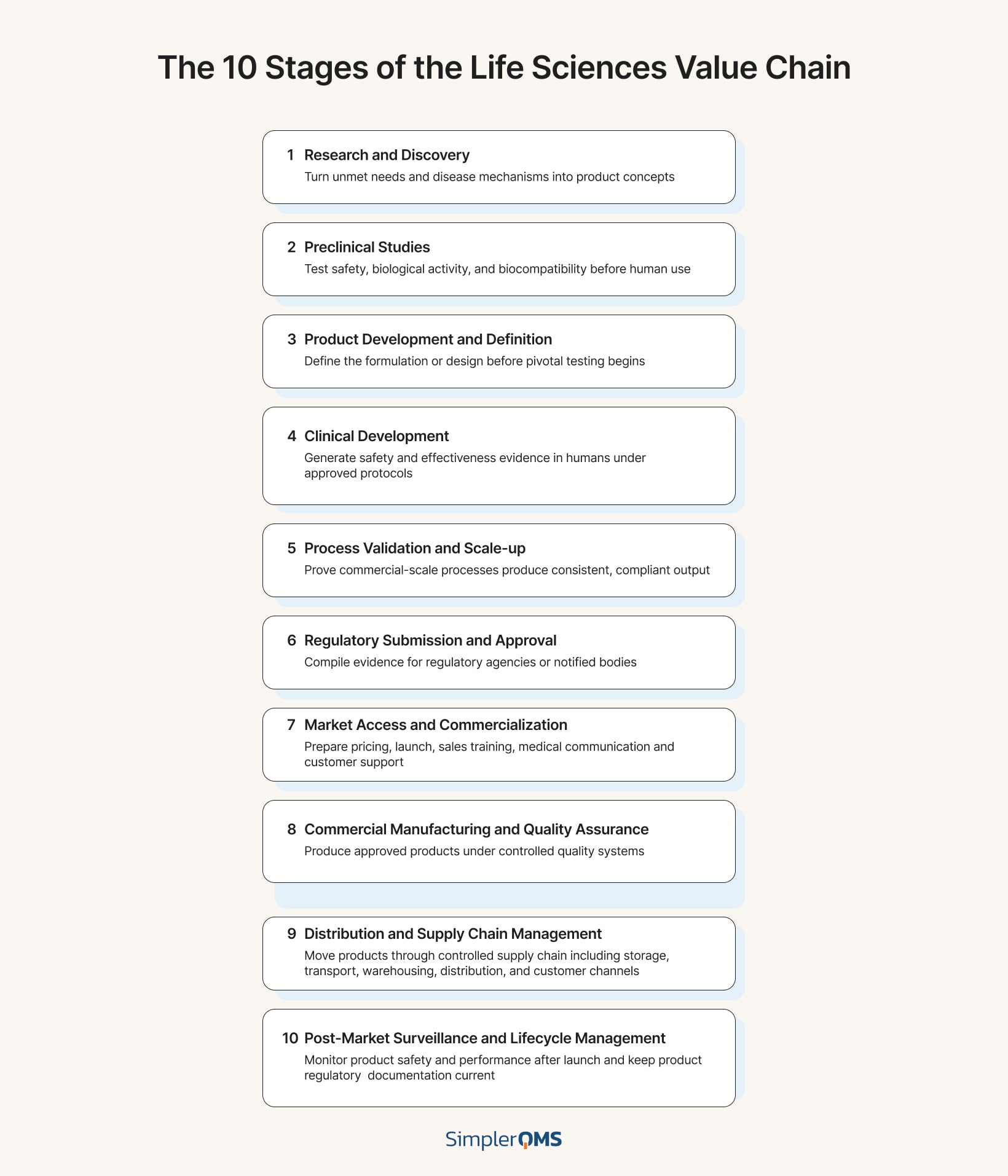
Life science organizations operate through an interconnected value chain that takes regulated products from scientific concept to commercialization. The life sciences value chain can be viewed as ten key stages. These stages are research and discovery, preclinical studies, product development and definition, clinical development, process validation and scale-up, regulatory submission and approval, market access and commercialization, commercial manufacturing and quality assurance, distribution and supply chain management, and post-market surveillance and lifecycle management.
The ten life sciences value chain stages and the role each stage plays in moving regulated products from concept to post-market management are listed below.
- Research and Discovery: Life science organizations identify unmet needs and disease mechanisms and translate them to product concepts. The research and discovery stage creates the scientific basis for a medicine, device, diagnostic, veterinary product, or enabling technology.
- Preclinical Studies: Life science organizations test safety, biological activity, and biocompatibility before human use or major clinical evaluation. Preclinical studies generate evidence for further product development and support decisions on whether the product should be tested on humans.
- Product Development and Definition: Life science organizations define the product’s formulation or design while preclinical studies progress in parallel. Preclinical studies typically start first, but product development and definition should be completed before pivotal preclinical tests because later changes may trigger additional studies.
- Clinical Development: Life science organizations test the product in humans to generate safety and effectiveness evidence. Clinical trials and clinical investigations follow approved protocols and monitoring requirements.
- Process Validation and Scale-up: Life science organizations prove that manufacturing processes at commercial scale produce consistent outputs that meet predefined requirements. Validation requirements include equipment qualification, analytical method validation, cleaning validation, process and packaging validation.
- Regulatory Submission and Approval: Life science organizations compile evidence for regulatory agencies or notified bodies. Regulatory submission and approval differ per product type and aim to prove quality, safety, and efficacy or performance.
- Market Access and Commercialization: Life science organizations prepare pricing, launch, sales training, medical communication, and customer support. Market access and commercialization connect regulatory approval with market availability.
- Commercial Manufacturing and Quality Assurance: Life science organizations manufacture approved products under controlled quality systems. This stage includes batch production, quality control testing, document control, deviation and non-conformance handling, supplier qualification, CAPA, training, audits, and batch release.
- Distribution and Supply Chain Management: Life science organizations move products through a controlled supply chain, including storage, transport, warehousing, distribution, and customer channels. Supply chain management protects product quality, traceability, and recall readiness.
- Post-Market Surveillance and Lifecycle Management: Life science organizations monitor product safety and performance after launch and keep product regulatory documentation up to date. Lifecycle management supports product updates, process improvements, regulatory renewals, and lifecycle decisions.
The life sciences value chain encompasses ten key stages, from research and discovery to product development, regulatory approval, commercial manufacturing, distribution, and post-market surveillance, as shown in the image below.
1. Research and Discovery
Research and discovery is the first stage of the life sciences value chain. Research and discovery identifies an unmet medical need, a disease mechanism, a biological target, or a product opportunity. A qualified research output translates into a successful drug candidate for humans or animals, or a medical device or diagnostics concept when the evidence supports further development.
Research and discovery in pharmaceutical companies focuses on disease biology, target identification and validation, compound screening, lead selection, and pre-formulation development. Research and discovery in medical device companies focuses on clinical needs, intended use, device concepts, feasibility studies, and early risk evaluation.
Research and discovery involves R&D scientists, bioinformatics, translational science, engineers, clinical experts, product managers, quality teams, regulatory teams, and intellectual property specialists. External partners include universities, research institutes, and external consultants.
Research and discovery uses inputs such as unmet medical needs, disease data, clinical practice gaps, scientific literature, market data, regulatory pathway information, competitor analysis, available technologies, and strategic portfolio priorities. Research and discovery delivers a product concept or development candidate for the next stage.
Research and discovery depends on research instruments, data analysis tools, literature databases, compound libraries, biological sample repositories, modeling tools, and risk management tools.
Research and discovery success is measured by technical feasibility, clinical relevance, early safety signals, intellectual property potential, and strategic fit. Strong feasibility, clinical relevance, and intellectual property potential increase development readiness, while weak safety signals or poor strategic fit reduce a candidate’s likelihood of progressing. Pharmaceutical companies measure success through candidate nomination rate, cycle time, cost per candidate, patent output, and early safety or developability success rates. Medical device companies measure success through user-need evidence, the strength of the feasibility assessment, and the clarity of the intended use.
2. Preclinical Studies
Preclinical or non-clinical studies are the second stage of the life sciences value chain, where organizations test safety, performance, effectiveness, feasibility, and risk before human clinical studies. Preclinical studies generate evidence for further product development and improvement.
Preclinical studies usually starts before product development and definition is finalized, and the two stages run in parallel. However, product definition must be completed before pivotal preclinical tests whose results depend on the final formulation, design, or materials. Later product changes can prompt regulatory questions and require additional bridging studies when the changes affect the validity of completed tests.
Preclinical drug development involves pharmacodynamic, pharmacokinetic, and toxicology studies, the results of which feed directly into the investigational product dossier. These studies inform the proposed dose range and starting dose for clinical trials.
Preclinical device development may include engineering tests, laboratory tests, biological and chemical characterization, simulated use, and animal or ex vivo testing, depending on device type. Preclinical device development also includes evaluation of published literature for the device or similar devices. This literature evaluation considers intended purpose, preclinical safety, and conformity with specifications.
Preclinical diagnostics development evaluates analytical performance characteristics, including analytical sensitivity, analytical specificity, trueness, precision, accuracy, limits of detection, limits of quantitation, measuring range, linearity, and cut-off. Preclinical diagnostics development also defines specimen collection criteria, specimen handling criteria, interference controls, and cross-reactivity controls.
Preclinical studies involve R&D scientists, quality assurance, regulatory affairs, clinical operations, product management, and project management teams. Organizations assign preclinical studies to qualified test laboratories and contract research organizations when internal facilities or technical capabilities cannot support the required test.
Preclinical studies need inputs from research and discovery. These inputs include a selected drug candidate, device concept, diagnostic concept, intended use, target population, design and development inputs, early risk analysis, feasibility data, and scientific rationale.
Preclinical studies produce evidence that moves the product toward clinical development. Drug outputs include toxicology, pharmacology, and pharmacokinetics reports, dosing, formulation data, and an investigational submission package. Device outputs include bench test reports, biocompatibility reports, and finalized design and development inputs and outputs. Diagnostic outputs include analytical performance data, stability data, and design information.
Preclinical studies depend on laboratory facilities, equipment, quality management systems, and sample management. Sites conducting preclinical studies may be required to comply with GLP principles.
Preclinical studies measure success through technical performance, risk reduction, regulatory readiness, safety, and quality metrics. Drug developers measure preclinical success through study completion cycle time or study cost. Device programs measure success through bench performance, requirement traceability, and design readiness. Diagnostic programs measure success through analytical performance, reagent suitability, and reagent stability.
3. Product Development and Definition
Product development and definition is the third stage of the life sciences value chain, where organizations transform an early product concept into a defined product ready for verification, validation, clinical development, and regulatory testing. Product development and definition uses information generated during research, discovery, and early preclinical studies to define what the product’s intended use, performance characteristics, quality attributes, and control requirements.
In pharmaceutical companies, product development and definition focuses on formulation development. Pharmaceutical teams define dosage form, route of administration, excipients, finished product specifications, analytical methods, container closure system, and manufacturing process. In medical device companies, product development and definition focuses on establishing a controlled design baseline. Medical device teams define design inputs, design outputs, materials, risk controls, and the device configuration that will be evaluated through verification, validation, and key preclinical studies.
Product development and definition involves collaboration among R&D, formulation scientists, process development teams, engineers, quality assurance, regulatory affairs, manufacturing, and supply chain teams. Suppliers, laboratories, and external development partners, such as CDMOs, may be involved at this stage.
Product development and definition relies on inputs from research and discovery and early preclinical work. These inputs include feasibility data, early safety findings, early performance results, preliminary risk analysis, prototype data, formulation data, and regulatory pathway information.
Product development and definition delivers a defined product for verification, validation, clinical development, and technical dossier evidence. Pharmaceutical outputs include product specifications, analytical methods, stability data, and process development records. Medical device outputs include design specifications, updated risk management file, traceability matrix, prototype specifications, and design and development file records.
Product development and definition depends on CDMOs, quality management systems, risk management tools, electronic quality management systems (eQMS), computer-aided design tools, laboratory information systems, and analytical instruments.
Product development and definition success is measured by manufacturability, technical feasibility, effectiveness of risk controls, and design verification outcomes.
4. Clinical Development
Clinical development is the fourth stage of the life sciences value chain, where organizations test a defined product in humans or target users under controlled clinical conditions. Clinical development generates evidence on safety, efficacy, performance, usability, and benefit-risk profile to support regulatory submission and market approval.
Clinical developmentactivities include protocol development, regulatory authorization, site selection, investigator training, patient or participant recruitment, informed consent, study monitoring, data collection, safety reporting, statistical analysis, and clinical study reporting. Pharmaceutical clinical trials are divided into three phases, including Phase I, Phase II, and Phase III studies. In medical device development, clinical activities include clinical investigations, clinical performance studies, usability studies, human factors studies, and clinical evaluations, depending on the product type.
Clinical development involves both primary and supporting stakeholders. Primary clinical development stakeholders include clinical operations teams, investigators, clinical sites, patients or participants, and regulators. Supporting stakeholders include medical affairs, regulatory affairs, quality assurance, data management, pharmacovigilance or vigilance teams, ethics committees, CROs, and laboratories. Clinical studies are often contracted to CROs for services such as monitoring, site management, data management, medical writing, regulatory support, and study reporting.
Clinical development requires inputs from earlier stages, including a defined formulation or controlled device design, preclinical evidence, risk management documentation, clinical protocols, informed consent forms, manufacturing and release records, regulatory approvals, ethics approvals, a study monitoring plan, and safety signal management procedures.
Clinical development produces the clinical evidence for regulatory submission and market access planning. Clinical development outputs include clinical study reports, safety data, efficacy data, performance data, usability findings, protocol deviation records, adverse event reports, and benefit-risk conclusions.
Clinical development uses clinical trial management systems, electronic data capture systems, electronic Trial Master File systems, pharmacovigilance systems, data analytics tools, and quality management systems. Clinical trials require validated systems when electronic records support regulated decisions.
Clinical developmentsuccess is measured through achievement of study endpoints, protocol compliance, participant safety, site performance, inspection readiness, and regulatory acceptance of clinical evidence.
5. Process Validation and Scale-up
Process validation and scale-up forms the fifth stage of the life sciences value chain, where organizations prove that a defined product and its manufacturing process work at the intended commercial batch size.
Process validation and scale-up includes process performance qualification of the desired commercial scale. Supplementary validation activities include equipment qualification, cleaning validation, packaging validation, and sterilization validation, where relevant. Process validation produces a validated commercial-scale manufacturing process and supporting documentation.
Process validation and scale-up involves manufacturing, engineering, quality assurance, quality control, regulatory affairs, validation, and supply chain teams. Other important stakeholders are raw material suppliers and, where relevant, CDMOs or CMOs.
Process validation and scale-up relies on data from product development and product definition. Inputs include the final formulation or controlled device design, product specifications, manufacturing instructions, critical quality attributes, critical process parameters, analytical methods, risk controls, and stability data. Clinical trial batches must be representative of the intended commercial product because significant differences between clinical and commercial batches require additional bridging studies when those differences affect product comparability or performance evidence.
Process validation and scale-up delivers a validated commercial manufacturing process that supports regulatory submission and commercial launch. Outputs include validation protocols, validation reports, batch manufacturing records, and approved commercial process controls.
Process validation and scale-up depends on qualified production equipment, calibrated instruments, controlled environmental conditions, and validated analytical methods. Common systems and tools used include manufacturing execution systems, laboratory information management systems, electronic batch records, eQMS, and environmental monitoring systems.
Process validation and scale-up success are measured by metrics such as batch success rate, acceptable yield, process capability, and right-first-time.
6. Regulatory Submission and Approval
Regulatory submission and approval form the value chain stage, where life science organizations submit product evidence to regulatory authorities and notified bodies and seek approval. Regulatory submission and approval demonstrate that product evidence supports acceptable safety, efficacy, performance, quality, and benefit-risk profile before commercial launch.
Submission and approval activities include dossier or technical documentation compilation, submission pathway selection, evidence collection, data review, authority communication, deficiency response, and approval tracking.
The regulatory submission stage requires coordination between regulatory affairs, quality assurance, clinical teams, medical affairs, R&D, manufacturing, quality control, and pharmacovigilance or vigilance teams. External partners may include CROs, CDMOs/CMOs, notified bodies, and competent authorities.
Regulatory submissions rely on inputs from product development, preclinical and clinical studies, and often from process validation and manufacturing scale-up. Inputs include clinical study reports, preclinical reports, product specifications, process validation protocol, risk management files, stability data, analytical method validation, labeling, instructions for use, and post-market plans.
The approval process delivers regulatory outcomes, such as marketing authorization, clearance, certification, CE marking, approval conditions, deficiency letters, or authority feedback. Positive regulatory outcomes move the product to market access, launch planning, commercial manufacturing, distribution, and post-market surveillance. Deficiency letters require response preparation or additional study planning.
Regulatory submission and approval depend on regulatory information management systems (RIMS), electronic common technical document (eCTD) publishing tools, and secure submission portals. Life science organizations need controlled records because regulators review evidence across development, manufacturing, clinical evaluation, quality, labeling, and post-market plans.
Submission and approval process success is measured by submission acceptance, the number of deficiency findings, and approval timelines. Life science organizations measure this stage by whether the submission supports approval without major evidence gaps, delayed launch, or additional studies.
7. Market Access and Commercialization
Market access and commercialization is the life sciences value chain stage where regulatory approval leads to product availability, payer coverage, and revenue. Market access and commercialization link approved clinical, quality, safety, and performance evidence with pricing, reimbursement, launch planning, medical communication, sales channels, and customer support.
Market access and commercialization activities include pricing strategy, reimbursement planning, tender preparation, sales training, medical education, promotional review, product positioning, and customer onboarding.
The commercialization stage involves market access teams, business development teams, medical affairs, regulatory affairs, quality assurance, supply chain, finance, legal, sales, and marketing. External stakeholders include distributors, payers, reimbursement bodies, and healthcare professionals.
Market access and commercialization require inputs from regulatory submission and approval. These inputs include approved labeling, clinical evidence, safety data, performance data, product claims, and target customer segments.
Market access and commercialization deliver launch plans, payer dossiers, reimbursement decisions, tender responses, sales materials, medical education materials, and customer training plans.
Market access and commercialization depend on customer relationship management (CRM) systems, RIMS, and market intelligence tools. Market access and launch teams require approved claims and accurate product data to support product marketing.
The success of the commercialization stage is measured by reimbursement approval, tender wins, customer onboarding, and compliant promotion. This stage succeeds when approved products reach the right users through compliant channels, a stable supply, and clear customer education.
8. Commercial Manufacturing and Quality Assurance
Commercial manufacturing and quality assurance is the life sciences value chain stage where approved products are manufactured at routine commercial scale under controlled quality systems. Commercial manufacturing and quality assurance ensure each released batch or device meets approved specifications, regulatory requirements, and customer expectations.
Manufacturing activities include production planning, raw materials receipt, equipment setup, batch production, device assembly, environmental control, cleaning, packaging, labeling, and sterilization, where required. Quality operations include raw materials analysis, in-process checks, finished product testing, non-conformance investigation, CAPA, change control, supplier quality management, training, and product release.
Commercial manufacturing involves manufacturing, quality assurance, quality control, engineering, validation, supply chain, warehouse, regulatory affairs departments, and, where applicable, qualified persons. Other stakeholders are the raw material suppliers, CMOs, and distributors. Quality teams maintain oversight across documentation, process performance, nonconformances, CAPA, changes, and release decisions.
Routine production uses inputs from regulatory approval, validation, and scale-up. Key inputs include approved product specifications, validated processes, master batch records, device master records, approved labeling, quality agreements, supplier qualifications, and demand forecasts.
This stage delivers released commercial batches, batch records, quality control results, non-conformance records, and CAPA records.
Commercial manufacturing and quality assurance depend on qualified facilities and equipment, and trained personnel. Commonly used digital tools include MES, electronic batch records, LIMS, environmental monitoring systems, enterprise resource planning (ERP) systems, and eQMS.
Manufacturing and quality operations success is measured by right-first-time rate, batch release cycle time, yield, batch success rate, audit outcomes, supplier performance, complaint trends, product availability, and process capability. Commercial manufacturing and quality assurance succeed when product quality remains consistent, records remain complete, and supply meets market demand without compromising compliance.
9. Distribution and Supply Chain Management
Distribution and supply chain management is the life sciences value chain stage that moves released products from manufacturing sites to approved markets, distributors, healthcare providers, laboratories, pharmacies, or end users. Distribution and supply chain management protect product quality, availability, traceability, and compliance during storage, transport, import, export, and delivery.
Supply chain management activities include demand planning, inventory control, warehousing, order fulfillment, transport validation, distributor qualification, returns handling, recall readiness, and temperature excursion management.
Distribution involves supply chain teams, warehouse teams, logistics providers, distributors, wholesalers, quality assurance, customer service, customs brokers, pharmacies, hospitals, laboratories, and qualified transport providers. Quality teams oversee storage conditions, distribution records, supplier controls, deviations, complaints, and recall execution.
Distribution and supply chain management inputs include released batches, certificates of analysis where relevant, approved storage conditions, transport requirements, distributor agreements, customer orders, and recall procedures.
The outputs of the distribution stage include shipped products, delivery records, temperature records, inventory data, distributor performance data, return records, and product traceability. These outputs support post-market surveillance, complaint handling, field actions such as recalls, and market supply.
Distribution management depends on ERPs, warehouse management systems, transport management systems, and temperature data loggers. Life science organizations need qualified warehouses, controlled vehicles and storage areas, calibrated monitoring equipment, and approved logistics partners.
Distribution and supply chain management success is measured by on-time and in-full delivery, inventory accuracy, temperature excursion rate, shipment damage rate, traceability completeness, recall execution speed, distributor performance, and audit findings. This stage succeeds when products reach approved markets under approved storage and transport conditions, with complete records and full traceability of distribution actions.
10. Post-Market Surveillance and Lifecycle Management
Post-market surveillance and lifecycle management form the value chain stage that monitors approved products upon market release. Post-market surveillance and lifecycle management protect patient safety, monitor product performance, and maintain regulatory compliance.
Post-market surveillance and lifecycle management include complaint handling, adverse event and incident reporting, field safety corrective actions such as recalls, periodic safety reports, post-market clinical follow-up, product performance monitoring, regulatory variation management, and change control.
Post-market surveillance and lifecycle management involve quality assurance, regulatory affairs, pharmacovigilance, vigilance teams, medical affairs, customer service, commercial teams, and supply chain teams. Other stakeholders include distributors, healthcare professionals, patients, regulators, and notified bodies. Legal manufacturers or marketing authorization holders remain accountable even when service providers, such as CROs, collect post-market information.
The main inputs of post-market surveillance and lifecycle management include customer complaints, adverse event and incident reports, returned products, service records, sales data, clinical feedback, commercial manufacturing changes, and supplier changes.
Post-market surveillance and lifecycle management outputs include safety reports, complaint investigations, trend reports, CAPA records, field action records, updated risk files, updated labeling, regulatory variation submissions or post-approval changes, lifecycle change records, and product improvement plans.
Post-market surveillance and lifecycle management depend on pharmacovigilance systems, eQMS, RIMS, CRMs, and data analytics tools. These systems support signal detection, investigation of quality or safety issues, adverse event and incident reporting, CAPA linkage, field action management, and regulatory lifecycle management.
Post-market surveillance and lifecycle management success is measured by indicators such as complaint closure time, adverse event reporting timeliness, CAPA effectiveness, regulatory compliance, and product performance trends.
What Challenges Do Life Science Organizations Face?
Life science organizations face scientific, regulatory, operational, and commercial challenges across the product lifecycle. These challenges affect product development, approval timelines, manufacturing control, market access, and lifecycle management.
The main challenges that life science organizations face are listed below.
- Lengthy and Costly R&D Cycles: Life science organizations often spend years moving a product from discovery to approval. High research costs, clinical study costs, failed candidates, and repeated testing increase financial pressure.
- Complex Regulatory Requirements: Life science organizations must meet strict and complex regulatory requirements for quality, safety, efficacy, performance, documentation, and post-market monitoring. Requirements differ across regions, product types, and regulatory pathways.
- Fragile Supply Chains and Disruption Risks: Life science organizations depend on qualified suppliers and controlled supply chains. Shortages, delays, quality issues, and geopolitical disruption may affect product availability.
- Talent Shortages and Skill Gaps: Life science organizations need specialists in regulatory affairs, quality assurance, clinical operations, validation, manufacturing, data science, cybersecurity, and advanced technologies. Skill gaps slow development, increase compliance risk, and limit scaling.
- Infrastructure and Capacity Constraints: Life science organizations need qualified facilities, validated systems, trained personnel, production capacity, laboratory capacity, and controlled storage. Infrastructure and capacity constraints can limit production scalability and commercial product availability.
- Increasing Competition and Reimbursement Pressure: Life science organizations compete for market share, clinical adoption, payer coverage, and pricing acceptance where applicable. Patent expiry, tender pressure, and reimbursement limits reduce profit margins.
- Rapid Technological Change: Life science organizations must keep pace with automation, artificial intelligence, digital quality systems, and advanced manufacturing. Technology adoption requires validation and training to fulfill compliance obligations.
- Data Management and Cybersecurity Risks: Life science organizations manage large volumes of regulated data across research and development, clinical, manufacturing, quality, and post-market surveillance. Poor data integrity, fragmented systems, weak access controls, cyberattacks, and audit trail gaps create compliance and business risk.
What Requirements Govern the Life Sciences Industry?
The life sciences industry is governed by requirements covering safety, efficacy, performance, quality, manufacturing, clinical research, product approval, labeling, data privacy, and post-market surveillance. National and international authorities enforce these requirements across medicines, biologics, medical devices, diagnostics, and veterinary medicines.
The main life science regulatory agencies and organizations include the following.
- EMA and EU National Authorities: The European Medicines Agency (EMA) coordinates scientific evaluation of centrally authorized human and veterinary medicines in the EU. EU national competent authorities authorize certain medicines, oversee clinical trials, inspect sites, and enforce national requirements.
- EC and EU Notified Bodies: The European Commission sets the EU regulatory framework for medical devices and in vitro diagnostic devices through MDR and IVDR. EU notified bodies assess conformity for medium-risk and high-risk devices before CE marking.
- FDA: FDA regulates human and veterinary drugs, biological products, and medical devices in the United States. FDA requirements cover product approval, quality systems, manufacturing controls, labeling, and post-market safety monitoring.
- National Competent Authorities: National competent authorities enforce local product rules, licensing, inspections, clinical trial oversight, vigilance, and market surveillance. National authorities are important because life science products must comply with country-level regulations in markets where national licensing, inspection, or surveillance rules apply.
- ISO: The International Organization for Standardization publishes voluntary standards used in regulated quality systems. For example, ISO 13485 sets quality management system requirements for medical device organizations, and ISO 14971 defines risk management for medical devices.
- ICH: The International Council for Harmonisation creates harmonized technical guidelines for pharmaceutical quality, safety, efficacy, and multidisciplinary topics. Although ICH guidelines are not legally binding, regulators use them to align drug development, registration, and quality expectations across major markets.
- WHO: The World Health Organization provides guidance and standards on the quality, safety, and efficacy of health products. WHO guidance supports national regulators, public health systems, and global alignment across the health product value chain.
The main categories of regulations governing the life sciences industry are given below.
- Pharmaceutical Requirements: Pharmaceutical requirements govern drug development, clinical trials, manufacturing, marketing authorization, market access, and pharmacovigilance.
- Medical Device and Diagnostic Requirements: Medical device and diagnostic requirements govern classification, design control, risk management, performance evidence, quality management systems, technical documentation, labeling, and post-market surveillance.
- Biotech Requirements: Biotech requirements govern biological products, such as cell and gene therapies, vaccines, monoclonal antibodies, and blood and blood components. Biologics carry dedicated regulatory requirements in addition to following drug, medical device, or combination product rules depending on the product classification.
- Life Science Software Requirements: Life science software requirements govern regulated software, cybersecurity, data integrity, validation, and software lifecycle controls. Software as a medical device falls under medical device requirements when software performs a medical purpose without being part of a hardware medical device.
- Veterinary Medicine Requirements: Veterinary medicine requirements govern animal medicines across manufacturing, authorization, labeling, and pharmacovigilance.
Pharmaceutical Requirements
Pharmaceutical requirements govern how medicines are researched and developed, approved, manufactured, analyzed, labeled, distributed, and monitored throughout the lifecycle.
The main pharmaceutical requirements are described below and include quality, clinical, manufacturing, safety, data integrity, and market authorization rules.
- Good Manufacturing Practices: GMP covers quality system, personnel, facilities, equipment, production, quality controls, documentation, suppliers, and returned products. Good Manufacturing Practices establish the minimum standards to ensure manufacturing processes consistently produce safe, effective, and high-quality products. FDA 21 CFR Parts 210 and 211 govern cGMP for drugs in the United States, and EU GMP governs medicinal products marketed in the European Union.
- ICH Q7, Q8, Q9, Q10, and Related Quality Guidelines: ICH quality guidelines govern aspects such as active pharmaceutical ingredient manufacturing, pharmaceutical development, quality risk management, pharmaceutical quality systems, stability, and lifecycle management.
- Good Laboratory Practice (GLP): GLP governs nonclinical laboratory studies used to support research or marketing authorizations. FDA 21 CFR Part 58 and OECD GLP principles cover study planning, conduct, monitoring, recording, reporting, facilities, equipment, personnel, and archives.
- Good Clinical Practice (GCP): GCP governs clinical trials and protects the rights, safety, and well-being of trial participants while protecting data integrity. ICH E6 provides a common framework for clinical trial conduct, and EU Regulation 536/2014 governs clinical trials on medicinal products for human use in the EU.
- FDA IND and NDA Requirements: FDA 21 CFR Part 312 governs Investigational New Drug (IND) applications for clinical development in the United States. FDA 21 CFR Part 314 governs applications for FDA approval to market new drugs, including New Drug Applications (NDA) and Abbreviated New Drug Applications (ANDA).
- EU Marketing Authorization Requirements: Directive 2001/83/EC governs the Community code for medicinal products for human use in the EU. These requirements shape product authorization, dossier content, labeling, pharmacovigilance, manufacturing, wholesale distribution, and placing medicines on the market. EudraLex Volume 2 serves as a comprehensive Notice to Applicants providing regulatory and procedural guidance for medicinal products for human use.
- Good Pharmacovigilance Practice (GVP): GVP governs post-authorization safety monitoring in the EU. These requirements apply to marketing authorization holders, EMA, and medicines regulatory authorities in EU Member States.
- Good Distribution Practice (GDP) and Supply Chain Security: GDP governs wholesale distribution and protects medicine quality and integrity across the supply chain. The U.S. Drug Supply Chain Security Act supports traceability and product identification for certain prescription drugs during distribution.
- Electronic Records and Data Integrity Requirements: FDA 21 CFR Part 11 governs electronic records and electronic signatures used in FDA-regulated activities. EU GMP Annex 11 governs computerized systems used in EU GMP environments.
- Labeling and Prescription Drug Advertising Requirements: FDA 21 CFR Part 201 governs drug labeling, and FDA 21 CFR Part 202 governs prescription drug advertising in the United States. EU Directive 2001/83/EC governs labeling, package leaflets, and advertising requirements for medicinal products in the EU.
Pharmaceutical requirements are important because medicines affect patient safety and public health. Pharmaceutical requirements ensure companies demonstrate product quality, safety, and efficacy, maintain traceability of changes, and monitor the benefit-risk profile.
Pharmaceutical companies must follow operational requirements for validated methods, qualified suppliers, trained personnel, standardized procedures, controlled manufacturing and batch release, clinical trial oversight, pharmacovigilance, recall readiness, and product lifecycle management. Pharmaceutical companies must maintain quality systems that connect R&D, manufacturing, regulatory affairs, quality assurance, quality control, supply chain, medical affairs, and commercial operations.
Compliance with pharmaceutical requirements mandates controlled documentation, including SOPs, batch records, specifications, validation protocols and reports, stability data, laboratory records, deviation records, CAPA records, change controls, supplier qualification records, training records, clinical trial files, technical dossiers, and safety reports. Pharmaceutical companies need these records to prove that each product was developed, manufactured, tested, released, distributed, and monitored according to standardized procedures.
Noncompliance with the pharmaceutical requirements can result in patient safety risk, product quality failures, regulatory findings, product recalls, batch rejection, license suspension, fines, and reputational damage. Significant noncompliance in the pharmaceutical industry can disrupt supply, delay product launch, and reduce trust among regulators, healthcare professionals, and patients.
Medical Device and Diagnostic Requirements
Medical device and diagnostic requirements govern how companies classify, design, test, manufacture, label, distribute, monitor, and improve medical devices and in vitro diagnostic products. Medical device and diagnostic requirements apply across product development, market approval, quality management, risk control, clinical and performance evidence, post-market surveillance, and vigilance activities.
The main medical device and diagnostic requirements are given below.
- EU MDR (Regulation (EU) 2017/745): EU MDR governs medical devices placed on the EU market. EU MDR covers classification, general safety and performance requirements, conformity assessment, clinical evaluation, technical documentation, UDI, post-market surveillance, vigilance, and CE marking.
- EU IVDR (Regulation (EU) 2017/746): EU IVDR governs in vitro diagnostic medical devices placed on the EU market. EU IVDR covers IVD classification, general safety and performance requirements, performance evaluation, technical documentation, conformity assessment, post-market surveillance, vigilance, and CE marking.
- FDA Medical Device Regulatory Requirements: FDA requirements govern medical devices and IVDs marketed in the United States. FDA-regulated devices are classified into three classes, which are subject to different regulatory controls. FDA regulatory pathways for medical devices include premarket notification 510(k), De Novo, premarket approval, humanitarian device exemption, exempt devices, and product development protocol.
- FDA 21 CFR Part 820 (QMSR): FDA 21 CFR Part 820 contains the Quality Management System Regulation (QMSR) for medical devices. QMSR became effective on February 2, 2026, and incorporates ISO 13485:2016 for medical device quality management systems.
- FDA 21 CFR Subchapter H: FDA 21 CFR Subchapter H regulates medical devices, including classification procedures and regulatory pathways, QMSR, recall, post-market surveillance, reporting, and UDI requirements.
- ISO 13485:2016: ISO 13485:2016 sets quality management system requirements for the medical device industry. ISO 13485 applies to organizations involved in medical devices and supports regulatory expectations across design, development, production, testing, service, delivery, and post-market processes.
- ISO 14971:2019: ISO 14971 governs risk management for medical devices. ISO 14971 supports risk analysis, risk evaluation, risk control, residual risk evaluation, risk management review, and production and post-production activities.
Medical device and diagnostic requirements are important because these products affect clinical decisions, patient safety, diagnostic accuracy, and treatment selection. Medical device and diagnostic requirements require companies to prove that products meet safety, performance, quality, risk, usability, and post-market obligations before and after placing them on the market.
Medical device and diagnostic companies must follow operational requirements for product classification, design control, design verification, design validation, performance evaluation, risk management, process validation, labeling control, complaint handling, field actions, and post-market surveillance.
Medical device and diagnostic compliance requires the maintenance of controlled documentation, including design and development files, medical device files/ technical documentation, risk management files, manufacturing records, complaint files, CAPA records, change control records, training records, and post-market surveillance records.
Severe noncompliance with medical device and diagnostic requirements can result in risks such as patient safety hazards, incorrect clinical decisions, device malfunction, false positive or false negative results, audit findings, warning letters, recalls, field safety corrective actions, approval delays, fines, supply interruption, and reputational harm.
Biotech Requirements
Biotech requirements govern the development, manufacture, analysis, approval, and post-market monitoring of biological products. Biotech requirements depend on product classification because a biological product follows drug, medical device, diagnostic, or combination product rules based on its classification.
The key biotech requirements include the following.
- FDA 21 CFR Parts 600–680: FDA 21 CFR Parts 600–680 govern biological products in the United States, including biologics licensing, general biological product standards, blood products, and diagnostic substances. A Biologics License Application (BLA) requests authorization to place a biologic product into interstate commerce under 21 CFR Parts 600–680.
- FDA 21 CFR Part 1271: FDA 21 CFR Part 1271 governs human cells, tissues, and cellular and tissue-based products (HCT/Ps). The purpose of Part 1271 is to create an electronic registration and listing system for establishments that manufacture human cells, tissues, and cellular and tissue-based products. Part 1271 also aims to establish donor eligibility, current good tissue practice, and other procedures to prevent the introduction, transmission, and spread of communicable diseases by HCT/P’s.
- EU GMP Annex 2: EU GMP Annex 2 governs the manufacture of biological active substances and biological medicinal products for human use. Annex 2 is divided into two main parts. Part A includes general guidance, and Part B includes specific guidance on selected product types.
- EU GMP Annex 14: EU GMP Annex 14 governs medicinal products derived from human blood or human plasma. Annex 14 covers quality management, traceability and post-collection measures, premises and equipment, manufacturing, quality control, release of intermediate and finished products, retention of plasma pool samples, and disposal of waste.
- EU GMP Part IV for Advanced Therapy Medicinal Products: EU GMP Part IV governs Good Manufacturing Practice specific to advanced therapy medicinal products. Part IV applies to gene therapy medicinal products, somatic cell therapy medicinal products, and tissue-engineered products.
- ICH Q5 Guidelines: ICH Q5 guidelines govern biotechnology product quality topics such as viral safety evaluation, expression constructs in cells, derivation and characterization of cell substrates, comparability, and stability.
- ICH Q6B: ICH Q6B governs specifications, test procedures, and acceptance criteria for biotechnological and biological products. ICH Q6B guideline supports new marketing applications for proteins, polypeptides, their derivatives, and products that contain them.
- GLP, GCP, GMP, and GVP Requirements: GLP governs nonclinical laboratory studies, GCP governs clinical trials, GMP governs manufacturing, quality control, and quality assurance, and GVP governs post-market safety monitoring.
Biotech requirements are important because biological products are complex, have inherent variability, and are sensitive to process changes. Biotech requirements protect patient safety by controlling biological raw materials, production, contamination risks, potency, purity, identity, sterility, and stability.
Biotech companies must follow operational requirements relevant to their product, including donor screening, cell bank control, aseptic processing, viral clearance, and cold-chain supply. Biotech companies must apply contamination control, validated analytical methods, process validation, clinical trial oversight, batch release, pharmacovigilance, and change control.
Biotech compliance requirements include batch records, donor records where applicable, raw material specifications, analytical method validation, stability data, process validation protocols, validation reports, contamination control records, deviation records, CAPA records, change controls, clinical trial files, regulatory submissions, and safety reports.
Noncompliance with biotech requirements can lead to patient safety risk, contamination risk, batch rejection, license suspension, warning letters, product recalls, fines, and reputational damage.
Life Science Software Requirements
Life science software requirements govern regulated computerized systems, including electronic records, cybersecurity, artificial intelligence, validation, and software lifecycle controls used in life science operations. Life science software requirements apply to software used in manufacturing or quality systems, clinical systems, laboratory systems, regulatory systems, and electronic records that support regulated decisions. When life science software performs a medical purpose, it is regulated as a medical device (SaMD).
The main requirements and guidelines for life science software are listed below.
- FDA 21 CFR Part 11: FDA 21 CFR Part 11 governs electronic records and electronic signatures in FDA-regulated activities. Part 11 sets criteria for electronic records and signatures to be trustworthy, reliable, and equivalent to paper records and handwritten signatures.
- EU GMP Annex 11: EU GMP Annex 11 applies to computerized systems used in GMP-regulated activities. Annex 11 requires validation, lifecycle control, security controls, business continuity planning, supplier oversight, and data integrity.
- FDA Computer Software Assurance Guidance: FDA computer software assurance guidance refers to software used in medical device production or quality systems. FDA CSA promotes a risk-based approach to validating computers or automated data processing systems.
- ISPE GAMP 5: ISPE GAMP 5 is an industry guidance for developing, validating, and maintaining computerized systems used in regulated life science environments.
- Software as a Medical Device (SaMD) Requirements: SaMD requirements apply to software that performs a medical purpose without being part of a hardware medical device. SaMD products follow medical device requirements when software supports diagnosis, treatment, monitoring, or other medical purposes.
- FDA Medical Device Cybersecurity Guidance: FDA medical device cybersecurity guidance is applicable to devices with cybersecurity considerations, including but not limited to devices that include software or that contain software (including firmware) or programmable logic.
- GDPR and Data Privacy Requirements: General Data Protection Regulation (GDPR) outlines the requirements for personal data processing in the European Union. Life science software used in areas such as research, clinical trials, pharmacovigilance, or customer operations must comply with GDPR if it processes the personal data of individuals within the EU.
- AI Requirements: EC has published a new draft annex of EU GMP, Annex 22, on AI, which establishes requirements for the use of AI and machine learning in the manufacturing of active substances and medicinal products. The FDA and EMA published Guiding Principles of Good AI Practice in Drug Development in January 2026 to describe the principles of compliant AI use during drug development.
- ISO/IEC 27001:2022: ISO/IEC 27001:2022 specifies the requirements for establishing, implementing, maintaining, and continually improving an information security management system.
Life science software requirements are important because computerized systems may influence product quality, patient safety, clinical evidence, manufacturing control, and data integrity. These requirements help ensure that software works as intended, protects regulated records, supports traceability, and minimizes risks from defects, security vulnerabilities, or unauthorized changes.
Life science software companies must follow operational requirements for software lifecycle control, risk management, computerized system validation, configuration management and change control, incident management, cybersecurity management, and data protection.
Life science software compliance requirements include user requirement specifications, functional and design specifications, risk assessment, installation qualification (IQ), operational qualification (OQ), and performance qualification (PQ) documentation, traceability matrices, release notes, change records, incident records, vulnerability assessments, backup procedures, and disaster recovery plans.
Noncompliance with life science software requirements creates risks for software defects, data integrity failures, cybersecurity incidents, and unsuccessful validation. Noncompliance has a high business impact because life science customers depend on validated software and secure data flows. These failures could affect product quality, patient safety, and regulatory compliance.
Veterinary Medicine Requirements
Veterinary medicine requirements govern animal medicine processes such as development, manufacturing, authorization, labeling, distribution, and post-market safety surveillance. Veterinary medicine requirements protect animal health, public health, food safety, and environmental safety.
The key veterinary medicinal product requirements are listed below.
- EU Regulation (EU) 2019/6: EU Regulation 2019/6 governs the placing on the market, manufacturing, import, export, supply, distribution, pharmacovigilance, control, and use of veterinary medicinal products in the European Union.
- EU Veterinary GMP Requirements: EU Veterinary GMP remains linked to EudraLex Volume 4 until July 15, 2026. Commission Implementing Regulation (EU) 2025/2091 governs GMP for veterinary medicinal products from July 16, 2026. Commission Implementing Regulation (EU) 2025/2154 governs GMP for active substances used as starting materials in veterinary medicinal products from July 16, 2026.
- FDA Animal Drug Regulatory Requirements: FDA animal drug regulatory requirements set the criteria for animal drug approval in the United States. The FDA regulatory pathways for an animal drug include the new animal drug application (NADA), the abbreviated new animal drug application (ANADA), the conditional approval (CNADA), index listing, the emergency use authorization, or the investigational new animal drug (INAD) exemption.
- VICH Guidelines: International Cooperation on Harmonisation of Technical Requirements for Registration of Veterinary Medicinal Products (VICH) guidelines harmonize technical requirements for veterinary medicinal products quality, safety, and efficacy across the EU, Japan, and the US.
Veterinary medicine requirements are important because animal medicines affect treated animals, animal owners, consumers of animal-derived food products, and the environment.
Veterinary medicine companies must follow operational requirements for product marketing authorization, GMP production, controlled distribution, documentation, pharmacovigilance, and antimicrobial restrictions.
Veterinary medicine compliance requires regulatory technical documentation, batch records, distribution records, adverse event records, antimicrobial data collection, and recall procedures.
Veterinary medicine noncompliance creates animal safety risk, food residue risk, antimicrobial resistance risk, public health concerns, and environmental harm. Noncompliance may lead to regulatory findings, product recalls, license suspension, fines, and market withdrawal.
What Does Validation in the Life Sciences Industry Involve?
Validation in the life sciences industry is the documented process of demonstrating that systems, equipment, methods, and processes consistently perform as intended and produce results that meet predetermined quality, safety, and regulatory requirements.
Validation applies to manufacturing processes, analytical methods, cleaning methods, equipment, facilities, utilities, computerized systems, sterilization processes, packaging processes, and product design for medical devices. Validation provides documented evidence that regulated activities are controlled, reproducible, and suitable for their intended use.
Validation protects patient safety, product quality, and regulatory compliance. Validation supports batch-to-batch consistency and provides evidence that the organization controls critical operations.
The main types of validation in the life sciences industry are given below.
- Process Validation: Process validation proves that a manufacturing process consistently produces products that meet approved specifications and critical quality attributes.
- Analytical Method Validation: Analytical method validation confirms that a test method is suitable for its intended purpose with respect to specificity, range, accuracy, precision, detection limit, quantitation limit, and robustness.
- Cleaning Validation: Cleaning validation verifies that cleaning procedures remove residues, contaminants, cleaning agents, and microbial risks to acceptable limits.
- Computerized System Validation: Computerized system validation demonstrates that software and computerized systems perform as intended in regulated processes.
- Equipment and Facility Qualification: Equipment and facility qualification verifies that equipment, utilities, rooms, and supporting infrastructure are suitable for intended use.
- Design Validation: Design validation proves that a medical device meets user needs and intended use under actual or simulated use conditions.
Equipment qualification involves the sequential four-stage approach described below.
- Design Qualification (DQ): Design qualification verifies that equipment or facility design meets user requirements, intended use, and regulatory expectations before purchase or construction.
- Installation Qualification (IQ): Installation qualification confirms that equipment, utilities, and systems are installed according to approved design specifications, drawings, manuals, and manufacturer requirements.
- Operational Qualification (OQ): Operational qualification proves that equipment or systems operate according to functional specifications under controlled conditions across defined operating ranges, alarms, controls, and process limits.
- Performance Qualification (PQ): Performance qualification confirms that equipment or systems perform consistently as intended under routine operating conditions using trained personnel, approved procedures, and representative materials or products.
Validation documentation usually includes a validation master plan, user requirement specifications, risk assessments, protocols, test scripts, acceptance criteria, executed test records, deviations, change controls, calibration records, validation reports, traceability matrices, approval records, and periodic review evidence.
Validation expectations are shaped by FDA 21 CFR Part 211, FDA process validation guidance, FDA general principles of software validation, EU GMP and EU GMP Annex 15, Annex 11, FDA 21 CFR Part 11, ICH Q2, ICH Q7, ISO 13485, and GAMP 5.
How Does a QMS Support Quality and Compliance in Life Sciences?
A QMS in life sciences is a structured system that standardizes processes, documentation, controls, and oversight activities. A life sciences QMS helps organizations meet product quality, safety, and regulatory requirements across development, manufacturing, testing, distribution, and post-market activities.
A QMS supports the following life sciences operations.
- Regulatory Compliance: A QMS defines roles, procedures, and records required to satisfy FDA, EU, and other regulatory requirements. A QMS ensures facilities, processes, systems, and documentation remain inspection-ready and aligned with GxP expectations.
- Product Quality: A QMS standardizes design, development, manufacturing, and testing processes. A QMS helps organizations produce and control products that meet predefined specifications, including critical quality attributes.
- Patient Safety: A QMS links product quality to patient safety and product performance. A QMS manages complaints, adverse event reporting, and recalls, so defective products are evaluated and removed from the market when a product or batch recall is required.
- Document Control: A QMS establishes a controlled document hierarchy with version control, approvals, obsolescence management, and retention rules. A QMS ensures personnel use current versions and can retrieve evidence during audits or investigations.
- Quality Event Management: A QMS captures deviations, non-conformances, out-of-specification results, and customer complaints. A QMS provides structured workflows for investigation, impact assessment, corrective actions, and closure.
- CAPA Management: A QMS connects corrective and preventive actions with root-cause analysis and effectiveness checks, driving systemic improvement of products and processes.
- Change Management: A QMS controls changes to products, processes, equipment, software, suppliers, and documents. A QMS routes changes through request, assessment, review, approval, implementation, and effectiveness verification steps, so quality and regulatory risks are evaluated before and after implementation.
- Risk Management: A QMS integrates risk-based thinking into design, manufacturing, supplier control, validation, and post-market activities. A QMS helps life science teams focus resources on high-risk areas and justify control strategies to regulators.
- Training Management: A QMS tracks role-specific GxP training requirements, completion records, and competency assessments. A QMS ensures personnel have the required qualifications before they perform assigned tasks independently.
- Supplier Management: A QMS defines how suppliers and contract partners are qualified, monitored, audited, and periodically re-evaluated. A QMS ensures outsourced materials, manufacturing, testing, and services meet quality and regulatory expectations.
- Equipment Management: A QMS manages equipment qualification, including IQ, OQ, and PQ, along with calibration, maintenance, and change control. A QMS ensures instruments, systems, and utilities operate within defined parameters and produce valid data.
- Performance Review: A QMS uses quality metrics, KPIs, trend reports, and management reviews to turn quality data into strategic business decisions. A QMS supports continuous improvement through documented oversight and action tracking.
A QMS supports regulatory compliance by translating regulatory requirements, standards, and guidelines into controlled procedures, with assigned responsibilities and required documentation. A QMS creates evidence that products are designed, manufactured, tested, released, distributed, and monitored post-marketing in a standardized way.
A weak or ineffective life science QMS creates quality risk, compliance gaps, poor traceability of actions, and weak management oversight. A life sciences company with a weak QMS may face audit findings, warning letters, rejected batches, product recalls, regulatory approval delays, patient safety risks, financial losses, and reputational damage.
Why Do Many Life Science Companies Use QMS Software Instead of Paper-Based QMS Systems?
QMS software in life sciences is a digital system used to manage quality processes such as document control, nonconformance, CAPA, training, change control, audits, complaints, and supplier quality. QMS software replaces paper-based workflows with controlled electronic records, automated task assignments, and embedded audit trails.
Life science companies use QMS software instead of paper-based systems because paper-based systems introduce higher quality, compliance, and efficiency risks. The 4 key reasons why many life science companies prefer QMS software are listed below.
- Data Integrity Gaps and Record Loss: Paper-based QMS systems depend on manual signatures, physical storage, and manual filing. QMS software protects data integrity through controlled access, audit trails, backups, and secure record retention.
- Version Control Gaps and Outdated Procedures: Paper-based QMS systems make it more difficult to ensure personnel are using the current approved versions of procedures. QMS software controls document versions, approval status, effective dates, and archival of obsolete versions.
- Traceability Limitations and Disconnected Records: In paper-based QMS systems, deviations, CAPAs, changes, training records, complaints, and supplier files are often kept in separate files. QMS software links related records enabling end-to-end traceability from issue detection to closure.
- Audit Preparation Delays: Paper-based QMS systems require manual retrieval and collation of records before audits. QMS software keeps evidence organized, searchable, and accessible for review.
The 8 main advantages of QMS software are described below.
- Enhanced Regulatory Compliance: QMS software supports regulated workflows, electronic signatures, controlled records, and inspection-ready documentation.
- Improved Data Integrity: QMS software records who performed each action, when the action occurred, and what changed in audit trails, strengthening compliance with ALCOA+ principles.
- Strengthened Document Management: QMS software manages document creation, review, approval, distribution, revision, obsolescence, and retention. QMS software ensures teams use current instructions during regulated operations.
- Secure Data Storage: QMS software stores records in controlled digital repositories. QMS software reduces the risk of misplaced files, unauthorized access, damaged paper records, and incomplete archives.
- Streamlined Quality Workflows: QMS software routes documents, nonconformances, CAPAs, changes, complaints, and supplier tasks through predefined workflows. QMS software reduces manual handoffs and process delays.
- Improved Accountability and Governance: QMS software assigns ownership, due dates, reviews, and approvals. QMS software gives quality leaders visibility into open tasks, overdue actions, and process performance.
- Reduced Missed Tasks: QMS software uses notifications, reminders, dashboards, and task tracking. QMS software helps teams complete training, investigations, approvals, CAPAs, and periodic reviews on time.
- Enhanced Audit Readiness: QMS software maintains linked, complete and searchable quality records. QMS software helps auditors review evidence without lengthy document collection cycles.
The main points to look for in a life science QMS software solution include compliance with computerized system and data integrity expectations, life science industry expertise, validation support, audit support, software usability, scalability, integration capabilities, and implementation timeline. A strong life science QMS software solution aligns with life science workflows and strict regulatory requirements, supporting inspection readiness while remaining practical for daily operations.
How Has Digital Transformation Changed the Life Science Industry?
Digital transformation has changed the life science industry by replacing manual, paper-based, and disconnected processes with digital systems, automated workflows, connected data, and improved oversight. Digital transformation improves how life science organizations discover products, run studies, manufacture products, manage quality, control supply chains, and monitor post-market safety.
The 9 main life science operational areas impacted by digital transformation are listed below.
- Discovery and Preclinical Research: Digital transformation supports efficiency in discovery and preclinical research through faster target discovery, compound screening, biological modeling, prototype testing, and data analysis. Life science teams use artificial intelligence, bioinformatics, electronic lab notebooks, laboratory systems, and modeling tools to improve early research decisions.
- Clinical Trials: Digital transformation improves clinical study planning, site coordination, data capture, monitoring, and participant tracking. Clinical teams use electronic data capture, electronic Trial Master File systems, remote monitoring, eConsent, and clinical trial management systems to manage regulated clinical data.
- Manufacturing and Process Control: Digital transformation strengthens production control through MES, electronic batch records, process automation, and real-time equipment monitoring. Manufacturing teams use digital records and connected equipment to reduce manual errors and improve process visibility.
- Quality Control: Digital transformation improves laboratory testing, sample tracking, and result review. Quality control teams use LIMS and digital data review tools to improve testing accuracy and traceability.
- Quality Management and Compliance: Digital transformation supports core quality management activities through eQMS platforms. Quality teams use digital workflows, electronic signatures, and dashboards to maintain inspection-ready evidence.
- Supply Chain and Distribution: Digital transformation improves inventory visibility, supply chain monitoring, warehouse control, and shipment tracking. Supply chain teams use ERP systems, warehouse systems, temperature loggers, and track-and-trace tools to protect product quality during storage and transport.
- Post-Market Surveillance and Patient Safety: Digital transformation improves complaint handling, adverse event reporting, signal detection, trend analysis, and field action management. Life science organizations use pharmacovigilance systems, eQMS, analytics tools, and connected product data to identify safety or performance issues earlier.
- Customer Engagement: Digital transformation improves how life science companies educate customers, manage approved product information, support users, and respond to inquiries. Commercial, medical, and service teams use CRM systems, approved content platforms, customer portals, and digital training tools to deliver consistent and compliant communication.
How Is AI Used in Life Sciences?
AI is used across the life sciences industry to analyze data, detect patterns, and improve decision-making and oversight across the product lifecycle. AI supports discovery, non-clinical studies, clinical research, manufacturing, quality management, safety monitoring, medical devices, and diagnostics.
The 6 main AI uses in life sciences are given below.
- Discovery and Development: AI supports target identification, compound screening, and molecule design. AI helps life science teams compare large datasets and identify development options that need further laboratory testing.
- Non-Clinical and Clinical Research: AI assists in pharmacokinetic and pharmacodynamic modeling, study design optimization, site selection, trial recruitment, and data review.
- Manufacturing and Process Control: AI enables better process monitoring, predictive maintenance, process optimization, and real-time production oversight. AI can support manufacturing teams in detecting process drift and support more consistent product quality.
- Quality Management: AI supports report summarization, gap assessments, trend analysis, audit preparation, and document comparison. AI enables quality teams to identify recurring issues, missing evidence, and process weaknesses faster.
- Post-market Surveillance: AI supports adverse event intake, literature monitoring, and safety trend analysis. AI enables pharmacovigilance and vigilance teams to review large safety datasets and identify potential product risks earlier.
- Medical Devices and Diagnostics Applications: AI supports image analysis, diagnostic decisions, and device monitoring. FDA maintains a public list of AI-enabled medical devices authorized for marketing in the United States, showing that AI is already part of regulated device and diagnostic products.
What Types of Software Do Life Sciences Organizations Use?
Life sciences organizations use software systems to manage regulated quality, manufacturing, clinical, regulatory, safety, supply chain, facility management, and commercial processes.
The 13 main types of software used in life sciences are listed below.
- QMS Software: QMS software manages quality processes such as document control, CAPA, nonconformances, change control, training, audits, complaints, and supplier quality.
- Manufacturing Execution System (MES): MES software controls and tracks manufacturing activities on the shop floor, such as equipment use, production steps, and operator actions.
- Laboratory Information Management System (LIMS): LIMS manages laboratory samples, analytical workflows, specifications, and results.
- Enterprise Resource Planning (ERP) System: ERP software manages business processes such as procurement, inventory, finance, production planning, and order management.
- Warehouse Management System (WMS): WMS software manages warehouse activities such as receiving, storage, picking, packing, shipping, and inventory control.
- Building Management System (BMS): BMS software monitors and controls facility environmental conditions such as temperature, humidity, pressure, and ventilation.
- Electronic Logbooks: Electronic logbooks replace paper records for equipment use, cleaning, maintenance, environmental checks, and room activities.
- Electronic Batch Records: Electronic batch records manage batch manufacturing instructions, production data, in-process controls, approvals, nonconformances, and release evidence.
- Serialization and Aggregation Software: Serialization and aggregation software assigns and manages unique product identifiers at the packaging level.
- Clinical Trial Management System (CTMS): CTMS software manages clinical trial planning, sites, investigators, milestones, budgets, monitoring, and study progress.
- Pharmacovigilance (PV) / Safety Database: PV and safety database software manages adverse event intake, case processing, medical review, and reporting.
- Regulatory Information Management System (RIMS): RIMS software manages product registrations, regulatory submissions, commitments, variations, renewals, and authority correspondence.
- Customer Relationship Management (CRM): CRM software manages customer interactions, commercial activities, and service requests.
What Types of Consulting Services Do Life Science Businesses Use?
Life science businesses use consulting services to access specialized knowledge across regulatory, clinical, quality, manufacturing, commercial, legal, and strategic activities.
The 10 main types of consulting that life science organizations use are listed below.
- Regulatory Affairs Consulting: Regulatory affairs consulting supports regulatory strategy, product classification, submission planning, and authority interactions.
- Clinical Research Consulting: Clinical research consulting supports protocol design, study planning, site selection, monitoring oversight, data review, and clinical evidence generation.
- Quality and Compliance Consulting: Quality and compliance consulting supports QMS design, gap assessments, and inspection preparation.
- Manufacturing and Supply Chain Consulting: Manufacturing and supply chain consulting supports GMP operations, process validation, technology transfer, transportation qualification, and distribution strategy.
- R&D and Portfolio Strategy Consulting: R&D and portfolio strategy consulting supports product selection, feasibility assessment, development planning, investment prioritization, and pipeline management.
- Commercialization and Launch Consulting: Commercialization and launch consulting supports market access, pricing, reimbursement, payer evidence, launch planning, tender strategy, and sales readiness. Life science businesses use this service to connect regulatory approval with market adoption.
- Intellectual Property and Patent Consulting: Intellectual property and patent consulting supports patent searches, patent filing strategy, and licensing.
- Medical Affairs and Clinical Application Consulting: Medical affairs and clinical application consulting supports scientific communication, clinical training, key opinion leader engagement, and product education.
- Post-Market Surveillance Consulting: Post-market surveillance consulting supports vigilance system design, complaint handling, trend analysis, and field action planning.
- Management and Corporate Strategy Consulting: Management and corporate strategy consulting supports growth planning, operational design, mergers and acquisitions, and organizational structure.
