Laboratory quality control (QC) is the set of testing, inspection, measurement, and review activities used to generate accurate, precise, and reliable laboratory results. Laboratory quality control (QC) applies across pharmaceutical, biotechnology, medical device, clinical, and nonclinical laboratories. Laboratory QC protects patient safety, product quality, study validity, regulatory compliance, and organizational credibility.
The laboratory QC workflow has 3 main stages, including pre-analytical, analytical, and post-analytical activities. Pre-analytical activities include sample handling and equipment checks. Analytical testing uses approved methods, qualified instruments, and suitable controls. The post-analytical stage includes review, investigation of any abnormal results, approval, and reporting.
The laboratory QC process involves 13 main steps. The process begins with establishing standard operating procedures (SOPs), defining acceptance criteria, and establishing methods. Then QC teams obtain qualified reference materials, prepare samples and standards, confirm calibration and system suitability, run QC samples, and evaluate results. The process also includes reporting out-of-specification or out-of-trend findings, supporting root-cause analysis, implementing corrective actions, maintaining complete records, and reviewing trends over time.
Effective laboratory QC depends on defined applicable requirements, an established quality management system (QMS), controlled procedures, and defined key performance indicators (KPIs). Properly trained personnel, calibrated equipment, and qualified suppliers support effective laboratory QC. Effective laboratory QC depends on reporting and investigation of quality events, traceable records, internal audits, and continual improvement actions.
Laboratory quality control requirements come from regulations, standards, and guidelines and depend on the laboratory type, product type, and testing purpose. Key requirements include U.S. Food and Drug Administration (FDA) 21 CFR Parts 211 and 58, European Union Good Manufacturing Practice (EU GMP) Chapter 6, Organisation for Economic Co-operation and Development Good Laboratory Practice (OECD GLP), International Council for Harmonisation (ICH) Q2, ISO/IEC 17025, ISO 15189, Clinical Laboratory Improvement Amendments (CLIA), Clinical and Laboratory Standards Institute (CLSI) guidance, World Health Organization (WHO) pharmaceutical QC guidance, WHO Good Clinical Laboratory Practice (GCLP), and the WHO Laboratory Quality Management System Handbook.
QMS software supports laboratory QC by centralizing key processes and records, such as document control, training, change management, nonconformance handling, corrective and preventive action (CAPA), equipment records, and supplier management. QMS software helps QC laboratories improve traceability, data integrity, workflow control, and audit readiness.
What Is Quality Control in a Laboratory?
Laboratory quality control (QC) is the set of testing, inspection, measurement, and review activities used to produce accurate, precise, and reliable test results. Laboratory quality control verifies that a sample meets established acceptance criteria before use, release, reporting, or further processing.
Quality control in a laboratory supports valid decisions by detecting product or material nonconformances before product release, study completion, clinical diagnosis, or regulatory submission. Effective laboratory QC supports result accuracy, study validity, product safety, investigation timeliness, and record reliability. Poor laboratory QC increases the risk of incorrect results, invalid studies, unsafe products, delayed investigations, and unreliable quality records.
Laboratory QC applies to life science laboratories that test, inspect, or analyze regulated products and materials. These life science laboratories include pharmaceutical laboratories, biotechnology laboratories, medical device testing laboratories, medical laboratories, and nonclinical laboratories.
What Is the Importance of Quality Control in a Laboratory?
Quality control in a laboratory is important because it protects the validity of test results and supports correct decisions about products, materials, studies, and diagnoses.
The 5 main points of laboratory QC importance are presented below.
- Produces Accurate and Reliable Results: Accurate and reliable result generation depends on effective laboratory QC that detects analytical errors, instrument issues, reagent problems, and method variation before results are approved or reported.
- Protects Patient Safety and Clinical Outcomes: Patient safety and clinical outcomes improve when laboratory QC reduces the risk of incorrect diagnoses, unsafe product release, inappropriate treatment decisions, and delayed clinical action.
- Builds Trust and Credibility: Trust and credibility increase when laboratory QC gives regulators, clinicians, sponsors, manufacturers, and customers confidence that laboratory results were produced by validated methods and meet defined acceptance criteria.
- Supports Consistency and Reproducibility: Laboratory QC confirms that tests produce comparable results across analysts, batches, shifts, sites, and time periods, supporting method consistency and reproducibility.
- Ensures Regulatory Compliance: Laboratory QC provides documented evidence that testing activities comply with applicable laboratory regulatory requirements, quality standards, approved procedures, and data integrity expectations.
What Is the Difference Between Quality Control and Quality Assurance in a Laboratory?
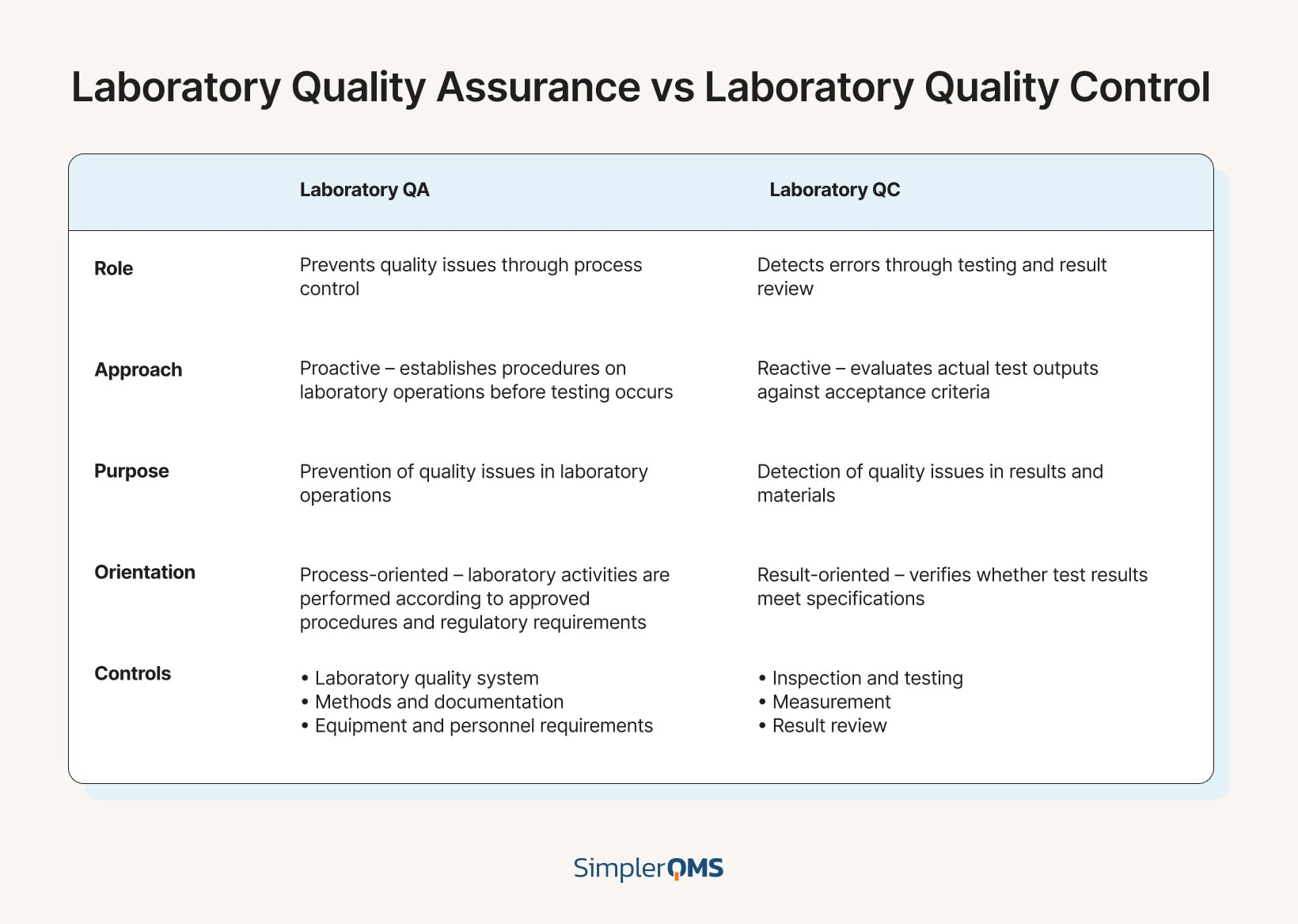
The main difference between Quality Control (QC) and Quality Assurance (QA) in a laboratory is their role in quality management. Laboratory QA prevents errors through process control. Laboratory QC detects errors through testing and result review.
The 3 main differences between QA and QC in a laboratory are given below.
- Proactive vs Reactive: Laboratory QA is proactive because it establishes procedures to prevent defects during laboratory operations before testing occurs. Laboratory QC is primarily reactive because it produces and evaluates actual test outputs against acceptance criteria.
- Prevention vs Detection: Laboratory QA prevents quality issues by controlling the laboratory quality system, methods, documentation, equipment, and personnel requirements. Laboratory QC detects quality issues through inspections, testing, measurement, and result review.
- Result-Oriented vs Process-Oriented: Laboratory QC is result-oriented because it verifies whether test results meet specifications. Laboratory QA is process-oriented because it ensures laboratory activities are performed according to approved procedures and regulatory requirements.
The key differences between Laboratory Quality Assurance (QA) and Quality Control (QC), including their roles, approaches, purposes, orientations, and controls, are shown in the image below.
What Are the Types of Laboratory Quality Control?
Laboratory QC types are grouped by tested material, test method, and performance evaluation approach. The 8 main types of laboratory quality control are described below.
- Physicochemical QC: Physicochemical QC verifies chemical identity, purity, composition, and physical properties. Physicochemical QC determines properties such as concentration, purity, pH, conductivity, osmolality, appearance, viscosity, and moisture.
- Biological QC: Biological QC evaluates biological products and materials, including living systems, cells, tissues, or biological components. Biological QC tests properties such as activity, potency, toxicity, cell viability, and bioassay response.
- Microbiological QC: Microbiological QC is a subcategory of biological QC focused on microorganisms, microbial contamination, and microbial control. Microbiological QC evaluates attributes such as sterility, bioburden, yeast and mold presence, and antimicrobial effectiveness.
- Quantitative QC (Analytical QC): Quantitative QC or Analytical QC uses instruments for the separation, identification, and quantification of chemical components. Common instruments used for analytical QC include high-performance liquid chromatography (HPLC) systems, gas chromatography (GC) systems, ultraviolet-visible (UV-Vis) spectrophotometers, and mass spectrometers.
- Semi-Quantitative QC (Limit Testing QC): Semi-Quantitative QC or Limit testing QC uses semi-quantitative pass/fail tests to verify that an impurity, contaminant, or residue stays below a defined threshold, without generating a precise numeric value.
- Qualitative QC: Qualitative QC confirms the presence or absence, or identity of a substance, without determining its quantity.
- Internal QC: Internal QC includes routine monitoring by laboratory staff to confirm test reliability, such as running control materials with known values, including positive and negative controls, alongside patient samples, study samples, or product samples.
- External QC: External QC compares laboratory performance with peer laboratories, typically using proficiency testing programs or external quality assessment.
What Are the Main Stages of Laboratory Quality Control?
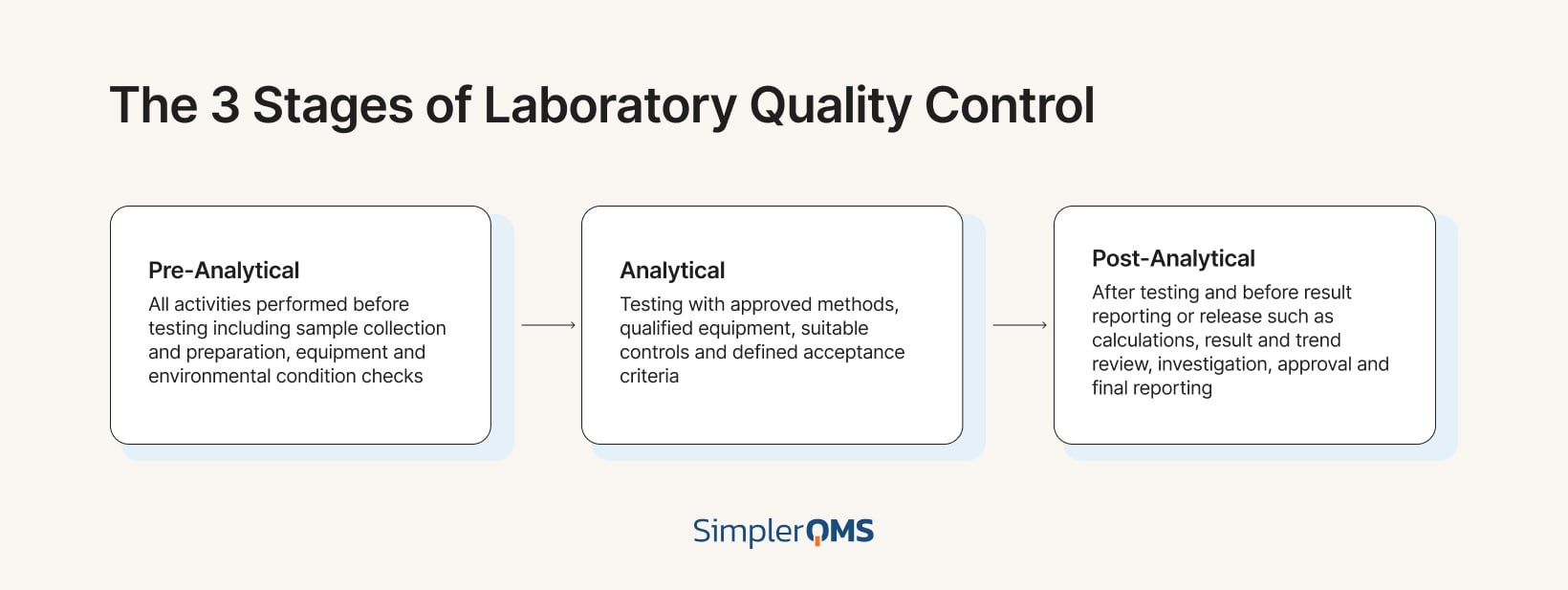
Laboratory QC involves the 3 main stages listed below.
- Pre-Analytical Stage: The pre-analytical, or pre-examination, stage includes all activities performed before testing. These activities include sample collection, incoming material verification, sample preparation, reagent preparation, equipment calibration status checks, and environmental condition checks. The pre-analytical stage requires robust process control because sample collection, handling, storage, preparation, and equipment setup directly affect result validity.
- Analytical Stage: The analytical, or examination, stage is the testing phase where laboratory staff analyze the sample using the approved method, qualified equipment, suitable reagents, and defined acceptance criteria. System suitability testing confirms the analytical system is performing as expected before the samples are analyzed. Laboratory QC during this stage monitors method performance, instrument function, control results, and test execution.
- Post-Analytical Stage: The post-analytical, or post-examination, stage occurs after testing and before result reporting or release. The post-analytical stage includes calculations, result review, trend review, nonconformance reporting, quality investigation, approval, and final reporting.
The three main stages of laboratory quality are shown in the image below.
What Are the Steps in the Laboratory Quality Control Process?
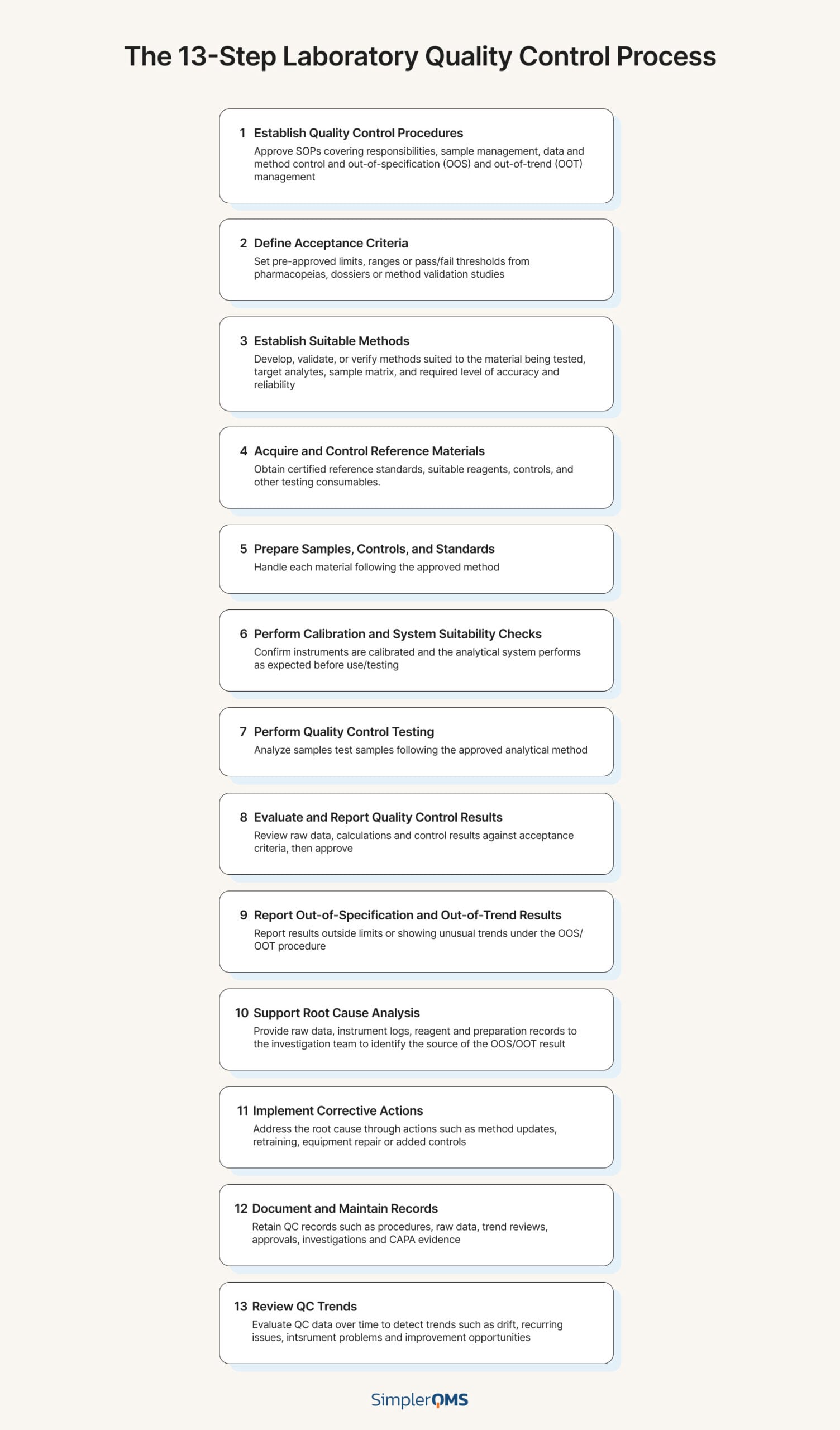
The 13 key steps in laboratory QC are the following.
- Establish Quality Control Procedures: Define how the core QC activities are performed. QC SOPs commonly cover responsibilities, , sample management, test method control, data review, and out-of-specification (OOS) and out-of-trend (OOT) management. The exact SOP scope can vary by laboratory function and compliance requirements.
- Define Acceptance Criteria: Set acceptance criteria, which are the pre-approved numerical limits, ranges, or pass/fail thresholds for control materials and sample results. Acceptance criteria usually come from pharmacopeias, product dossier specifications, or method validation studies. Acceptance criteria can also come from justified internal specifications when no compendial or dossier limit applies.
- Develop Appropriate Methods: Develop and validate appropriate test methods to confirm fitness for the sample matrix, target analytes, and intended use. Method development runs in parallel with acceptance criteria definition because methods and limits are interlinked.
- Acquire and Control Reference Materials: Acquire certified reference standards, suitable reagents, controls, and other testing consumables. Reference materials require proper receipt verification, storage, tracking, labeling, and use within expiry dates.
- Prepare Samples, Controls, and Standards: Prepare QC samples, controls, and standards following the approved method. Correct handling, dilution, labeling, storage, and preparation reduce the risk of laboratory errors.
- Perform Equipment Calibration and System Suitability Checks: Confirm that instruments are calibrated, qualified, and fit for use before testing starts. Verify through system suitability that the analytical system performs as expected for the method.
- Run Quality Control Samples: Analyze test samples following the approved analytical method. Standard sample results show whether the testing run remains in control.
- Evaluate and Report Quality Control Results: Evaluate raw data, control results, calculations, and acceptance criteria. Approve QC results to support final sample result calculation and formal reporting.
- Report Out-of-Specification and Out-of-Trend Results: Report any sample result outside predefined limits or any result that shows an unusual trend. Affected batches, samples, and studies are handled according to the approved OOS/OOT procedure.
- Support Root Cause Analysis: Support root cause analysis by providing preliminary laboratory investigation findings. Provide raw data, instrument logs, reagent records, preparation records, and witness statements to the investigation team to identify the source of the OOS/OOT result.
- Implement Corrective Actions: Implement corrective actions to address the root cause of the incident. Actions may include method updates, retraining, equipment repair, reagent replacement, procedure revision, or added controls.
- Document and Maintain Records: Document and maintain QC records, including procedures, raw data, calculations, approvals, non-conformance reporting, laboratory investigations, corrective action evidence, and trend reviews. QC records typically require controlled retention and archiving under the document management procedure. Retention requirements can vary by record type, regulatory requirement, and internal record retention procedure.
- Review QC Trends: Evaluate QC data over time to detect any trends such as drift, recurring issues, instrument problems, and improvement opportunities. Trend review improves laboratory performance and supports reliable test results.
The 13 key steps of the laboratory quality control process, from establishing QC procedures to reviewing QC trends, are shown in the image below.
1. Establish Quality Control Procedures
Establishing quality control procedures is the first step in the laboratory QC process. Establishing quality control SOPs defines the controlled instructions that describe how laboratory QC activities are performed, reviewed, documented, and improved.
Laboratory QC procedures reduce variation, assign accountability, support validated methods, control OOS/OOT handling, and protect result reliability.
The 6 main activities included in establishing laboratory QC procedures are listed below.
- SOP Creation and Control: QC teams create, approve, and control SOPs for activities such as sampling, equipment calibration, instrument operation, labeling, data review, result reporting, and laboratory investigations.
- Role and Responsibility Assignment: Laboratory QC SOPs define the roles and responsibilities of QC personnel, including analysts, reviewers, supervisors, and laboratory management.
- Test Method Control: Laboratory procedures define the requirements for the use, transfer, validation, verification, and ongoing control of test methods to ensure they remain suitable for their intended purpose.
- OOS and OOT Management: Laboratory SOPs for OOS and OOT management describe how out-of-specification and out-of-trend results are reported, assessed, investigated, approved, and closed.
- Documentation Requirements: Laboratory QC procedures include documentation requirements such as which records must be created, reviewed, approved, retained, and archived for each QC activity.
- Training Requirements: Laboratory QC SOPs define the training requirements that laboratory staff must complete before performing QC tasks.
The outcome of establishing quality control procedures is an approved set of laboratory QC SOPs that reflect operational workflows.
2. Define Acceptance Criteria
Defining acceptance criteria is the second step in the laboratory QC process. Acceptance criteria are the pre-approved limits, ranges, or pass/fail thresholds used to determine whether a specific product or material meets its specifications.
Laboratory QC acceptance criteria support the objective evaluation of the produced results. This step links the product or material specification to the approved test method because a result is valid only when it is produced by an appropriate method.
The 6 key activities for defining acceptance criteria are given below.
- Limit Definition: Limit definition involves the description of numerical ranges, maximum limits, minimum limits, or pass/fail thresholds for sample results and control materials.
- Source Verification: QC teams develop acceptance criteria based on verified sources such as pharmacopoeias, product dossiers, method validation studies, stability data, or approved internal specifications.
- Method Alignment: QC teams confirm that each acceptance criterion matches the approved or validated method used to generate the result.
- Control Material Criteria: Laboratory QC teams define expected values and acceptable ranges for reference standards, control samples, blanks, and system suitability parameters.
- Review and Approval: QC, QA, and regulatory teams review and approve the acceptance criteria before finalizing them.
- Change Control: QC teams update acceptance criteria through controlled change management when methods, specifications, requirements, or product knowledge change.
The output of defining acceptance criteria is an approved set of measurable limits for a specific product, material, and test. Laboratory QC teams use these criteria to decide whether results pass or require OOS/OOT reporting.
3. Establish Suitable Methods
Establishing suitable methods is the third step in the laboratory QC process. Laboratory QC method development, method validation or verification, and method transfer define how a specific product or material is tested against approved acceptance criteria.
Establishing suitable methods enables the detection or quantification of a specific analyte in a specific sample matrix.
There are 9 key activities involved in establishing appropriate laboratory QC methods, and they are listed below.
- Method Selection: Laboratory QC teams select a suitable compendial or internally developed method for the target analyte.
- Method Development: Laboratory QC teams work with test method development teams to define test conditions, reagents, instruments, sample preparation steps, reference materials, and system suitability requirements when a new method is needed.
- Dossier/Pharmacopeia Alignment: Laboratory QC teams ensure that selected or developed methods align with the approved product dossier, regulatory requirements, or applicable pharmacopeia requirements.
- Method Validation: Laboratory QC teams participate in or lead validation of non-compendial or modified methods to confirm accuracy, precision, specificity, robustness, and range, including detection limit and quantitation limit.
- Method Transfer: Laboratory QC teams transfer approved methods between laboratories, sites, or external partners using defined transfer protocols and acceptance criteria.
- Method Verification: Laboratory QC teams verify compendial methods or externally validated methods to confirm that the laboratory can perform the method correctly for the intended sample and testing conditions.
- Acceptance Criteria Alignment: Laboratory QC teams confirm that each method supports the product or material specification and produces results that match the approved acceptance criteria.
- Method Approval: Laboratory QC teams document the method, review the supporting data, approve the procedure, and train analysts before routine use.
- Method Changes and Improvements: Laboratory QC teams manage changes or improvements to existing methods, assess their impact, and, when required, perform partial or full revalidation to confirm continued suitability for use.
The outcome of establishing suitable methods is an approved, validated laboratory QC method. Laboratory QC teams use this method to generate reliable results for a specific product or material.
4. Acquire and Control Reference Materials
Acquiring and controlling reference materials is the fourth step in the laboratory QC process. Laboratory QC reference material acquisition secures the appropriate reference standards, controls, reagents, and consumables required by the test method before testing starts.
Obtaining appropriate reference materials is critical for reliable and accurate results. The approved method must specify the reference materials required for testing.
The 8 main activities involved in acquiring laboratory QC reference materials are listed below.
- Method Requirement Review: Laboratory QC teams review the approved method to identify all required standards, reagents, controls, solvents, media, columns, kits, and other consumables.
- Supplier Qualification: Laboratory QC teams participate in the supplier’s qualification process for critical reference standards, reagents, and consumables before purchasing.
- Reference Material Procurement: Laboratory QC teams acquire required reference material. Where applicable, working standards required for the test are prepared from primary reference standards.
- Certificate Review: Laboratory QC teams review certificates of analysis, traceability records, expiry dates, and storage requirements before use.
- Material Receipt and Identification: Laboratory QC teams verify received materials against purchase requirements, labels, lot numbers, certificates, the approved supplier list, and approved method requirements.
- Storage Control: Laboratory QC teams store reference materials, reagents, and consumables under defined temperature, humidity, light, and contamination controls.
- Inventory Tracking: Laboratory QC teams maintain inventory records, including lot numbers, expiry dates, opening dates, preparation dates, use history, and remaining quantities.
- Use Control: Laboratory QC teams use reference materials, reagents, and consumables within approved expiry dates and according to the approved method.
Acquiring appropriate reference materials yields a controlled set of qualified, traceable, and suitable materials for laboratory testing.
5. Prepare Samples, Controls, and Standards
Preparing samples, controls, and standards is the fifth step in the laboratory QC process. Sample, control, and standard preparation forms part of the pre-analytical stage and marks the beginning of the technical laboratory work for a specific test.
Preparing samples, controls, and standards involves accurately weighing, diluting, or otherwise processing each material to the specifications defined in the approved analytical method. Appropriate sample, control, and standard preparation is essential for ensuring the identity, concentration, purity, and traceability of test material prior to testing.
The 8 main activities for preparing laboratory QC samples and standards are presented below.
- Sample Receipt and Verification: Laboratory QC teams confirm sample identity, label details, batch number, storage condition, container integrity, and required documentation before preparation.
- Sample Handling: Laboratory QC teams handle samples according to the approved method.
- Sample Preparation: Laboratory QC teams perform required steps such as weighing, dilution, extraction, filtration, homogenization, centrifugation, pH adjustment, or incubation.
- Preparation of Standards and Controls: Laboratory QC teams prepare reference standard solutions, working standards, calibration standards, blanks, and control samples under the approved method.
- Labeling and Traceability: Laboratory QC teams label each prepared sample, standard, control, and solution with identity, concentration, preparation date, preparer, lot number, and expiry or use-by time.
- Environmental Control: Laboratory QC teams prepare samples and standards under environmental conditions specified by the method, including temperature, humidity, light, and contamination controls.
- Calculation Check: A second independent laboratory QC team member verifies weights, volumes, concentrations, and calculations before testing.
- Preparation Record Completion: Laboratory QC teams document preparation steps, materials, equipment, observations, nonconformances, and reviewer checks in controlled laboratory records.
The outcome of this step is a set of prepared samples, standards, blanks, and controls that meet approved method requirements. Laboratory QC teams use these materials for system suitability checks and valid result generation.
6. Perform Equipment Calibration and System Suitability Checks
Performing equipment calibration and system suitability checks is the sixth step in the laboratory quality control process. Equipment calibration and system suitability checks confirm that the equipment, instrument, or system selected for testing is qualified, calibrated, and appropriate for the approved method.
Equipment calibration and system suitability checks prevent invalid results caused by equipment drift, instrument malfunction, or unsuitable testing conditions.
Equipment calibration follows predefined schedules and equipment is only acceptable for testing while within its valid calibration period. The QC analyst must confirm that the equipment or instrument is within its calibration period before use.
System suitability is not required for all testing methods. System suitability is common in regulated environments, such as pharmaceutical and clinical laboratories, when small changes in equipment, reagents, or test conditions affect the result. System suitability is common in chromatographic methods, such as HPLC and GC.
The 5 main activities included in equipment calibration and system suitability checks are listed below.
- Calibration Status Review: Laboratory QC teams confirm that the equipment or instrument is calibrated before testing starts.
- Calibration Labeling: Equipment should bear a calibration label to display the calibration status, calibration date, next due date, and equipment identification number.
- Instrument Setup: QC analyst prepares the instrument according to the approved method, including required settings, columns, detectors, and test conditions.
- System Suitability Check: The laboratory QC analyst runs system suitability tests when the approved method requires them. QC analysts verify suitability results against approved limits, such as precision, resolution, retention time, tailing factor, and theoretical plates.
- Nonconformance Reporting: Analysts report uncalibrated equipment, failed system suitability, or any equipment malfunction according to the approved procedure.
The outcome of equipment calibration and system suitability checks is confirmed equipment readiness and confirmed system suitability before sample analysis when required.
7. Run Quality Control Samples
Performing QC testing is the seventh step in the laboratory QC process. Performing QC testing occurs during the analytical stage of the laboratory QC process. Laboratory QC teams test prepared samples, standards, blanks, and controls under the approved method.
QC sample testing confirms that the product or material complies with its established specifications.
The 6 key activities involved in running quality control samples are listed below.
- Sample Analysis: Laboratory QC analysts test prepared product samples, material samples, study samples, or patient samples according to the approved method.
- Control Sample Analysis: Laboratory QC teams analyze control samples, blanks, calibration standards, or reference standards to confirm method performance and test validity during the run.
- Instrument Monitoring: QC analysts monitor instrument response, baseline behavior, signal quality, alarms, and any interruptions during analysis.
- Result Capture: Laboratory QC teams record raw data, instrument outputs, observations, chromatograms, spectra, readings, images, or manual test results.
- Run Validity Check: Laboratory QC teams confirm that control results, blank results, and method-specific requirements meet approved limits before sample results are accepted.
- Nonconformance Reporting: Laboratory QC analysts report failed controls, abnormal signals, sample mix-ups, instrument issues, or invalid runs according to the approved procedure.
The outcome of QC testing is a controlled set of raw test data and QC results. Laboratory QC teams evaluate these results to determine whether the tested product or material meets its approved specifications.
8. Evaluate and Report Quality Control Results
The evaluation and reporting of quality control results is the eighth step in the laboratory QC process. The QC team reviews raw data, control results, calculations, and acceptance criteria during the evaluation and reporting step before approving or reporting final results.
Evaluation and reporting of QC results confirms that the test run is valid and that the reported result reflects the approved method, sample data, and specification. Laboratory QC result evaluation prevents incorrect, incomplete, or unsupported results from being used for release decisions, study reports, or clinical reports.
The 8 main activities included in evaluating and reporting laboratory QC results are listed below.
- Raw Data Review: Laboratory QC analysts review raw data such as instrument outputs, worksheets, chromatograms, spectra, images, readings, observations, and manual entries for completeness and accuracy.
- Control Result Review: Laboratory QC teams confirm control results by verifying that blanks, standards, and control samples meet approved limits.
- Calculation Verification: Laboratory QC teams perform calculation verification by checking formulas, dilution factors, weights, volumes, unit conversions, and final result calculations.
- Acceptance Criteria Comparison: Laboratory QC teams compare sample results against approved product or material specifications.
- Data Integrity Check: Laboratory QC reviewers check that records are attributable, legible, contemporaneous, original, accurate, complete, consistent, enduring, and available (ALCOA+ principles).
- Result Approval: Laboratory QC reviewers approve valid results after confirming that the method, controls, calculations, and records meet requirements.
- Result Reporting: Laboratory QC teams report approved results in the required format, such as a certificate of analysis, laboratory report, study report, or clinical report.
- Failure Escalation: Laboratory QC teams flag any failed, invalid, questionable, or unusual results for OOS/OOT handling under the approved procedure.
The QC result evaluation and reporting step produces an approved QC report or an OOS or OOT report for further investigation. Laboratory QC teams use the approved QC report to support batch disposition, material release, study completion, diagnosis, or regulatory reporting.
9. Report Out-Of-Specification and Out-Of-Trend Results
Reporting OOS and OOT results is the ninth step in the laboratory QC process. An out-of-specification (OOS) result is a test result that falls outside predefined acceptance limits. An out-of-trend (OOT) result is a test result that remains within specification but shows an unusual pattern compared with expected results.
Reporting OOS and OOT results prevents unsupported release, study documentation, or use of noncompliant products. Laboratory QC teams report OOS and OOT results to trigger investigation, segregate affected batches or samples, and maintain data integrity.
The 7 main activities involved in reporting OOS and OOT results are listed below.
- Result Identification: Laboratory QC teams identify results that fall outside approved specifications or show unusual trends against historical data or expected performance.
- OOS/OOT Record Creation: Laboratory QC teams document the result, method, acceptance criteria, analyst, instrument, materials, batch or sample details, and initial observations.
- Immediate Escalation: The laboratory QC analyst escalates the issue to the supervisor, quality assurance, or the responsible reviewer according to the approved OOS/OOT procedure.
- Data Preservation: Laboratory QC teams preserve raw data, worksheets, chromatograms, and preparation records.
- Affected Material Control: Laboratory QC teams place affected batches, materials, standards, reagents, and samples on hold when required by the approved procedure.
- Preliminary Check: A preliminary check identifies obvious errors, such as calculation mistakes, transcription errors, instrument alarms, erroneous sample preparation, or invalid control results. Preliminary check activities performed as part of the laboratory investigation are documented.
- Investigation Handoff: If the preliminary check does not identify an assignable laboratory error, the QC teams provide the OOS/OOT record and supporting evidence to the investigation team for root cause analysis.
The OOS/OOT reporting step produces a documented OOS or OOT result, controlled evidence for the affected product or material, and a preliminary laboratory investigation record. Laboratory QC teams use these outputs to support further investigation, evaluation of result validity, assessment of product impact, batch disposition decisions, and corrective action planning.
10. Support Root Cause Analysis
Root cause analysis support is the tenth step in the laboratory QC process. Root cause analysis uses preliminary laboratory investigation results, raw data, and supporting records to identify the source of a failed or unusual result.
The purpose of root cause analysis support is to determine why the OOS/OOT result occurred and to identify the product, material, method, equipment, or process-related causes. Laboratory QC teams provide technical evidence so the investigation team can make a justified decision on result validity, batch disposition, and further action.
The 3 main ways that QC teams support root cause analysis are given below.
- Evidence Handoff: Laboratory QC teams provide complete records and technical observations to the investigation owner or investigation team. The main record is the preliminary investigation report. The preliminary investigation report includes the QC analyst interview, examination of raw data, verification of calculations, instrument performance check, confirmation that appropriate standards, solvents, and reagents were used, and evaluation of method performance.
- Additional Laboratory Testing: Additional laboratory testing includes retesting and resampling when the preliminary investigation does not identify a laboratory error as the root cause. Additional laboratory testing follows approved procedures and generates further evidence to support the investigation.
- Root Cause Documentation: Investigation teams document confirmed laboratory errors, suspected causes, excluded causes, and unresolved findings under the approved investigation procedure.
The outcome of the root cause analysis step is a documented investigation package with technical evidence, evaluation of potential causes, and the investigation’s conclusion, including the identified root cause.
11. Implement Corrective Actions
Implementing corrective actions is the eleventh step in the laboratory QC process. This step puts approved actions into practice after root cause analysis confirms the source of an OOS, OOT, or other nonconformance related to QC.
The purpose of implementing corrective actions is to address the confirmed cause of the laboratory issue and prevent recurrence. Corrective and preventive actions oversight is typically a QA responsibility, while laboratory QC teams support implementation when the action affects methods, equipment, materials, training, samples, or laboratory records.
The 7 main activities included in implementing corrective actions are listed below.
- Action Plan Execution: Laboratory QC teams complete assigned corrective actions according to the approved investigation or CAPA plan.
- Procedure Update: Laboratory QC teams revise SOPs, test methods, worksheets, forms, or instructions when the root cause relates to unclear or incomplete procedures.
- Method or Test Control Update: Laboratory QC teams update method controls, sample preparation steps, system suitability requirements, or acceptance checks when improvements are required.
- Equipment Action Completion: Laboratory QC teams arrange equipment repair, maintenance, calibration, qualification, or replacement when the root cause relates to equipment performance.
- Material Control Action: Laboratory QC teams replace, quarantine, relabel, or improve controls for reagents, standards, solvents, consumables, or samples when materials caused or contributed to the issue.
- Training Completion: Laboratory QC teams complete and document training when the corrective action requires analyst retraining or reviewer retraining.
- Effectiveness Check: Laboratory QC teams provide follow-up data, trend data, or other evidence in order for QA or the CAPA owner to evaluate CAPA effectiveness.
This step results in completed corrective actions with documented implementation evidence and data to evaluate CAPA effectiveness.
12. Document and Maintain Records
Proper documentation and maintenance of records is the twelfth step in the laboratory QC process. Record documentation and maintenance include record creation, review, approval, retention, and archiving. These records prove that quality control activities followed approved procedures, study protocols, and regulatory requirements.
Proper documentation preserves evidence of laboratory testing, result review, investigations, corrective actions, and quality decisions, including worksheets, instrument outputs, chromatograms, investigation reports, and approval records. Laboratory QC records support traceability, data integrity, audit readiness, batch disposition, study completion, clinical reporting, and regulatory compliance.
The 7 key activities included in the documentation and maintenance of laboratory QC records are the following.
- Raw Data Recording: Laboratory QC teams record and keep instrument outputs, worksheets, chromatograms, spectra, images, readings, observations, and manual entries.
- Test Record Completion: Laboratory QC teams complete test records following data integrity principles.
- Review and Approval Documentation: Laboratory QC reviewers document checks, comments, corrections, approvals, and result decisions.
- Document Control: Laboratory QC teams use documents and records that are issued and controlled under the document control system.
- Equipment and Material Record Linking: Laboratory QC teams link test records to equipment calibration records, maintenance records, reagent lots, standard lots, and sample preparation records.
- Record Retention and Archiving: Laboratory QC teams retain and archive records according to the approved document management procedure and regulatory requirements.
- Retrieval and Audit Preparation: Laboratory QC teams keep records organized and retrievable for internal review, investigations, audits, inspections, and regulatory requests.
Good documentation practices in laboratory QC result in complete, traceable, accurate, and reliable records that support product or material quality decisions.
13. Review QC Trends
QC trend review is the thirteenth step in the laboratory QC process. QC trend review refers to the evaluation of QC data over time to detect patterns, shifts, drift, recurring failures, and changes in laboratory performance.
Laboratory QC trend review supports stable methods, reliable equipment, controlled materials, and continual improvement.
The 6 main activities included in the QC trend review are listed below.
- QC Data Collection: Laboratory QC teams collect data from approved sources such as QC records and certificates, OOS/OOT records, invalid run records, noncompliance records, and corrective action data.
- Trend Analysis: Laboratory QC teams compare results over time to detect drift, shifts, repeated variation, recurring failures, and abnormal patterns.
- Method Performance Review: Laboratory QC teams evaluate method performance using obtained results and process performance data.
- Equipment Performance Review: Laboratory QC teams review calibration results, maintenance history, system suitability failures, instrument errors, and repeated equipment-related nonconformances.
- Material and Reagent Review: Laboratory QC teams assess trends linked to reagent lots, reference standards, consumables, media, solvents, and sample preparation materials.
- Trend Report Preparation: Laboratory QC teams document trend findings, data sources, reviewed periods, conclusions, actions, and approvals.
The outcome of this step is a documented QC trend review that identifies emerging risks, recurring issues, and improvement actions.
What Equipment Is Used for Laboratory Quality Control?
Laboratory QC equipment includes instruments, tools, and systems used to prepare samples, perform tests, control test conditions, and record results. The product or material, approved method, sample matrix, analyte, and acceptance criteria define which equipment is suitable. Equipment requirements are specified in the approved analytical method.
The key equipment types used in laboratory QC operations are the following.
- Analytical Instruments: Analytical instruments identify, separate, and quantify chemical or biological components. Common examples include HPLC, GC, UV-Vis spectrophotometers, Fourier transform infrared spectroscopy (FTIR), mass spectrometers, dissolution testers, and particle size analyzers.
- Balances: Balances measure samples, standards, reagents, and materials before preparation or testing. Laboratory QC teams use analytical balances for weighing activities.
- Calibration and Reference Tools: Calibration and reference tools confirm measurement accuracy and equipment performance. Common examples include certified weights, reference thermometers, and reference standards.
- Physical Testing Instruments: Physical testing instruments measure physical properties of products and materials. Common examples include hardness testers, friability testers, viscometers, density meters, and moisture analyzers.
- Electrochemical Instruments: Electrochemical instruments measure chemical properties through electrical response. Common examples include pH meters and conductivity meters.
- Microbiology Equipment: Microbiology equipment supports microbial testing, contamination control, and sterility checks. Common examples include incubators, microscopes, and microbial air samplers.
- Sample Preparation Equipment: Sample preparation equipment prepares samples and standards before analysis. Common examples include centrifuges, vortex mixers, homogenizers, sonicators, hot plates, and water baths.
- Environmental Control Equipment: Environmental control equipment monitors or controls laboratory conditions that affect testing. Common examples include temperature monitors, humidity monitors, refrigerators, freezers, and stability chambers.
- General Support Equipment: General support equipment supports routine laboratory operations and safe testing. Common examples include pipettes, glassware, fume hoods, drying ovens, desiccators, timers, laboratory washers, and safety cabinets.
- Computerized Systems: Computerized systems capture, process, store, and control laboratory data. Common examples include Laboratory Information Management System (LIMS), Electronic Laboratory Notebook (ELN), Chromatography Data System (CDS), environmental monitoring systems, and electronic QMS software.
What Are the Best Practices for Effective Laboratory Quality Control?
The best practices for effective laboratory QC include clearly defined requirements, controlled procedures, trained personnel, qualified equipment, suitable materials, complete records, and continuous improvement actions. Effective laboratory QC produces accurate results, detects quality issues, supports compliance, and maintains confidence in product, material, study, or diagnostic decisions.
The 11 best practices for effective laboratory quality control are listed below.
- Define Applicable Requirements: Identify the regulatory requirements, standards, pharmacopoeia requirements, product specifications, method requirements, and acceptance criteria that apply to each product, material, or test.
- Establish a Robust Quality Management System (QMS): Define the procedures, responsibilities, controls, documentation, and review activities that govern laboratory QC operations.
- Develop Comprehensive Standard Operating Procedures (SOPs): Establish SOPs that define how laboratory personnel collect samples, handle standards, perform tests, review results, manage nonconformances, maintain records, and handle OOS/OOT results.
- Define Key Performance Indicators (KPIs): Track key performance areas using KPIs such as OOS rates, invalid run rates, repeat testing rates, cycle time, equipment downtime, number of significant audit findings, and CAPA completion status.
- Train QC Personnel: Train laboratory QC personnel on test methods, equipment use, data integrity, occupational safety, SOPs, and applicable regulatory requirements before performing assigned tasks.
- Qualify, Calibrate, and Maintain QC Equipment: Ensure euquipment is qualified, calibrated, and maintained at defined intervals to support accurate measurements and valid test results.
- Use Qualified Materials and Suppliers: Use qualified suppliers, approved reference standards, controlled reagents, and suitable consumables according to the approved method.
- Report and Investigate Failures: Report and investigate failed controls, invalid runs, OOS results, OOT results, deviations, and other nonconformances under approved procedures.
- Keep Complete Records: Maintain complete and accurate laboratory QC records including raw data, calculations, approvals, equipment records, reagent records, laboratory investigations, and result reports.
- Conduct Internal Audits: Verify through internal audits whether QC activities follow approved procedures, regulatory requirements, data integrity principles, and QMS controls.
- Apply Improvement Actions: Apply corrective actions and preventive actions, such as method updates, training requirement updates, and process changes based on investigations, audits, and trend reviews.
What Are the Risks of Poor Laboratory Quality Control?
Poor laboratory quality control increases the risk of inaccurate laboratory results, flawed clinical decisions, compromised product quality, noncompliance, higher operating costs, and damaged organizational credibility. Poor laboratory QC risks increase when testing controls, equipment controls, material controls, and investigation procedures are weak.
The 7 key risks of poor laboratory QC are listed below.
- Inaccurate Results: Poor laboratory QC increases the risk of incorrect, incomplete, or invalid test results caused by method errors, instrument issues, unsuitable reagents or standards, or uncontrolled sample handling.
- Patient Harm and Misdiagnosis: Poor laboratory QC in clinical laboratories contributes to incorrect diagnoses, delayed treatment, wrong treatment, and unsafe clinical decisions.
- Release of Defective Materials: Poor laboratory QC increases the risk that nonconforming raw materials, intermediates, or finished products are incorrectly accepted, released, or used in further processing.
- Regulatory Noncompliance: Poor laboratory QC can result in deficiencies related to procedures, records, data integrity, equipment management, investigation handling, and traceability required by applicable regulations and standards.
- Product Quality Issues and Recalls: Poor laboratory QC increases the risk of product quality issues or recalls when defective, contaminated, or incorrectly tested products reach the market.
- Wasted Resources and Operational Inefficiency: Poor laboratory QC causes repeat testing, invalid runs, investigation backlogs, delayed releases, rejected batches, and increased laboratory workload.
- Loss of Trust and Reputation: Poor laboratory QC weakens confidence among regulators, customers, sponsors, clinicians, or patients.
Which Regulations, Standards, and Guidelines Apply to Laboratory Quality Control?
Laboratory quality control requirements come from regulations, standards, and guidelines that define how laboratories control methods, equipment, samples, records, and data. QC compliance requirements depend on the laboratory type, product type, testing purpose, and applicable regulatory requirements.
The key regulations, standards, and guidelines that apply to laboratory QC are given below.
- FDA 21 CFR Part 211: FDA 21 CFR Part 211 applies to pharmaceutical QC laboratories that test components, in-process materials, and finished drug products for drugs marketed in the United States. Subpart I defines laboratory controls, including written specifications, sampling plans, test procedures, calibration, and records. Part 211 requires the quality control unit to review and approve proposed laboratory control mechanisms.
- EudraLex Volume 4, Chapter 6: EudraLex Volume 4, Chapter 6 defines EU GMP expectations for quality control in medicinal product manufacturing in the European Union (EU). Chapter 6 covers laboratory operations such as sampling, testing, and documentation requirements. According to Chapter 6, QC must be involved in all decisions that concern product quality. QC independence from production is fundamental to satisfactory QC operation.
- WHO Good Practices for Pharmaceutical Quality Control Laboratories: WHO good practices provide guidance for pharmaceutical QC laboratories that test active ingredients, excipients, and finished products. The guideline aligns with WHO GMP principles and ISO/IEC 17025 and is divided into 3 parts. Part 1 covers management and infrastructure. Part 2 covers materials, equipment, instruments, and other devices. Part 3 covers working procedures.
- ICH Q2: ICH Q2 applies to the validation of analytical procedures used for the release and stability testing of commercial drug substances and products. The guideline supports validation of analytical methods and describes the main performance characteristics, including specificity, range, accuracy, precision, and robustness.
- GLP (OECD Principles of GLP): OECD Principles of Good Laboratory Practice apply to nonclinical safety studies in the EU. GLP requirements cover test facility organization and personnel, quality assurance, facilities, apparatus, material, reagents, test systems, reference items, SOPs, performance of the study, reporting of study results, and storage and retention of records and materials.
- FDA 21 CFR Part 58: FDA 21 CFR Part 58 applies to nonclinical laboratory studies that support applications for research or marketing permits for FDA-regulated products. The regulation defines Good Laboratory Practice requirements for personnel, facilities, equipment, testing facilities operations, test and control, protocol for and conduct of a nonclinical laboratory study, records and reports, and disqualification of testing activities.
- ISO/IEC 17025: ISO/IEC 17025 is an international standard that defines general requirements for the competence of testing and calibration laboratories. ISO/IEC 17025 outlines general, structural, resource, process, and management system requirements.
- FDA 42 CFR Part 493 (CLIA): FDA 42 CFR Part 493 sets forth the conditions that all laboratories must meet to be certified to perform testing on human specimens under the Clinical Laboratory Improvement Amendments of 1988 (CLIA). FDA 42 CFR Part 493 subparts cover general provisions, certificate of waiver, registration certificate, certificate of accreditation, accreditation by private organization, general administration, participation in proficiency testing, proficiency testing programs, facility administration, quality system, personnel, inspection, enforcement procedures, and consultations.
- ISO 15189: ISO 15189 applies to medical laboratories and specifies requirements for quality and competence. ISO 15189 aims to support the effectiveness of the medical laboratory management system, decrease the risk of invalid results, and reduce potential harm to patients, laboratory personnel, the public, and the environment.
- Clinical and Laboratory Standards Institute (CLSI): CLSI publishes consensus standards and guidelines for clinical and medical laboratories. CLSI standards support laboratory quality control in areas such as method evaluation, microbiology, pre-examination processes, quality management systems, and other clinical testing practices.
- WHO Good Clinical Laboratory Practice (GCLP) Guidance: WHO Good Clinical Laboratory Practice guidance applies to laboratories that generate clinical trial data. GCLP combines GLP and Good Clinical Practice (GCP) principles to provide a unified framework for sample analysis, support data credibility, and facilitate the acceptance of clinical data by global regulatory authorities.
- WHO Laboratory Quality Management System (LQMS) Handbook: The WHO LQMS Handbook supports health laboratories, including clinical laboratories, diagnostic laboratories, medical laboratories, public health laboratories, animal and environmental health laboratories, in building laboratory quality management systems. The handbook is based on ISO 15189 and CLSI quality system essentials. The chapters follow the framework developed by CLSI and are organized as the “12 Quality System Essentials”.
What Challenges Do Laboratories Face When Managing Quality Control?
Laboratory QC management challenges include resource limitations, staffing constraints, workload pressure, equipment and method issues, data integrity issues, compliance complexity, and limited validation time. The 7 key challenges that laboratories face when managing QC are described below.
- Resource Constraints: Laboratory QC requires qualified equipment, reference standards, reagents, consumables, calibration, maintenance, and computerized systems. Budget constraints limit the laboratory’s ability to maintain equipment, replace materials, leverage technology, and expand testing capacity.
- Staffing Shortage: Laboratory QC needs trained analysts, reviewers, and supervisors with technical, quality, and regulatory knowledge. Personnel shortages increase the risk of testing delays, review bottlenecks, and investigation gaps.
- Workload Pressure: QC teams handle routine testing, laboratory investigations, laboratory document management, and audit support. High workload pressure increases the risk of errors, delayed approvals, and incomplete records.
- Equipment and Method Issues: Laboratory QC depends on calibrated and qualified equipment, suitable methods, and stable testing conditions. Equipment drift, method variability, and maintenance delays create the risk of unreliable results.
- Data Management Pressure: Laboratory QC generates raw data, calculations, chromatograms, spectra, audit trails, reports, and trend records. Manual or disconnected systems increase the risk of transcription errors, missing records, weak traceability, and data integrity gaps.
- Compliance Complexity: Laboratory QC teams must follow applicable GMP, GLP, GCLP, ISO, pharmacopoeia, and internal QMS requirements. Compliance complexity increases documentation workload, audit pressure, and the need for controlled procedures.
- Method Implementation Time Constraints: Laboratory QC teams need validated, verified, or transferred methods before routine use. Short timelines compress method development, validation planning, protocol execution, data review, and approval activities.
What Is the Relationship Between QC, QA, and Laboratory QMS?
The relationship between laboratory QC, laboratory QA, and laboratory QMS is that they are interconnected parts of laboratory quality management. Laboratory QC generates test results using qualified equipment and appropriate methods to determine whether products or materials meet established acceptance criteria. Laboratory QA defines and controls processes, including training, audits, investigations, and improvement processes, to ensure reliable results.
Laboratory QMS provides the structured framework of procedures, responsibilities, and records that governs both QA and QC across the laboratory. Laboratory QA supports reliable processes, laboratory QC produces reliable results, and laboratory QMS connects both functions into one controlled quality system.
How Does QMS Software Support Laboratory Quality Control?
QMS software supports laboratory QC by centralizing key processes and records that enable accurate, traceable, and compliant laboratory results across the full testing workflow. Laboratory QMS software reduces manual work, improves data integrity, and connects QC activities with the broader laboratory QMS.
The main modules of a QMS software that support life science laboratory QC are listed below.
- Document Control: The document control module manages the creation and approval of laboratory SOPs, test methods, specifications, forms, worksheets, protocols, and reports with version tracking, controlled distribution, and clear visibility of current and historical versions.
- Training Management: The training management module assigns training to QC personnel and maintains evidence that analysts, reviewers, and supervisors are trained before performing laboratory tasks.
- Change Management: The change management module controls changes to methods, specifications, equipment, materials, procedures, and laboratory workflows through documented review and approval.
- Nonconformance Management: The nonconformance management module digitalizes the reporting of laboratory nonconformances, such as OOS/OOT results or equipment issues.
- CAPA Management: The CAPA management module handles corrective and preventive actions linked to laboratory investigations, audits, and trend findings.
- Equipment Management: The equipment management module tracks laboratory equipment records, calibration schedules, maintenance activities, qualification status, and related documentation.
- Supplier Management: The supplier management module streamlines the supplier qualification process and centralizes supplier records, certificates, and the approved supplier list for laboratory materials.
SimplerQMS supports laboratory QC by providing fully validated QMS software for life science laboratories. SimplerQMS connects key processes such as document control, training management, change management, nonconformance management, CAPA management, equipment management, and supplier management in one platform. Life science laboratories use SimplerQMS to maintain traceable QC records, controlled procedures, trained personnel, calibrated equipment evidence, supplier documentation, and investigation records in an electronic QMS.
