A Contract Research Organization (CRO) is a third-party company that provides outsourced research, clinical development, regulatory, laboratory, and scientific services to pharmaceutical, biotechnology, medical device, and healthcare organizations. CROs support product development by managing activities such as preclinical research, clinical trials, regulatory submissions, data management, pharmacovigilance, medical writing, and laboratory testing. Sponsors retain product ownership and regulatory accountability.
CRO involvement begins with study planning and regulatory preparation and continues through site activation, clinical trial execution, data analysis, regulatory submissions, and study closeout activities.
CROs vary in scope and specialization and are categorized as full-service CROs, specialty CROs, preclinical CROs, clinical CROs, functional service providers (FSPs), laboratory and central laboratory CROs, and decentralized or digital CROs. These CRO types provide tailored support based on a sponsor’s development strategy, therapeutic area, budget, and operational requirements.
The services offered by CROs span the entire product development lifecycle and include clinical trial management, regulatory affairs, medical writing, biostatistics and data management, site monitoring, pharmacovigilance, real-world evidence research, laboratory testing, and project management. CROs provide specialized expertise, global infrastructure, and scalable resources that help sponsors accelerate development timelines, improve operational efficiency, and maintain regulatory compliance.
In the life sciences industry, contract research organizations provide access to scientific expertise and operational capabilities without requiring sponsors to build extensive internal infrastructures. CRO involvement ranges from early-stage research and clinical development to post-marketing surveillance and lifecycle management.
Sponsors evaluate regulatory compliance history, therapeutic expertise, operational capabilities, quality management system (QMS) maturity, global reach, technology infrastructure, financial stability, project management capabilities, staffing resources, and cost structure when selecting a CRO. Outsourcing to CROs offers benefits such as faster time to market, access to specialized expertise, reduced operational costs, improved scalability, and stronger regulatory support. However, sponsors must manage risks related to oversight, communication, data integrity, quality compliance, vendor dependency, and budget control.
CROs operate within highly regulated environments and must comply with requirements such as FDA regulations, EU Clinical Trial requirements, ICH guidelines, Good Clinical Practice (GCP), Good Laboratory Practice (GLP), and Good Manufacturing Practice (GMP), depending on the services provided. To maintain compliance and inspection readiness, CROs rely on robust quality management systems that include document control, training management, deviation and CAPA management, audit management, supplier oversight, risk management, data integrity controls, and management review processes.
Modern QMS software solutions such as SimplerQMS help CROs centralize document control, training management, CAPA, deviations, audits, supplier management, and risk management activities while supporting regulatory compliance, inspection readiness, and continuous quality improvement.
What Is a Contract Research Organization (CRO)?
A Contract Research Organization (CRO) is a third-party company that provides outsourced research, clinical development, regulatory, laboratory, and scientific support services for pharmaceutical, biotechnology, medical device, and life science companies.
The abbreviation CRO stands for Contract Research Organization. The term refers to an external organization contracted by sponsor companies to perform research, development, testing, clinical, or regulatory activities according to agreed scientific, operational, and regulatory requirements.
CROs manage outsourced activities such as preclinical research, clinical trials, data management, regulatory submissions, biostatistics, medical writing, pharmacovigilance, and clinical monitoring throughout the product development lifecycle. Contract research organizations support product development by providing specialized scientific expertise, operational infrastructure, regulatory knowledge, and global clinical trial management capabilities.
A CRO differs from a sponsor because the sponsor owns the investigational product, funds development activities, makes strategic development decisions, and retains regulatory responsibility. Sponsors define development objectives, study strategies, regulatory pathways, and commercialization plans, while CROs perform outsourced scientific and operational activities on the sponsor’s behalf according to sponsor-approved protocols and contractual agreements.
CROs perform a broad range of development and research activities, including protocol development, clinical trial management, site monitoring, patient recruitment, data management, biostatistics, medical writing, pharmacovigilance, laboratory testing, quality management, and regulatory support. Depending on the outsourcing model, sponsors may delegate selected operational decisions to CROs. However, sponsors generally retain ownership of intellectual property, responsibility for trial quality, data integrity, regulatory compliance, final regulatory submissions, commercialization, and overall program governance.
The CRO market has expanded due to clinical trial complexity, rising development costs, globalization of clinical research, advanced therapy development, and demand for specialized scientific expertise. Pharmaceutical and biotechnology companies increasingly outsource research and clinical development activities to CROs to improve operational flexibility, accelerate timelines, access global patient populations, and reduce internal infrastructure requirements. Some sponsor companies retain internal development teams for strategic programs, proprietary platforms, or highly specialized therapeutic areas. Growth in decentralized trials, biologics, cell and gene therapies, and data-driven clinical development models continues to expand CRO service demand across global markets.
Major CROs with large global market presence include IQVIA, Fortrea, ICON plc, Syneos Health, Parexel, Medpace, and WuXi AppTec. These CROs provide large-scale global clinical development, laboratory, regulatory, and data management services across multiple therapeutic areas and international regulatory environments. Specialized CROs focus on niche therapeutic areas, early-phase research, biologics, or regional clinical trial operations. Full-service CROs operate as integrated global development partners across multiple development functions.
What Are the Types of Contract Research Organizations?
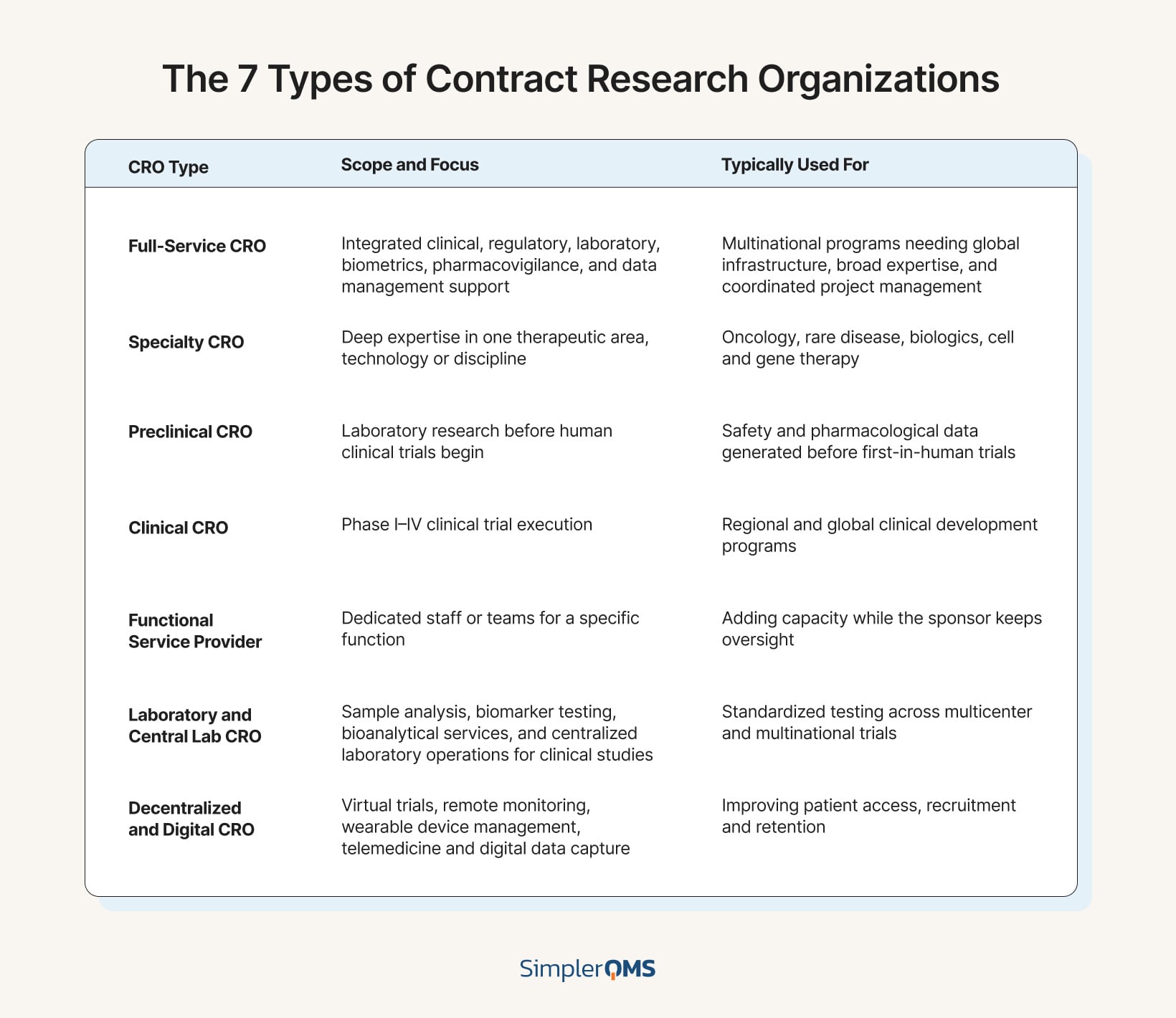
Contract Research Organizations can be categorized into 7 main types based on scope of service, therapeutic specialization, geographic reach, operational scale, and outsourcing model. Understanding CRO types enables sponsor companies to select outsourcing partners that align with development timelines, technical requirements, budget constraints, regulatory expectations, and operational strategy.
The main CRO types are described below.
- Full-Service CROs: Full-service CROs provide integrated clinical development, regulatory, laboratory, biometrics, pharmacovigilance, and data management support across preclinical, clinical, and post-marketing phases. These organizations manage activities such as study startup, clinical operations, regulatory submissions, medical writing, data management, and post-marketing support through a centralized outsourcing model. Full-service CROs are commonly used for multinational development programs that require global infrastructure, broad expertise, and coordinated project management. Full-service CROs provide broad expertise and scalability, but they involve higher operational costs and less flexibility than specialized providers in many outsourcing models.
- Specialty CROs: Specialty CROs focus on specific therapeutic areas, technologies, product categories, or scientific disciplines such as oncology, rare diseases, biologics, medical devices, cell and gene therapy, or laboratory testing. These organizations provide deep scientific expertise and specialized regulatory knowledge within focused development areas. Specialty CROs are often selected when technical expertise is more important than broad service coverage. Specialty CROs provide technical depth and therapeutic specialization, but offer narrower service coverage than full-service CROs.
- Preclinical CROs: Preclinical CROs support laboratory research, toxicology, pharmacology, bioanalysis, animal studies, and product characterization before human clinical trials begin. These organizations generate safety and pharmacological data used to support investigational product development and regulatory submissions. Preclinical CROs provide specialized laboratory capabilities and scientific expertise but do not manage Phase I, II, III, or IV clinical trials.
- Clinical CROs: Clinical CROs manage Phase I, II, III, and IV clinical trial activities, including site management, patient recruitment, monitoring, biometrics, pharmacovigilance, and trial coordination. These organizations support regional and global clinical development programs by providing operational expertise and trial management capabilities. Clinical CROs improve study execution and enrollment performance but require coordination with separate laboratory or regulatory partners when those services fall outside their scope.
- Functional Service Providers (FSPs): Functional service providers supply dedicated personnel or functional teams for activities such as data management, biostatistics, pharmacovigilance, medical writing, regulatory affairs, and clinical monitoring. The FSP outsourcing model allows sponsors to retain strategic oversight while expanding operational capacity in specific functions. FSP arrangements provide flexibility and cost efficiency but require greater sponsor involvement and coordination.
- Laboratory and Central Lab CROs: Laboratory and central lab CROs provide sample analysis, biomarker testing, bioanalytical services, genetic testing, pathology support, and centralized laboratory operations for clinical studies. These organizations support standardized testing and specimen management across multicenter and multinational trials. Laboratory CROs provide specialized scientific testing capabilities and operate alongside broader clinical development partners.
- Decentralized and Digital CROs: Decentralized and digital CROs support virtual trials, remote patient monitoring, telemedicine integration, wearable device management, and digital data collection. These organizations use technology-enabled trial models to improve patient access, recruitment, retention, and study flexibility. Decentralized CROs provide flexibility and digital innovation, but decentralized trial models require additional technology integration, data security controls, and regulatory oversight when remote data collection and digital patient engagement tools are used.
Full-service CROs differ from specialty CROs and functional service providers in operational scale, outsourcing scope, flexibility, and cost structure. Full-service CROs provide centralized global infrastructure and integrated development management across multiple functions. This full-service CRO model supports large multinational programs but can reduce flexibility and increase outsourcing costs when sponsors need customized oversight or flexible service changes. Specialty CROs provide focused scientific expertise and therapeutic specialization that support complex or niche development programs requiring advanced technical capabilities. Functional service providers offer flexible staffing and outsourced functional support models that allow sponsors to retain more internal operational control while selectively outsourcing specialized activities. Sponsor companies select CRO models based on program complexity, internal expertise, budget, geographic scope, therapeutic specialization, and long-term outsourcing strategy. High program complexity favors full-service CROs, while narrow therapeutic specialization favors specialty CROs or functional service providers.
Contract Research Organizations (CROs) can be categorized into seven types based on their expertise, service scope, and role in research and clinical development, as shown in the image below.
What Services Does a Contract Research Organization Provide?
A CRO provides outsourced research, clinical development, laboratory, regulatory, safety, biometrics, and operational support services across the pharmaceutical and medical product development lifecycle. CRO services support sponsor companies during drug discovery, clinical trials, regulatory submissions, post-marketing studies, and real-world evidence generation. CROs enable sponsors to manage scientific complexity, improve operational efficiency, accelerate development timelines, access specialized expertise, and maintain compliance with global regulatory requirements throughout clinical development programs.
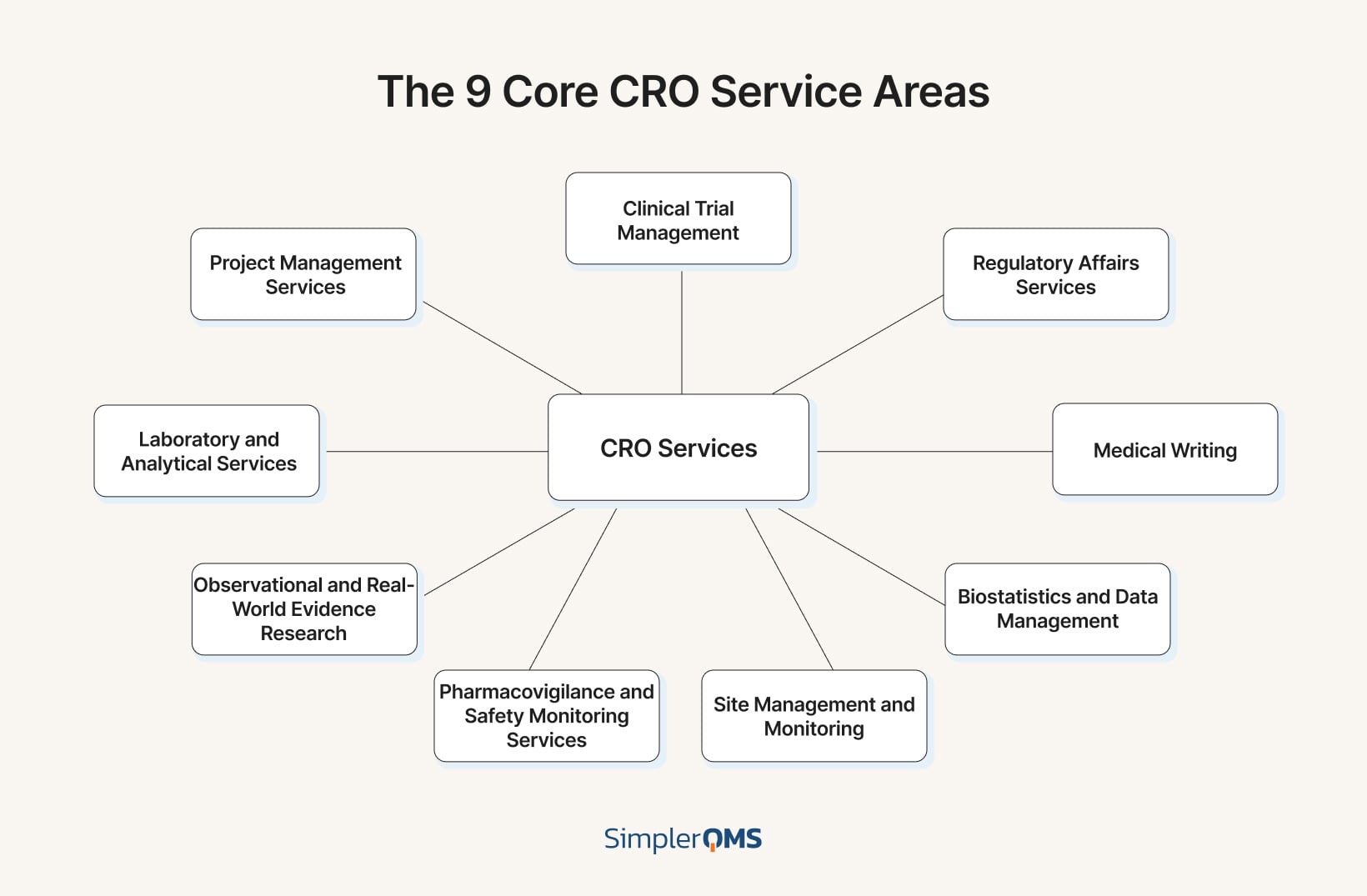
The 9 core CRO service areas and their roles in clinical development, regulatory compliance, data generation, safety oversight, and sponsor support are described below.
- Clinical Trial Management: Clinical trial management services coordinate Phase I, Phase II, Phase III, and Phase IV clinical studies across investigative sites and geographic regions. Clinical trial management includes study startup, patient recruitment, monitoring, site coordination, trial oversight, and clinical operations management activities that support protocol execution and regulatory compliance.
- Regulatory Affairs Services: Regulatory affairs services manage regulatory strategy development, health authority submissions, investigational application preparation, ethics committee coordination, and regulatory communication activities. CRO regulatory teams support compliance with Food and Drug Administration (FDA), European Medicines Agency (EMA), International Council for Harmonisation (ICH), and regional regulatory requirements throughout product development.
- Medical Writing: Medical writing services prepare clinical study protocols, investigator brochures, informed consent forms, clinical study reports, regulatory summaries, and submission documentation. Medical writing activities support clear scientific communication, regulatory consistency, and accurate presentation of clinical data across development programs.
- Biostatistics and Data Management: Biostatistics and data management services support clinical database design, statistical analysis planning, randomization management, data validation, and clinical data analysis activities. Biostatistics and data management services maintain data quality, statistical integrity, and reliable clinical study outcomes.
- Site Management and Monitoring: Site management and monitoring services oversee investigative site performance, protocol compliance, source data verification, patient safety reporting, and trial documentation activities. Clinical research associates (CRAs) and monitoring teams maintain data accuracy, Good Clinical Practice (GCP) compliance, and study oversight throughout clinical trials.
- Pharmacovigilance and Safety Monitoring Services: Pharmacovigilance and safety monitoring services support adverse event collection, case processing, signal detection, safety reporting, and benefit-risk evaluation activities during clinical development and post-marketing surveillance. CRO safety teams support sponsor compliance with global pharmacovigilance reporting requirements and patient safety obligations.
- Observational and Real-World Evidence Research: Observational and real-world evidence (RWE) research services support registries, post-marketing studies, epidemiology programs, healthcare database analysis, and outcomes research activities. Observational and real-world evidence research services evaluate product safety, effectiveness, utilization patterns, and long-term outcomes under real-world conditions.
- Laboratory and Analytical Services: Laboratory and analytical services include bioanalytical testing, biomarker analysis, central laboratory operations, genetic testing, pathology support, and specimen management activities. CRO laboratory services support standardized testing, scientific analysis, and data generation for preclinical and clinical studies.
- Project Management Services: Project management services coordinate timelines, budgets, vendor oversight, stakeholder communication, resource planning, and operational execution across development programs. CRO project management teams maintain development timelines, operational alignment, and cross-functional coordination throughout complex clinical studies.
CROs tailor their service mix based on product type, therapeutic area, development phase, geographic scope, regulatory complexity, budget, and sponsor outsourcing strategy. Sponsors outsource complete development programs to full-service CROs or selectively outsource specialized functions such as biometrics, pharmacovigilance, laboratory testing, and clinical monitoring. CRO service models vary depending on sponsor infrastructure, internal expertise, study complexity, and long-term development objectives. Strong internal infrastructure supports selective outsourcing, while high study complexity favors broader CRO service coverage.
Contract Research Organizations provide a range of services, including clinical trial management, regulatory affairs, pharmacovigilance, data management, and medical writing, across nine core service areas, as shown in the image below.
Clinical Trial Management
Clinical trial management encompasses the planning, coordination, execution, oversight, and reporting of clinical studies throughout the trial lifecycle. CROs manage operational activities required to conduct Phase I, II, III, and IV studies while maintaining compliance with study protocols, Good Clinical Practice (GCP), and regulatory requirements. Sponsors retain product ownership, strategic oversight, and regulatory accountability, while CROs perform delegated operational, clinical, and project management activities according to contractual agreements and study objectives.
The 8 key activities within CRO clinical trial management are described below.
- Protocol Development and Study Planning: CROs support protocol development, study design, feasibility assessments, timelines, risk management plans, and operational strategies. Sponsors approve final study designs and development objectives. These activities produce the protocol and study plans that guide trial execution.
- Regulatory and Ethics Submissions: CROs prepare and coordinate submissions to regulatory authorities, Institutional Review Boards (IRBs), Ethics Committees (ECs), and other regulatory bodies. Sponsors retain final regulatory responsibility and approval authority. Successful submissions result in study authorization and site approval.
- Site Selection and Activation: CROs identify qualified investigative sites, conduct feasibility assessments, negotiate contracts, and coordinate site startup activities. Sponsors review strategic site decisions and enrollment plans. Site activation enables patient recruitment and study initiation.
- Patient Recruitment and Enrollment Management: CROs support recruitment planning, enrollment tracking, site performance monitoring, and patient retention activities. These activities help achieve enrollment targets and maintain study timelines. Enrollment reports and recruitment metrics provide visibility into study progress.
- Clinical Operations and Trial Oversight: CROs manage day-to-day study execution, monitoring activities, issue resolution, vendor coordination, and study performance tracking. Sponsors receive regular updates through governance meetings, project reviews, and performance reports. Effective oversight supports protocol compliance and operational efficiency.
- Safety Management and Reporting: CROs coordinate adverse event reporting, safety surveillance, and regulatory safety submissions according to protocol and regulatory requirements. Sponsors retain responsibility for overall benefit-risk evaluation and safety decision-making. These activities support patient protection and regulatory compliance.
- Data Management and Interim Analyses: CROs support data collection, data review, database management, interim analyses, and study reporting activities. Interim analyses provide sponsors with predefined assessments of study progress, safety, or efficacy when required by the protocol or statistical analysis plan.
- Study Closeout and Final Reporting: CROs coordinate site closeout activities, finalize study documentation, support database lock, and prepare clinical study reports. These activities produce the final study records and reports required for regulatory review and development decisions.
CROs use a range of technologies to manage clinical trials operationally. Common systems include electronic Clinical Trial Management Systems (eCTMS) for study oversight, electronic Trial Master Files (eTMF) for document management, Randomization and Trial Supply Management (RTSM) systems for treatment allocation and drug supply control, electronic Data Capture (EDC) systems for clinical data collection, and analytics platforms for performance monitoring and reporting. These technologies improve visibility, coordination, traceability, and operational efficiency across complex development programs.
CROs maintain GCP compliance through documented procedures, qualified personnel, training programs, monitoring activities, quality oversight processes, audit programs, risk management practices, and validated computerized systems. Compliance activities help ensure that participant rights, safety, and well-being are protected and that clinical trial data remain accurate, complete, and reliable throughout the study lifecycle.
Regulatory Affairs Services
Regulatory affairs services support product development and regulatory compliance from early development through post-approval activities. CRO regulatory teams assist sponsors with regulatory strategy, health authority interactions, submission preparation, compliance management, and lifecycle maintenance activities across multiple jurisdictions. These services help sponsors navigate complex regulatory requirements while supporting timely product development, regulatory approvals, and ongoing compliance obligations. Sponsors retain regulatory accountability and final approval authority, while CROs provide regulatory expertise, operational support, and submission management throughout the product lifecycle.
The 7 key regulatory affairs deliverables managed by CROs are described below.
- Regulatory Strategy Development: Regulatory strategy development defines the regulatory pathway, submission approach, development milestones, and agency interaction plans for a product. This activity supports development programs across major jurisdictions, including the United States, European Union, and other global markets. CRO regulatory teams provide strategic recommendations, while sponsors approve the overall regulatory strategy.
- Pre-IND and Early Development Regulatory Support: CROs support pre-Investigational New Drug (pre-IND) activities, scientific advice meetings, regulatory consultations, and early development planning. These activities help sponsors align development programs with regulatory expectations before formal submissions occur. Sponsors retain responsibility for strategic development decisions and agency interactions.
- IND, CTA, and Clinical Trial Applications: CROs prepare and coordinate Investigational New Drug (IND) applications, Clinical Trial Applications (CTAs), and other study authorization submissions required before clinical trials begin. These submissions support regulatory review and approval of proposed clinical studies. Sponsors review and approve submission content before filing with health authorities.
- Marketing Authorization and Registration Submissions: CROs support preparation of marketing authorization applications, registration dossiers, and supporting documentation required for product approval. These submissions may be directed to agencies such as the FDA, EMA, Medicines and Healthcare products Regulatory Agency (MHRA), Health Canada, Pharmaceuticals and Medical Devices Agency (PMDA), and other national regulatory authorities. Sponsors retain ownership of the submission and final regulatory accountability.
- Regulatory Correspondence and Agency Interactions: CROs coordinate responses to regulatory questions, information requests, deficiency letters, and agency feedback throughout product development and review processes. Regulatory teams help manage communication timelines, documentation, and submission updates. Sponsors approve final responses before submission to regulatory authorities.
- Labeling and Regulatory Documentation: CROs support development of product labeling, prescribing information, regulatory summaries, briefing documents, and other regulatory communications. These documents help support product approval, compliance, and lifecycle management activities.
- Post-Approval Regulatory Support: CROs assist with post-approval variations, supplements, renewals, annual reports, safety-related submissions, and regulatory maintenance activities. These services support continued product compliance after commercialization and throughout the product lifecycle.
CROs support global regulatory strategy by coordinating submissions, timelines, and regulatory requirements across multiple jurisdictions simultaneously. Regulatory teams monitor changing requirements, manage country-specific submission activities, coordinate health authority interactions, and align global development plans with regional expectations. This coordination helps sponsors maintain consistent regulatory strategies while reducing delays associated with multinational development programs.
CRO regulatory affairs teams provide expertise that many small and emerging sponsors may not possess internally. These teams often include specialists with experience in regulatory strategy, submission preparation, agency interactions, global registration requirements, and evolving regulatory frameworks. Access to this expertise helps sponsors navigate complex regulatory environments, reduce compliance risks, and improve the efficiency of product development and approval activities.
Medical Writing
Medical writing services support the preparation of scientific, clinical, regulatory, and safety documents throughout the product development lifecycle. CRO medical writing teams develop documents used by sponsors, investigators, ethics committees, regulatory authorities, and healthcare professionals to support clinical research, regulatory submissions, product approvals, and post-marketing activities. These services help ensure that complex scientific and clinical information is communicated accurately, consistently, and in accordance with applicable regulatory requirements.
The 7 principal document types produced by CRO medical writing teams are described below.
- Clinical Study Protocols: Clinical study protocols define study objectives, design, methodology, eligibility criteria, endpoints, statistical considerations, and operational procedures. Protocols guide study conduct and support regulatory and ethics committee review before trial initiation. These documents are developed during study planning and startup activities.
- Investigator Brochures (IBs): Investigator brochures summarize available preclinical, clinical, pharmacological, and safety information about an investigational product. These documents support investigator understanding of product risks and benefits and are required for clinical trial conduct under Good Clinical Practice (GCP) requirements. Investigator brochures are maintained throughout clinical development.
- Informed Consent Forms (ICFs): Informed consent forms provide study participants with information regarding study objectives, procedures, risks, benefits, and participant rights. These documents support ethics committee review and informed consent requirements before participant enrollment. ICFs are developed during study startup and updated as needed throughout the trial.
- Clinical Study Reports (CSRs): Clinical study reports summarize study design, conduct, statistical analyses, safety outcomes, efficacy results, and study conclusions. CSRs support regulatory submissions and health authority review following study completion. These documents are prepared after database lock and final statistical analysis.
- Regulatory Submission Documents: Regulatory submission documents include clinical summaries, nonclinical summaries, efficacy and safety overviews, briefing documents, and other submission components required for health authority review. These documents support submissions to agencies such as the FDA, EMA, MHRA, PMDA, and other regulatory authorities throughout product development and registration activities.
- Safety and Pharmacovigilance Documents: Safety documents include periodic safety reports, risk management documentation, safety narratives, adverse event summaries, and benefit-risk assessments. These documents support regulatory safety reporting requirements during clinical development and post-marketing activities.
- Scientific Publications and Manuscripts: Scientific publications include journal manuscripts, conference abstracts, posters, presentations, and scientific communications that disseminate study findings to the scientific and medical community. These documents support scientific communication and evidence dissemination after study completion.
CRO medical writers develop documents according to applicable ICH guidelines, including ICH E3 for Clinical Study Reports, ICH E6 Good Clinical Practice (GCP), ICH M4 Common Technical Document (CTD) requirements, and other relevant regulatory guidance. Medical writing teams also incorporate agency-specific requirements from regulatory authorities such as the FDA, EMA, MHRA, PMDA, and Health Canada. Close collaboration with sponsors, clinical teams, statisticians, regulatory specialists, and subject matter experts helps ensure scientific accuracy, consistency, and regulatory compliance.
CRO-authored regulatory documents undergo structured quality review and approval processes before submission or publication. Review activities typically include scientific review, statistical verification, quality control checks, regulatory review, and sponsor approval. Version control, document traceability, comment reconciliation, and formal approval workflows help ensure that documents are accurate, complete, compliant, and ready for regulatory or scientific use.
Biostatistics and Data Management
Biostatistics and data management services support the collection, validation, analysis, and reporting of clinical trial data throughout the study lifecycle. CRO biometrics teams develop statistical analysis plans (SAPs), build and manage clinical databases, perform statistical analyses, generate study datasets, and prepare outputs required for regulatory submissions. These services help sponsors maintain data quality, statistical integrity, regulatory compliance, and reliable study outcomes while supporting evidence-based development decisions.
The 6 key activities within CRO biostatistics and data management are described below.
- Statistical Analysis Plan (SAP) Development: SAP development defines the statistical methods, analysis populations, endpoints, handling of missing data, and reporting procedures used during clinical trials. SAPs provide the framework for analyzing study results and are commonly developed according to ICH E9 Statistical Principles for Clinical Trials. CRO statisticians typically collaborate with sponsor statisticians to ensure alignment with study objectives, regulatory requirements, and clinical development strategies.
- Clinical Database Design and Management: Clinical database management develops and maintains electronic databases used to collect, store, and manage clinical trial data. Database design activities include data collection structures, validation rules, edit checks, and data review processes. CRO data management teams work with sponsors to ensure databases support protocol requirements, data quality standards, and regulatory expectations.
- Data Validation and Quality Control: Data validation and quality control identify incomplete, inconsistent, or inaccurate clinical data through programmed edit checks, manual review processes, and query management activities. These controls support data accuracy, completeness, and reliability throughout the study lifecycle. CRO teams coordinate data review activities with study sites and sponsors to resolve data discrepancies before analysis.
- Randomization and Trial Design Support: Randomization services support treatment allocation and study design requirements through randomization schedules, stratification approaches, and blinding procedures. CRO statisticians work closely with sponsor teams to develop methodologies that reduce bias and support valid statistical conclusions.
- Statistical Analysis and Reporting: Statistical analysis activities evaluate study endpoints, safety data, efficacy outcomes, and exploratory objectives using predefined statistical methods. CRO statisticians generate analysis outputs, tables, figures, listings, and clinical study reports used for regulatory submissions and development decision-making. Statistical analyses are performed according to approved SAPs and applicable regulatory guidelines.
- Dataset Preparation and Submission Support: Dataset preparation converts clinical trial data into standardized formats suitable for regulatory review and submission. CRO biometrics teams prepare submission datasets, metadata, and supporting documentation required by health authorities. These activities support efficient regulatory review and submission readiness.
CROs commonly apply Clinical Data Interchange Standards Consortium (CDISC) standards, including CDASH (Clinical Data Acquisition Standards Harmonization), SDTM (Study Data Tabulation Model), and ADaM (Analysis Data Model). CDASH standardizes clinical data collection, SDTM standardizes submitted study datasets, and ADaM standardizes analysis datasets used for statistical evaluation. These standards improve data consistency, facilitate regulatory review, and support submission requirements established by regulatory authorities such as the FDA, EMA, and PMDA. CROs work closely with sponsor biometrics teams to ensure datasets comply with applicable CDISC requirements and submission standards.
CROs maintain data integrity and audit readiness through validated computerized systems, controlled data management procedures, audit trails, role-based access controls, data validation activities, quality reviews, and documented change management processes. These controls support compliance with Good Clinical Practice (GCP), FDA 21 CFR Part 11, EU Annex 11, and applicable data integrity requirements. Strong data governance practices help ensure that clinical data remain accurate, complete, consistent, attributable, and traceable throughout the clinical trial lifecycle.
Site Management and Monitoring
Site management and monitoring services oversee clinical trial activities at investigative sites from site selection through study closeout. CROs support site qualification, site initiation, patient enrollment, protocol compliance, source data review, safety reporting, issue management, and site closeout activities throughout the study lifecycle. These services help ensure that clinical trials are conducted according to approved protocols, Good Clinical Practice (GCP) requirements, sponsor expectations, and applicable regulatory requirements.
The 8 key monitoring activities performed by Clinical Research Associates (CRAs) are described below.
- Site Qualification and Selection: Site qualification evaluates investigator experience, patient access, facility capabilities, staffing resources, and previous research performance before study initiation. This activity supports GCP requirements related to investigator qualifications and site suitability. Site qualification reports help sponsors select sites capable of meeting enrollment, quality, and compliance expectations.
- Site Initiation Visits (SIVs): Site initiation visits prepare investigators and site personnel to conduct the study according to the approved protocol and regulatory requirements. CRAs review study procedures, informed consent requirements, safety reporting processes, and documentation expectations. Site initiation activities help reduce protocol compliance and training-related risks.
- Protocol Compliance Monitoring: Protocol compliance monitoring verifies that study activities are performed according to approved protocols, regulatory requirements, and sponsor instructions. Monitoring reports document protocol adherence, identified issues, and corrective actions. These activities help reduce protocol deviation risks and protect study validity.
- Source Data Verification (SDV) and Source Data Review (SDR): Source data verification and source data review compare clinical database entries against original source records to confirm data accuracy, completeness, and consistency. These activities support GCP requirements for data reliability and documentation integrity. Monitoring findings help identify data quality issues before database lock and regulatory submission.
- Informed Consent Review: Informed consent review verifies that study participants are properly informed and consented before study procedures begin. CRAs review consent documentation to confirm compliance with protocol requirements, ethical standards, and regulatory obligations. This activity helps protect participant rights and reduces regulatory compliance risks.
- Safety Reporting Oversight: Safety reporting oversight verifies that adverse events, serious adverse events, and other safety information are documented and reported according to protocol and regulatory requirements. Monitoring activities help support patient safety and regulatory compliance throughout the study.
- Investigational Product Accountability: Investigational product accountability verifies the receipt, storage, dispensing, return, and reconciliation of study products. Accountability records provide evidence that investigational products are managed according to protocol and regulatory requirements. These activities reduce risks related to product misuse, inventory discrepancies, and patient safety.
- Site Closeout Visits: Site closeout visits verify that study activities have been completed, investigational products reconciled, outstanding issues resolved, and essential documents archived appropriately. Closeout reports provide documented evidence that site responsibilities have been fulfilled and study records are complete.
Risk-based monitoring (RBM) has enhanced traditional monitoring approaches by shifting from extensive on-site source data verification toward a combination of centralized monitoring, targeted on-site visits, statistical data review, and risk-based oversight activities. RBM focuses monitoring resources on critical data, key risk indicators, patient safety concerns, protocol compliance, and high-risk study processes. This approach improves monitoring efficiency while maintaining data quality and regulatory compliance.
CROs manage site performance issues through ongoing performance reviews, risk assessments, escalation procedures, corrective action plans, and targeted site support. Recruitment shortfalls may be addressed through revised enrollment strategies, additional recruitment resources, or site expansion. Protocol deviations are investigated through root cause analysis and corrective actions, while data query backlogs are managed through focused monitoring activities, site training, and increased data review support. These interventions help maintain study timelines, data quality, and overall study performance.
Pharmacovigilance and Safety Monitoring Services
Pharmacovigilance and safety monitoring services support the collection, evaluation, documentation, reporting, and ongoing assessment of safety information throughout clinical development and post-marketing activities. CRO pharmacovigilance teams manage adverse event processing, safety surveillance, regulatory reporting, signal detection, and safety documentation while helping sponsors comply with global pharmacovigilance requirements. Sponsors retain overall responsibility for product safety and benefit-risk evaluation, while CROs perform delegated safety monitoring and reporting activities according to regulatory requirements and contractual agreements.
The 7 key pharmacovigilance activities managed or supported by CROs are described below.
- Adverse Event (AE) Collection and Processing: Adverse event processing captures, documents, evaluates, and records safety information reported during clinical studies. These activities support pharmacovigilance obligations under guidelines such as ICH E2A Clinical Safety Data Management. CRO safety teams manage case intake, data entry, medical review coordination, and case tracking using validated safety databases.
- Serious Adverse Event (SAE) Management: Serious adverse event management evaluates events involving death, hospitalization, disability, life-threatening conditions, or other significant medical outcomes. CRO teams collect and process SAE information, coordinate follow-up activities, and prepare reports for sponsor review. Sponsors retain responsibility for final safety assessment and regulatory accountability.
- SUSAR Identification and Expedited Reporting: Suspected Unexpected Serious Adverse Reaction (SUSAR) management identifies adverse reactions that are serious, unexpected, and potentially related to the investigational product. CROs support expedited reporting obligations required under regulations such as ICH E2A, Regulation (EU) No 536/2014 (EU Clinical Trials Regulation), and FDA 21 CFR 312.32. These activities help ensure timely communication of significant safety risks to regulatory authorities, ethics committees, and investigators.
- Safety Database Management: Safety database management maintains validated systems used to collect, process, track, and report safety information. CRO teams manage case workflows, coding activities, quality control reviews, and safety data reconciliation. These systems support data consistency, traceability, and regulatory compliance.
- Signal Detection and Safety Surveillance: Signal detection evaluates aggregated safety data to identify potential safety concerns, emerging risks, or trends associated with investigational or marketed products. CRO pharmacovigilance teams perform routine safety reviews and data analysis to support ongoing benefit-risk assessment activities.
- Aggregate Safety Reporting: Aggregate safety reporting prepares periodic safety reports required by regulatory authorities throughout clinical development and post-marketing activities. These reports may include Development Safety Update Reports (DSURs), Periodic Safety Update Reports (PSURs), and Periodic Benefit-Risk Evaluation Reports (PBRERs). CROs prepare and manage these reports while sponsors approve final submissions.
- Risk Management and Regulatory Safety Support: CROs support risk management planning, safety documentation, regulatory responses, inspection preparation, and health authority interactions related to product safety. These activities help sponsors maintain compliance with global pharmacovigilance requirements.
CROs maintain global pharmacovigilance compliance through standardized safety procedures, validated safety databases, workflow tracking systems, and jurisdiction-specific reporting processes. Safety teams monitor reporting timelines established by regulatory authorities and coordinate efficient case processing, medical review, quality control, and submission activities. These controls help ensure that reportable safety events are communicated within required timelines across multiple regulatory jurisdictions.
Clinical trial pharmacovigilance focuses on monitoring the safety of investigational products during clinical development and supports reporting requirements associated with ongoing studies. Activities include adverse event management, SAE reporting, SUSAR reporting, and safety surveillance under clinical trial regulations. Post-marketing pharmacovigilance occurs after product approval and focuses on monitoring safety under real-world conditions through spontaneous reporting systems, aggregate safety reporting, risk management activities, and ongoing benefit-risk evaluation. CROs may support both functions, although post-marketing pharmacovigilance typically involves larger safety datasets, broader patient populations, and long-term safety monitoring activities.
Observational and Real-World Evidence Research
Observational and real-world evidence (RWE) research services support the collection and analysis of data generated under routine clinical practice rather than controlled interventional clinical trial settings. Unlike interventional studies, observational studies do not assign treatments or require protocol-driven interventions. CROs design, manage, and analyze observational and real-world evidence studies that evaluate product safety, effectiveness, utilization patterns, healthcare outcomes, and economic impact across broader patient populations. These services support regulatory decision-making, market access activities, health technology assessments, and post-marketing evidence generation.
The 6 primary types of observational and real-world evidence studies managed by CROs are described below.
- Patient Registries: Patient registries collect longitudinal data on patients with specific diseases, conditions, or treatment exposures. Registries support long-term safety monitoring, effectiveness evaluations, disease natural history research, and post-marketing evidence generation. These studies typically rely on healthcare providers, treatment centers, patient-reported outcomes, and electronic health records as data sources.
- Cohort Studies: Cohort studies follow groups of patients over time to evaluate outcomes associated with treatments, exposures, or disease characteristics. These studies support comparative effectiveness research, safety evaluations, and healthcare outcomes assessments. Cohort studies commonly use electronic health records, insurance claims databases, registries, and healthcare system data.
- Case-Control Studies: Case-control studies compare patients who have experienced a specific outcome with patients who have not experienced that outcome to identify potential risk factors or treatment associations. These studies are frequently used to investigate rare events, safety concerns, and disease risk factors. Data sources often include medical records, registries, and healthcare databases.
- Post-Authorization Safety Studies (PASS): PASS studies evaluate the safety of approved products under real-world conditions after market authorization. Regulatory authorities may require PASS studies to monitor known or potential risks associated with marketed products. These studies commonly use registries, claims databases, electronic health records, and pharmacovigilance data sources.
- Health Economics and Outcomes Research (HEOR) Studies: HEOR studies evaluate healthcare utilization, treatment outcomes, quality of life, resource consumption, and economic impact associated with medical products. These studies support payer evaluations, reimbursement decisions, market access strategies, and value-based healthcare assessments. Common data sources include claims databases, patient registries, electronic health records, and patient-reported outcome data.
- Retrospective Database Studies: Retrospective studies analyze existing healthcare data to evaluate treatment patterns, safety outcomes, disease burden, and healthcare utilization. These studies provide efficient access to large patient populations and support regulatory, commercial, and clinical decision-making. Data sources typically include claims databases, electronic health records, registries, and healthcare networks.
CROs access and manage real-world data through partnerships with healthcare providers, research networks, registries, database providers, healthcare systems, and data aggregators. Data management activities include data acquisition, data cleaning, validation, anonymization, quality assessment, and governance oversight. CROs implement data security controls, privacy protections, audit trails, and quality management processes to support compliance with applicable data protection regulations and data governance requirements.
Real-world evidence plays an increasingly important role in regulatory decision-making and market access strategies. Regulatory authorities use RWE to support post-marketing surveillance, safety monitoring, label expansions, and benefit-risk assessments. Payers and health technology assessment organizations use RWE to evaluate treatment effectiveness, healthcare outcomes, resource utilization, and economic value under routine clinical practice conditions. As a result, CRO-managed RWE studies have become an important component of product lifecycle management, regulatory strategy, and evidence generation programs.
Laboratory and Analytical Services
Laboratory and analytical services support product development by generating scientific, safety, pharmacokinetic, pharmacodynamic, biomarker, and clinical laboratory data throughout the development lifecycle. CRO laboratories provide testing, sample analysis, method development, and laboratory operations for preclinical studies, clinical trials, regulatory submissions, and post-marketing research. These services help sponsors evaluate product safety, efficacy, quality, and biological activity while supporting regulatory compliance and evidence generation.
The 7 principal laboratory and analytical service areas managed by CROs are described below.
- Bioanalytical Testing: Bioanalytical testing measures drug concentrations, metabolites, and other analytes in biological samples such as blood, plasma, serum, urine, and tissues. These analyses support preclinical research, clinical pharmacology studies, and clinical trials. Bioanalytical laboratories commonly operate under Good Laboratory Practice (GLP), Good Clinical Laboratory Practice (GCLP), and applicable regulatory requirements.
- Pharmacokinetic (PK) and Pharmacodynamic (PD) Analysis: PK and PD services evaluate how a drug is absorbed, distributed, metabolized, and eliminated and how it affects biological systems. These studies support dose selection, dose optimization, exposure-response assessments, and early efficacy evaluations throughout clinical development.
- Biomarker Analysis: Biomarker testing evaluates biological indicators associated with disease progression, treatment response, safety monitoring, and patient stratification. Biomarker studies support precision medicine programs, patient selection strategies, endpoint evaluation, and clinical decision-making throughout development.
- Central Laboratory Services: Central laboratory services provide standardized clinical testing, specimen processing, laboratory reporting, and data management across multiple study sites. These services support multinational clinical trials by ensuring consistent laboratory procedures, standardized testing methods, and centralized result reporting.
- Genetic and Genomic Testing: Genetic and genomic testing evaluates genetic variations, molecular markers, and genomic characteristics associated with diseases or treatment responses. These services support personalized medicine, companion diagnostics, patient stratification, and targeted therapy development.
- Pathology and Histology Services: Pathology and histology services evaluate tissues, cells, and biological samples through microscopic examination and specialized laboratory analyses. These services support toxicology studies, disease characterization, biomarker research, and preclinical development programs.
- Safety and Clinical Laboratory Testing: Clinical laboratory testing includes hematology, clinical chemistry, immunology, coagulation, urinalysis, and other safety assessments used to monitor participant health during clinical studies. These services support patient safety monitoring and regulatory compliance throughout clinical development.
CROs manage central laboratory operations for multinational clinical trials through coordinated sample logistics, specimen tracking systems, chain-of-custody controls, laboratory information management systems (LIMS), standardized testing procedures, and centralized reporting processes. Laboratory teams coordinate sample collection, transportation, processing, storage, testing, and result reporting across participating sites and countries. These controls help maintain sample integrity, support reporting timelines, and ensure consistent laboratory data generation throughout global studies.
Project Management Services
Project management services coordinate the planning, execution, oversight, and reporting of clinical development programs to help ensure studies remain on schedule, within budget, and compliant with regulatory requirements. CRO project managers serve as the central coordination point between sponsors, study teams, investigators, vendors, laboratories, and other stakeholders. These services support operational efficiency, risk management, communication, resource allocation, and overall study performance throughout the clinical trial lifecycle.
The 8 core project management activities performed by CRO project managers and clinical trial managers are described below.
- Project Planning and Timeline Management: Project planning establishes study timelines, milestones, resource requirements, and operational deliverables. Project managers use project management tools, eCTMS platforms, and study dashboards to monitor progress and track key milestones. Effective planning supports timely study execution and delivery of project and regulatory requirements.
- Budget Management and Financial Oversight: Budget management monitors study expenditures, vendor costs, resource utilization, forecasts, and financial performance throughout the project lifecycle. Financial tracking systems and budget reports help identify cost variances and support informed decision-making. These activities help maintain financial control and budget predictability.
- Resource Coordination and Team Management: Resource coordination aligns personnel, vendors, laboratories, sites, and functional departments with study requirements. Project managers monitor staffing needs, workload distribution, and operational capacity to support study execution. Effective resource management helps maintain productivity and study continuity.
- Sponsor Communication and Governance Management: Project managers coordinate governance meetings, status updates, performance reviews, risk discussions, and executive reporting activities. Governance dashboards, meeting minutes, and project reports provide sponsors with visibility into study progress, risks, timelines, and quality metrics. These activities support transparency and collaborative decision-making.
- Risk Management and Issue Resolution: Risk management identifies, evaluates, tracks, and mitigates operational, quality, regulatory, financial, and timeline-related risks. Project managers maintain risk registers and issue logs while coordinating corrective actions and escalation activities. Effective risk management reduces project disruptions and supports study objectives.
- Vendor and Stakeholder Coordination: Vendor coordination manages interactions between laboratories, technology providers, central service vendors, investigative sites, and sponsor teams. Project managers oversee deliverables, timelines, and service performance across external partners. These activities support operational alignment and study execution.
- Performance Monitoring and Reporting: Performance monitoring evaluates enrollment progress, site performance, quality metrics, budget status, milestone completion, and operational effectiveness. Project managers use reporting tools and key performance indicators (KPIs) to assess study health and communicate performance trends to sponsors.
- Study Closeout and Project Completion: Project managers coordinate study closeout activities, final deliverables, documentation reconciliation, lessons learned reviews, and project completion reporting. These activities support successful project closure and regulatory readiness.
CRO project teams are typically structured around a dedicated project manager or clinical trial manager who serves as the primary sponsor contact throughout the study. Supporting team members may include clinical operations personnel, CRAs, regulatory specialists, medical writers, biostatisticians, data managers, pharmacovigilance professionals, quality personnel, and laboratory representatives. Escalation pathways are defined within governance plans and quality agreements, allowing operational, quality, regulatory, budget, or timeline issues to be communicated to sponsor leadership and executive stakeholders when necessary.
CROs manage scope changes, timeline delays, and budget overruns through formal change control, impact assessments, risk evaluations, governance reviews, and sponsor approvals. Project managers evaluate the operational, financial, and regulatory implications of proposed changes before implementing corrective actions. Ongoing performance monitoring, risk management activities, and sponsor communication help identify issues early and support timely resolution before significant project impacts occur.
What Is the Role of a CRO in Life Science Companies?
A Contract Research Organization (CRO) provides outsourced scientific, clinical, regulatory, laboratory, and operational support to pharmaceutical, biotechnology, medical device, and healthcare companies throughout the product development lifecycle. CROs help life science companies manage research programs, clinical trials, regulatory submissions, pharmacovigilance, biometrics, laboratory testing, and post-marketing activities without building every capability internally.
CROs enable life science companies to accelerate development by providing established infrastructure, specialized expertise, experienced personnel, global site networks, and validated clinical research technologies. This outsourcing model helps sponsors reduce internal resource burden, scale development programs faster, access therapeutic and regulatory expertise, and advance products through development more efficiently.
The main functional areas commonly outsourced to CROs are described below.
- Clinical Trial Management: Clinical trial management includes study startup, site management, patient recruitment, monitoring, trial coordination, and operational oversight across clinical studies. Outsourcing this function addresses internal capacity gaps and provides access to established clinical operations infrastructure. Clinical outsourcing improves study execution, enrollment performance, and regulatory-compliant trial management.
- Regulatory Affairs and Submission Management: Regulatory affairs includes regulatory strategy, investigational submissions, marketing authorization support, health authority communication, and lifecycle management activities. Outsourcing this function addresses gaps in regional regulatory expertise and submission infrastructure. Regulatory outsourcing improves submission readiness and supports compliance with global requirements.
- Biostatistics and Data Management: Biostatistics and data management include database design, statistical analysis planning, clinical data validation, randomization support, and data analysis. Outsourcing biometrics provides access to specialized statistical expertise and scalable data management systems. These services improve data quality, statistical reliability, and submission readiness.
- Pharmacovigilance and Safety Monitoring: Pharmacovigilance includes adverse event processing, signal detection, safety reporting, aggregate reporting, and benefit-risk monitoring. Outsourcing safety activities addresses resource limitations and global reporting complexity. Pharmacovigilance outsourcing supports patient safety oversight and timely regulatory reporting.
- Medical Writing and Regulatory Documentation: Medical writing includes preparation of study protocols, investigator brochures, informed consent forms, clinical study reports, regulatory summaries, and submission documents. Outsourcing medical writing provides access to experienced scientific writers and regulatory documentation expertise. These services improve documentation quality, consistency, and provide submission support.
- Laboratory and Bioanalytical Services: Laboratory and bioanalytical services include biomarker testing, specimen analysis, central laboratory operations, pathology support, genetic testing, and bioanalytical method support. Outsourcing these services provides access to specialized testing capabilities, laboratory infrastructure and standardized analytical capabilities. Laboratory outsourcing improves data quality, testing consistency, and scientific evidence generation.
- Patient Recruitment and Site Support: Patient recruitment and site support include feasibility assessments, enrollment campaigns, site activation, investigator support, and patient engagement activities. Outsourcing this function addresses patient access limitations and enrollment timeline pressures. Recruitment outsourcing improves site performance and supports timely clinical trial execution.
- Real-World Evidence and Observational Research: Real-world evidence and observational research include registries, epidemiology studies, healthcare database analysis, outcomes research, and post-marketing data collection. Outsourcing these activities provides access to specialized analytics expertise and real-world data resources. These services support long-term safety evaluation, market access strategies, and evidence generation under routine clinical conditions.
The role of a CRO evolves throughout the product development lifecycle, including preclinical research, clinical development, and post-marketing support. Preclinical CROs support toxicology, pharmacology, laboratory testing, and early investigational development activities before human trials begin. During clinical development, CROs manage trial operations, biometrics, safety monitoring, regulatory submissions, and site oversight across global studies. Post-marketing CRO activities include pharmacovigilance, real-world evidence research, observational studies, registry management, and lifecycle regulatory support. CRO involvement expands as development complexity, geographic scope, and regulatory requirements increase across later product lifecycle stages.
Several industry trends are reshaping how CROs integrate with life science company operations. Decentralized clinical trials, digital health technologies, artificial intelligence, real-world evidence generation, advanced therapy development, and data-driven development models are increasing demand for specialized CRO capabilities and technology-enabled service models. Strategic outsourcing partnerships, functional service provider (FSP) models, integrated development platforms, and global data integration systems are changing how sponsors coordinate with CRO partners across development programs. These trends are increasing operational collaboration, digital integration, and long-term strategic partnerships between sponsors and CROs.
How Does a Contract Research Organization Work?
A Contract Research Organization (CRO) works by providing outsourced scientific, clinical, regulatory, laboratory, and operational services that support product development from study planning through study closeout. CRO engagement follows a structured process that begins with sponsor evaluation and vendor selection and continues through study execution, oversight, reporting, and project completion.
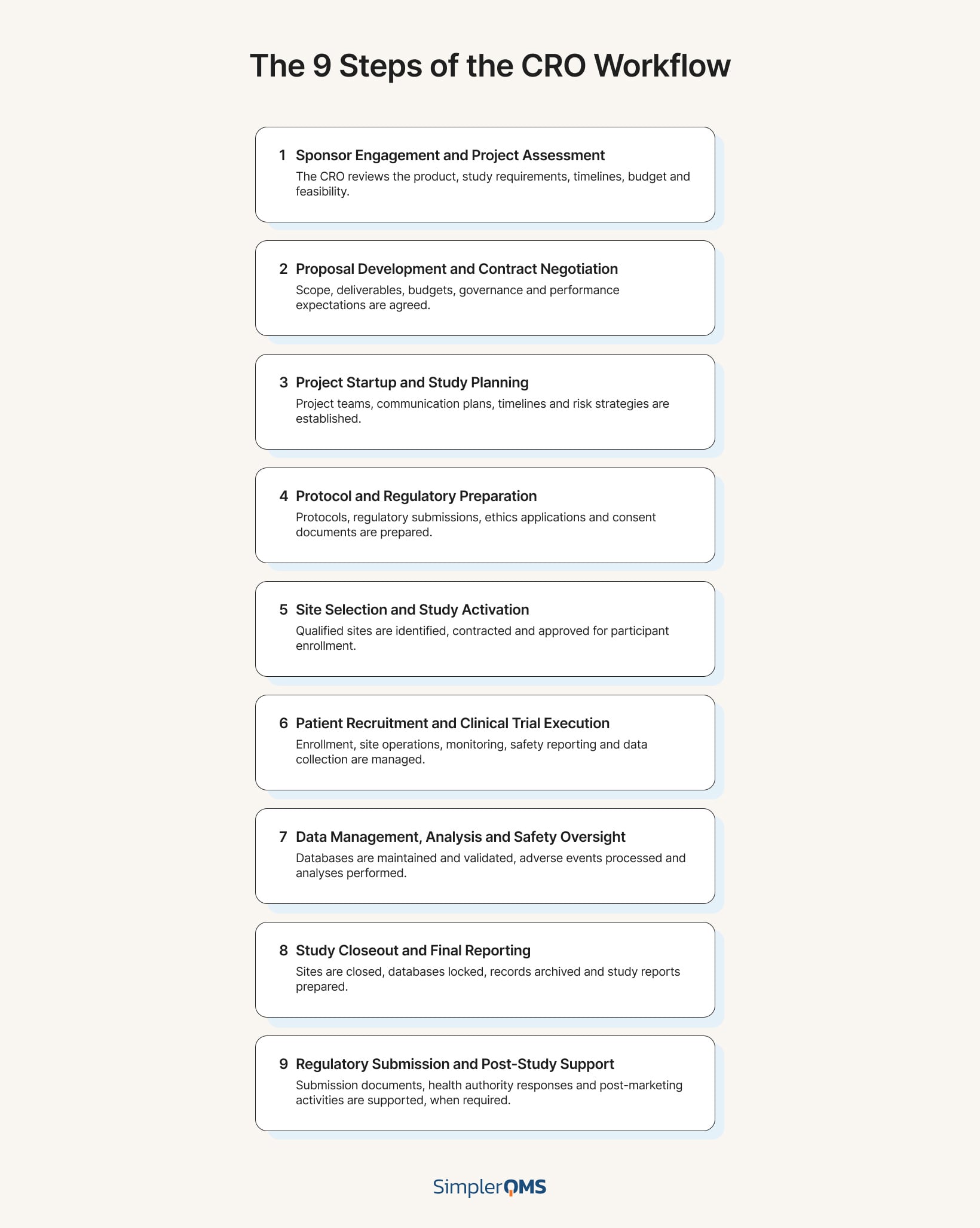
The 9 step CRO operational workflow is described below.
- Sponsor Engagement and Project Assessment: Sponsor engagement and project assessment evaluate the sponsor’s product, development objectives, study requirements, timelines, budget, regulatory strategy, and outsourcing needs. CRO teams assess project feasibility, resource requirements, therapeutic complexity, and operational scope to determine whether the proposed development program aligns with organizational capabilities.
- Proposal Development and Contract Negotiation: Proposal development and contract negotiation define project scope, deliverables, timelines, budgets, governance structures, and performance expectations. CROs prepare service proposals and project plans, while sponsors evaluate outsourcing models, service capabilities, and commercial terms. Contract negotiations establish the operational framework for the partnership.
- Project Startup and Study Planning: Project startup and study planning establish project teams, governance processes, communication plans, study timelines, risk management strategies, and operational procedures. These activities create the foundation required for effective study execution and project oversight.
- Protocol and Regulatory Preparation: Protocol and regulatory preparation develop study protocols, regulatory submissions, ethics committee applications, informed consent documents, and supporting clinical documentation. These activities support regulatory authorization and study approval before participant enrollment begins.
- Site Selection and Study Activation: Site selection and study activation identify qualified investigative sites, evaluate investigator capabilities, complete feasibility assessments, negotiate site contracts, and obtain required approvals. Site activation prepares study locations for participant recruitment and clinical trial execution.
- Patient Recruitment and Clinical Trial Execution: Patient recruitment and clinical trial execution manage participant enrollment, site operations, monitoring activities, safety reporting, protocol compliance, and clinical data collection. These activities generate the clinical evidence required to evaluate product safety and effectiveness.
- Data Management, Analysis, and Safety Oversight: Data management, analysis, and safety oversight maintain clinical databases, validate study data, process adverse events, perform statistical analyses, and monitor patient safety throughout the study. These activities support data integrity, regulatory compliance, and informed development decisions.
- Study Closeout and Final Reporting: Study closeout and final reporting complete site closure activities, finalize clinical databases, reconcile study documentation, archive records, and prepare clinical study reports. These activities generate the final study documentation required for regulatory review and future development planning.
- Regulatory Submission and Post-Study Support: Regulatory submission and post-study support involve the preparation of submission documents, support of health authority interactions, management of regulatory responses, and coordination of post-marketing activities when required. These activities support product approval, regulatory compliance, and lifecycle management.
CROs manage communication and escalation with sponsors through structured governance frameworks, predefined communication plans, project review meetings, operational reporting systems, and formal escalation procedures. Communication management helps maintain alignment between sponsor objectives and CRO execution activities throughout the study lifecycle.
Project managers serve as the primary communication link between sponsors and CRO operational teams. Regular project meetings, enrollment updates, milestone reviews, quality reviews, safety discussions, and risk assessments provide continuous visibility into study progress. CROs typically provide status reports covering enrollment performance, protocol deviations, safety events, budget status, regulatory activities, and operational risks.
Issue escalation follows predefined governance pathways based on severity and business impact. Operational issues such as enrollment delays, site performance concerns, or data quality findings are usually escalated through project management channels. Critical operational issues may escalate directly to governance committees when timelines, patient safety, or data integrity are affected. Quality, safety, compliance, or regulatory issues receive immediate escalation to sponsor leadership, quality representatives, and study governance committees when the issue affects or may affect patient safety, data integrity, or regulatory compliance. Structured escalation processes support timely decision-making, risk mitigation, and study continuity throughout clinical development.
A Contract Research Organization is structured into specialized functional departments that support different stages of product development and clinical research. Common CRO functions include clinical operations, regulatory affairs, medical writing, biostatistics, data management, pharmacovigilance, laboratory services, project management, quality assurance, information technology, and business development. These departments operate within a centralized governance and quality management framework that coordinates resources, maintains regulatory compliance, and supports study execution across multiple projects and therapeutic areas. Organizational structures vary based on CRO size, service scope, therapeutic specialization, and geographic footprint.
The CRO workflow typically involves nine key stages, from initial sponsor engagement and study planning to clinical trial execution, regulatory submission, and post-study support, as shown in the image below.
What Are the Criteria for Selecting a Contract Research Organization?
The criteria for selecting a Contract Research Organization (CRO) are the operational, scientific, quality, regulatory, financial, and strategic factors that determine whether a CRO can successfully support a sponsor’s development program.
The 10 main CRO selection criteria are described below.
- Regulatory Compliance History: Regulatory compliance history evaluates a CRO’s ability to comply with applicable regulations, guidelines, and industry standards. Sponsors assess compliance through qualification audits, inspection histories, quality documentation reviews, and regulatory records. Weak compliance performance increases the risk of inspection findings, regulatory delays, data rejection, and quality issues.
- Therapeutic and Scientific Expertise: Therapeutic and scientific expertise evaluates experience within specific disease areas, product categories, and research disciplines. Sponsors review previous studies, scientific publications, case studies, and project experience. Limited expertise may affect protocol design, study execution, recruitment performance, and overall development success.
- Service Capabilities and Operational Scope: Service capabilities evaluate whether a CRO can provide the required clinical, regulatory, laboratory, biometrics, pharmacovigilance, data management, and project management services. Sponsors assess capabilities through proposals, capability presentations, and operational reviews. Insufficient service coverage may require multiple vendors and increase coordination complexity.
- Quality Management System (QMS) Maturity: QMS maturity evaluates the effectiveness of document control, training management, audits, CAPA processes, deviation management, risk management, and quality oversight activities. Sponsors assess QMS performance through audits, quality questionnaires, and documentation reviews. Weak quality systems increase compliance, operational, and inspection risks.
- Operational Performance and Project Management: Operational performance evaluates study execution capabilities, enrollment performance, monitoring quality, timeline management, and issue resolution effectiveness. Sponsors review performance metrics, historical project outcomes, and customer references. Poor operational performance may result in delays, budget overruns, and study execution challenges.
- Geographic Reach and Site Network Access: Geographic reach evaluates access to investigator networks, clinical sites, laboratories, and patient populations across target regions. Sponsors assess regional experience, site relationships, and operational infrastructure. Limited geographic coverage may restrict recruitment opportunities and delay study timelines.
- Technology and Digital Infrastructure: Technology infrastructure evaluates the CRO’s clinical systems, data management platforms, analytics capabilities, cybersecurity controls, and decentralized trial technologies. Sponsors review system capabilities, validation documentation, and technology roadmaps. Weak technology infrastructure may affect data quality, operational efficiency, and study oversight.
- Financial Stability and Business Continuity: Financial stability evaluates the CRO’s ability to maintain operations and support long-term development programs. Sponsors review financial performance, organizational structure, business continuity plans, and market position. Financial instability increases operational and business risks throughout the outsourcing relationship.
- Staffing Resources and Team Experience: Staffing resources evaluate personnel qualifications, turnover rates, therapeutic expertise, and availability of dedicated project teams. Sponsors assess proposed team structures, résumés, training records, and organizational capacity. Insufficient staffing can affect study quality, timelines, and operational consistency.
- Cost Structure and Commercial Terms: Cost structure evaluates pricing models, budget transparency, contractual flexibility, and overall value. Sponsors assess proposals, budget assumptions, and pricing mechanisms during vendor selection. Cost considerations are important, but selecting a CRO based solely on price may increase quality, operational, and regulatory risks.
Sponsors manage and oversee CRO relationships through governance frameworks, quality oversight programs, performance monitoring, regular communication, and ongoing vendor management activities. Effective CRO oversight helps ensure that outsourced activities remain aligned with study objectives, contractual obligations, regulatory requirements, and quality expectations.
What Are the Benefits of Outsourcing to a CRO?
The benefits of outsourcing to a CRO include faster development timelines, access to specialized expertise, reduced operational costs, improved scalability, and increased operational flexibility. CRO outsourcing helps sponsors manage development complexity, access specialized resources, and accelerate product development without building extensive internal infrastructure.
The 8 main benefits of CRO outsourcing and the business value delivered by each benefit are described below.
- Faster Time to Market: Faster time to market enables sponsors to advance products through development more efficiently and reach regulatory submission or commercialization milestones sooner. CROs provide established clinical operations teams, regulatory expertise, site networks, and study management infrastructure that reduce startup delays and operational bottlenecks. Sponsors often face delays when building internal clinical operations capabilities, hiring specialized personnel, or establishing global study infrastructure. CRO partnerships reduce these delays by providing experienced teams and proven operational processes from project initiation. Faster development timelines improve competitive positioning, accelerate revenue generation, and reduce development costs associated with prolonged study durations.
- Access to Specialized Scientific and Clinical Expertise: Access to specialized scientific and clinical expertise allows sponsors to use experienced professionals across therapeutic, regulatory, operational, statistical, and safety disciplines. Many sponsors do not maintain internal expertise across every therapeutic area or development function. CROs provide specialists in areas such as oncology, rare diseases, biologics, cell and gene therapies, pharmacovigilance, biometrics, regulatory affairs, and decentralized clinical trials. Sponsors evaluate this expertise through therapeutic experience, previous study outcomes, scientific publications, and client references. Specialized expertise improves study quality, protocol design, regulatory strategy, and operational execution while reducing development risks associated with limited internal knowledge.
- Reduced Operational Costs: Reduced operational costs decrease the financial burden associated with maintaining large internal development organizations. Sponsors avoid substantial investments in infrastructure, staffing, technology platforms, training programs, and global operational networks. CRO outsourcing converts many fixed operational expenses into project-based costs that align more closely with development needs. Smaller biotechnology companies and virtual pharmaceutical organizations often use CROs because building comprehensive internal development capabilities may not be economically feasible. Cost reductions improve resource allocation and allow sponsors to focus investments on research, innovation, and portfolio development activities.
- Improved Development Scalability: Improved development scalability allows sponsors to increase or decrease operational resources according to study requirements, geographic expansion, enrollment demands, and portfolio growth. Development programs rarely maintain constant resource requirements throughout the product lifecycle. Early-stage studies may require limited support, while global Phase III studies often require substantial operational infrastructure and staffing. CROs provide flexible resource models that support changing development requirements. Strong scalability improves operational efficiency, while insufficient scalability can limit growth and delay study execution.
- Stronger Regulatory Support: Stronger regulatory support helps sponsors navigate complex global regulatory environments and evolving health authority expectations. Regulatory requirements continue to increase across clinical development, safety reporting, data integrity, and submission management activities. CRO regulatory teams support regulatory strategy development, agency interactions, submission preparation, compliance management, and regulatory intelligence activities. Sponsors often evaluate regulatory expertise through submission histories, inspection outcomes, and regional regulatory experience. Strong regulatory support reduces submission risks, improves compliance, and increases the likelihood of successful regulatory interactions throughout development programs.
- Broader Patient Access and Global Site Networks: Broader patient access and global site networks improve recruitment opportunities by providing access to established investigator relationships, clinical sites, healthcare systems, and patient populations across multiple regions. Patient recruitment remains one of the most common causes of clinical trial delays. CROs address this challenge through global site networks, feasibility assessments, recruitment strategies, and regional operational expertise. Expanded patient access improves enrollment performance, reduces recruitment timelines, and supports more diverse clinical study populations.
- Access to Advanced Technologies and Digital Capabilities: Access to advanced technologies and digital capabilities allows sponsors to use sophisticated clinical development systems without implementing and maintaining those systems internally. CROs commonly provide technologies such as electronic data capture (EDC), electronic Trial Master File (eTMF), clinical trial management systems (CTMS), remote monitoring platforms, analytics tools, decentralized trial technologies, and safety databases. Technology-enabled development improves data quality, operational visibility, study oversight, and decision-making efficiency. Limited technology capabilities may reduce operational efficiency and increase manual workload.
- Increased Operational Flexibility: Increased operational flexibility enables sponsors to adapt more effectively to changing study requirements, portfolio priorities, regulatory developments, and market conditions. CRO outsourcing allows sponsors to selectively outsource individual functions, entire studies, or complete development programs depending on business needs. Functional service provider (FSP) models, full-service outsourcing models, and hybrid outsourcing approaches provide varying levels of flexibility. Operational flexibility improves resource utilization and strategic agility. Limited flexibility can create operational inefficiencies and restrict development options during rapidly changing programs.
The value of CRO outsourcing depends on organizational size, development complexity, internal capabilities, and long-term business strategy. CRO partnerships provide immediate access to expertise, infrastructure, technology, and global operational capabilities, while reducing the investment required to build and maintain extensive internal development organizations. Many sponsors combine internal resources with CRO partnerships to balance operational control, scalability, cost efficiency, and specialized expertise.
What Are the Risks of Working With a Contract Research Organization?
There are 8 primary risks of working with a CROs, including reduced operational visibility, quality and compliance failures, communication challenges, data integrity issues, and regulatory inspection risks. Understanding these risks helps sponsors implement effective oversight and risk management strategies throughout outsourced development programs.
The primary CRO risks are described below.
- Reduced Operational Visibility and Control: Reduced operational visibility and control occur when sponsors delegate study activities to a CRO while retaining regulatory accountability for study outcomes. CRO teams manage daily operational activities, site interactions, monitoring activities, and project execution on behalf of the sponsor. Reduced visibility delays issue identification, limits oversight of study performance, and increases dependence on CRO reporting systems when sponsor governance and CRO reporting processes are insufficient. This risk results in delayed responses to enrollment challenges, protocol deviations, quality events, or site performance issues when escalation pathways and performance monitoring are not effective. Sponsors reduce this risk through governance committees, performance dashboards, escalation procedures, quality agreements, regular project reviews, and clearly defined oversight responsibilities. Effective oversight improves operational transparency, while limited oversight increases the likelihood of unmanaged operational issues.
- Quality and Compliance Failures: Quality and compliance failures occur when study activities do not comply with Good Clinical Practice (GCP), study protocols, sponsor requirements, or applicable regulatory requirements. Examples include inadequate monitoring, documentation deficiencies, protocol deviations, delayed investigations, and incomplete quality records. Quality failures result in inspection findings, warning letters, delayed submissions, rejected data, or increased regulatory scrutiny when study activities do not meet GCP, protocol, sponsor, or regulatory requirements. Sponsors reduce this risk through CRO qualification audits, quality agreements, compliance monitoring programs, CAPA oversight, and routine quality reviews. Strong quality systems improve compliance performance, while weak quality systems increase regulatory and operational risks.
- Communication and Coordination Challenges: Communication and coordination challenges occur when sponsors and CROs operate across different organizations, geographic regions, functional groups, and time zones. Communication failures affect decision-making, issue escalation, study alignment, and project execution when communication plans, governance structures, or reporting expectations are unclear. Poor communication results in missed deadlines, delayed issue resolution, inconsistent expectations, duplicated effort, and operational inefficiencies when sponsor and CRO teams lack clear escalation and reporting processes. Sponsors reduce communication risks through governance frameworks, communication plans, escalation pathways, regular status meetings, project management oversight, and clearly defined reporting structures. Effective communication improves collaboration and study performance, while communication gaps increase operational risk.
- Data Integrity and Data Quality Risks: Data integrity and data quality risks occur when clinical data are incomplete, inaccurate, inconsistent, delayed, or insufficiently controlled. Data management failures result from inadequate monitoring, weak system controls, insufficient validation, human error, or ineffective quality oversight. Data integrity issues can compromise statistical analyses, delay regulatory submissions, trigger inspection findings, and reduce confidence in study outcomes. Sponsors reduce this risk through system validation, audit trails, monitoring activities, data review procedures, computerized system assessments, and data governance controls. Strong data integrity programs improve study reliability, while weak controls increase regulatory and compliance risks.
- Patient Recruitment and Enrollment Delays: Patient recruitment and enrollment delays occur when CRO recruitment strategies, site activation plans, or patient outreach activities fail to meet planned enrollment targets. Recruitment challenges result from unrealistic enrollment projections, limited patient availability, ineffective recruitment strategies, restrictive eligibility criteria, or poor site performance. Enrollment delays frequently extend study timelines, increase development costs, delay regulatory submissions, and affect overall project milestones. Sponsors reduce this risk by evaluating CRO recruitment capabilities, reviewing historical enrollment performance, conducting feasibility assessments, and monitoring enrollment trends throughout study execution. Effective recruitment planning improves study timelines, while poor recruitment performance delays development programs.
- Vendor Dependency Risks: Vendor dependency risks occur when sponsors become highly dependent on a CRO for critical development activities, operational knowledge, specialized expertise, or technology platforms. Excessive dependency reduces sponsor flexibility and increases operational vulnerability when critical knowledge, systems, or decision-making capacity remain concentrated with the CRO. Vendor dependency creates challenges when service quality declines, key personnel leave the organization, business priorities change, or contractual disputes occur. Sponsors reduce this risk through knowledge transfer requirements, documentation controls, business continuity plans, contingency planning, and retention of critical strategic functions internally. Balanced outsourcing improves operational flexibility, while excessive dependency increases business risk.
- Budget Overruns and Cost Escalation: Budget overruns and cost escalation occur when study expenses exceed original project estimates. Common causes include protocol amendments, enrollment delays, scope expansion, additional services, and operational inefficiencies. Unexpected costs affect development budgets, portfolio planning, and overall project viability when project spending exceeds approved financial assumptions. Budget overruns delay future development activities and reduce available resources for other programs when excess spending consumes planned portfolio funding. Sponsors reduce this risk through detailed project scoping, transparent contracts, milestone-based budgeting, change-order controls, financial reviews, and ongoing budget monitoring. Effective financial oversight improves cost predictability, while poor budget control increases financial risk.
- Regulatory Inspection and Enforcement Risks: Regulatory inspection and enforcement risks occur when health authorities identify deficiencies during inspections of CRO operations, study conduct, quality systems, documentation, data management activities, or vendor oversight programs. Regulatory findings result in warning letters, inspection observations, delayed approvals, additional regulatory requirements, clinical holds, or increased agency oversight when deficiencies affect study conduct, quality systems, documentation, data management, or vendor oversight. Serious compliance deficiencies compromise study data acceptability and affect sponsor development programs when regulators question the reliability, traceability, or integrity of study records. Sponsors reduce this risk through vendor qualification audits, inspection readiness programs, routine compliance reviews, quality oversight activities, and ongoing regulatory monitoring. Strong compliance programs improve inspection outcomes, while weak compliance controls increase regulatory exposure.
Sponsors retain ultimate responsibility for study conduct, participant safety, data integrity, and regulatory compliance even when activities are outsourced to a CRO. ICH E6 Good Clinical Practice (GCP) requires sponsors to maintain oversight of delegated activities through governance processes, audits, performance monitoring, quality reviews, and risk management programs.
Effective sponsor oversight includes CRO qualification audits, quality agreements, governance committees, performance monitoring, risk-based oversight programs, and ongoing compliance assessments. Sponsors commonly use key performance indicators (KPIs) such as enrollment rates, protocol deviation trends, audit findings, CAPA effectiveness, budget performance, and vendor performance metrics to evaluate CRO performance. Strong oversight improves transparency, accountability, quality performance, and regulatory compliance throughout the CRO relationship.
What Regulatory Requirements Must a CRO Meet?
CROs must comply with multiple regulatory frameworks, standards, and guidelines that govern clinical research, laboratory operations, manufacturing support activities, data integrity, patient safety, and quality management. CRO regulatory requirements depend on the services provided, study type, product category, and geographic regions involved. Compliance with these requirements supports participant protection, data integrity, product quality, and regulatory acceptance of study results.
The 6 primary regulatory frameworks and standards that govern CRO operations are described below.
- FDA Regulations (21 CFR Parts 11, 50, 54, 56, and 312): FDA regulations establish legal requirements for clinical trials, electronic records, informed consent, investigator disclosures, Institutional Review Boards (IRBs), and investigational new drug studies conducted under U.S. regulatory jurisdiction. CROs supporting FDA-regulated studies must comply with applicable sections of Title 21 of the Code of Federal Regulations (CFR). Key requirements include electronic records and electronic signatures under Part 11, informed consent under Part 50, financial disclosures under Part 54, IRB requirements under Part 56, and investigational new drug requirements under Part 312. Compliance supports data integrity, protection of study participants, and regulatory acceptance of clinical data.
- European Union Clinical Trial Requirements and EMA Guidance: CROs supporting studies conducted within the European Union must comply with the EU Clinical Trials Regulation (EU CTR) 536/2014, Good Clinical Practice requirements, pharmacovigilance obligations, data protection requirements, and applicable national regulations. These requirements govern clinical trial authorization, study conduct, safety reporting, sponsor oversight, and regulatory submissions. Compliance supports participant safety, data reliability, and regulatory approval within European markets.
- International Council for Harmonisation (ICH) Guidelines: ICH guidelines provide globally recognized standards for pharmaceutical and clinical research activities. CROs commonly follow ICH E6(R3) Good Clinical Practice (GCP), ICH E2A Clinical Safety Data Management, ICH Q9 Quality Risk Management, ICH Q10 Pharmaceutical Quality System, and other relevant guidelines based on the services provided. These guidelines establish expectations for study conduct, quality management, safety reporting, risk management, and data integrity.
- Good Clinical Practice (GCP): Good Clinical Practice establishes ethical and scientific quality standards for clinical trials involving human participants. GCP requirements govern trial design, conduct, monitoring, recording, auditing, analysis, and reporting activities. CROs must implement procedures for informed consent, protocol compliance, monitoring, investigator oversight, data management, safety reporting, and quality assurance. Compliance with GCP supports participant protection and reliable clinical trial data.
- Good Manufacturing Practice (GMP): GMP requirements apply to CROs that support manufacturing activities, analytical testing, stability studies, quality control testing, or manufacturing-related research services. GMP establishes requirements for personnel qualifications, documentation, facilities, equipment, validation, quality control, and product traceability. Compliance supports product quality, patient safety, and regulatory approval activities.
- Good Laboratory Practice (GLP): GLP governs nonclinical laboratory studies used to support regulatory submissions for pharmaceuticals, medical devices, biologics, and other regulated products. CROs performing toxicology studies, safety studies, analytical testing, bioanalytical studies, or nonclinical research activities must comply with GLP requirements. GLP establishes expectations for study planning, personnel qualifications, equipment control, documentation, data integrity, quality assurance, and record retention.
CROs demonstrate regulatory compliance through documented quality systems, controlled procedures, training records, audit programs, inspection readiness activities, validated computerized systems, and CAPA processes. Sponsors assess CRO compliance through qualification audits, vendor assessments, quality questionnaires, performance reviews, and ongoing oversight activities before and during outsourced projects. Sponsor oversight depth depends on service criticality, regulatory risk, and prior CRO performance.
Consistent compliance performance improves sponsor confidence because sponsors rely on documented evidence of quality control and regulatory readiness. Poor compliance documentation increases audit risk because inspectors and sponsors cannot verify that required procedures, records, and oversight activities were performed.
FDA, EMA, and other regulatory authorities inspect CROs to verify compliance with applicable regulations, GCP requirements, quality procedures, and study-specific obligations. Inspectors review evidence such as SOPs, training records, monitoring reports, Trial Master File (TMF) documentation, safety reporting records, CAPA records, deviation investigations, vendor oversight records, computerized system controls, and audit trails. Common inspection findings include inadequate monitoring, incomplete documentation, delayed safety reporting, insufficient vendor oversight, data integrity concerns, and ineffective CAPA implementation. Strong quality systems and inspection readiness programs support successful inspection outcomes and regulatory confidence.
What Are the Key QMS Requirements for Contract Research Organizations?
The key QMS requirements for CROs are the policies, procedures, controls, and quality processes used to maintain regulatory compliance, data integrity, participant safety, and study quality throughout clinical research activities. CRO quality management system requirements govern clinical operations, regulatory activities, data management, pharmacovigilance, vendor oversight, personnel training, and quality assurance programs.
The 12 key QMS requirements are listed below.
- Document Control and SOP Management: Document control and SOP management maintain controlled procedures, policies, templates, forms, and quality records throughout CRO operations. Document control and SOP controls support document approval, version control, periodic review, distribution, and traceability. Effective document control improves process consistency, regulatory compliance, and inspection readiness.
- Training and Competency Management: Training and competency management verifies personnel qualifications, knowledge, and skills for assigned responsibilities. Training programs support regulatory compliance through documented training, competency verification, role-based qualifications, and periodic retraining activities.
- Deviation Management: Deviation management identifies, investigates, documents, and resolves departures from approved procedures, study protocols, or regulatory requirements. Effective deviation management supports root cause analysis, corrective actions, and continuous improvement.
- Corrective and Preventive Action (CAPA) Management: CAPA management identifies root causes of quality issues and implements actions that prevent recurrence. CAPAs address audit findings, deviations, complaints, inspection observations, and operational risks while supporting continuous improvement.
- Change Control Management: Change control management evaluates, approves, documents, and monitors changes affecting procedures, systems, vendors, study processes, facilities, and quality records. Effective change control reduces risk and maintains process consistency.
- Audit Management: Audit management supports planning, execution, documentation, follow-up, and closure of internal, supplier, subcontractor, and sponsor audits. Effective audit programs strengthen compliance monitoring and inspection readiness.
- Supplier and Vendor Management: Supplier and vendor management controls the qualification, approval, monitoring, and requalification activities for laboratories, consultants, technology providers, and outsourced service partners. Effective supplier oversight improves service quality and regulatory compliance.
- Risk Management: Risk management identifies, assesses, controls, and monitors risks affecting participant safety, data integrity, study quality, regulatory compliance, and operational performance. Risk-based approaches support informed decision-making and proactive quality oversight.
- Data Integrity and Electronic Records Management: Data integrity and electronic records management maintain accurate, complete, consistent, and traceable records throughout the clinical research lifecycle. These controls support compliance with FDA 21 CFR Part 11, EU Annex 11, and GCP requirements.
- Issue Management: Issue management investigates, documents, evaluates, and resolves quality concerns raised by sponsors, investigators, study sites, vendors, or internal personnel. Effective issue management supports quality improvement and sponsor satisfaction.
- Quality Oversight and Management Review: Quality oversight and management review evaluate quality system performance, compliance status, operational risks, quality metrics, and improvement opportunities. Regular management review strengthens governance and continuous improvement.
- Inspection Readiness and Regulatory Compliance Management: Inspection readiness and regulatory compliance management prepare CROs for sponsor audits, regulatory inspections, customer assessments, and quality reviews. Strong inspection readiness improves audit outcomes and supports ongoing regulatory compliance.
How Can a QMS Software Support Quality and Compliance at a Contract Research Organization?
QMS software supports quality and compliance at a CRO by centralizing quality processes, automating compliance workflows, maintaining controlled documentation, and improving oversight of clinical research activities. CROs operate within highly regulated environments that require documented procedures, training records, audit readiness, deviation investigations, CAPA management, and supplier oversight. CRO compliance obligations include regulations and guidelines such as ICH GCP, FDA 21 CFR Part 11, and EU Annex 11. QMS software helps CROs manage these quality obligations through a unified digital platform that improves traceability, consistency, and regulatory compliance across research and clinical operations.
The 10 key QMS software features are described below, along with their role in supporting CRO quality management, regulatory compliance, inspection readiness, and operational oversight.
- Document Control and SOP Management: Document control and SOP management maintain controlled procedures, work instructions, study documents, templates, and quality records throughout CRO operations. Document control and SOP controls support version management, document approval, periodic review, and traceability requirements. Effective document control improves audit readiness, reduces procedural deviations, and helps ensure personnel follow current approved processes.
- Training Management: Training management helps ensure CRO personnel complete required training before performing regulated activities. Training records provide documented evidence of personnel qualifications, role-based training, and competency verification. Automated training management improves compliance visibility, reduces overdue assignments, and supports workforce competency across regulated operations.
- Deviation Management: Deviation management identifies, investigates, documents, and resolves events that differ from approved procedures, study protocols, or regulatory requirements. Structured deviation processes support root cause analysis, corrective actions, and issue resolution. Effective deviation management improves quality oversight and reduces recurring compliance problems.
- Corrective and Preventive Action (CAPA) Management: Corrective and Preventive Action (CAPA) management identifies root causes of quality issues and implements actions that prevent recurrence. CAPAs are commonly used to address audit findings, deviations, inspection observations, and operational risks. Effective CAPA management supports continuous improvement, accelerates issue resolution, and reduces recurring quality failures.
- Audit Management: Audit management supports planning, execution, documentation, follow-up, and closure of internal, supplier, and sponsor audits. Centralized audit processes strengthen compliance monitoring, improve inspection readiness, and support timely resolution of audit findings.
- Change Control Management: Change control management evaluates, approves, documents, and tracks changes affecting procedures, systems, processes, vendors, facilities, and quality records. Effective change control reduces implementation risks, maintains validated states, and supports regulatory compliance during organizational change.
- Supplier and Vendor Management: Supplier and vendor management controls qualification, evaluation, monitoring, and requalification activities for laboratories, service providers, technology vendors, and subcontractors. Structured supplier oversight improves vendor performance, strengthens quality control, and reduces risks associated with outsourced activities.
- Risk Management: Risk management identifies, assesses, controls, and monitors risks that affect study quality, regulatory compliance, participant safety, data integrity, and operational performance. Risk-based approaches support informed decision-making, resource prioritization, and proactive quality oversight.
- Electronic Signatures and Audit Trails: Electronic signatures and audit trails maintain traceable records of approvals, reviews, modifications, and user activities within regulated systems. These controls support compliance with FDA 21 CFR Part 11, EU Annex 11, and other electronic records requirements while strengthening data integrity and inspection readiness.
- Quality Metrics and Reporting: Quality metrics and reporting provide visibility into deviations, CAPAs, audits, training status, supplier performance, and quality trends across CRO operations. Centralized reporting supports management review activities, risk-based decision-making, and continuous improvement initiatives.
SimplerQMS is a QMS software suitable for CROs because it combines document control, training management, CAPA, deviation management, audit management, change control, supplier management, and risk management within a single validated quality platform designed for regulated life science environments.
SimplerQMS helps CROs maintain compliance with ICH GCP, FDA 21 CFR Part 11, EU Annex 11, and other life science regulatory requirements through automated workflows, electronic signatures, audit trails, role-based permissions, and controlled document management. Automated workflows improve process consistency, while centralized records improve traceability and inspection readiness across clinical and quality operations.
SimplerQMS supports CRO quality teams by reducing manual administrative activities, improving visibility into quality events, accelerating CAPA and deviation closure, and maintaining audit-ready documentation throughout the organization. The platform’s validated cloud-based architecture, integrated quality modules, and compliance-focused design support CRO requirements for controlled documentation, training records, audit trails, electronic signatures, CAPA management, deviation management, and inspection readiness.
