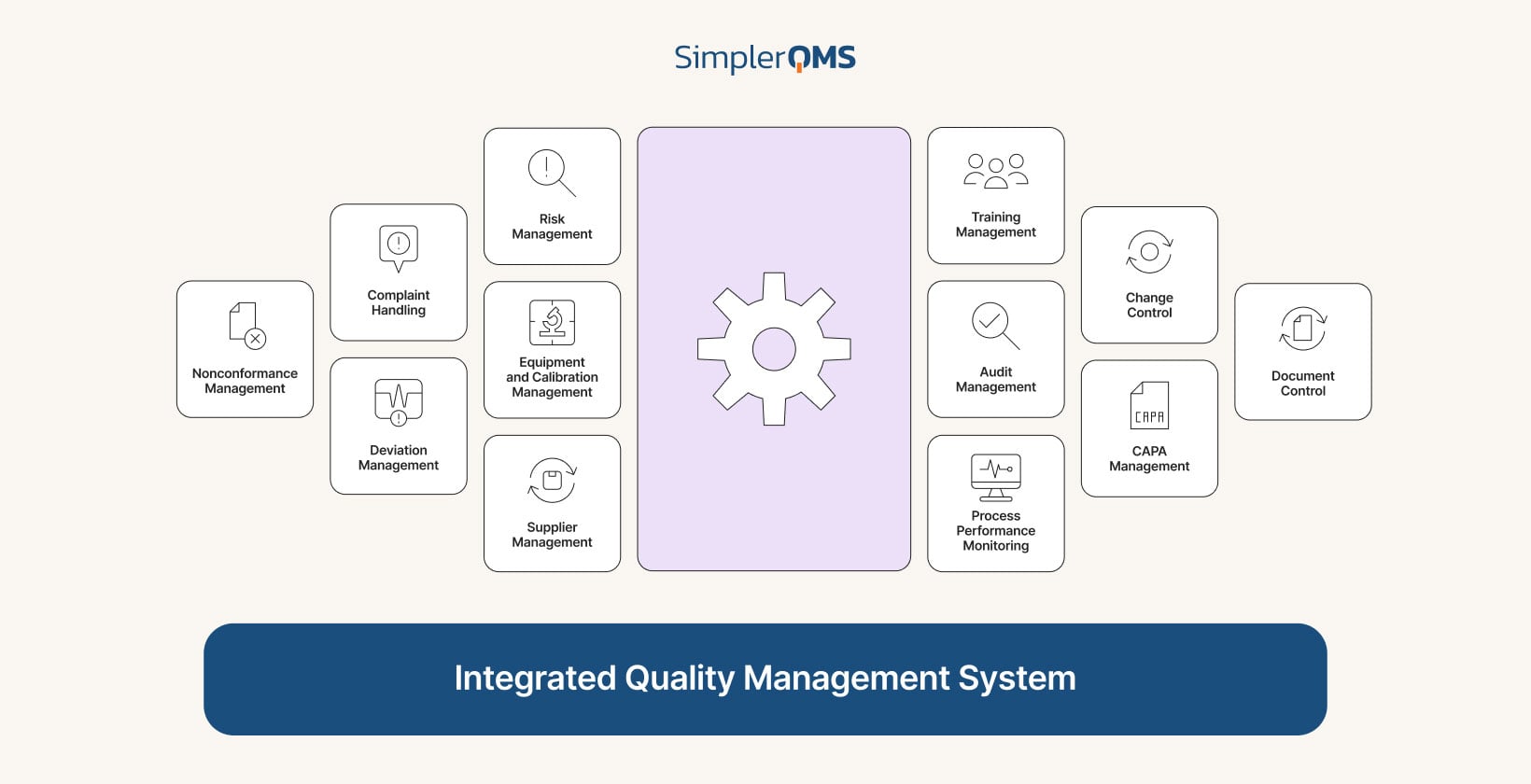
An Integrated Quality Management System (IQMS) is a centralized framework that manages quality-related processes across an organization in one system. An IQMS can form part of an Integrated Management System (IMS). IQMS primarily focuses on quality management activities, while also considering related areas such as risk and compliance, whereas an IMS encompasses areas such as environmental management, health and safety, and information security.
Key IQMS components include document control, change control, training management, nonconformance and deviation management, CAPA management, audit management, risk management, supplier quality management, complaint handling, and equipment and calibration management. IQMS frameworks commonly integrate requirements such as ISO 9001, ISO 13485, FDA 21 CFR Part 820, IATF 16949, AS9100, ISO 15189, ISO/IEC 17025, and industry-specific regulations, including EU GMP or ISO 22000. The integrated standards vary by industry, geography, and product risk class.
Implementing an IQMS improves regulatory compliance, strengthens audit readiness, increases traceability, reduces quality and compliance risk, and supports continuous improvement through standardized workflows. IQMS is implemented across regulated industries, including pharmaceuticals, medical devices, biotechnology, food and beverage, cosmetics, chemical manufacturing, aerospace and defense, and automotive manufacturing.
Organizations implement an IQMS by defining integration needs, securing executive support, mapping core quality processes, selecting IQMS software, standardizing documentation, training cross-functional teams, monitoring performance, conducting audits and management reviews, and driving continuous improvement.
SimplerQMS is QMS software for life science companies, supporting and integrating processes such as document control, change control, training management, CAPA, nonconformance and deviation management, audits, supplier quality, and risk management within a single eQMS platform.
What Is an Integrated Quality Management System (IQMS)?
An Integrated Quality Management System (IQMS) is a centralized quality management framework that manages and connects all quality-related processes across an organization within a single system. An Integrated Quality Management System integrates key components, including document control, nonconformance and corrective and preventive action (CAPA), change management, training management, audit management, risk management, supplier quality management, and regulatory compliance workflows.
In an IQMS, integration means that quality processes are structurally connected rather than managed in isolation. Integrated quality processes share common data, standardized workflows, and centralized visibility, which ensures traceability between documents, training records, deviations, CAPA records, audit findings, and risk controls. This integrated structure improves control over quality activities across the entire product or service lifecycle.
The core objectives of an IQMS are regulatory compliance, continuous improvement, risk reduction, and operational efficiency. An IQMS supports these objectives by harmonizing quality management activities across departments, sites, and functions, maintaining audit readiness, enforcing process consistency, and reducing quality-related errors through automation and centralized oversight.
Compared to a traditional Quality Management System (QMS), an IQMS provides broader and more interconnected quality architecture. A traditional QMS manages individual quality processes as separate modules. An IQMS links the processes into one unified system, improving cross-functional visibility, end-to-end traceability, and coordinated quality decision-making.
What Is the Difference Between IQMS and an Integrated Management System (IMS)?
The core difference between an Integrated Quality Management System (IQMS) and an Integrated Management System (IMS) lies in their scope, focus, and purpose.
An IQMS is quality-centric and focuses on integrating quality processes, compliance activities, and quality workflows such as document control, CAPA, audit management, training management, and risk management within one centralized system.
In contrast, an IMS is a broader organizational framework that connects multiple management systems under a single structure. An IMS combines quality management with other management domains such as environmental management (ISO 14001), occupational health and safety (ISO 45001), and information security (ISO 27001) to create a unified approach to governance, risk control, and organizational compliance.
What Are the Types of Integrated Management Systems?
The most common types of IMS integrate standardized management systems addressing quality, environmental performance, occupational health and safety, energy, food safety, information security, and other regulatory or operational disciplines.
The main IMS types and the standards that govern each system are outlined below.
- Quality Management System (QMS): A Quality Management System focuses on controlling and improving product and process quality to ensure customer satisfaction and regulatory compliance. Quality management systems are aligned with ISO 9001 and other relevant standards such as ISO 13485 for medical devices.
- Environmental Management System (EMS): An Environmental Management System manages environmental responsibilities, reduces environmental impact, and ensures compliance with environmental and sustainability regulations. Environmental management systems are structured according to ISO 14001.
- Occupational Health and Safety Management System (OHSMS): An Occupational Health and Safety Management System prevents workplace injuries, controls occupational risks, and ensures safe working conditions. Occupational health and safety management systems are aligned with ISO 45001.
- Energy Management System (EnMS): An Energy Management System improves energy efficiency, reduces energy consumption, and manages energy performance across organizational operations. Energy management systems are governed by ISO 50001.
- Food Safety Management System (FSMS): A Food Safety Management System ensures that food products remain safe for consumption by controlling food safety hazards throughout the supply chain. Food safety management systems follow ISO 22000 and Hazard Analysis and Critical Control Points (HACCP) principles.
- Information Security Management System (ISMS): An Information Security Management System protects sensitive organizational information by managing risks related to confidentiality, integrity, and availability of data. Information security management systems are implemented according to ISO/IEC 27001.
- Other Integrated Management System Types: Other Integrated Management System types include business continuity management systems (ISO 22301), risk management frameworks, and industry-specific compliance systems that organizations integrate based on operational complexity and regulatory requirements.
What Are the Key Components of an IQMS?
The key components of an IQMS are the interconnected quality processes that ensure consistent quality control, regulatory compliance, and continuous improvement across the organization.
The most common IQMS components are listed below.
- Document Control: Document control manages controlled quality documentation, versioning, approvals, and compliance with standards such as ISO 9001 and ISO 13485.
- Change Control: Change control ensures that process, product, or system changes are reviewed, assessed for risk, approved, and implemented in a compliant manner.
- Training Management: Training management tracks employee qualifications, role-based training, and retraining requirements to maintain regulatory readiness.
- Nonconformance and Deviation Management: Nonconformance and deviation management capture quality events, deviations, and failures to ensure timely investigation and corrective action.
- Corrective and Preventive Action (CAPA) Management: CAPA management supports corrective and preventive actions by identifying root causes, implementing solutions, and preventing recurrence.
- Audit Management: Audit management enables internal and external audit planning, execution, findings tracking, and inspection readiness.
- Risk Management: Risk management integrates risk-based thinking into quality processes and supports compliance with ISO 14971 and regulatory risk management expectations.
- Supplier Quality Management: Supplier quality management controls supplier qualification, monitoring, and performance to ensure external providers meet quality and regulatory requirements.
- Complaint Handling: Complaint handling manages customer complaints through investigation, documentation, regulatory reporting, and linkage to CAPA when required.
- Equipment and Calibration Management: Equipment and calibration management tracks calibration, maintenance, and qualification of equipment to ensure accuracy, reliability, and compliance with Good Manufacturing Practice (GMP) expectations.
- Process Performance Monitoring: Process performance monitoring measures and analyzes process outputs and Key Performance Indicators (KPIs) to detect trends, prevent deviations, and drive continuous improvement.
Document Control
Document control within an IQMS is the structured process of creating, reviewing, approving, and maintaining controlled quality documents in a centralized environment. Document control ensures that employees follow current approved procedures by controlling version history, access permissions, and traceability of approvals.
The primary objectives of document control in an IQMS are maintaining approved procedures, preventing the use of obsolete information, and supporting regulatory compliance.
Document control functions through standardized workflows for document creation, review, approval, version control, distribution, and archival, supported by audit trails and role-based access controls. Key stakeholders involved in document control include quality managers, document owners, process owners, reviewers, approvers, and employees who rely on controlled procedures to perform regulated tasks.
Change Control
Change control manages changes to processes, documents, equipment, products, and computerized systems to protect product quality and maintain regulatory compliance. Change control reduces quality risk by requiring formal review and approval before a change is implemented.
Change control operates through a structured workflow that includes change request submission, impact assessment, risk analysis and evaluation, approval, implementation, and effectiveness verification. The primary objectives of change control are evaluating change impact, preventing unintended quality issues, and maintaining controlled documentation of change history. Key stakeholders include quality managers, process owners, regulatory teams, engineering or manufacturing personnel, and approvers responsible for controlled implementation.
Training Management
Training management ensures that employees remain competent and qualified to perform their roles according to applicable procedures and regulatory requirements. Training management supports compliance by linking training records to controlled documents and job-specific responsibilities.
Training management in an IQMS functions by assigning training based on roles, tracking completion, managing retraining requirements, and documenting evidence of competency for audits and inspections. The core objectives of training management are maintaining workforce competency, ensuring role-based qualification, and supporting audit readiness. Stakeholders include quality teams, training coordinators, department managers, auditors, and employees responsible for completing required training activities.
Nonconformance / Deviation Management
Nonconformance and deviation management control quality events that do not meet approved requirements, specifications, or procedures. This IQMS process protects product quality by ensuring that nonconformances and deviations are documented, investigated, contained, and corrected.
Nonconformance and deviation management follow a workflow that includes nonconformance/deviation reporting, containment actions, impact assessment, investigation, root cause analysis, and CAPA linkage when required. The primary objectives are preventing the release of nonconforming product, ensuring systematic investigation of quality events, and supporting continuous improvement through corrective action. Key stakeholders include quality assurance teams, production or operational staff, process owners, regulatory compliance personnel, and auditors who review deviation handling effectiveness.
CAPA Management
Corrective action and preventive action (CAPA) management is the structured process of investigating quality issues, addressing root causes, and implementing actions to prevent recurrence or occurrence. CAPA management strengthens quality system effectiveness by turning nonconformances, deviations, audit findings, complaints, and trend signals into structured improvement actions.
CAPA management functions through workflows for issue identification, root cause analysis, action planning, corrective action implementation, preventive action implementation, and effectiveness checks. The core objectives of CAPA management are driving continuous improvement, strengthening compliance, and ensuring systematic resolution of quality issues. Key stakeholders include quality managers, process owners, cross-functional investigation teams, regulatory staff, and leadership responsible for oversight of quality improvement activities.
Audit Management
Audit management is the IQMS process that plans, executes, documents, and tracks audits to verify compliance and quality system performance. Audit management supports inspection readiness by ensuring that audit findings are documented, addressed, and closed with traceability.
Audit management includes workflows for audit scheduling, checklist execution, audit reporting, classification of findings, CAPA linkage, and closure tracking. The primary objectives of audit management are identifying gaps in quality processes, maintaining regulatory readiness, and supporting corrective actions and continuous improvement. Stakeholders include internal auditors, quality assurance teams, department managers, regulatory compliance personnel, and external inspectors or certification bodies.
Risk Management
Risk management identifies, assesses, controls, and monitors risks that impact product quality, patient safety, or regulatory compliance. Risk management improves proactive decision-making by integrating risk-based thinking across quality workflows.
Within an IQMS, risk management functions through workflows for risk identification, risk assessment, mitigation planning, residual risk evaluation, and periodic review. The main objectives of risk management are preventing quality failures, prioritizing risk controls, and ensuring effective risk analysis and evaluation across the product and process lifecycle. Stakeholders include quality and regulatory teams, process owners, engineering or manufacturing staff, and leadership responsible for risk-based oversight.
Supplier Quality Management
Supplier quality management ensures that externally provided products and services meet defined quality and regulatory requirements. Supplier quality management reduces supply chain risk by controlling supplier qualification, monitoring performance, and managing supplier-related quality events.
Supplier quality management functions through workflows for supplier evaluation, qualification, approved supplier list management, performance monitoring, supplier audits, and handling of supplier -related quality events. The primary objectives are maintaining consistent material and service quality, reducing supplier-related risks, and supporting compliance with frameworks such as ISO 9001, ISO 13485, and EU GMP. Key stakeholders include quality assurance teams, procurement departments, supplier managers, regulatory compliance personnel, and suppliers responsible for meeting defined quality expectations.
Complaint Handling
Complaint handling manages customer complaints related to product quality, safety, or performance to ensure appropriate investigation and regulatory compliance. Complaint handling supports post-market quality control by detecting trends and escalating issues to CAPA when needed.
Complaint handling operates through workflows for complaint intake, investigation, root cause analysis, CAPA linkage, regulatory reporting when required, and closure with documented evidence. The primary objectives of complaint handling are ensuring timely response to quality concerns, supporting regulatory reporting requirements, and identifying recurring issues through complaint trending. Stakeholders include quality teams, customer service representatives, regulatory affairs personnel, investigation owners, and management responsible for complaint oversight.
Equipment and Calibration Management
Equipment and calibration management control equipment qualification, calibration, maintenance, and performance monitoring to ensure reliable and accurate operations. Equipment and calibration management support quality control by preventing measurement errors and process inconsistencies.
Equipment and calibration management functions through workflows for equipment registration, calibration scheduling, maintenance tracking, deviation handling for out-of-tolerance results, and documentation of calibration certificates and service records. The primary objectives are ensuring equipment reliability, maintaining compliance with GMP expectations, and supporting traceability of calibration status. Key stakeholders include quality assurance personnel, engineering or maintenance teams, laboratory staff, equipment owners, and auditors verifying equipment compliance.
Process Performance Monitoring
Process performance monitoring measures, analyzes, and controls quality-related process outputs to maintain compliance and improve process stability. This IQMS component supports continuous improvement by detecting trends early and preventing deviations before they escalate.
Process performance monitoring functions through workflows for defining KPIs, collecting quality and operational data, performing trend analysis, escalating performance issues, and linking results to CAPA or risk management when required. The primary objectives are detecting process inefficiencies, preventing quality deviations, and enabling data-driven decision-making. Key stakeholders include quality teams, process owners, production or operations managers, compliance personnel, and leadership reviewing performance outcomes and improvement priorities.
What Requirements Are Commonly Integrated into IQMS?
The requirements integrated into an IQMS are the standards, regulations, and industry guidelines that define how organizations must control quality processes, ensure compliance, and maintain consistent performance across regulated operations.
An IQMS commonly integrates the requirements listed below.
- ISO 9001: ISO 9001 is the global standard for quality management systems, focused on process consistency, customer satisfaction, and continual improvement. ISO 9001 applies across industries and provides the foundational quality framework within an IQMS.
- ISO 13485: ISO 13485 is the international standard for medical device quality management systems, emphasizing risk-based controls, design oversight, and regulatory compliance. ISO 13485 applies to medical device manufacturers and suppliers operating in regulated healthcare markets.
- FDA 21 CFR Part 820 (Quality Management System Regulation (QMSR), formerly Quality System Regulation (QSR)): FDA 21 CFR Part 820 defines mandatory quality system requirements for medical device manufacturers in the United States. The regulation ensures that medical devices are designed and produced in compliance with FDA safety and effectiveness expectations.
- IATF 16949: IATF 16949 is the automotive industry quality management standard, built on ISO 9001 with additional requirements for defect prevention, supplier quality, and process control. IATF 16949 applies to automotive manufacturers and suppliers operating in high-reliability production environments.
- AS9100: AS9100 is the aerospace quality management standard that expands ISO 9001 with requirements for product safety, risk management, and traceability. AS9100 applies to aerospace and defense organizations requiring strict compliance and high-assurance manufacturing controls.
- ISO 15189: ISO 15189 specifies quality and competence requirements for medical laboratories, supporting accurate testing, reliable results, and patient safety. ISO 15189 applies to clinical laboratories and diagnostic service providers under healthcare regulatory oversight.
- ISO/IEC 17025: ISO/IEC 17025 defines competence requirements for testing and calibration laboratories, ensuring reliable measurement accuracy and technical validity. ISO/IEC 17025 applies to laboratories that must demonstrate compliance with international testing and calibration standards.
- Other Industry-Specific Regulatory Frameworks: An IQMS integrates additional requirements such as EU GMP for pharmaceuticals, ISO 14001 for environmental management, ISO 45001 for occupational health and safety, or ISO/IEC 27001 for information security, depending on industry and geography. These frameworks extend the IQMS scope beyond core quality management to support broader regulatory and compliance needs.
What Are the Benefits of Implementing an IQMS?
An IQMS delivers measurable benefits across quality, compliance, and operational performance, including improved regulatory compliance, centralized quality management, enhanced traceability, and strengthened audit readiness and inspection preparedness.
The key benefits of implementing an IQMS are as follows.
- Improved Regulatory Compliance: Improved regulatory compliance occurs when an IQMS enforces controlled workflows, standardized documentation practices, and compliance-ready records across all quality activities, helping organizations meet regulatory and quality standard requirements.
- Centralized Quality Management: Centralized quality management is achieved when an IQMS consolidates processes such as document control, CAPA, audits, and training into a unified system, reducing fragmentation and improving oversight.
- Enhanced Traceability: Enhanced traceability results from integrated workflows that connect products, processes, deviations, and corrective actions, supporting faster investigations and stronger regulatory evidence.
- Audit Readiness and Inspection Preparedness: Audit readiness and inspection preparedness are strengthened when an IQMS maintains audit trails, controlled documentation, and real-time quality records, enabling efficient responses to inspections and audits.
- Reduced Quality Risk: Reduced quality risk is achieved when an IQMS embeds risk-based thinking into quality processes to identify, assess, and mitigate compliance and product risks before they escalate.
- Standardized Quality Processes: Standardized quality processes are established when an IQMS supports consistent execution of workflows across departments, sites, and regions, reducing variation and improving reliability.
- Increased Operational Efficiency: Increased operational efficiency occurs when automation and centralized management reduce manual effort, streamline approvals, and accelerate quality-related tasks.
- Faster Issue Identification and Resolution: Faster issue identification and resolution occur when integrated deviation, complaint, and CAPA workflows enable quicker detection of quality issues and more effective resolution through structured root cause analysis.
- Improved Data Integrity and Accuracy: Improved data integrity and accuracy are ensured when an IQMS enforces controlled access, version control, electronic signatures, and secure audit trails that support reliable decision-making.
- Stronger Cross-Functional Collaboration: Stronger cross-functional collaboration is enabled when an IQMS connects workflows across quality, operations, regulatory, engineering, and supplier functions.
- Support for Continuous Improvement: Support for continuous improvement is provided when an IQMS enables organizations to track performance trends, implement corrective actions, and drive ongoing improvement aligned with quality objectives.
- Improved Management Visibility and Reporting: Improved management visibility and reporting are achieved when centralized dashboards and reporting tools provide leadership with real-time insight into quality performance, compliance status, and risk trends.
- Lower Cost of Quality: Lower cost of quality is realized when an IQMS reduces deviations, rework, audit findings, and compliance failures, lowering long-term remediation costs.
- Scalability Across Sites and Regions: Scalability across sites and regions is supported when an IQMS standardizes quality processes globally while maintaining compliance with local regulatory requirements.
What Are the Integrated Quality Management System Examples Across Industries?
Integrated Quality Management System examples across industries show how organizations adapt a centralized quality framework to meet industry-specific regulatory and operational requirements.
Common IQMS implementation examples across industries are listed below.
- Pharmaceuticals: The pharmaceutical industry operates under strict GMP oversight and requires an IQMS that integrates deviation management, CAPA, change control, supplier quality, and validation workflows. Pharmaceutical IQMS implementations follow EU GMP, FDA GMP regulations, ICH Q10, and FDA 21 CFR Part 11 requirements for electronic records and data integrity.
- Medical Devices: Medical device organizations implement IQMS platforms to manage design controls, risk management, complaint handling, post-market surveillance, and regulatory documentation. These systems align with ISO 13485, FDA 21 CFR Part 820, ISO 14971, and EU MDR or IVDR compliance requirements.
- Biotechnology: Biotechnology companies rely on IQMS solutions to support rapid innovation while maintaining regulatory readiness through controlled documentation, training, validation, and audit preparedness. Biotechnology IQMS implementations integrate ISO 9001, GMP expectations, and FDA or EMA regulatory requirements, depending on the product development stage.
- Food and Beverage: Food and beverage manufacturers implement IQMS frameworks to ensure product safety, traceability, supplier controls, and hazard management across production and distribution. These systems integrate with ISO 22000, HACCP principles, and food safety regulatory requirements to reduce contamination risk and support inspection readiness.
- Cosmetics and Personal Care: Cosmetics and personal care organizations use IQMS platforms to manage quality documentation, supplier qualification, batch traceability, and compliance with consumer safety expectations. Industry implementations align with ISO 22716 (Cosmetic GMP), ISO 9001, and regional regulatory guidelines for product safety and labeling.
- Chemical Manufacturing: Chemical manufacturers implement IQMS systems to control process quality, risk management, safety compliance, and environmental obligations. These IQMS frameworks integrate ISO 9001, ISO 14001, ISO 45001, and regulatory requirements related to hazardous material handling and process safety.
- Aerospace and Defense: Aerospace and defense organizations require highly structured IQMS solutions focused on traceability, risk control, supplier oversight, and strict documentation governance. These implementations follow AS9100 standards and defense-related compliance expectations for product safety and reliability.
- Automotive Manufacturing: Automotive manufacturers implement IQMS systems to support defect prevention, supplier performance, production consistency, and continuous improvement across complex supply chains. Automotive IQMS frameworks integrate with IATF 16949, ISO 9001, and industry-specific requirements for process control and quality assurance.
- Electronics and Semiconductor Manufacturing: Electronics and semiconductor companies implement IQMS solutions to manage high-precision manufacturing quality, change control, supplier qualification, and nonconformance handling. These systems integrate ISO 9001 and specialized industry quality frameworks to support reliability and rapid production scalability.
- Manufacturing (General / Industrial): General industrial manufacturers use IQMS platforms to standardize quality processes such as document control, CAPA, audits, training, and operational quality metrics across production environments. These implementations are based on ISO 9001 and expand into safety or environmental systems depending on operational scope.
- Energy and Utilities: Energy and utility organizations implement IQMS frameworks to manage asset reliability, safety compliance, operational risk, and regulatory reporting across large-scale infrastructure. These systems integrate ISO 9001, ISO 45001, ISO 14001, and sector-specific regulatory oversight requirements.
What Are the Steps to Implement an IQMS?
The 10 structured steps organizations follow to successfully implement an IQMS are outlined below.
- Understand Organizational Context and Integration Requirements: Analyze internal and external factors that affect quality, compliance, and operations. In an IQMS, this step includes identifying how quality processes intersect across departments, systems, and regulatory frameworks to define integration requirements.
- Gain Executive Commitment and Allocate Resources: Secure active executive leadership support for the IQMS initiative by setting priorities, approving resources, and promoting cross-functional collaboration. Leadership commitment ensures alignment between quality objectives and business strategy.
- Define Integrated Quality Policy and Objectives: Establish a unified quality policy and measurable quality objectives that guide all quality-related activities. In an IQMS, these objectives are shared across functions to ensure consistent goals, performance expectations, and regulatory alignment.
- Identify and Map Core Integrated Quality Processes: Identify key quality processes such as document control, change control, CAPA, training, audits, and risk management, and map them end-to-end. This step focuses on eliminating silos and defining how processes interact within a single integrated framework.
- Evaluate and Select the Right IQMS Tools: Select an IQMS platform that supports integrated workflows, centralized data management, audit trails, and regulatory compliance. Tool selection prioritizes standardization, scalability, and validation readiness over heavy customization.
- Develop an Integrated Documentation Structure: Create or update quality documentation to reflect standardized, interconnected processes. Policies, procedures, and records are aligned across functions to ensure consistency, traceability, and controlled access within the IQMS.
- Implement the IQMS and Train Cross-Functional Teams: Deploy the IQMS across the organization and train users on integrated processes and system workflows. Training emphasizes role-based responsibilities and how individual activities contribute to overall quality performance.
- Monitor and Measure IQMS Performance: Define and monitor integrated performance metrics to evaluate process effectiveness, compliance status, and risk trends. Centralized reporting provides management with visibility across all quality activities.
- Conduct Internal Audits and Management Reviews: Conduct internal audits to assess the effectiveness of integrated processes and system controls. Use management reviews to evaluate consolidated IQMS data, address gaps, and make informed quality decisions.
- Drive Continuous Improvement of the IQMS: Drive continuous improvement using audit results, performance data, CAPAs, and management feedback. An IQMS supports ongoing optimization by linking improvement actions across processes and departments.
An IQMS implementation generally follows the same foundational steps as a traditional Quality Management System (QMS) implementation, but places stronger emphasis on process integration, cross-functional alignment, and a centralized system architecture that connects all quality activities into a unified framework.
What Are the Common Challenges When Implementing an IQMS?
The common challenges when implementing an IQMS are organizational, technical, and compliance-related obstacles that delay deployment, reduce system effectiveness, or prevent full process integration across the organization.
The most common IQMS implementation challenges are listed below.
- Lack of Cross-Functional Alignment: Lack of cross-functional alignment occurs when IQMS implementation does not properly coordinate Quality, Operations, IT, Regulatory, HR, and other departments. Misalignment between teams leads to inconsistent workflows, conflicting priorities, and fragmented ownership of quality processes.
- Resistance to Change and User Adoption Issues: Resistance to change and user adoption issues arise when employees push back against new workflows, system controls, and standardized processes, especially when transitioning from paper-based or decentralized systems. Low adoption reduces data accuracy, weakens compliance, and limits the value of integration.
- Process Complexity and Over-Customization: Process complexity and over-customization occur when organizations attempt to replicate every legacy workflow inside the IQMS instead of simplifying and standardizing processes. Excessive customization increases implementation time, validation effort, and long-term maintenance cost.
- Data Migration and System Integration Difficulties: Data migration and system integration difficulties arise when documents, training records, CAPAs, audit data, and legacy quality history must be transferred into an IQMS. Integration with ERP, MES, PLM, or HR systems can create technical delays and ongoing synchronization challenges.
- Unclear Requirements and Scope Creep: Unclear requirements and scope creep occur when stakeholders continuously add new modules, processes, or integration requests during IQMS implementation. Poorly defined scope increases cost, delays timelines, and creates confusion about priorities.
- Insufficient Executive Sponsorship: Insufficient executive sponsorship occurs when leadership does not provide adequate funding, internal resources, or enforcement of standardized processes. Weak sponsorship reduces accountability across departments and limits organizational commitment.
- Inadequate Training and Role Clarity: Inadequate training and role clarity occur when organizations fail to provide role-based training and clearly defined responsibilities for each workflow step. When training is incomplete, or roles are unclear, users bypass controls, introduce errors, or fail to follow compliant processes.
- Regulatory Complexity: Regulatory complexity increases implementation effort because IQMS deployment must support requirements such as ISO 9001, ISO 13485, FDA 21 CFR Part 11, EU GMP, and other applicable frameworks. Meeting validation, audit trail, and documentation requirements requires careful system design.
- Poor Data Quality and Inconsistent Records: Poor data quality and inconsistent records create traceability issues when organizations begin IQMS implementation with incomplete, outdated, or inconsistent documentation. These deficiencies increase cleanup effort and compromise audit readiness.
- Scalability and Multi-Site Deployment Challenges: Scalability and multi-site deployment challenges arise when an IQMS is implemented across multiple locations with different languages, regulatory requirements, levels of process maturity, and system readiness. Without strong governance, multi-site deployment leads to inconsistent execution and fragmented quality management.
What Is Integrated Quality Management System Software?
IQMS software is an enterprise-wide digital platform that centralizes, automates, and connects quality management processes in one system to support regulatory compliance, traceability, and continuous improvement across an organization. IQMS software replaces disconnected spreadsheets, paper records, and siloed tools by managing quality workflows, records, and approvals in a controlled, audit-ready environment.
IQMS software includes the core capabilities listed below.
- Centralized Management of Quality Processes and Records: IQMS software stores controlled quality data, documents, and records in a single system to improve consistency, accessibility, and governance across departments and sites.
- Workflow Automation and Approval Controls: IQMS software automates key workflows such as document approvals, CAPA routing, training assignments, and change approvals using predefined rules, role-based responsibilities, and electronic sign-off controls.
- End-to-End Traceability Across Quality Events: IQMS software links related quality activities, such as deviations, CAPAs, complaints, audits, and risk assessments, to support complete traceability and faster root cause investigations.
- Role-Based Access and Audit Trails: IQMS software enforces secure access controls and maintains audit trails that record who performed actions, what was changed, and when changes occurred, supporting compliance with regulated quality standards.
- Reporting, Dashboards, and Quality Analytics: IQMS software provides real-time visibility into quality and compliance performance through dashboards, KPIs, and reporting tools that support management review and continuous improvement.
IQMS software supports and integrates quality processes such as Document Control, Change Control, Training Management, CAPA Management, Nonconformance and Deviation Management, Complaint Handling, Audit Management, Risk Management, Supplier Quality Management, Equipment and Calibration Management, and Process Performance Monitoring.
Compared to paper-based or disconnected systems, IQMS software reduces manual effort by automating workflows and eliminating repetitive administrative tasks. It improves data integrity by standardizing record formats, enforcing required fields, and maintaining controlled versioning. IQMS software strengthens audit readiness by ensuring complete traceability, real-time reporting, and consistently maintained compliance evidence.
SimplerQMS is an example of an integrated Quality Management System (QMS) software for life sciences companies, designed to support regulated environments through a single eQMS platform. SimplerQMS integrates core QMS processes such as document control, change control, training management, CAPA, nonconformance and deviation management, audits, and risk management to help organizations maintain compliance, improve traceability, and reduce the cost and complexity of quality management.
