21 CFR Part 11 is a regulation established by the U.S. Food and Drug Administration (FDA) that defines the requirements under which electronic records and electronic signatures are considered trustworthy, reliable, and equivalent to paper records and handwritten signatures. Achieving 21 CFR Part 11 compliance requires that an organization’s digital systems and processes implement necessary 21 CFR Part 11 controls. These controls include system validation, secure access management, audit trails, and proper handling of electronic records and signatures.
We have provided a detailed 21 CFR Part 11 compliance checklist to assess whether electronic systems, such as electronic Quality Management System (eQMS) or document management system (DMS) platforms, meet the 21 CFR Part 11 regulatory requirements.
Available downloadable free tools to support organizations on their compliance journey are provided below.
- 21 CFR Part 11 Gap Analysis Checklist: To identify areas of non-compliance and corrective actions.
- 21 CFR Part 11 Compliance Checklist: To verify adherence to Part 11 controls.
Both checklists are offered in PDF and Excel formats to support internal audits, system reviews, and ongoing compliance monitoring.
The 21 CFR Part 11 compliance checklist is organized into seven key categories, including validation, audit trails, systems, copies of records, record retention, electronic signatures, and access security. Each category contains targeted questions to assess whether the necessary 21 CFR Part 11 compliance controls are adequately implemented and functioning.
Compliance checklists provide structured guidance aligned with FDA expectations. Compliance checklists help organizations identify gaps, support audits, and standardize record management. These checklists simplify the compliance journey, reduce risk, and drive continuous improvement amid growing regulatory demands in life science organizations.
SimplerQMS is a fully validated eQMS for life science companies, integrating document control, training, CAPA, change control, supplier management, complaints, and more in a 21 CFR Part 11–compliant framework. By embedding FDA, ISO 13485, and EU Annex 11 requirements, SimplerQMS streamlines QMS processes, helps ensure regulatory compliance, and reduces unnecessary administrative work.
Download Free 21 CFR Part 11 Compliance Checklists
Maintaining compliance with FDA 21 CFR Part 11 is essential for audit readiness and ongoing regulatory approval in the life sciences sector. To make this easier, we’ve created two free, practical tools, i.e., a 21 CFR Part 11 Gap Analysis Checklist and a 21 CFR Part 11 Compliance Checklist. Download them today to identify gaps, strengthen controls, and simplify your 21 CFR Part 11 compliance journey.
Download the 21 CFR Part 11 Gap Analysis Checklist, available in both PDF and Excel formats, to review current practices and uncover areas that need alignment with electronic records and signature requirements.
You can download the 21 CFR Part 11 Gap Analysis Checklist by clicking the link below (depending on the preferred format).
Download 21 CFR Part 11 Gap Analysis Checklist PDF version
The image below shows the 21 CFR Part 11 Gap Analysis Checklist in PDF format.

Download 21 CFR Part 11 Gap Analysis Checklist Excel version
The image below shows the 21 CFR Part 11 Gap Analysis Checklist in MS Excel format.
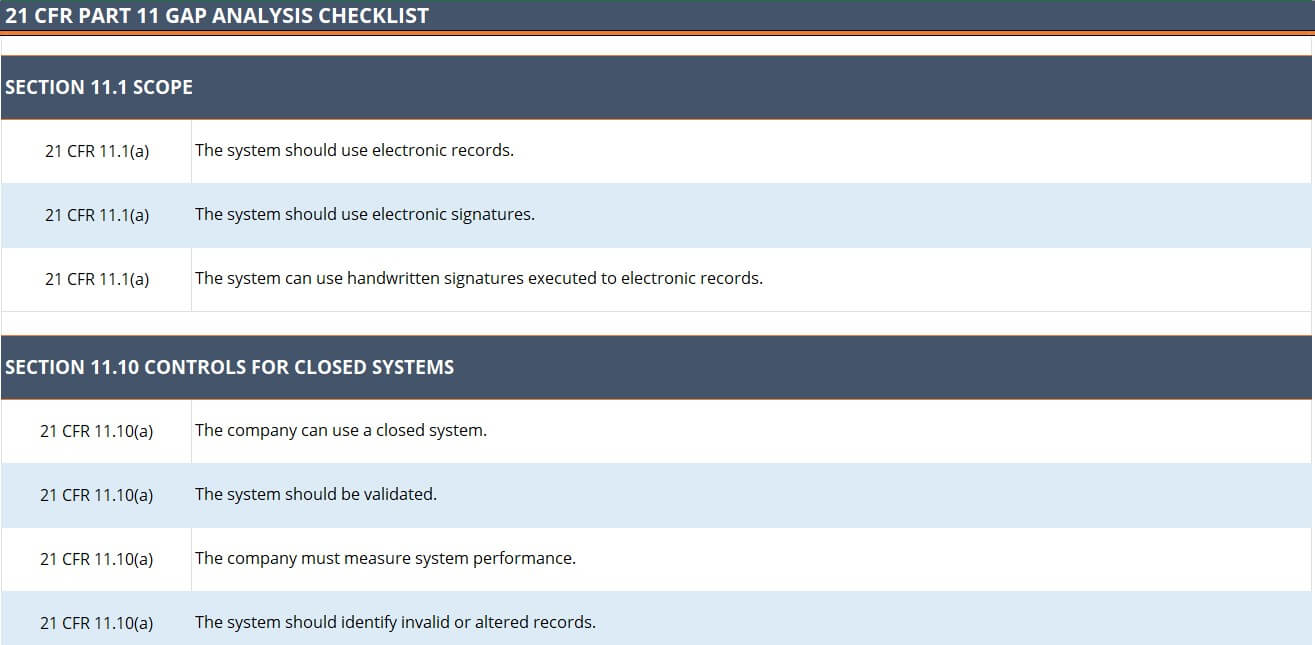
Download the 21 CFR Part 11 Compliance Checklist to confirm your processes meet 21 CFR Part 11 requirements. Our downloadable 21 CFR Part 11 compliance checklist is available in PDF and Excel formats.
Choose your preferred format and download the 21 CFR Part 11 Compliance Checklist using the links below.
Download 21 CFR Part 11 Compliance Checklist PDF version
The image below displays the 21 CFR Part 11 Compliance Checklist in PDF format.

Download 21 CFR Part 11 Compliance Checklist Excel version
Shown below is the 21 CFR Part 11 Compliance Checklist Excel version.

Core Components of a 21 CFR Part 11 Compliance Checklist
The core components of a 21 CFR Part 11 compliance checklist are listed below.
- Validation: Validation of computerized systems is the documented process of proving that a system or software consistently performs according to predefined specifications and quality attributes.
- Audit Trails: An audit trail is a secure, computer-generated log that records the date, time, user identity, and actions taken relating to electronic records
- Systems: Systems refer to the electronic platforms, applications, or software solutions used to manage regulated records and processes.
- Copies of Records: Copies of records are accurate reproductions of original electronic data, available in both human-readable and electronic formats.
- Record Retention: Record retention refers to the secure storage of records for a predefined period, in line with regulatory and business requirements.
- Electronic Signatures: An electronic signature is a digital method of signing a document or record that is legally binding and uniquely identifies the signer.
- Access Security: Access security encompasses the methods and technologies used to control and restrict access to electronic systems and records.
Furthermore, a 21 CFR Part 11 applicability assessment helps determine which systems, processes, and records fall under the scope of 21 CFR Part 11.
Validation
Validation is the documented process of demonstrating that electronic or computerized systems consistently perform as intended and generate accurate, reliable records. Validation is also known as computer system validation (CSV).
Validation safeguards the accuracy, reliability, and integrity of electronic records. Without proper validation, electronic records cannot be relied upon for regulatory submissions or audits, exposing the organization to compliance risks, potential enforcement actions, risk to product quality, patient safety, and other regulatory consequences.
According to 21 CFR Part 11.10(a), any system that creates, modifies, maintains, or transmits electronic records must be validated. To demonstrate compliance, validation activities should be fully documented and performed according to a defined procedure. The validation must include documented evidence that user requirements are met, such as installation qualification (IQ), operational qualification (OQ), and performance qualification (PQ).
In addition, validation should integrate traceability and risk management throughout the lifecycle of the system. Revalidation is required when changes occur that may affect system performance, including software updates, patches, upgrades, or configuration changes.
The key questions to consider for computerized system validation are listed below.
- Validation: Is the system validated?
- Performance: Does the system consistently perform accurately, reliably, and as intended?
- Record Integrity: Can the system detect invalid or altered records?
- Policies: Are there written policies defining accountability and user responsibility for actions taken under electronic signatures?
- Training and Awareness: Are users informed and trained in policies to prevent falsification of records or signatures?
- Training Records: Can you provide documentation showing that personnel who develop, maintain, or use electronic record/signature systems have the necessary training and experience?
- Identity Verification: Is there a documented process to verify user identity before establishing, assigning, or certifying an electronic signature?
- Signature Safeguards: Is the system designed to require collaboration of two or more individuals to prevent misuse of another person’s electronic signature?
SimplerQMS ensures compliance with the validation requirements of 21 CFR Part 11 by delivering a fully validated system aligned with ISPE GAMP5 guidelines. Customers receive complete documentation, including IQ, OQ, PQ, reports, and certificates. Continuous validation support is provided through system updates, thereby removing the burden of internal re-validation and ensuring the system remains audit-ready at all times. SimplerQMS is compliant with EU Annex 11, ISO 13485, and other applicable requirements.
Audit Trails
Audit trails, also known as electronic event records or audit logs, are secure, computer-generated logs that capture details of actions affecting electronic records. Audit trails record who performed an action, what was changed, and when it occurred.
Under 21 CFR Part 11.10(e), audit trail requirements must ensure entries are secure, time-stamped, and automatically generated for all actions that create, modify, and delete electronic records. Each entry must be clearly linked to a specific user action. Audit trails must remain protected from unauthorized alteration or deletion, be independently reviewable, and be retained throughout the entire record lifecycle. They must remain accessible to FDA inspectors during the retention period.
As a foundation of data integrity and ALCOA+ (Attributable, Legible, Contemporaneous, Original, Accurate, Complete, Consistent, Enduring, and Available), audit trails ensure accountability, traceability, and prevent unauthorized changes. Audit trails provide inspectors with critical evidence of proper record management and help identify misuse, errors, or fraud. Without audit trails, electronic records cannot be considered trustworthy in regulated environments.
Key questions to assess audit trail compliance are outlined below.
- Are procedures for document management and change control in place to define how audit trails must be created, maintained, and controlled?
- Does the system generate a secure, computer-based audit trail that records operator entries and actions that create, modify, or delete electronic records?
- Does the audit trail capture the date and time of each operator entry and action?
- When records are changed, is the original information preserved and still accessible (not erased or hidden)?
- Is audit trail documentation retrievable, reviewable, and available for FDA inspection and copying?
SimplerQMS ensures compliance with 21 CFR Part 11 audit trail requirements by providing automated, time-stamped audit trails for every record and user action. Each event is logged with user ID, date, time, and justification, creating secure, non-editable histories that remain fully accessible for audits and inspections.
Systems
Systems are the digital environments used to create, modify, maintain, archive, retrieve, or transmit electronic records.
Under 21 CFR Part 11.10 for closed systems and 11.30 for open systems, the FDA outlines required controls for each system to ensure the integrity of electronic records. A closed system is an environment where access is controlled by individuals responsible for the content of the electronic records on that system. An open system is an environment where access is not controlled by those responsible for the records’ content.
Both types of systems must implement appropriate technical and procedural controls to ensure that electronic records are trustworthy, reliable, and equivalent in integrity to paper records. 21 CFR Part 11 open and closed systems requirements include the following for both open and closed systems.
- Validated for accuracy, reliability, and consistent performance.
- Equipped with secure user authentication and access management.
- Designed to generate tamper-proof audit trails automatically.
- Capable of producing accurate copies of records for inspection.
- Operated under documented policies and procedures.
Compliance with these requirements ensures that systems support secure, reliable electronic records and protect data integrity in FDA-regulated operations. Non-compliance can lead to regulatory findings that could threaten product approval or distribution, and create risks to product quality and patient safety.
To ensure system compliance, you can use the following questions.
- Does the company use electronic records?
- Does the company use electronic signatures?
- Does the company use handwritten signatures executed on electronic records?
- Does the company use electronic signatures based on biometrics?
- Does the system prevent biometric signatures from being used by anyone other than their genuine owners?
- Is the system designed to ensure only authorized individuals can access and perform actions?
- Does the system prevent unauthorized access to operations or computer input/output devices?
- Does an open system comply with the procedures and controls identified in §11.10?
- Does an open system employ additional controls (e.g., encryption, digital signatures) to ensure record authenticity, integrity, and confidentiality?
- Is there a procedure for device checks to verify the validity of data input sources or operational instructions?
- Are authority checks used to ensure that only authorized individuals can use the system, electronically sign records, access system inputs/outputs, alter records, or perform the operation at hand?
- Does the system enforce operational checks to ensure actions are performed in the correct sequence?
- Are there appropriate controls in place for the distribution of system documentation?
- Are revision and change control procedures in place that maintain an audit trail for the development and modification of systems documentation?
- Is there an access control procedure to ensure only authorized users can access system operation and maintenance documentation?
- Is there a procedure to ensure proper use of documentation for operation and maintenance?
SimplerQMS supports 21 CFR Part 11 system requirements by delivering a fully validated electronic Quality Management System (eQMS) with integrated role-based access control, encrypted audit trails, and compliant electronic signatures.
Copies of Records
Copies of records represent a system’s ability to generate accurate and complete reproductions of electronic records, both in electronic and human-readable formats.
Systems must be capable of producing reliable and comprehensive copies of records as mandated by 21 CFR Part 11.10(b). Systems must generate these copies of records on demand, preserve the permanent linkage of electronic signatures to their corresponding records, and deliver them in formats suitable for FDA inspectors. Additional safeguards must prevent unauthorized changes during the copy process.
Ensuring compliance in generating copies of records is critical for maintaining data integrity and enabling regulatory bodies to access trustworthy original and reproduced records during audits or reviews. Failure to provide accurate copies of records can lead to data integrity issues, inspection observations, or enforcement actions.
Questions to ensure record copy compliance are listed below.
- Is the system capable of producing accurate and complete copies of electronic records?
- Are electronic signatures permanently linked to their respective records, preventing removal, copying, or transfer?
- Can all electronic records be provided to the FDA for inspection and review in an acceptable format?
- Are records protected from unauthorized changes by requiring authorization checks during the copy process?
SimplerQMS ensures compliance with copies of records outlined in 21 CFR Part 11 by automatically binding electronic signatures to records, preventing manipulation. SimplerQMS enables controlled print and download operations while logging each output to ensure accurate, verifiable copies are always available for both digital and paper-based reviews.
Record Retention
Record retention requires that digital records remain accurate, complete, secure, and retrievable for their entire retention period, defined by applicable predicate rules.
Under 21 CFR Part 11.10(c), organizations must preserve electronic records for the required duration. Key compliance requirements are outlined below.
- Securing records within a validated system.
- Maintaining complete signature details (name, date, time, and intent).
- Retaining audit trails for the same retention period.
- Ensuring records are retrievable without delay during audits or inspections.
- Aligning retention policies with both predicate rules and internal governance.
Effective record retention allows regulators to confirm product quality, safety, and compliance long after data is created. Noncompliance risks include inspection findings, legal or regulatory actions, and potential impacts on product approval or continued distribution.
The following checklist provides key questions to ensure compliance with record retention requirements.
- Do signed electronic records contain the signer’s printed name?
- Do signed electronic records show the date and time of signature execution?
- Do signed electronic records indicate the meaning of the signature (e.g., review, approval, responsibility, authorship)?
- Is the control level for signature information equivalent to that of the electronic records themselves?
- Are electronic records maintained in a manner that preserves accuracy, completeness, and integrity for the entire required retention period?
- Are electronic records readily retrievable throughout the entire retention period?
- Is audit trail documentation retained and retrievable for the entire retention period of the related records?
SimplerQMS ensures full compliance with record retention requirements under 21 CFR Part 11 by retaining all records with associated signatures intact and preserving audit trails throughout the retention lifecycle. SimplerQMS provides rapid search and retrieval capabilities, ensuring compliance with FDA and predicate rule requirements.
Electronic Signatures
Electronic signatures or digital sign-offs are legally binding digital equivalents of handwritten signatures. Electronic signatures are uniquely assigned to individuals to verify identity, approve records, and ensure accountability in regulated environments.
Electronic signatures must be unique, securely authenticated, and legally equivalent to handwritten signatures according to 21 CFR Part 11.100 and 11.200. Organizations must ensure the following.
- Each user has a unique signature permanently bound to their records, which must not be reused or reassigned.
- Signatures require at least two factors of identification (e.g., username and password).
- Users are trained and acknowledge the legal equivalence of their electronic signature.
Proper implementation supports accountability, data integrity, and regulatory trust. Noncompliance may result in rejected records, failed audits, or regulatory penalties. Improperly controlled electronic signatures can undermine confidence in key decisions that directly affect product quality.
To ensure compliance with electronic signature requirements, check the following steps.
- Are electronic signatures restricted to authorized users only?
- Does each user have a unique electronic signature?
- Are signatures used solely by their genuine owners?
- Do electronic signatures require at least two identification components (e.g., ID code and password)?
- Does the system require all signature components for the first signature in a series during one system access?
- Does the system require at least one component for subsequent signatures within the same access?
- Does the system require all signature components when signing during multiple system accesses?
- Is there a procedure preventing signatures from being reassigned or reused?
- Have users signed an Electronic Signature Agreement acknowledging equivalence to a handwritten signature?
- Has the company submitted certification to the FDA for all users applying electronic signatures on or after August 20, 1997?
- Has the company followed FDA guidelines for Letters of Non-Repudiation Agreement to certify electronic signatures?
- Are users aware that the FDA may require additional certification or testimony confirming the equivalence of electronic to handwritten signatures?
SimplerQMS ensures compliance with 21 CFR Part 11 electronic requirements by enforcing two-factor authentication for all signatures, permanently linking signatures to records, and displaying signer information such as name, date, time, and meaning of signing (e.g., review, approval, responsibility, or authorship). Users are required to acknowledge the equivalence of electronic and handwritten signatures.
Access Security
Access security refers to the controls that ensure only authorized individuals can enter electronic systems, sign records, and perform regulated activities. These access security controls rely on unique identification codes, password protections, and formal procedures to safeguard system integrity.
Under 21 CFR Part 11.300, organizations must implement strict controls for identification codes, passwords, and access management. Compliance with access security requires the following.
- Assigning each user a unique ID and password.
- Periodically updating and expiring passwords.
- Promptly revoking credentials when staff leave.
- Disabling accounts when credentials are lost or compromised.
- Implementing safeguards and monitoring systems for unauthorized access attempts.
- Regularly verifying the validity of identification codes and associated devices.
Effective access security prevents unauthorized system use and protects records from tampering. Weak controls expose organizations to data breaches, falsified records, failed inspections, and potential risks to patient safety.
Ensure access security by checking off the following.
- Are controls in place to ensure each individual has a unique identification code and password combination?
- Does the system prevent the creation of duplicate identification code and password combinations?
- Are passwords required to expire and be updated periodically?
- Are procedures established to recall or revise identification codes and passwords when necessary?
- Is there a process to periodically verify the validity of identification codes and password combinations recorded in the system?
- Are procedures in place to revoke identification codes and passwords that may have been compromised?
- Is there a process to promptly revoke credentials when an individual leaves the company?
- Is there a procedure to disable lost, stolen, or missing devices to protect access and sensitive data?
- Are password replacements (temporary or permanent) issued using rigorous controls?
- Does the system detect and log attempts of unauthorized use of passwords and identification codes?
- Is the system security unit immediately informed of unauthorized access attempts?
- Is organizational management notified of unauthorized access attempts, where appropriate?
- Does the company perform initial testing of devices that generate or store identification codes or password information?
- Does the company conduct periodic testing to confirm that devices continue to function properly?
- Is there a procedure to test devices for unauthorized alterations that could compromise identification codes or password information?
SimplerQMS supports compliance with 21 CFR Part 11 requirements for password controls and access security by leveraging Microsoft Entra ID or Google Workspace for secure authentication. Each user is assigned a unique account with role-based permissions, supported by strong password policies and expiration rules. Login activity is continuously monitored, and inactive or compromised accounts are disabled after a specified time of inactivity.
How to Achieve FDA 21 CFR Part 11 Compliance?
To achieve FDA 21 CFR Part 11 compliance, the following steps are recommended.
- Validate Systems: Organizations must perform risk-based validation, such as IQ/OQ/PQ, to prove system reliability, accuracy, and consistent performance. This ensures that electronic systems produce trustworthy data across GxP environments.
- Implement Audit Trails: 21 CFR Part 11 requires time-stamped, tamper-proof logs that capture user actions, prevent unauthorized deletion or alteration, and guarantee traceability for FDA inspections.
- Control Access Security: Compliance with 21 CFR Part 11 requires unique user IDs, role-based permissions, and strong authentication methods. Organizations must monitor systems for unauthorized access and revoke credentials promptly when personnel leave.
- Manage Electronic Signatures: Electronic signatures must be unique and non-transferable and use two identification factors (e.g., password + username), with signatures permanently linked to records to ensure accountability and prevent repudiation.
- Provide Copies of Records: Systems must be capable of producing accurate and complete copies of records in both electronic and human-readable formats for submission or review during regulatory audits.
- Retain Records Securely: Organizations must maintain records in secure archives with reliable retrieval capabilities, ensuring they remain accessible and unaltered for the mandated retention period.
- Establish Policies and Procedures: Companies must implement standard operating procedures (SOPs) covering validation, system use, signature accountability, and staff responsibilities to demonstrate structured compliance management.
- Train Personnel: Organizations must maintain 21 CFR Part 11 compliant training records demonstrating that personnel are qualified to operate electronic record and electronic signature systems and perform assigned tasks in compliance with regulatory requirements.
- Maintain Continuous Compliance: Maintaining compliance involves system revalidation after updates, monitoring audit trails, and conducting internal audits to maintain readiness for FDA inspections.
How SimplerQMS Ensures FDA 21 CFR Part 11 Compliance?
SimplerQMS is a life science electronic Quality Management System (eQMS) that ensures FDA 21 CFR Part 11 compliance through built-in controls and features aligned with 21 CFR Part 11 requirements. SimplerQMS enables pharmaceutical, biotechnology, medical device, and related organizations to manage quality management processes digitally.
Compliance with FDA 21 CFR Part 11 of SimplerQMS is achieved through the following key features.
- Validated implementation based on GAMP5 guidelines with continuous updates.
- Automatic, time-stamped audit trails for all record actions.
- Unique, multi-factor electronic signatures are permanently bound to records.
- Robust access security via Microsoft Entra ID or Google Workspace with role-based permissions and strong authentication.
- Controlled printing and export to ensure accurate, complete copies.
- Secure long-term record retention with reliable retrieval.
As FDA 21 CFR Part 11 compliant software, SimplerQMS not only provides secure electronic records and signatures, but also supports broader QMS processes such as document control, training management, change control, corrective and preventive action (CAPA), supplier management, complaint handling, and more. Additionally, our eQMS software supports compliance with various life science requirements, including ISO 9001:2015, ISO 13485:2016, FDA 21 CFR Part 210, 211, and 820, EU GMP Annex 11, EU GMP, and more.
