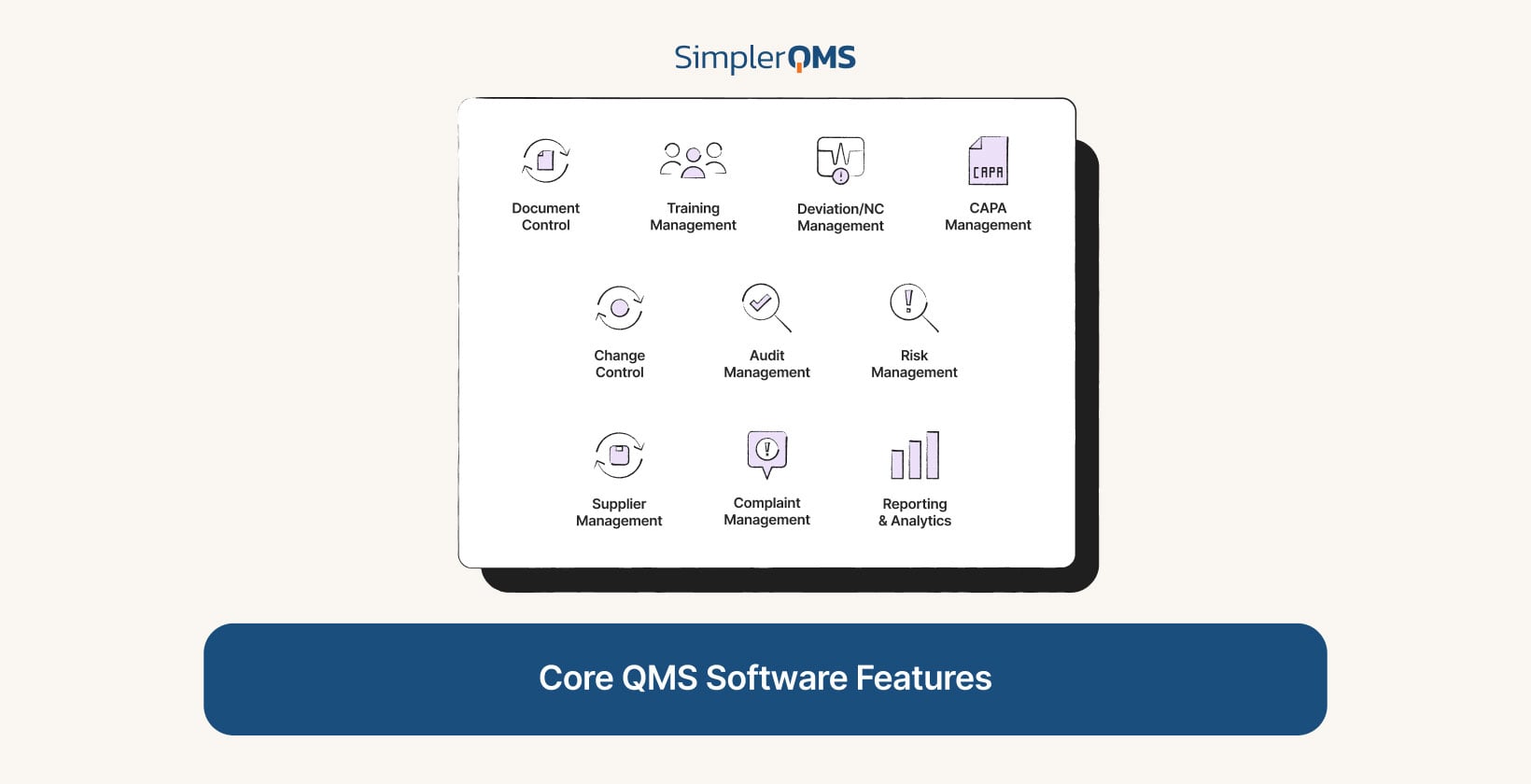
Core QMS software features are essential QMS system functions that control quality processes, ensure regulatory compliance, maintain traceability, and support continuous improvement across the entire quality lifecycle.
The 10 core QMS software feature examples are listed below.
- Document Control and Management: Document control and management enable the controlled process flow of documents, such as SOPs, policies, and protocols, through defined workflows for creation, approval, versioning, obsolescence, and periodic review. Document control helps maintain quality records and appropriately store them to ensure data integrity.
- Training Management: Training management ensures personnel competency by assigning required procedures and documentation through a user training matrix and role-based training assignments. Training management facilitates real-time tracking of completion status, ensures training effectiveness verification, and supports audit readiness by maintaining complete training histories.
- Corrective Action and Preventive Action (CAPA) Management: CAPA management captures quality issues, initiates root cause analysis, and tracks resolution workflows. CAPA management includes verification steps to ensure effectiveness and prevent recurrence, while linking CAPA activities to related risk management, change control, and audit processes.
- Change Management or Change Control: Change management manages changes to products, processes, or validated systems through a structured workflow and impact assessment. Change management enforces formal approvals, risk and impact assessments, and traceability through workflow automation, ensuring full documentation for compliance.
- Audit and Inspection Management: Audit and inspection management supports planning, execution, and documentation of internal audits and regulatory inspections while tracking findings, corrective actions, and follow-up activities.
- Risk Management: Risk management in QMS software identifies and assesses risks across the product lifecycle. Risk management ensures risk mitigation, links identified risks to appropriate controls and CAPAs, and supports proactive decision-making using real-time data and analytics.
- Deviation and Nonconformance Management: Deviation and nonconformance management captures, logs, and investigates events where products, processes, or systems deviate from approved procedures or specifications.
- Supplier Quality Management: Supplier quality management qualifies, monitors, and audits suppliers to ensure materials and services meet quality and regulatory requirements. Supplier quality management links supplier risks and quality issues to CAPA and risk registers, enhancing overall quality oversight in the supply chain.
- Complaint Management: Complaint management is the structured intake, evaluation, investigation, and resolution of customer complaints within QMS software. Complaint handling ensures that the potential impact on product quality, patient safety, and regulatory obligations is assessed.
- Reporting, Dashboards, and Analytics: Reporting, dashboards, and analytics deliver real-time visibility through configurable dashboards, enabling performance tracking, trend analysis, and management review. These features support operational excellence, data-driven quality strategies, and informed decisions.
In addition to the core QMS features, life science organizations often implement additional QMS modules to support more complex regulatory and operational requirements. These QMS features include validation, design control, post-market surveillance, regulatory reporting, equipment and calibration management, electronic batch record management, and more. These capabilities are critical for meeting strict regulatory expectations, ensuring data integrity, and minimizing inspection burdens.
SimplerQMS offers all core QMS software functions essential to life science organizations, such as pharmaceutical, medical devices, and biotechnology companies, in a fully validated system. SimplerQMS unifies quality documentation, training, CAPA, change control, audits, and other features into a single, validated platform. This reduces validation workload, strengthens compliance, and enables scalable growth for regulated organizations.
Document Control and Management
Document control and management is the structured control of quality documents and records across their full lifecycle within QMS software. Document control and management enable the controlled process flow of documents, such as SOPs, policies, and protocols, through defined workflows for creation, approval, versioning, obsolescence, and periodic review.
Document control and management ensure that procedures, records, and forms remain accurate, authorized, and readily accessible. Document control and management directly support process consistency, data integrity, and inspection readiness, making it a core feature of QMS software.
Document control and management functions through embedded workflows that streamline review, approval with electronic signatures, and release of quality documents. The system routes content through predefined steps, locks approved versions from edits, and automatically enforces version control and obsolescence, ensuring only current, authorized documents are accessible for use.
The primary functions of document control and management are listed below.
- Document Lifecycle Control: Document control and management manage creation, review, approval, revision, distribution, periodic review, retirement, and archiving of documents.
- Version Control: Document control and management ensure only the latest approved version is available for use while preserving prior versions.
- Access and Permission Control: Document control and management restrict document access based on roles and responsibilities.
- Change Tracking and History: Document control and management have a full audit trail that records all document changes with timestamps, authors, and reasons.
- Document Linking and Traceability: Document control and management link documents to relevant processes such as training, CAPAs, change control, audits, and risk management.
The main benefits of document control and management are listed below.
- Regulatory Compliance: Document control and management ensure alignment with requirements such as FDA 21 CFR Part 11, ISO 9001, and GxP by maintaining validated document versions, approved workflows, and audit trails that demonstrate compliance.
- Process Consistency: Document control and management enforce the use of current, approved procedures across departments. Document control and management minimize variability by providing standardized instructions, reducing the risk of deviation in operational execution.
- Audit Readiness: Document control and management provide immediate access to document history, approvals, and change logs, enabling regulatory inspectors and internal auditors to verify compliance in real time.
- Operational Efficiency: Document control and management reduce manual distribution, retrieval, and revision processes by automating document workflows. Document control and management cut down rework, minimize human error, and accelerate approval cycles, improving overall efficiency.
- Traceability: Document control and management link documents to other processes such as training records, CAPAs, risk assessments, and quality events. Document control and management create a traceable document lifecycle that supports decision-making and accountability across the quality management system.
On the other hand, risks arise when document control and management features are missing or poorly implemented. These risks are listed below.
- Incomplete Audit Trails: Document control and management weaknesses can lead to missing timestamps, unverified edits, or gaps in user accountability, undermining traceability and compliance with relevant requirements and standards.
- Regulatory Findings: Document control and management failures often result in nonconformities during regulatory inspections. Auditors may cite issues such as a lack of version control, outdated SOPs, or missing approvals as major violations.
- Process Inconsistency: Document control and management gaps contribute to inconsistent execution across departments. Teams may follow obsolete or conflicting procedures, increasing the risk of errors and quality deviations without centralized control.
- Loss of Data Integrity: Document control and management weaknesses expose organizations to data integrity risks, including unauthorized changes, document duplication, and missing digital signatures, in violation of requirements such as 21 CFR Part 11 and GxP guidelines.
- Outdated Procedures in Use: Document control and management failures allow obsolete documents to circulate, resulting in procedural errors, safety risks, and diminished confidence in the overall quality system.
Training Management
Training management is the controlled planning, execution, tracking, and verification of personnel training within QMS software. Training management is a core eQMS feature because regulatory compliance requires documented proof that personnel are trained and qualified for their assigned roles and responsibilities.
Training management functions through assigning training based on approved or updated documents. The system provides real-time visibility into training status, ensuring ongoing compliance across all roles.
The primary functions of training management in a QMS software are the following.
- Training Assignment Control: Training management assigns learning tasks based on user role, department, process ownership, or document type. Training assignment control ensures targeted training delivery and role-based access to controlled procedures.
- Training Record Management: Training management maintains complete, time-stamped records of all completed training events. Each record includes user identification, training content, dates, and status, ensuring audit readiness and compliance tracking.
- Curriculum and Matrix Management: Training management organizes training requirements into structured curricula and training matrices. The training matrix provides visibility into user qualifications, cross-training needs, and overall compliance status by job function.
- Training Effectiveness Verification: Training management verifies comprehension through assessments, acknowledgments, and quizzes. Training effectiveness confirms understanding of quality procedures and supports regulatory requirements for documented competency.
- Training Linkage and Traceability: Training management links training activities to controlled documents, change controls, CAPAs, audits, and job roles. The linkage creates a traceable learning lifecycle connected to broader quality system events.
The main benefits of training management are the following.
- Regulatory Compliance: Training management fulfills documented training and competency requirements outlined in various life science requirements such as ISO 9001, ISO 13485, and GxP regulations. Training management ensures that employees are prepared before performing activities that impact quality.
- Reduced Operational Risk: Training management restricts access to controlled processes until training is completed and verified. Training management prevents unqualified personnel from executing regulated tasks, reducing the risk of deviations, errors, or safety incidents.
- Audit Readiness: Training management maintains real-time, audit-ready records of completed training. Readily available training records provide inspectors and internal auditors with instant access to personnel qualifications, training dates, and completion status by role and document.
- Process Consistency: Training management ensures that staff consistently follow approved procedures by aligning training to current SOPs and revisions. Training minimizes execution variability across departments and locations.
- Organizational Transparency: Training management offers centralized dashboards and reports that display training gaps, overdue assignments, and qualification status by user, department, or process. The visibility of training dashboards supports proactive compliance and workforce planning.
Several risks may arise if the training management feature is missing or poorly implemented, as described below.
- Unqualified Personnel: Gaps in training management permit individuals to perform tasks without verified competencies, increasing the likelihood of procedural errors, product quality issues, and regulatory violations.
- Regulatory Findings: Training management failures result in audit observations and formal nonconformities. Inspectors may cite insufficient training records, outdated curricula, or a lack of role-based qualification controls as compliance breaches.
- Inconsistent Process Execution: Training management weaknesses cause variation in how tasks are performed. Without enforced alignment of training with updated SOPs, teams may rely on outdated practices, compromising quality and consistency.
- Incomplete Training Evidence: Training management deficiencies prevent organizations from producing complete training documentation during inspections, potentially resulting in citations or penalties for noncompliance.
- Delayed Change Implementation: Gaps in training implementation may delay the rollout of revised procedures or critical updates. Without timely training linked to procedural changes, organizations face lagging compliance and increased exposure to risk.
CAPA Management (Corrective and Preventive Actions)
CAPA management is the structured handling of corrective and preventive actions within QMS software. CAPA management is a core QMS software feature because regulatory and quality standards require documented investigation, root cause analysis, corrective measures, preventive actions, and verification of effectiveness for quality issues. CAPA management ensures systematic resolution of nonconformities and supports continuous improvement.
CAPA management functions through controlled workflows that guide users from issue identification to resolution. The system enforces investigation and root cause analysis before approving actions, tracks execution progress and deadlines, and maintains complete, traceable records from initiation through closure.
CAPA management’s primary functions are listed below.
- Issue Intake and Categorization: CAPA management captures quality events originating from deviations, audits, customer complaints, nonconformances, and data trends. CAPA management features may also allow to categorize issues by severity, source, and product impact to prioritize investigation.
- Root Cause Analysis (RCA): CAPA management documents structured root cause analysis using tools like 5 Whys, Fishbone Diagrams, or Fault Tree Analysis. RCA provides a defensible rationale for CAPA initiation, ensuring accountability and compliance.
- Action Planning and Assignment: CAPA management defines targeted corrective and preventive actions, assigns responsible owners, and sets due dates with escalation workflows. Action planning and assignment ensure timely resolution and visibility across functional teams.
- Effectiveness Verification: CAPA Management verifies that implemented actions have eliminated the root cause and prevented recurrence. Verification results are documented and required before CAPA closure, supporting audit readiness and compliance.
- Traceability and Linkage: CAPA management links each CAPA to associated documents, changes, training updates, risk assessments, and audit findings. Linkage of CAPA management to other QMS features creates a traceable CAPA lifecycle integrated across the QMS for systemic oversight.
The main benefits of CAPA management are listed below.
- Regulatory Compliance: CAPA management fulfills requirements from FDA, ISO, and ICH by documenting corrective and preventive actions (CAPAs) with traceable workflows, root cause analysis, and effectiveness verification.
- Risk Reduction: CAPA management identifies, resolves, and eliminates the root causes of quality issues to prevent recurrence. Linking CAPAs to risk assessments and process controls strengthens the organization’s overall risk posture.
- Continuous Improvement: CAPA management supports data-driven decision-making by analyzing trends in nonconformances, audits, and complaints. CAPA management enables long-term process improvements aligned with operational excellence and lean quality principles.
- Audit Readiness: CAPA management maintains comprehensive, time-stamped CAPA histories, including investigation results, action plans, and verification outcomes. These CAPA records support inspection readiness and demonstrate a closed-loop quality system.
- Organizational Accountability: CAPA management assigns ownership to individuals for each step in the CAPA process and enforces deadlines through escalation and task tracking. Assignment of CAPA fosters accountability, transparency, and cross-functional engagement.
Several risks arise when CAPA management is inadequately implemented.
- Recurring Quality Issues: Inadequate CAPA implementation may result in unresolved root causes, allowing the same deviations, complaints, or audit findings to resurface. Recurring issues undermine quality assurance and contribute to chronic process instability.
- Regulatory Nonconformities: CAPA management failures often lead to formal audit findings, observations, or warning letters. Incomplete or undocumented CAPAs are viewed as signs of a deficient quality system during inspections.
- Incomplete Investigations: Weak CAPA management may result in shallow or unsupported root cause analysis. Without structured methodologies, organizations miss critical insights, reducing the effectiveness of corrective actions.
- Lack of Traceability: Deficiencies in CAPA management prevent proper linkage between issues and follow-up actions. Without integration with training, documents, or risk assessments, CAPAs become isolated and ineffective.
CAPA Management gaps prevent linkage between issues and actions. - Loss of Quality Oversight: Gaps in CAPA management diminish visibility into systemic risks and recurring problems. This reduces leadership’s ability to enforce accountability, identify trends, and drive continuous improvement initiatives.
Change Management (Change Control)
Change management, also known as change control, is the controlled evaluation, approval, implementation, and documentation of changes within QMS software. Change management is a core eQMS feature because regulated environments require formal control over changes that may affect product quality, compliance, or data integrity. Change management ensures changes are assessed and reviewed for risks, approved, and traceable before execution.
Change management or change control functions through structured workflows that control how changes are proposed, evaluated, and approved. It enforces documented impact analysis before any approval, blocks unauthorized implementation, and preserves a complete change history from initiation to closure for traceability and compliance.
The primary functions of change management are listed below.
- Change Request Initiation: Change management captures proposed modifications to documents, products, processes, systems, and suppliers. Requests are logged with rationale, source, and category to initiate controlled evaluation workflows.
- Impact and Risk Assessment: Change management performs cross-functional impact analysis covering quality, operations, risk, regulatory compliance, validation requirements, and training needs. This step ensures that changes are fully scoped before approval.
- Review and Approval Workflows: Change management routes proposed changes through predefined, risk-based approval workflows. Reviewers are assigned by function or process area, and digital signatures ensure accountability and traceability.
- Implementation Tracking: Change management tracks execution tasks, timelines, and responsible owners. Implementation status is updated in real time, and overdue tasks can trigger automated escalations to maintain compliance timelines.
- Traceability and Linkage: Change management maintains complete traceability by linking each change to associated documents, CAPAs, risk assessments, training updates, and validation records. Traceability and linkage ensure end-to-end visibility across the QMS.
The main benefits of change management are as follows.
- Regulatory Compliance: Change management fulfills global regulatory requirements for documented change control as mandated by FDA, ISO, GxP, and ICH guidelines. Structured evaluations, approvals, and traceable implementation demonstrate compliance.
- Risk Control: Change management prevents quality and safety issues by identifying and mitigating risks before implementation. It prevents uncontrolled changes from impacting validated systems, products, or procedures.
- Process Stability: Change management maintains consistency in validated processes by ensuring that only approved changes are implemented. It helps preserve product quality, reduce variability, and maintain inspection readiness.
- Audit Readiness: Change management maintains full change histories, including justification, approvals, impact assessments, and outcomes. These records support regulatory inspections and internal audits with defensible traceability.
- Cross-Functional Alignment: Change management coordinates quality, regulatory, operations, and IT stakeholders through role-based workflows. Change management promotes organizational alignment and accountability in the implementation of complex changes.
Risks relating to poor implementation of change management include the following.
- Regulatory Noncompliance: Change management failures violate requirements such as FDA, ISO, and GxP requirements for documented change control. Unapproved changes can trigger audit findings, observations, and warning letters during inspections.
- Uncontrolled Process Changes: Change management gaps allow changes to validated systems, procedures, or products without risk evaluation or documentation. This disrupts process stability, product quality, and inspection readiness.
- Incomplete Impact Assessments: Weak change management can overlook effects on training, risk, validation, or regulatory filings. Poorly scoped changes introduce downstream compliance gaps and operational errors.
- Traceability Breakdowns: Change management deficiencies prevent proper linkage between change requests and associated CAPAs, documents, risks, or training updates. This fragmentation undermines lifecycle traceability and accountability.
- Cross-Functional Misalignment: Change management failures reduce visibility and coordination between departments. Without structured review and approval workflows, changes proceed without full stakeholder input, increasing the chance of rework and failure.
Audit and Inspection Management
Audit and inspection management is the structured planning, execution, documentation, and follow-up of audits within QMS software. Audit management is a core eQMS feature because regulatory compliance requires formal, traceable audits to evaluate quality systems, suppliers, and processes. Audit management ensures objective oversight and readiness for inspections.
Audit and inspection management functions through predefined workflows that guide auditors using structured checklists. From an auditee perspective, the platform stores audit reports and links findings to other QMS processes, such as CAPA management. Audit and inspection management captures audit findings, tracks corrective actions, and verifies closure to ensure all issues are resolved and documented for regulatory compliance.
The main functions of audit and inspection management are listed below.
- Audit Planning and Scheduling: Audit and inspection management defines audit scope, frequency, and type, such as internal, supplier, and regulatory, and assigns qualified auditors. Schedules are risk-based and support proactive compliance monitoring.
- Audit Execution and Documentation: Audit and inspection management guides auditors through checklists and predefined workflows. It records activities, observations, and evidence in a secure, structured, and time-stamped format.
- Finding Classification: Audit and inspection management categorizes findings by severity (e.g., minor, major, critical) and assesses regulatory, quality, or operational impact. Classification supports prioritization and structured CAPA initiation.
- CAPA Management Linkage: Audit and inspection management links findings directly to CAPAs, change controls, and risk assessments. CAPA linkage tracks follow-up actions and closure, creating a closed-loop quality system.
- Audit History and Traceability: Audit and inspection management preserves complete audit records, from planning to closure. Time-stamped logs, reviewer comments, and outcomes support traceability and audit trail integrity.
Several main benefits of audit and inspection management are described below.
- Regulatory Compliance: Audit and inspection management fulfills internal and external audit requirements under ISO 13485, FDA QMSR, and GxP. Audit and inspection management ensures that audits are scheduled, conducted, and documented in accordance with regulatory requirements.
- Early Issue Detection: Audit and inspection management helps identify systemic gaps before inspections, recalls, or customer complaints. Audit and inspection management enables preemptive CAPAs, reducing compliance risk and failure costs.
- Continuous Improvement: Audit and inspection management contribute to process improvement by analyzing trends in findings and implementing corrective actions that enhance system performance over time.
- Inspection Readiness: Audit and inspection management ensure audit records, findings, and actions are readily available for rapid retrieval during regulatory inspections, improving transparency and confidence.
- Management Oversight: Audit and inspection management provides leadership with dashboards and reports showing audit frequency, status, and recurring issues, supporting strategic quality system decisions.
Audit and inspection management risks arise when the feature is missing or poorly implemented. Some risks are as follows.
- Missed Compliance Gaps: Audit and inspection management deficiencies result in overlooked process issues, allowing systemic nonconformities to persist and increasing risk exposure.
- Regulatory Findings: Audit and inspection management failures contribute to FDA observations, ISO nonconformities, and inspection citations due to incomplete or missing audit documentation.
- Unclosed Audit Actions: Audit and inspection management weaknesses lead to open findings that remain unresolved. This undermines the credibility of the quality system and fails to demonstrate corrective action effectiveness.
- Loss of Audit Evidence: Audit and inspection management gaps result in missing or incomplete records, preventing organizations from proving that audits occurred, findings were tracked, and follow-up was performed.
- Reduced Quality Control: Audit and inspection management failures limit visibility into compliance performance, trends, and high-risk areas, reducing the ability of leadership to proactively manage the QMS.
Risk Management
Risk management is the structured identification, evaluation, control, and monitoring of risks within QMS software. Risk management is a core eQMS feature because regulatory frameworks require documented, risk-based decisions throughout product and process lifecycles. Risk management ensures hazards are proactively controlled to protect patient safety, product quality, and compliance.
Risk management functions through structured workflows that standardize risk identification, scoring, and acceptance criteria. Risk management enforces documentation of risk controls and mitigation actions, while maintaining dynamic, lifecycle-based risk files that update as products and processes evolve.
The primary functions of risk management are listed below.
- Risk Identification: Risk management captures and documents potential hazards and sources of risk related to products, processes, suppliers, IT systems, and quality events, forming the foundation of risk-based decision-making.
- Risk Analysis and Evaluation: Risk management assesses identified risks using predefined criteria such as severity, probability, and detectability. It supports both quantitative and qualitative analysis aligned with ISO 14971 and ICH Q9 methodologies.
- Risk Control and Mitigation: Risk management documents control measures, mitigation actions, and risk acceptance criteria. It enables tracking of action status and residual risk post-control implementation.
- Risk Review and Monitoring: Risk management supports ongoing monitoring of residual risks, with periodic reviews to reassess impact based on new data, changes, or audit findings. Review and monitoring ensure the risk profile remains current over time.
- Traceability and Linkage: Risk management links risks to associated CAPAs, design controls, audit findings, change controls, and training updates. This traceability and linkage builds full risk lifecycle traceability within the QMS.
Several benefits of risk management are described below.
- Regulatory Compliance: Risk Management satisfies regulatory expectations for risk-based QMS controls, including those set forth in ISO 14971, ISO 13485, FDA QMSR, and ICH Q9. Risk management enables traceable, auditable risk processes from design through post-market.
- Patient and Product Safety: Risk management reduces the likelihood of harm or product failure by proactively identifying and mitigating safety risks. Risk management enhances reliability and supports a safety-first culture in regulated industries.
- Informed Decision-Making: Risk management enables data-driven quality decisions by prioritizing resources and actions based on quantified risk profiles. Risk management supports better design, procurement, and compliance strategies.
- Audit Readiness: Risk management maintains structured, time-stamped evidence of risk evaluations and controls. These records demonstrate a proactive approach to quality and safety during inspections.
- Lifecycle Control: Risk management supports full lifecycle oversight, from product design and development through commercialization and post-market surveillance. It aligns with ISO and FDA expectations for ongoing risk management.
The risks of poorly implementing risk management are listed below.
- Unidentified Hazards: Risk management deficiencies result in critical hazards going undocumented, leaving the organization exposed to product failures, safety events, and regulatory scrutiny.
- Reactive Quality Management: Without proactive risk management, quality control and assurance become reactive, only addressing issues after failures or complaints arise. This increases cost, liability, and reputational damage.
- Regulatory Nonconformities: Poor or missing risk management systems can lead to major audit findings, observations, or ISO certification risks due to the lack of documented risk control processes.
- Weak Traceability: Risk management gaps prevent linkage between identified risks and the corresponding mitigations, CAPAs, or process changes, breaking the traceability chain required for compliance.
- Increased Safety Exposure: Without robust risk management, patient safety and business continuity are compromised. Undetected risks escalate into adverse events, recalls, or product withdrawals.
Deviation and Nonconformance Management
Deviation and nonconformance management is the structured recording, investigation, and disposition of events that do not meet approved requirements within a QMS software. Deviation and nonconformance management are core QMS features because regulatory requirements mandate formal control over deviations from procedures, specifications, and quality norms to ensure product quality, compliance, and patient safety.
Deviation and nonconformance management functions through controlled workflows that document deviations at the point of occurrence. Deviation and nonconformance management tracks investigation progress, enforces required approvals, and preserves complete event histories to ensure traceability, compliance, and timely resolution.
The primary functions of deviation and nonconformance management in QMS software include the following.
- Event Capture and Classification: Deviation and nonconformance management captures quality events, including deviations from standard procedures, nonconforming outputs, supplier defects, and audit findings. Events are categorized by severity, risk, and product impact.
- Immediate Containment and Correction: Deviation and nonconformance management enables immediate containment actions to limit the scope of impact. Immediate corrections are documented to prevent further product, process, or customer exposure.
- Investigation and Disposition: Deviation and nonconformance management supports structured investigations using root cause analysis methods. Final disposition options such as rework, use-as-is, or scrap are documented for traceability and compliance.
- Escalation to CAPA: Deviation and nonconformance management escalates recurring or high-risk events to CAPA workflows. This ensures systemic issues are investigated, corrected, and verified for effectiveness.
- Traceability and Linkage: Deviation and nonconformance management links each event to related products, batches, equipment, documents, suppliers, and CAPAs. Full traceability supports audit readiness and lifecycle control.
The main benefits of deviation and nonconformance management are listed below.
- Regulatory Compliance: Deviation and nonconformance management fulfills compliance under requirements such as ISO 13485, FDA 21 CFR Part 820 or FDA QMSR, and ICH Q10. Deviation and nonconformance management ensures events are recorded, evaluated, and resolved through documented workflows.
- Product Quality Protection: Deviation and nonconformance management prevents the release of nonconforming products by enforcing controls, disposition reviews, and quarantine procedures prior to product release decisions.
- Risk Reduction: Deviation and nonconformance management limits the operational, quality, and regulatory impact of quality issues by enabling timely containment and root-cause resolution, minimizing recurrence and spread.
- Audit Readiness: Deviation and nonconformance management maintains structured, traceable records of deviations, investigations, actions, and outcomes. This supports inspection readiness by providing ready access to documented evidence.
- Continuous Improvement: Deviation and nonconformance management enables trend analysis across products, sites, or suppliers. Repeating issues can trigger CAPAs, driving systemic improvements and strengthening the QMS.
Risks for poorly implementing deviation and nonconformance management are listed below.
- Undocumented Deviations: Deviation and nonconformance management gaps lead to unrecorded quality events. Undocumented deviations undermine traceability, process transparency, and auditability.
- Release of Nonconforming Products: Deviation and nonconformance management failures can lead to the unintended release of defective or unapproved products, increasing customer risk and liability.
- Regulatory Findings: Deviation and nonconformance management weaknesses may result in inspection citations or warning letters due to incomplete records, undocumented dispositions, or unresolved issues.
- Loss of Traceability: Deviation and nonconformance management gaps prevent linkage between deviations and associated corrective actions, suppliers, or documents, reducing lifecycle visibility.
- Systemic Issues Overlooked: Deviation and nonconformance management failures prevent issue escalation to CAPA, allowing recurring problems to persist without formal resolution or trend monitoring.
Supplier Quality Management
Supplier quality management is the structured control, evaluation, and monitoring of external suppliers within a QMS software system. Supplier quality management is a core eQMS feature because supplier performance impacts product quality, regulatory compliance, and patient safety.
Supplier quality management ensures compliance with requirements and maintains documented oversight throughout the supplier’s lifecycle.
Supplier quality management functions through controlled workflows that enforce supplier qualification before procurement. Supplier quality management records supplier changes, periodic re-evaluations, and maintains complete, traceable histories to ensure continuous oversight and compliance with quality and regulatory requirements.
Supplier quality management’s primary functions are listed below.
- Supplier Qualification and Approval: Supplier quality management evaluates suppliers against pre-defined criteria including certifications, audit results, product scope, and risk level. Qualification records are maintained prior to supplier activation.
- Approved Supplier List Control: Supplier quality management maintains a controlled, versioned list of authorized suppliers. Access and procurement are restricted to approved vendors, ensuring traceable and compliant sourcing decisions.
- Supplier Performance Monitoring: Supplier quality management tracks key performance indicators such as delivery quality, defect rates, audit scores, and nonconformance trends over time. These metrics drive ongoing supplier evaluation and risk reassessment.
- Supplier Audit Management: Supplier quality management schedules and conducts supplier audits based on supplier criticality, risk profile, and regulatory requirements. Findings are documented, and follow-up actions are tracked through closure.
- Issue and CAPA Linkage: Supplier quality management connects supplier-related nonconformances, deviations, or complaints to internal CAPAs and risk management records. This supports root cause analysis and systemic quality oversight.
The main benefits of supplier quality management are listed below.
- Regulatory Compliance: Supplier quality management fulfills requirements for supplier control and oversight as defined by regulatory requirements such as FDA 21 CFR Part 820, ISO 13485, and GxP guidelines. Supplier management ensures due diligence in supplier selection and monitoring.
- Product Quality Protection: Supplier quality management minimizes the risk of defective materials, components, or services entering the production process by enforcing qualification, audits, and performance reviews.
- Risk Visibility: Supplier quality management provides data-driven insight into supplier-related risks by consolidating audit results, nonconformance trends, and corrective action history.
- Audit Readiness: Supplier quality management delivers complete, structured supplier records including qualification files, audit reports, and CAPA linkages. These supplier records are easily retrievable during inspections.
- Supply Chain Stability: Supplier quality management supports continuity of operations by tracking supplier performance and enabling proactive risk management in the supply chain.
When supplier quality management is absent or poorly implemented, the risks outlined below may occur.
- Unqualified Suppliers: Supplier quality management gaps result in sourcing from unvetted or noncompliant suppliers. This gap in supplier management increases the risk of quality failures and nonconforming product release.
- Supplier-related Quality Failures: Supplier quality management weaknesses lead to higher defect rates, late deliveries, and increased product recalls due to insufficient oversight or lack of performance monitoring.
- Regulatory Findings: Supplier quality management failures can result in audit observations or warning letters when supplier qualification and oversight cannot be demonstrated.
- Loss of Traceability: Supplier quality management deficiencies prevent linkage between quality issues and the responsible supplier, limiting the ability to perform root cause analysis and implement effective CAPAs.
- Supply Chain Risk Escalation: Supplier quality management failures reduce control over outsourced processes, increasing vulnerability to supply disruption, compliance gaps, and operational or regulatory risk.
Complaint Management
Complaint management is the structured intake, evaluation, investigation, and resolution of customer complaints within QMS software. Complaint management is a core eQMS feature because life science regulations require documented handling of complaints that may impact product quality, safety, and regulatory reporting obligations.
Complaint management ensures that external quality signals are captured and assessed consistently.
Complaint management functions through controlled workflows that route complaints for evaluation, investigation, and approval. It enforces issue assessment before closure and preserves complete, traceable complaint records from initial receipt to final resolution to support compliance and corrective action.
The main functions of complaint management are the following.
- Complaint Intake and Registration: Complaint management captures and registers customer complaints with detailed metadata, including product name, batch or lot number, customer information, and event description. Structured intake workflows support standardization, consistent documentation, and timeliness.
- Complaint Evaluation and Classification: Complaint management evaluates each case for validity, severity, and potential impact on patient safety, product performance, or regulatory requirements. Events are classified using predefined risk-based criteria.
- Investigation Management: Complaint management documents investigation activities, including root cause analysis, testing, documentation reviews, and interview summaries. Conclusions are logged with evidence to support CAPA decisions.
- Regulatory Reporting Assessment: Complaint management evaluates whether complaints meet the criteria for regulatory submission. This includes evaluation for adverse events, medical device reporting, or other mandatory submissions based on predefined regulatory rules.
- CAPA and Risk Linkage: Complaint management links confirmed complaints to CAPAs, risk records, audit findings, and change controls, when appropriate. It also feeds into trend analysis to detect recurring quality or safety signals.
Several benefits of complaint management are listed below.
- Regulatory Compliance: Complaint management supports compliance with global complaint handling requirements. Complaint management ensures timely, traceable, and complete resolution of complaints.
- Patient and User Safety: Complaint management enables early detection of safety issues and product defects. Complaint management supports signal detection and mitigates harm by triggering containment, investigation, and CAPA when necessary.
- Post-Market Oversight: Complaint management plays a central role in post-market surveillance by monitoring product performance through real-world feedback and enabling proactive risk management.
- Audit Readiness: Complaint management maintains structured, searchable complaint files including intake records, investigation documentation, decision logs, and regulatory reporting history. These support inspection readiness and traceability.
- Quality Improvement: Complaint management contributes to continuous improvement by feeding complaint trends into CAPA, design reviews, and risk assessments. Complaint management enables data-driven updates to processes, product design, and controls.
Risks that may arise from improper complaint management are listed below.
- Unreported Adverse Events: Complaint management gaps result in missed or delayed regulatory submissions for reportable events. Unreported adverse events expose the organization to legal penalties and increase risk to patients.
- Regulatory Enforcement Actions: Complaint management failures such as incomplete records, delayed reporting, or weak investigations can trigger FDA warning letters or EU nonconformities.
- Loss of Safety Visibility: Complaint management deficiencies obscure recurring safety or quality issues, preventing signal detection and delaying corrective action. This reduces the effectiveness of post-market surveillance activities.
- Incomplete Investigations: Complaint management gaps result in superficial or inconclusive investigations. This reduces CAPA effectiveness and fails to eliminate root causes.
- Reputational Damage: Complaint management failures undermine trust among regulators, healthcare professionals, and customers. They may lead to product recalls, public safety alerts, and damage to the organization’s reputation.
Reporting, Dashboards, and Analytics
Reporting, dashboards, and analytics are the structured aggregation, visualization, and analysis of quality data within QMS software. These reporting functionalities are a core eQMS feature for management oversight, performance monitoring, and evidence-based decision-making.
Reporting, dashboards, and analytics convert quality records into actionable information and support transparency, control, and continuous improvement.
Reporting, dashboards, and analytics function through centralized data models that aggregate live quality data across QMS modules. It updates metrics automatically as records change and enforces consistent definitions and calculations, enabling accurate, real-time visibility into system performance and compliance status.
The primary functions of reporting, dashboards, and analytics are listed below.
- Standard Quality Reporting: Reporting, dashboards, and analytics generate predefined reports across QMS modules, including CAPA, audit, deviation, training, risk, and change management. Reports are based on validated data models and updated in real time.
- Dashboard Visualization: Reporting, dashboards, and analytics present real-time KPIs in interactive, role-based dashboards tailored for quality managers, auditors, and executives. Dashboards reflect the current state of quality system health.
- Trend and Performance Analysis: Reporting, dashboards, and analytics identify quality trends, recurring issues, and process gaps using filters, graphical visualization, and multi-variable analysis. It supports root cause identification and early detection of risk signals.
- Management Review Support: Reporting, dashboards, and analytics provide structured summaries for management review, including regulatory metrics, audit performance, training status, and CAPA cycle times aligned with requirements.
- Data Traceability and Drill-Down: Reporting, dashboards, and analytics enable users to navigate from high-level indicators to underlying records such as CAPAs, complaints, audit findings, and risk logs, ensuring traceability and context.
Various benefits of reporting, dashboards, and analytics are as follows.
- Regulatory Compliance: Reporting, dashboards, and analytics support documented oversight as required by regulatory requirements. These reports provide auditable evidence of control, review, and improvement activities.
- Early Risk Detection: Reporting, dashboards, and analytics enable proactive identification of emerging issues by aggregating and trending cross-functional data, improving responsiveness and preventing escalation of quality risks.
- Data-Driven Decisions: Reporting, dashboards, and analytics replace intuition and anecdotal decisions with evidence-based insights. This feature supports objective prioritization of corrective actions, resources, and process redesign.
- Audit Readiness: Reporting, dashboards, and analytics provide inspectors with readily accessible evidence of quality system performance. Time-stamped records and historical trends improve confidence in QMS control.
- Continuous Improvement: Reporting, dashboards, and analytics highlight systemic gaps and recurring issues, feeding insights into CAPA planning, training improvements, and risk control strategies to strengthen the QMS over time.
Reporting, dashboards, and analytics risks arise when these features are absent or poorly implemented. These risks can be as follows.
- Lack of Quality Visibility: Reporting, dashboards, and analytics gaps obscure the true performance of the quality system. Stakeholders operate without insight into open issues, bottlenecks, or compliance status.
- Missed Systemic Issues: Reporting, dashboards, and analytics failures prevent trend recognition, allowing recurring deviations, training lapses, or CAPA delays to persist without escalation.
- Regulatory Findings: Reporting, dashboards, and analytics weaknesses lead to inadequate management review documentation, which may result in audit nonconformities or warning letters during inspections.
- Ineffective Decision-Making: Reporting, dashboards, and analytics deficiencies cause reactive management behavior based on incomplete or outdated information, delaying preventive actions and resource alignment.
- Fragmented Data Interpretation: Reporting, dashboards, and analytics gaps result in inconsistent metrics across departments. This reduces confidence in reported data and undermines strategic alignment across the organization.
What Additional Features Do Modern eQMS Systems Offer?
Additional features that modern eQMS systems offer include extended system capabilities that enhance control, integration, and scalability beyond core QMS functions. These features support advanced regulatory, operational, and lifecycle needs in regulated environments.
Modern eQMS platforms offer the following additional capabilities or features as listed below.
- Design Control: Design control manages design inputs, outputs, reviews, verification, validation, and change control in alignment with FDA and ISO design control requirements. Design control ensures traceability across the product development lifecycle.
- Post-Market Surveillance (PMS): PMS tracks product performance after release by collecting and analyzing complaints, adverse events, customer feedback, and field data. PMS supports regulatory reporting and risk mitigation.
- Equipment and Calibration Management: Maintains electronic records of equipment status, calibration schedules, and preventive maintenance. Equipment and calibration management ensures asset readiness and compliance with calibration standards.
- Electronic Batch Record Management (eBRM): eBRM digitizes batch manufacturing records (EBRs) to ensure compliance, consistency, and traceability across production runs. eBRM supports deviation tracking and electronic approvals.
- Out-of-Specification (OOS) Management: OOS management captures and investigates laboratory or production results that fall outside of predefined specifications. OOS management enables root cause analysis, CAPA linkage, and regulatory documentation.
- Validation Lifecycle Management: Validation lifecycle management governs validation protocols, test execution, deviations handling, approvals, and revalidation cycles. Validation lifecycle management ensures systems and processes meet regulatory requirements like ISPE GAMP5, ISO 13485, EU Annex 14, and 21 CFR Part 11.
- Product Lifecycle Management (PLM) Integration: Integration with PLM systems aligns quality processes with product development and engineering workflows. PLM enables faster change execution and cross-functional collaboration.
- Regulatory Submission Readiness: Regulatory submission readiness ensures that required technical, quality, and clinical documentation is complete, consistent, traceable, approved, and aligned with regulatory requirements prior to submission to authorities such as the FDA, EMA, and Notified Bodies. This feature can also track submission status, deadlines, and approval history.
- Customer Complaint and Feedback Portals: Customer portals enable external users such as distributors and customers to submit complaints or feedback directly into the eQMS. Customer portals ensure real-time intake and compliance with complaint handling SOPs.
Which QMS Software Features and Modules Are Essential for Life Science Companies?
QMS software features and modules that are essential for life science companies are features that must support compliance with regulatory requirements for life sciences such as FDA 21 CFR Parts 11, 210, 211, and 820; ISO 13485; ISO 14971; ICH Q10; EU GMP including Annex 11; EU MDR; EU IVDR and more. A QMS software must also maintain validated environments, control electronic records and signatures, and provide lifecycle traceability from design and development to post-market surveillance.
Life science companies have more stringent QMS requirements than general industries because regulatory bodies impose legally binding controls to protect public health. These companies operate under FDA, EU, and international regulations that mandate documented evidence of control, validation, traceability, and risk management across the product lifecycle. Regulatory approvals, inspections, and enforcement actions depend directly on QMS performance and data integrity.
Important QMS software features and modules for life sciences include document control, training management, nonconformance and CAPA, risk management, change control, audit management, supplier quality, complaint handling, and more. These features ensure regulatory compliance, product quality, patient safety, and readiness for inspections.
Which Life Science eQMS Solutions Offer All Essential Features and Modules?
Many eQMS solutions in the market offer all essential features and modules for life sciences.
The table below shows some life science eQMS solutions that offer comprehensive feature and module coverage.
| eQMS Solution | Primary Industry Focus | Core QMS Coverage | Validation Approach | Integrations | Pricing Model | Best Fit |
|---|---|---|---|---|---|---|
| SimplerQMS | Life sciences companies (pharma, biotech, medtech, etc.) | Full QMS scope incl. Document Control, Training, CAPA, Change Control, NC/Deviation, Complaints, Risk, Audit, Supplier, Design, Equipment | Fully validated to GAMP 5, validation included | Native Microsoft Office, open API | All-inclusive annual subscription | Small to mid-sized life sciences companies seeking predictable costs |
| Qualio | Growing life science companies | Core QMS modules (including documents, training, risk) | Pre-validated; customer-side validation required | Third-party app integrations, no native Office | Tiered pricing by features and users | Early-stage or scaling life science companies |
| MasterControl | Life sciences and other regulated industries | Broad enterprise QMS and manufacturing | GAMP 5 aligned, Validation Excellence Tool (VxT) | ERP, CRM, MES, others | Modular, tiered enterprise pricing | Large, complex enterprises |
| TrackWise | Pharma, medtech, manufacturing | Enterprise-wide configurable QMS | Validation package per release | Salesforce and enterprise systems | Custom enterprise pricing | Global manufacturers needing high configurability |
| Ideagen Quality Management | Multi-industry incl. life sciences | Modular QMS (including documents, CAPA, audits) | Validation via CompliancePath, add-on for full scope | Microsoft Office, ERP, CRM | Perpetual or subscription | Organizations wanting modular deployment |
| Greenlight Guru | MedTech only | Full MedTech QMS with strong Design Control | Risk-based CSV aligned with FDA | Limited external integrations | Tiered subscription | Medical device companies, especially early to mid-stage |
| Dot Compliance | Life sciences | Interconnected QMS modules | Fully executed GAMP 5 validation package | Salesforce platform, Microsoft Office | Tiered plans by module | Growing life science companies on Salesforce |
| QT9 | Multi-industry incl. life sciences | 25+ QMS modules | IQ/OQ/PQ provided with updates | Strong ERP linkage (QT9 ERP); broad integration | Modular pricing, free trial | Cost-sensitive companies needing flexibility |
| Scilife | Life sciences | Core QMS modules | GAMP 5 validated on AWS | Microsoft Office | Free plan + tiered pricing | Startups and small life science companies |
| Veeva Vault Quality | Life sciences (pharma & biotech focus) | Separate apps for docs, training, QMS | Validated Vault platform | Deep Veeva ecosystem integrations | Subscription per application | Organizations already using Veeva Vault |
| ETQ Reliance | Multi-industry incl. life sciences | Broad modular QMS apps | Validation dependent on configuration | Wide integration support | Custom, module-based pricing | Organizations prioritizing configurability |
